

A client's aircraft lands, the booking is confirmed, and everyone expects the vehicle to be waiting at the terminal. Instead, the chauffeur is circling the wrong arrivals level, the dispatcher has outdated flight information, and the affiliate office is working from a different set of instructions. The customer experiences one failure, but the failure usually began much earlier, in a handoff nobody owned.
That's why learning how to ensure quality control in premium ground transport requires more than adding another inspection form. A dependable program combines standards, training, fleet controls, vendor governance, live dispatch discipline, and closed feedback loops. The objective is to make the right action obvious before a weak handoff becomes a visible service failure.
Why Premium Ground Transport Quality Control Keeps Failing
A client's aircraft lands, but the chauffeur is at the wrong arrivals level. The dispatcher has outdated flight information, and the affiliate office is following different instructions. The customer sees one missed pickup. Operations usually created it earlier, during a handoff without a clear owner.
Premium transport often spans several cities. A booking may be sold by one office, dispatched by another, and fulfilled by an affiliate chauffeur elsewhere. That structure can work, but only when information, responsibility, and escalation authority survive every transfer.
The weak points sit between departments
Failures usually come from ordinary inconsistencies rather than a single dramatic mistake:
- Different SOPs: One office requires terminal confirmation, while another considers the booking covered once a vehicle is assigned.
- Poor transfer visibility: Flight tracking works for the original dispatcher but stops being visible after the booking moves to an affiliate or overnight team.
- Compressed turnarounds: A vehicle finishes a demanding assignment and receives another before cleaning, fueling, or inspection is complete.
- Unreturned feedback: The client reports a complaint to the account manager, but the chauffeur and affiliate receive no specific corrective action.
A final ride review can identify the symptom. It seldom fixes the process that produced it. Controls must reach upstream into booking data, dispatch instructions, partner selection, vehicle readiness, and escalation authority.
Practical rule: Treat every handoff as a quality checkpoint. The receiving party must confirm what arrived, what changed, and who owns the next action. Without that confirmation, the handoff remains exposed.
This pattern aligns with the development of modern quality management. On May 16, 1924, Walter A. Shewhart issued a Bell Telephone Laboratories memo introducing the first modern control chart. The approach established a foundation for statistical process control and later quality systems by emphasizing measurement and reduced variation over intuition. That distinction matters in transport operations, where one traffic disruption should be separated from a recurring dispatch weakness. The historical development of control charts and their use in large-scale production is documented by the Royal Statistical Society's historical account.
The practical answer is a layered quality system. Standards define acceptable service, training makes those requirements executable, and fleet controls support consistent delivery. Vendor governance limits risk outside the home operation, while feedback turns failures into revised instructions and better handoffs. A checklist can record whether a control exists. Only linked controls across these layers show whether the service will hold when the booking changes hands.
Setting the Standards That Hold Up
A quality charter fails when it describes intentions instead of observable conditions. “Provide exceptional service” may suit a brand document, but it cannot tell an auditor whether a specific airport pickup passed. A workable standard states what must happen, by when, who verifies it, and what happens when it doesn't.
For an airport booking, the rule might require the chauffeur to be positioned with a 10-minute pre-arrival buffer. The no-show process might require a 7-minute grace window before raising a no-show flag. These figures are operating examples, not universal industry requirements. Validate them against airport access rules, client expectations, and local conditions.
Convert promises into acceptance criteria
Use the same structure at every critical service point:
- Observable condition: The chauffeur is at the approved meeting point, the vehicle presentation is complete, and the client has a clear contact method.
- Pass or fail rule: The record either meets the stated timing, presentation, and communication requirements or it does not.
- Named owner: The dispatcher, chauffeur, affiliate manager, or supervisor owns verification.
- Escalation action: The procedure states who acts when the condition fails.
| Standard Area | Observable Condition | Pass/Fail Rule |
|---|---|---|
| Airport arrival | Chauffeur is positioned at the approved meeting point before the planned pickup window | Pass when location and readiness are confirmed in the dispatch record, fail when either is missing |
| No-show handling | Chauffeur remains available through the defined grace window and records contact attempts | Pass when the timeline and attempts are documented, fail when the flag is raised without evidence |
| Vehicle presentation | Interior, exterior, luggage area, and required amenities are checked between assignments | Pass when every checklist field is complete and acceptable, fail when a required item is missing or unverified |
| Chauffeur appearance | Approved attire, grooming, footwear, identification, and conduct requirements are met | Pass when the supervisor or audit record confirms compliance, fail when any mandatory element is absent |
| Flight diversion | Dispatcher and chauffeur receive the revised meeting instructions through the named escalation path | Pass when receipt is acknowledged, fail when the change remains unconfirmed |
Two auditors in different offices should score the same ride identically. If one passes a vehicle because it “felt premium” while another fails it because the rear cabin lacked a required amenity, the standard leaves too much room for judgment.
Control the documents, not just the service
Every SOP needs an owner, effective date, revision history, and withdrawal process. Affiliates should not operate from an old PDF saved in a shared folder. Place the current version in a controlled portal, require acknowledgement, and make obsolete versions inaccessible where possible.
Document control also protects handoffs. A dispatcher may follow the current airport procedure while an affiliate uses an earlier version, creating a failure that appears to be a chauffeur problem. The audit should identify which instruction was issued, which version the receiving party acknowledged, and whether the change reached the person delivering the ride.
The ISO 9000 historical background explains why process orientation matters. The ISO 9000 family was created in 1987 as the first international standards family for quality assurance systems, while ISO 9001 editions in 1994, 2000, 2008, and 2015 reflected a move toward process-based, auditable management systems. The same logic applies to service-level agreements. A service promise becomes enforceable when the operating conditions, owners, verification method, and consequences are documented.
Choosing KPIs and Control Charts You Can Trust
A chauffeur arrives at the wrong terminal while the dashboard still shows the booking as “on time.” The failure sits between flight monitoring, dispatch, the affiliate, and the chauffeur. A useful quality system must expose that handoff, not reward a clean-looking status field.
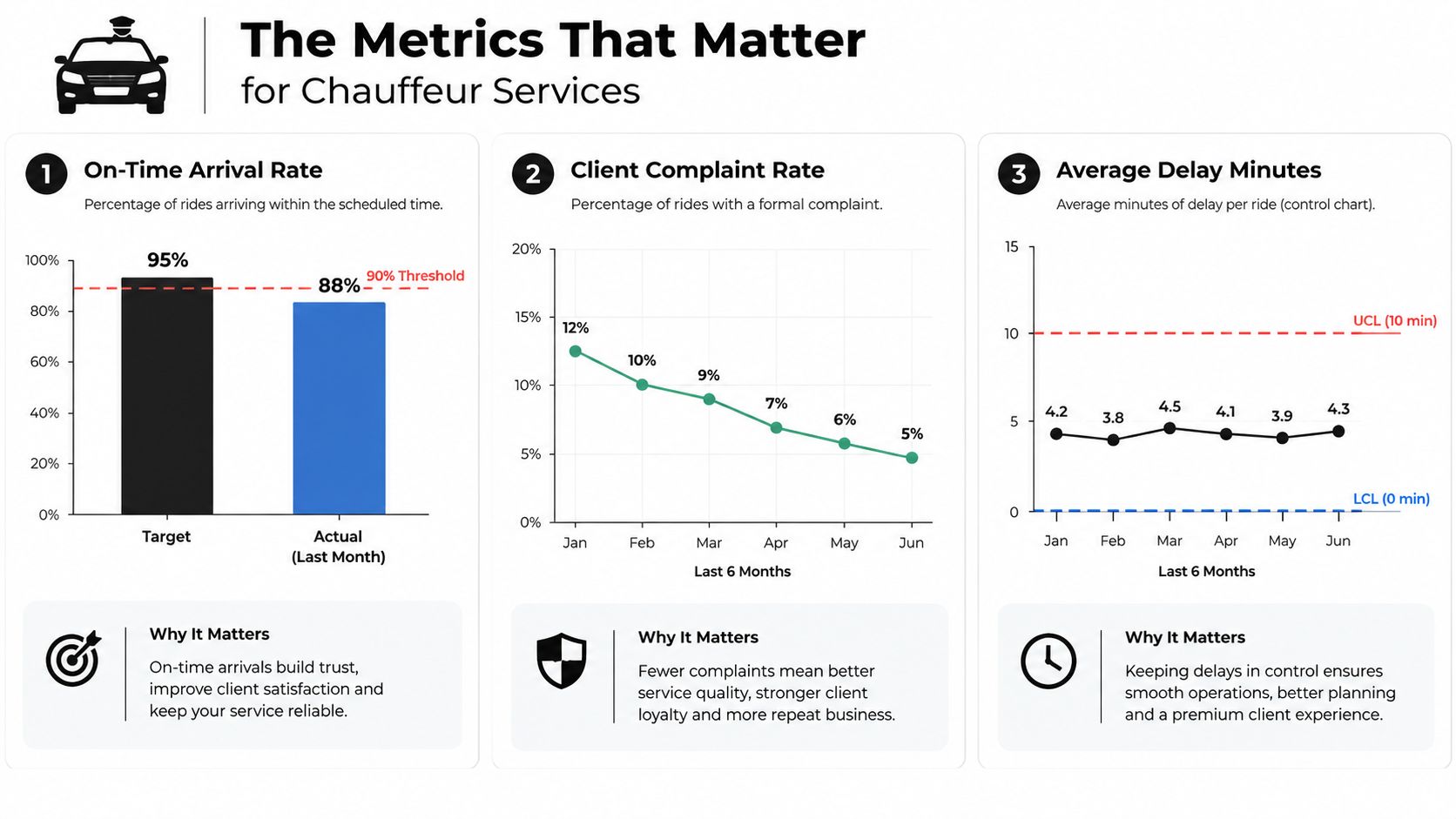
Choose measures tied to service risk rather than metrics that are easy to export. On-time arrival, flight-meeting accuracy, no-show handling, recovery speed, complaints, vehicle presentation, and live-call resolution each point to an operating behavior that someone can correct.
Set threshold bands from the service charter and your own operating baseline. One target will not fit every city, airport, vehicle class, or client segment. A same-day corporate transfer and a high-security FBO movement may need different escalation rules, even when both are recorded as “on time.”
Turn measures into operating decisions
Each KPI needs an owner, a review cadence, and a defined response:
- On-time arrival: Compare actual arrival with the approved pickup buffer. Review exceptions daily while dispatch can still recover the schedule.
- Flight-meeting accuracy: Confirm that the chauffeur used the correct flight status, terminal, and meeting point. Examine failed or unclear records during the weekly service review.
- No-show rate: Separate genuine client no-shows from chauffeur communication failures. A combined figure conceals the handoff problem.
- Missed-flight recovery time: Measure the interval from a missed meeting signal to a confirmed alternative plan. A quick replacement limits the impact but does not erase the incident.
- Complaint rate per 100 rides: Keep the denominator consistent and classify the reason. Complaints about communication, vehicle condition, and routing require different corrective actions.
- Vehicle-cleanliness audit score: Record the failed condition, such as glass, upholstery, odor, luggage area, or amenities.
- First-resolution rate on live dispatch calls: Track whether the first person answering can resolve the issue or repeatedly transfers it.
Use daily dispatch dashboards for active risk, weekly reviews for recurring patterns, and monthly affiliate scorecards for partner decisions. A long dashboard has little value if nobody changes a booking, closes a vehicle, or coaches a chauffeur because of it.
Use control charts with discipline
Statistical process control depends on a trustworthy measurement system. Validate measurement reliability with a Gauge R&R study, collect 20 to 30 rational subgroups under normal operating conditions, select a chart suited to the data, and calculate fixed center-line, upper-control-limit, and lower-control-limit values from the baseline. Recalculate them only after a verified process improvement, following the CSA guidance on statistical techniques.
A control limit is not a customer tolerance limit. A stable process can still miss a client requirement, while a process within specification can become unusually unstable. Managers who react to every normal fluctuation may introduce more variation, especially when affiliate handoffs are already generating inconsistent records. The review should connect the signal to the responsible process owner before anyone changes the standard or blames the chauffeur.
Training Chauffeurs and Maintaining the Fleet
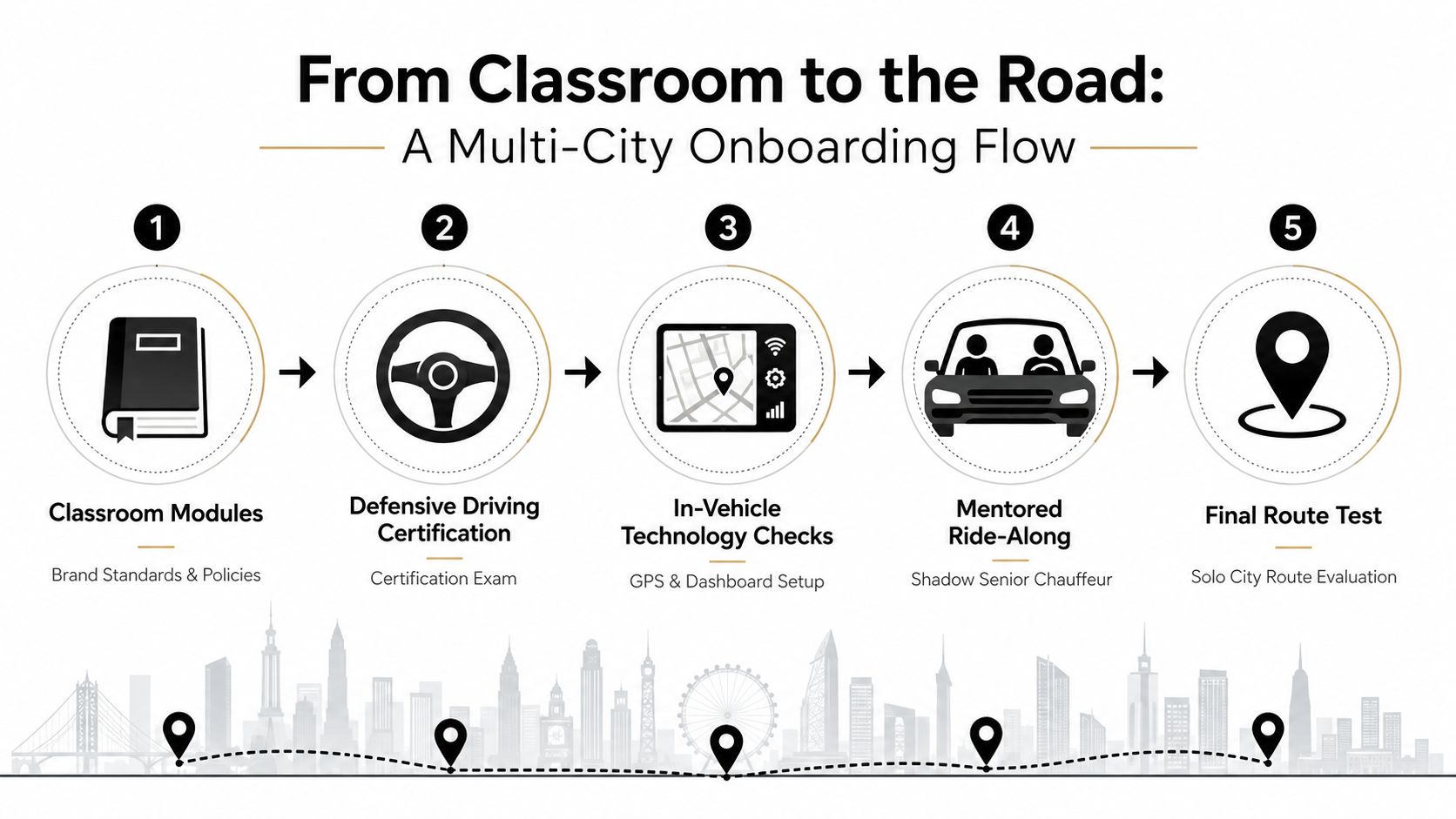
A chauffeur can pass paperwork review and still fail an executive booking. Quality control starts with a controlled onboarding path that tests knowledge, conduct, technology use, and local route judgment before independent work begins.
A practical multi-city sequence begins with classroom modules on brand standards, privacy, communication, incident reporting, and airport procedures. Defensive driving certification follows. The chauffeur then completes an in-vehicle technology check covering navigation, dispatch messages, status updates, and emergency contact procedures.
Make observation part of qualification
A senior chauffeur should conduct a mentored ride-along before release. The evaluator records greeting technique, luggage handling, route choices, cabin temperature, conversation judgment, braking smoothness, and the ability to stay attentive without becoming intrusive.
The final solo route test should include conditions that create real exposure, such as an airport pickup, hotel arrival, event venue, or FBO transfer. Record observable evidence instead of relying on a general impression. “Professional” becomes a usable score only after the organization defines the behaviors behind it.
Onboarding alone does not maintain performance. Use ride-alongs for recurring calibration, quarterly recertification, and unannounced spot-checks. Managers should compare observation records with telematics exceptions, customer feedback, and dispatch notes, then coach the specific behavior requiring correction. This comparison also catches handoff failures that a classroom test will miss.
Treat vehicle readiness as a daily control
Fleet standards require the same operating discipline:
- Before each operating day: Inspect tires, lights, fluids, safety equipment, exterior condition, cabin condition, and technology.
- Between shifts: Reset the interior and capture required photos when the program calls for visual evidence.
- At scheduled intervals: Tie mechanical service to mileage and elapsed time, so low-use vehicles still receive attention.
- For every vehicle: Maintain a digital record of inspections, defects, repairs, cleaning, and release authorization.
Remove a vehicle from service when it fails a safety or presentation condition that the program classifies as critical. A manager who cannot close that vehicle will eventually ask a chauffeur to “make it work,” converting a known defect into client-facing risk. A documented fleet maintenance protocol keeps maintenance evidence connected to the decision to release or hold the vehicle.
One operating view is more useful than separate spreadsheets, ride-along forms, and workshop invoices. Training records, telematics alerts, inspection results, and maintenance status should be reviewable together, allowing supervisors to see whether a service failure came from the chauffeur, the vehicle, or a broken handoff.
The video below can support practical discussion of chauffeur readiness and road behavior.
Vetting and Managing Your Global Affiliate Network
A partner can deliver a polished airport pickup for months, then fail when a flight changes, a replacement vehicle is needed, or a hotel handoff shifts after dispatch. Those moments expose the weak links between booking, local operations, chauffeur, and client contact. Affiliate quality control therefore needs to manage the handoffs, not just approve a company once.
In-house service gives direct control over hiring, training, vehicle condition, and supervisor response. It also limits geographic coverage and can leave an operator dependent on local capacity during surges. Affiliates extend coverage across borders and time zones, while adding risk at the points premium clients notice first, including airport arrivals, itinerary changes, and last-minute replacements.
Use in-house delivery where control and volume justify it. Use affiliates where reach matters, then hold both models to the same client-facing standard.
Qualify the partner before releasing live work
Start with evidence from the operating team, not a polished sales presentation. Confirm licensing, commercial insurance, operating authority, and client-specific requirements. Then test the service without advance notice. A mystery-shop booking should examine booking accuracy, dispatch communication, vehicle presentation, chauffeur conduct, and invoice consistency.
Sample different operating conditions, including airport peaks, events, early mornings, and late nights. A partner that performs only during quiet hours has not been fully assessed. Record the results in an internal rubric weighted toward on-time performance, vehicle condition, and chauffeur presentation. The rubric supports a governance decision, not a claim about industry performance.
Approval should also determine how much work the partner receives. Assign preferred status only after consistent execution and responsive recovery are demonstrated. Partners below the approved threshold need a dated remediation plan, a named owner, and a follow-up audit. Repeated failure should reduce volume or suspend approval.
The agreement must preserve preventive control. The buyer should be able to inspect operations, conduct ride-alongs, request records, and pull a booking when the partner cannot demonstrate readiness. A preferred vendor agreement should define those rights before an incident occurs. A contract that permits only post-service complaints leaves the network reacting after the client has already experienced the failure.
Control the handoffs, not only the vendor
For each affiliate booking, identify who owns confirmation, flight or itinerary changes, chauffeur assignment, vehicle release, client updates, and escalation. Require acknowledgment when a change is sent. Keep the booking record, contact trail, and recovery decision together so a supervisor can determine whether the breakdown came from the partner, the internal team, or an unassigned handoff.
Review affiliates as operating units through regular business reviews. Compare incident categories, complaint themes, response times, documentation quality, and recovery behavior. A blended score can conceal a specific risk. A partner may meet punctuality expectations while handling flight changes poorly, creating serious airport exposure despite an acceptable headline result.
The strongest affiliate networks operate as one service system. Use a shared charter, controlled SOP versions, consistent escalation language, and a clear rule that local convenience cannot override the client's approved standard. That discipline keeps quality consistent across cities without pretending every market operates identically.
Incidents, Feedback Loops, and Continuous Improvement
A late pickup exposes the strength of the entire service chain. The response matters, but the record afterward matters more because it shows whether the failure came from standards, training, fleet readiness, vendor execution, or a broken handoff.
Consider an international-terminal pickup that arrives 22 minutes late. The chauffeur reports a runway delay, dispatch searches for a replacement, and a second vehicle is rerouted. The customer receives an apology, while the account team records the recovery, including a post-ride credit when commercial policy permits it.
A useful incident record answers four questions: what happened, when it happened, who owned the next action, and which control should change.
Classify the breakdown before assigning blame
Log the timeline in operational language, then assign a cause category:
- Flight misread: The team used an outdated flight number, terminal, or arrival status.
- Traffic misjudgment: The routing plan missed a known constraint.
- Vehicle issue: The assigned car became unavailable or failed its readiness check.
- Communication gap: A change was sent but not acknowledged by the responsible person.
The category determines the remedy. Replacing a chauffeur will not correct recurring flight-data errors, and adding buffer time will not repair a maintenance failure.
The useful question isn't “Who caused the delay?” It's “Which control should have detected the risk earlier, and what evidence proves that control now works?”
Customer feedback belongs in the same review queue as internal incidents. Post-ride surveys, concierge calls, and email complaints should carry the same trip identifier and failure category. Without that link, the account team sees one version, dispatch sees another, and leadership receives a sanitized summary.
Turn findings into controlled changes
A weekly review may reveal repeated missed flight meetings after late status updates. The operations lead could add a 15-minute airport buffer rule to the relevant SOP. The change is incomplete until the instruction is version-controlled, acknowledged by affiliates, and checked against later bookings. The number illustrates a documented process change, not a universal airport rule.
Each action needs an owner, due date, and verification method. A monthly quality council should examine KPI trends, incident categories, customer feedback, and affiliate performance together, then commit to one or two defined changes. Discussion without an adoption check creates the appearance of improvement while the process remains unchanged.
Use statistical discipline to separate ordinary variation from a meaningful process shift, as noted earlier in the quality techniques guidance. In transport operations, that distinction prevents leaders from overreacting to one unusual traffic event while overlooking sustained deterioration in a city or affiliate network.
Where to Focus Next for Lasting Quality
A chauffeur arrives at the wrong terminal because dispatch missed a flight change, the affiliate never acknowledged it, and the client's preference remained in a separate system. A new inspection will not correct that failure. Leadership must trace the handoff, identify the missing control, and assign one person authority to act before the trip reaches the passenger.
Quality programs weaken when they measure activity instead of control. More inspections, mystery shops, and dashboard fields can create audit theater: forms are complete, compliance is reported, yet information, authority, or vehicle readiness still fails at the operational handoff.
Recent quality guidance points toward traceability, supplier oversight, recall readiness, visibility beyond first-tier suppliers, and audits of packaging and raw materials. The transport equivalent extends beyond the contracted affiliate to the local operator, vehicle source, dispatcher, and terminal handoff. Current quality compliance trends also reinforces that records matter only when they produce an operational signal early enough to prevent a customer-facing defect.
Prioritize the points where small failures cascade
Direct leadership attention to three control points:
- Harden affiliate admission: Keep weak partners away from live premium bookings. Require evidence of standards, test response under pressure, and retain the authority to suspend or remove an affiliate when performance falls below the agreed threshold.
- Tighten airport and event handoffs: Set one accountable chain from dispatcher to chauffeur to ground supervisor. Flight changes, meeting-point updates, vehicle substitutions, and client preferences need an acknowledgement owner and a visible status.
- Authorize frontline recovery: Let a qualified manager close an unready vehicle, rebook a trip, deploy a replacement, or escalate a client issue without waiting through several approval layers.
The third control changes where decisions sit. That trade-off deserves explicit rules, because broader authority can create inconsistent judgment if managers lack training or documentation. Clear recovery limits, escalation triggers, and post-incident review allow supervisors to stop an unready vehicle while preserving accountability. A monthly report may explain why a vehicle should not have departed, but a manager with authority can prevent the departure.
Use automation carefully
AI can identify unusual patterns, but it cannot replace controls that staff can explain and follow. For transport operations, an alert might flag repeated status gaps, an unusual delay pattern, or an affiliate whose response behavior has changed.
Every alert still needs a readable threshold, an escalation path, an audit trail, and a named decision-maker. An automated notification without authority or follow-through adds another inbox. Keep the system focused on signals that lead to action, and review false positives so dispatch does not learn to ignore it.
A practical next-quarter sequence starts with a handoff map and a pass/fail condition for each transfer of responsibility. Audit the highest-risk affiliates next, then verify vehicle and chauffeur readiness records. Establish a short KPI review rhythm, give frontline managers defined recovery authority, and check whether each corrective action changed the underlying pattern.
A quality program earns trust when it catches risk early, makes responsibility visible, and changes the operating method after failure. More paperwork is not the objective. Better control at the weak links is.