
The aircraft is on final approach, but the trip isn't finished. A corporate traveler may be expecting to step from a private terminal into a waiting SUV, while the line team still has to position equipment, confirm fuel, process passengers, and move luggage without exposing the traveler to a public curb. The quality of that transition depends less on the lounge furniture than on the operational connection between the aircraft, the FBO, and the car service.
That's the true meaning of FBO Signature Flight Support. Signature Flight Support provides the airport-side infrastructure, while the transport partner must turn that infrastructure into a controlled, discreet journey to the city. For travel managers, the right question isn't whether an FBO looks premium. It's whether every handoff has an owner, a protocol, and a backup plan.
A Day That Starts on the Ramp
The Gulfstream noses into a private terminal on a Tuesday morning. The CEO is already on a call, the chauffeured SUV is waiting a short distance from the stair door, and the schedule allows no room for a surprise stop at the main terminal.
Before the passenger stands up, several teams are moving. The line service crew is fueling the wing while cabin staff restock refreshments. A customs officer walks toward the aircraft for an international arrival. A concierge confirms the passenger's onward transport and hands over a pre-cleared luggage tag before the final wheel stops turning.

None of this should feel like a sequence of separate services to the traveler. The passenger should see the car, confirm the destination, and leave. Behind that quiet departure, the FBO team has coordinated ramp access, aircraft servicing, passenger processing, luggage movement, and vehicle positioning.
Operational rule: Every minute recovered on the ramp becomes usable time in the executive's day. Every unassigned handoff becomes a delay that someone has to explain.
The difference between a smooth trip and a frustrating one usually appears before the aircraft arrives. The flight department must send accurate passenger details, confirm the aircraft's parking requirement, identify whether customs or immigration support is needed, and share the vehicle's staging instructions with the chauffeur desk. If those details reach the FBO and transport provider separately, gaps appear quickly.
Signature Flight Support matters because it gives operators a repeatable ground-services framework across many airports. That framework still needs to be connected to the road journey. A well-run FBO can prepare the aircraft perfectly, but the traveler's experience remains fragmented if the driver is waiting at the wrong gate, lacks controlled-ramp credentials, or hasn't received the revised arrival time.
What an FBO Actually Does and Where Signature Fits
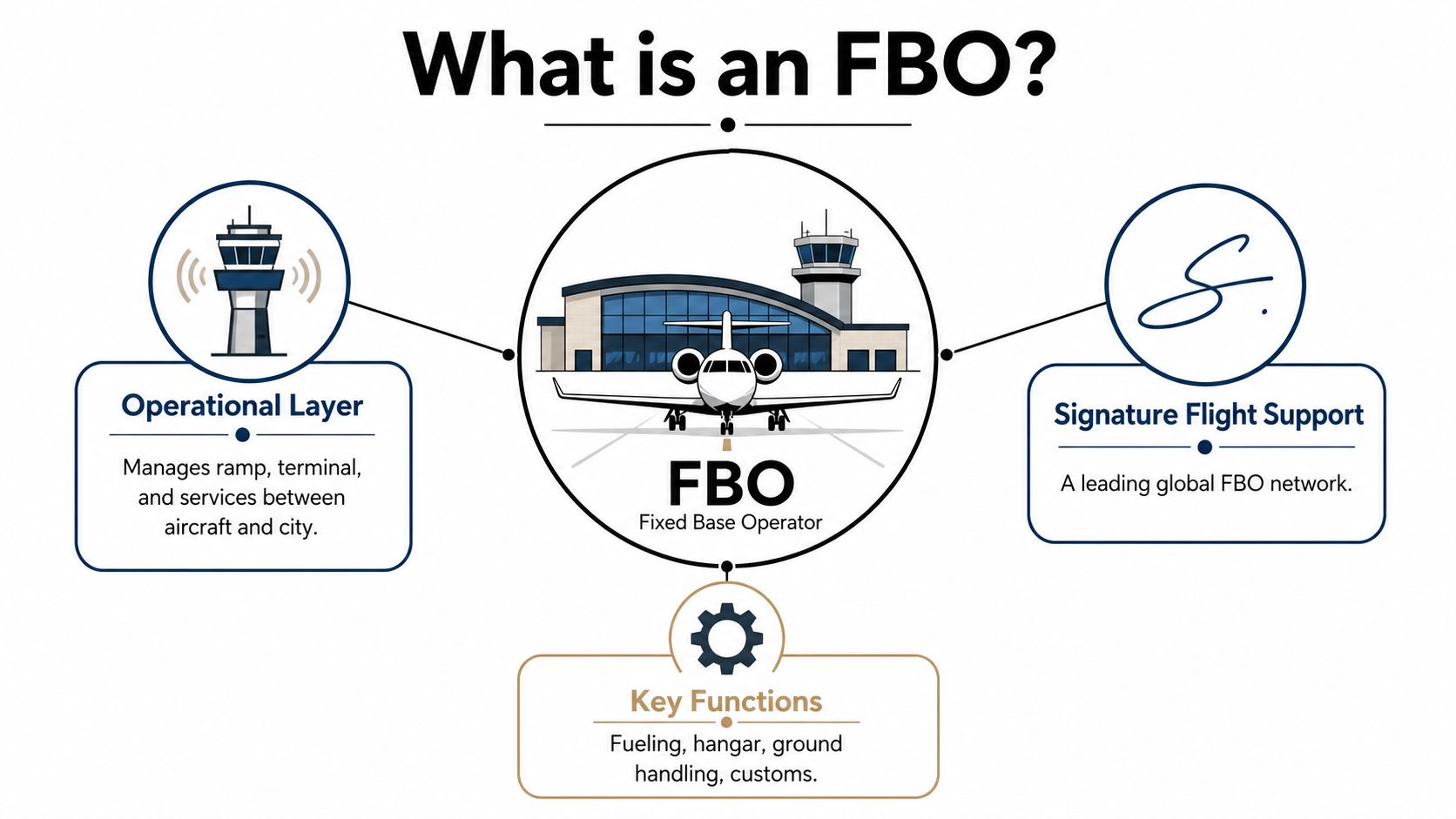
A Fixed-Base Operator, or FBO, is the private-aviation services company responsible for the terminal, ramp, and operational layer between an aircraft and the city it serves. Its work generally includes fueling, aircraft parking, hangarage, passenger processing, crew support, and coordination with airport and border authorities.
The FBO isn't just a private waiting room. It manages the physical environment where aircraft arrive, receive service, and depart. That includes marshalling an aircraft into position, connecting ground power, arranging fuel trucks, handling baggage, and coordinating the people who need access to the ramp.
The operational layer
Aircraft operators depend on the FBO because flight crews usually can't manage every ground task themselves. The FBO receives the arrival information, assigns parking, arranges servicing, supports the crew, and prepares the passenger pathway into the terminal or onward vehicle.
A useful corporate travel overview of aviation ground services should be read through that operational lens. The service is successful when the aircraft, terminal, authorities, luggage team, and chauffeur all work from the same arrival plan.
Where Signature belongs
Signature Flight Support is a network operator within that FBO model, not a single airport terminal. Signature was created in 1992 through the merger of Butler Aviation and Page Avjet, and its network had grown to almost 95 FBO locations worldwide by the end of 2008, according to BJT Online's company history. In 2016, BBA acquired Landmark Aviation, adding 62 locations and taking the network to more than 200 FBOs globally, as the same source records.
A later 2022 industry report described Signature as having 188 branded FBOs worldwide plus 27 affiliates, showing the scale created through successive acquisitions. The network had expanded across North America, Europe, South America, Africa, and Asia by the mid-2010s.
That footprint gives corporate operators a standardized starting point. It doesn't mean every location performs identically, and it doesn't eliminate local airport rules. It means a flight department can book against a recognizable operating framework instead of rebuilding the ground plan from scratch at every stop.
The Core Services Behind Signature Flight Support
Premium FBO support is a collection of separate deliverables. Each one has a different failure mode, and travel managers should evaluate them separately rather than treating “full service” as a sufficient answer.
Ground handling
Ground handling covers the visible aircraft work: marshalling, towing, fueling, lavatory service, potable water, ground power connections, and baggage movement. During a long-haul crew changeover, the line team may need to fuel the aircraft, connect a GPU, remove waste, load supplies, and reposition the aircraft while the cabin team works inside.
The failure mode is poor sequencing. If the fuel truck arrives late or the tow plan isn't clear, cabin preparation and passenger boarding can wait even when every individual vendor is competent.
Concierge coordination
Concierge support extends beyond coffee and a quiet lounge. The team may coordinate catering, hotel arrangements, restaurant reservations, local access requests, and last-minute itinerary changes.
For a senior executive, the important deliverable is not the reservation itself. It's the ability to make a change without forcing the traveler or assistant to call several providers while the aircraft is still being serviced.
Security and controlled access
Security involves ramp-access control, passenger screening where required, secure lounge procedures, and monitored movement around the aircraft. High-profile travelers need privacy, but they also need the FBO to control who approaches the aircraft and vehicle.
The common failure is an informal handoff. A driver may be known to the travel team but still lack the credentials or authorization required to cross a controlled apron. That turns a discreet arrival into a curbside transfer.
Customs and immigration
International arrivals require accurate manifests, authority coordination, and a clear passenger-processing plan. At suitable private terminals, customs or equivalent border officers may process travelers away from the main passenger terminal.
The operational risk is incomplete information. A late passenger change, mismatched document detail, or unclear arrival instruction can turn an efficient private-terminal process into a preventable wait.
Crew assistance
Crew support includes transportation, hotel arrangements, per diem logistics, and planning around rest requirements. The flight crew often needs a different service pattern from the passenger, especially when the aircraft departs again after a short ground period.
A strong FBO keeps the crew plan separate from the executive plan while coordinating both. The crew needs reliable transport and rest support, while the passenger needs privacy, punctuality, and a direct route into the city.
| Service Category | What It Covers | Operational Example |
|---|---|---|
| Ground handling | Marshalling, towing, fuel, lavatory, potable water, GPU, and baggage | A crew changeover is sequenced so fueling and cabin servicing don't block departure preparation |
| Concierge | Catering, hotels, reservations, and special requests | An assistant changes the dinner arrangement while the aircraft is still on the ramp |
| Security | Access control, screening, secure lounges, and monitored movement | A vetted vehicle and authorized driver meet the passenger at the aircraft |
| Customs and immigration | Manifests, border officers, and private-terminal processing | An international arrival is directed through the FBO process rather than the main terminal |
| Crew assistance | Transport, hotels, per diem logistics, and rest planning | The crew receives separate transport and accommodation coordination from the passenger |
How FBO Operations Connect to Executive Ground Transport
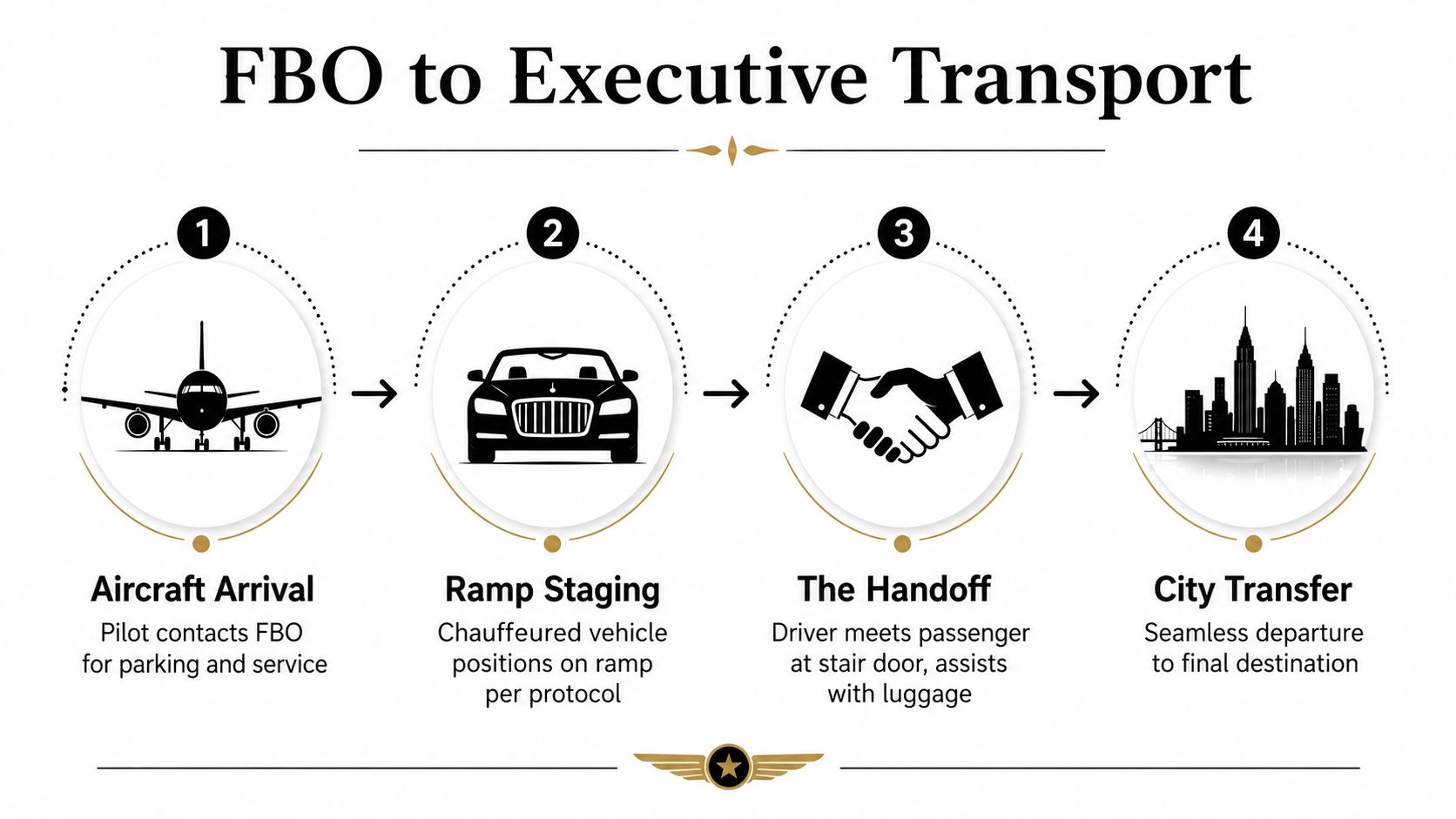
The most fragile point in an FBO journey is the aircraft-door-to-vehicle handoff. The FBO may complete every aviation task correctly, yet the passenger can still lose time if the SUV is staged at the wrong access point or the driver can't enter the controlled ramp.
Three details decide whether the handoff works:
- Vehicle positioning: The car must be staged where airport rules permit, close enough to the stair door to protect time and privacy.
- Credential readiness: The chauffeur needs the credentials and permissions required to access the relevant ramp or meet the passenger at the approved point.
- Shared movement data: The FBO team and transport desk need the same tail number, arrival estimate, passenger details, and change notifications.
The last item is routinely underestimated. A flight can arrive early, hold short, change parking positions, or replace a passenger. If the FBO and chauffeur desk receive different updates, the driver may be ready while the passenger is still being processed, or the vehicle may be waiting at an inaccessible gate.
What the handoff should look like
The cleanest process is simple from the passenger's perspective. The driver meets the traveler at the approved aircraft-side location, assists with luggage, confirms the destination discreetly, and moves directly to the city vehicle route without a public curb stop or redundant paperwork.
That outcome requires planning before departure. The flight department should provide the transport desk with the aircraft identifier, passenger manifest, estimated arrival, luggage expectations, and any security preferences. The FBO should confirm where the vehicle can wait, which access rules apply, and who owns the final passenger release.
A practical resource on what ground transportation includes helps separate the vehicle itself from the wider dispatch and coordination function. For executive travel, the car is only one component. The service includes timing, access, communication, luggage handling, and contingency response.
The connection also matters for international arrivals. Customs officers may need to meet the aircraft or process passengers in the private terminal while the chauffeur waits in an approved staging zone. The driver shouldn't enter a controlled area by assumption, and the passenger shouldn't have to repeat the itinerary to multiple people.
The following video provides a visual reference for the arrival-to-transport sequence.
The best air-to-ground transfer feels uneventful because the teams have already resolved the complicated parts.
Scale, Infrastructure, and Why Global Reach Matters
For a corporate trip spanning several regions, the FBO's logo matters less than the handoffs behind it. Travel managers need to know whether each local team can coordinate aircraft service, terminal access, customs, and the chauffeured car waiting at the ramp gate. Network scale helps only when those responsibilities remain clear at every stop.
Signature's expansion illustrates how acquisitions can build multinational infrastructure faster than airport-by-airport organic growth. The company reached almost 95 locations by the end of 2008 and moved beyond 200 global FBOs after the 2016 acquisition of Landmark Aviation, according to the documented Signature Flight Support history. Those figures describe corporate growth, not identical service delivery. A branded site and an affiliate may operate under different staffing, access rules, and escalation procedures.
Infrastructure determines resilience
Dallas Love Field shows why physical capacity deserves more attention than terminal appearance. Signature's fuel-farm documentation describes underground storage with multiple 48,000-gallon Jet A tanks, monthly leak monitoring through a Red Jacket system, and 18 to 20 fuel trucks handling Jet A, AvGas, and gasoline delivery, as shown in the Dallas Love Field Signature documentation.
Fueling is a throughput issue. Tank capacity, monitoring, truck availability, and dispatch discipline determine whether several aircraft can be serviced without a queue that disrupts departure planning. They also support spill-risk control and continuity during busy operating periods.
Terminal hours create another handoff to verify. Signature's 24/7 operations at Chicago O'Hare are described in the Chicago O'Hare FBO information. Around-the-clock access still requires qualified line personnel, customs coordination where applicable, and a transport plan that works outside ordinary business hours. A car service desk should know who receives the live arrival update and who releases the passenger.
| Metric | Signature Scale | Operational Implication |
|---|---|---|
| Network by the end of 2008 | Almost 95 FBO locations worldwide | The business had moved well beyond a small regional footprint |
| Landmark Aviation acquisition in 2016 | 62 locations added | Acquisition accelerated network expansion |
| 2022 reported network | 188 branded FBOs plus 27 affiliates | Operators should distinguish branded service from affiliate coverage |
| Dallas fuel storage | Multiple 48,000-gallon Jet A tanks | Fuel-farm capacity supports high-throughput operations |
| Dallas fuel-truck fleet | 18 to 20 trucks | Truck depth supports multiple fuel products and busy movement periods |
Global reach earns its place when local execution matches the itinerary. Before departure, confirm staffing, customs capability, parking rules, vehicle access, and escalation ownership at every airport. The corporate travel manager should treat the network as a series of local operating plans, not as one uniform promise.
Choosing the Right FBO Provider for VIP and Corporate Travel
Don't choose an FBO because the lobby photographs well. Choose it because the provider can answer operational questions in writing before the aircraft departs.
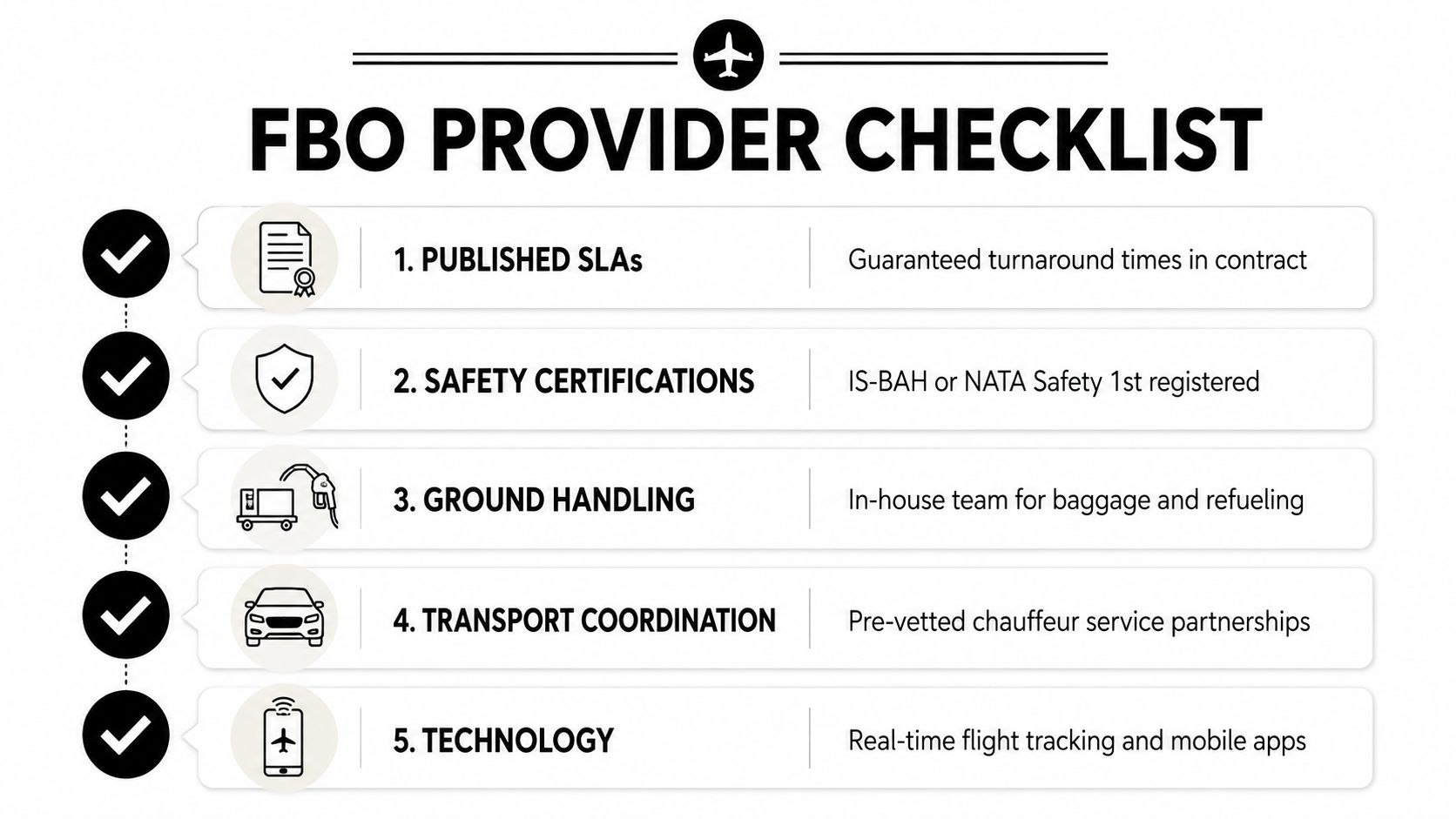
The first requirement is a documented service standard. Ask for turnaround expectations, escalation contacts, arrival procedures, and the service owner for each airport. If the provider can't explain who takes responsibility when fuel, customs, baggage, or transport falls behind, the travel manager is being asked to carry the risk.
The non-negotiable checks
- Published service levels: Require clear turnaround expectations and escalation procedures rather than verbal assurances.
- Safety registration: Ask whether the location holds IS-BAH or NATA Safety 1st registration, and verify the status for the actual airport being used.
- Security procedures: Request written rules for ramp access, passenger screening, vehicle staging, and high-profile movements.
- Irregular-operations planning: Confirm how the team handles diversions, medical events, aircraft swaps, weather disruption, and passenger changes.
- Customs capability: Establish whether international arrivals can be processed at the private terminal and what documentation deadlines apply.
- Transport integration: Verify that chauffeurs can follow airport access rules and that the vehicle desk receives live flight updates.
- Crew support: Inspect the quality of rest areas, hotel coordination, transport, and scheduling support instead of assuming the passenger service covers crew needs.
- Fuel transparency: Ask how fuel pricing, service charges, and account requirements are communicated before arrival.
Test the provider before a critical trip
Run a tabletop exercise using a realistic disruption. Move the arrival time, change the passenger list, add an international connection, and ask how the FBO and transport team would respond. The provider should identify the revised owner, communication channel, vehicle plan, and passenger-processing impact without sending you through several departments.
Signature's status rules also deserve attention for irregular travelers. The company says status is based on the frequency of an aircraft using Signature FBOs compared with the aircraft's total flights into airports where Signature operates, with calculations tied to publicly available tower records, as stated in its status terms and conditions.
That matters for assistants and operators managing multiple aircraft. Don't assume an individual's travel frequency automatically determines value. Evaluate the aircraft's actual routing, the airports used, and whether the program's calculation method matches the way the fleet flies.
MLR Worldwide Service as the Ground-Transport Layer
An FBO-grade arrival breaks down if the chauffeur team doesn't understand private-terminal procedures. The driver must know the aircraft identifier, the approved meeting point, the access restrictions, the luggage plan, and the communication protocol for an early or delayed arrival.
That's where the ground-transport layer earns its place. MLR Worldwide Service provides airport transfers and FBO support, including coordination for private terminals, planeside meet-and-greets, and secure tarmac departures. Its role is to connect the flight movement with the vehicle movement so the traveler isn't handed from one isolated vendor to another.
The information the transport desk must own
A dependable transport operation tracks more than a scheduled pickup time. It should maintain:
- Tail-number coordination: The aircraft identifier anchors the correct arrival, passenger group, and staging plan.
- Live movement updates: Changes in estimated arrival or parking position must reach the chauffeur and FBO contacts.
- Credential status: The team must confirm whether the driver and vehicle can enter the relevant controlled area.
- Passenger privacy: The chauffeur needs enough information to identify the traveler without broadcasting sensitive details.
- Contingency instructions: The plan should cover delays, diversions, aircraft substitutions, and changes after customs processing.
MLR's published service model includes pre-trip confirmation, pickup instructions, flight coordination, and a 24/7 concierge operations function for last-minute changes. Those capabilities are relevant when the FBO has completed its aviation responsibilities but the city transfer still depends on a precise vehicle handoff.
The practical payoff is accountability. If the passenger is delayed between the aircraft and the terminal, or the vehicle cannot access the planned staging point, one coordinated transport desk should be able to speak with the FBO, update the chauffeur, and give the travel manager a clear answer.
For itinerary planning beyond a single airport, global travel coordination should include FBO procedures, crew movements, event schedules, and vehicle access rather than treating each transfer as a standalone booking. That approach protects confidentiality and reduces the number of people the executive assistant must chase when the itinerary changes.
Delivering White-Glove FBO Support Across Global Hubs
A reliable journey has one continuous operating plan. The aircraft arrives, Signature Flight Support handles ramp service and passenger processing, customs support is coordinated where required, and the transport team stages the right vehicle at the approved FBO access point.
The executive shouldn't have to manage the seams. The flight crew needs a clear service order, the FBO needs accurate passenger and aircraft information, customs officers need the correct documentation, and the chauffeur needs permission, timing, and destination details. When those pieces sit inside one communications loop, the traveler receives a quieter and more predictable departure.
For corporate travel managers, the decision is straightforward. Select providers that can document service levels, explain airport access rules, support irregular operations, and assign a named owner to the aircraft-to-car handoff. Premium service isn't a collection of amenities. It's fewer moving parts, faster decisions, and one accountable operating chain across the hubs your executives use.
MLR Worldwide Service coordinates executive chauffeur transportation, airport transfers, FBO support, secure movements, crew travel, and changing itineraries through a 24/7 operations team. Visit MLR Worldwide Service to map your next Signature-connected itinerary, align the FBO and vehicle handoffs, and establish a single point of accountability before departure.