

At 2 a.m., an executive's inbound flight is delayed, the morning meeting has moved across town, and the chauffeur scheduled for the original arrival time is no longer aligned with the itinerary. The traveler needs more than a message confirming that someone is “available.” Someone must verify the new arrival, adjust the vehicle, update the hotel or meeting transfer, and communicate one reliable plan before the executive leaves the aircraft.
That distinction defines useful 24/7 concierge service for executive travel. Availability is only the front door. The service is the ability to make authorized decisions, coordinate several providers, preserve privacy, and complete changes across time zones without forcing the traveler or travel manager to rebuild the journey manually.
The role has deep roots in hospitality. The modern concierge traces back to medieval France, where the term described castle gatekeepers by the twelfth century. It later developed into a hospitality service role, with Boston's Tremont House opening in 1829 as a milestone in formalized professional guest support, as documented by Johnson & Wales University's history of concierge service.

This guide is for corporate travel managers, executive assistants, family offices, private aviation teams, event planners, and airline operations staff who need to understand what round-the-clock support should deliver. It moves from the basic operating model to response standards, staffing, use cases, security, and vendor evaluation.
What 24/7 Concierge Service Really Means for Executive Travel
A 24/7 concierge service is a continuous coordination function, not a phone line that stays open overnight. It receives requests, assesses urgency, confirms what can change, obtains authorization when required, and coordinates the people and systems needed to complete the request.
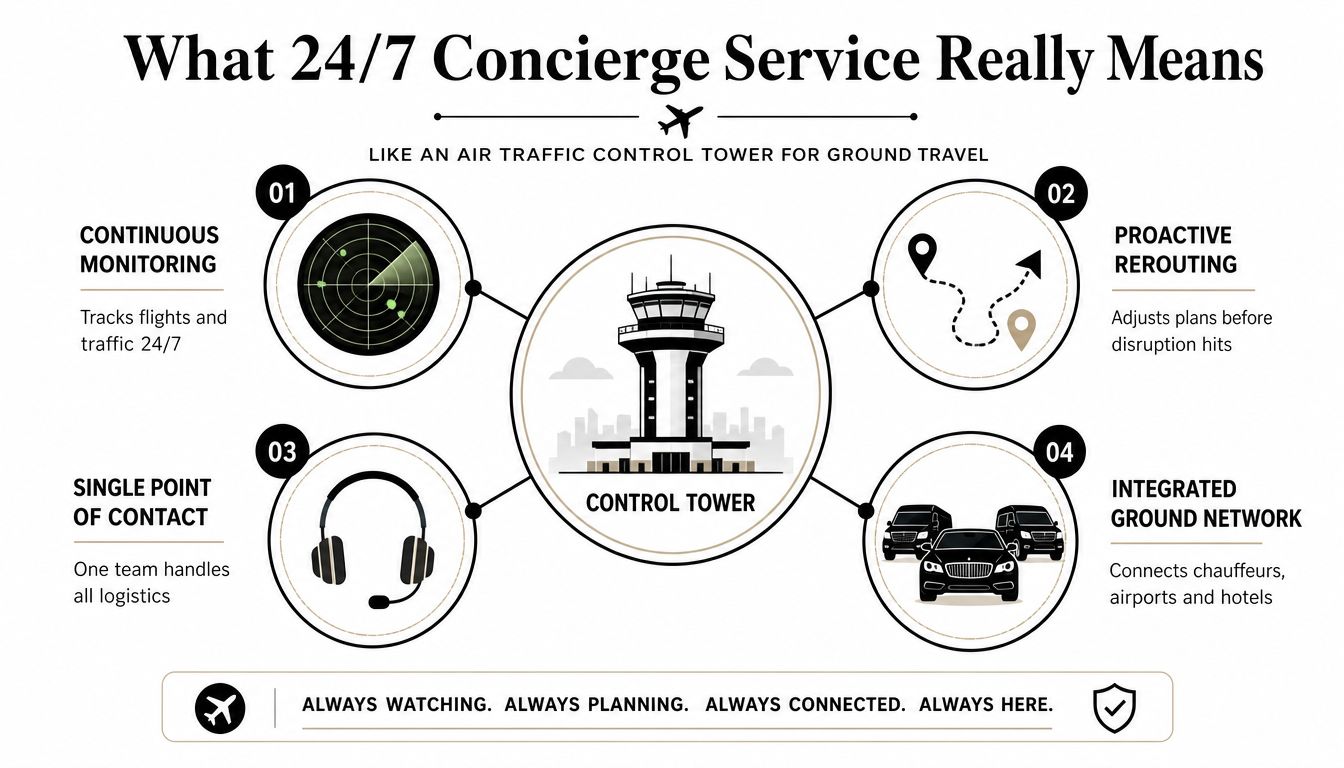
An air traffic control tower offers a useful analogy. The tower doesn't fly the aircraft or drive the vehicles, but it maintains a shared view of movement, identifies conflicts, and directs activity so each participant can act safely. For executive ground travel, the concierge plays a similar coordinating role across chauffeurs, airports, FBOs, hotels, restaurants, meeting venues, and local affiliates.
The comparison breaks down into four practical responsibilities:
- Continuous monitoring: The team watches flight status, arrival changes, traffic conditions, vehicle assignments, and itinerary updates.
- Proactive rerouting: Agents identify a developing conflict and propose a workable alternative before the traveler reaches the point of failure.
- Single-point coordination: The executive or travel manager communicates with one operations team instead of separately calling a driver, hotel, aviation provider, and transport vendor.
- Integrated execution: The team sends the revised instructions to each party and confirms that the change has been accepted.
The operating principle: 24/7 means the service remains able to execute, not merely able to answer.
That distinction separates a hotel front desk, a general call center, and an executive mobility desk. A front desk may resolve property-level requests. A call center may log a ticket and pass it to another department. A concierge operations team owns the movement of the request until the traveler receives a confirmed outcome.
Continuity matters because executive itineraries rarely consist of one isolated ride. A late aircraft can affect the FBO pickup, the hotel arrival, a morning transfer, and the first meeting. A continuous team preserves context during each handoff, so the next operator sees the traveler's preferences, authorization rules, vehicle requirements, and current itinerary rather than starting from a blank screen.
For a broader view of how high-touch travel support connects planning and execution, see luxury travel concierge services for executive mobility.
The market context also helps explain why this function has become more formalized. One industry forecast estimates that the global concierge services market could reach $18.6 billion by 2027, with a compound annual growth rate of 8.2% from 2022 to 2027, according to World Metrics' concierge industry data. Those projections don't prove that every provider can deliver reliable overnight execution, but they do show that concierge support has developed into a substantial professional service category.
The practical question for a buyer is therefore simple: When something changes, can the team complete the next action without waiting for ordinary business hours?
Core Features and Response Standards That Define Quality
Quality begins with an operating promise that can be tested. A provider should explain how it receives urgent requests, how it prioritizes them, which channels it uses, and what happens when the first vendor cannot fulfill the change.
A serious service normally combines several capabilities:
- Live itinerary coordination: Agents maintain the current trip plan and update every affected movement.
- Last-minute booking support: The team locates available vehicles, chauffeurs, hotels, or related services when the original plan fails.
- Multi-stop management: Operators track linked transfers instead of treating each ride as a separate transaction.
- Global partner access: Local affiliates extend coverage while following defined service, privacy, and communication procedures.
- Escalation ownership: Someone remains responsible until the request is accepted, dispatched, and confirmed.
Response time should vary by channel and urgency. A message about a meeting address can usually follow a different path from a traveler stranded after a canceled flight. Hospitality benchmark guidance places best-in-class email first replies from under 12 hours to under 1 hour, live chat from under 1 minute to 5 to 10 seconds, and one phone benchmark at 80% of calls answered within 20 seconds, as summarized by Ringly's customer-service response benchmarks.
| Channel | Best-in-Class Target | Best Use in Executive Travel |
|---|---|---|
| Under 12 hours to under 1 hour | Non-urgent itinerary work, confirmations, and documentation | |
| Live chat | Under 1 minute, with some targets at 5 to 10 seconds | Fast questions, status checks, and active trip coordination |
| Phone | 80% answered within 20 seconds | Immediate disruption, safety concern, or time-critical intervention |
These are benchmark ranges, not a universal service-level agreement. Your provider should translate them into explicit commitments for your travel profile. A private aviation arrival, for example, may require a live operator to coordinate an aircraft update, FBO arrival, vehicle staging, and passenger communication at the same time.
The channel also affects staffing cost and operational risk. If every request enters one general queue, urgent changes can wait behind routine questions. Good teams reserve phone and messaging for situations that need immediate intervention, while email handles work that doesn't require a live response.
For a practical look at how response expectations can be documented and measured, review customer support response time standards.
A vague phrase such as “global assistance” isn't enough. Ask whether the provider can show a sample escalation record, explain who contacts the chauffeur, identify who updates the traveler, and confirm how the team closes the loop. A fast first reply has limited value if no one owns execution after the reply.
How 24/7 Concierge Operations Actually Work Behind the Scenes
Round-the-clock coverage depends on process design, not on adding more names to a staffing roster. The strongest operations combine regional coverage, cross-trained dispatchers, live trip visibility, vendor capacity checks, and clear authority for exceptions.
A request usually follows a sequence like this:
- Intake and identification: The operator confirms the traveler, trip, location, request, and urgency.
- Triage: The team separates an immediate intervention from work that can wait for email or scheduled planning.
- Authorization: The operator checks whether the requested change falls within preapproved rules or needs a designated decision-maker.
- Execution: The team contacts the relevant chauffeur, airline, FBO, hotel, or affiliate and updates the operating record.
- Confirmation: The traveler receives a clear revised plan, and the operator verifies that each affected provider has acknowledged it.
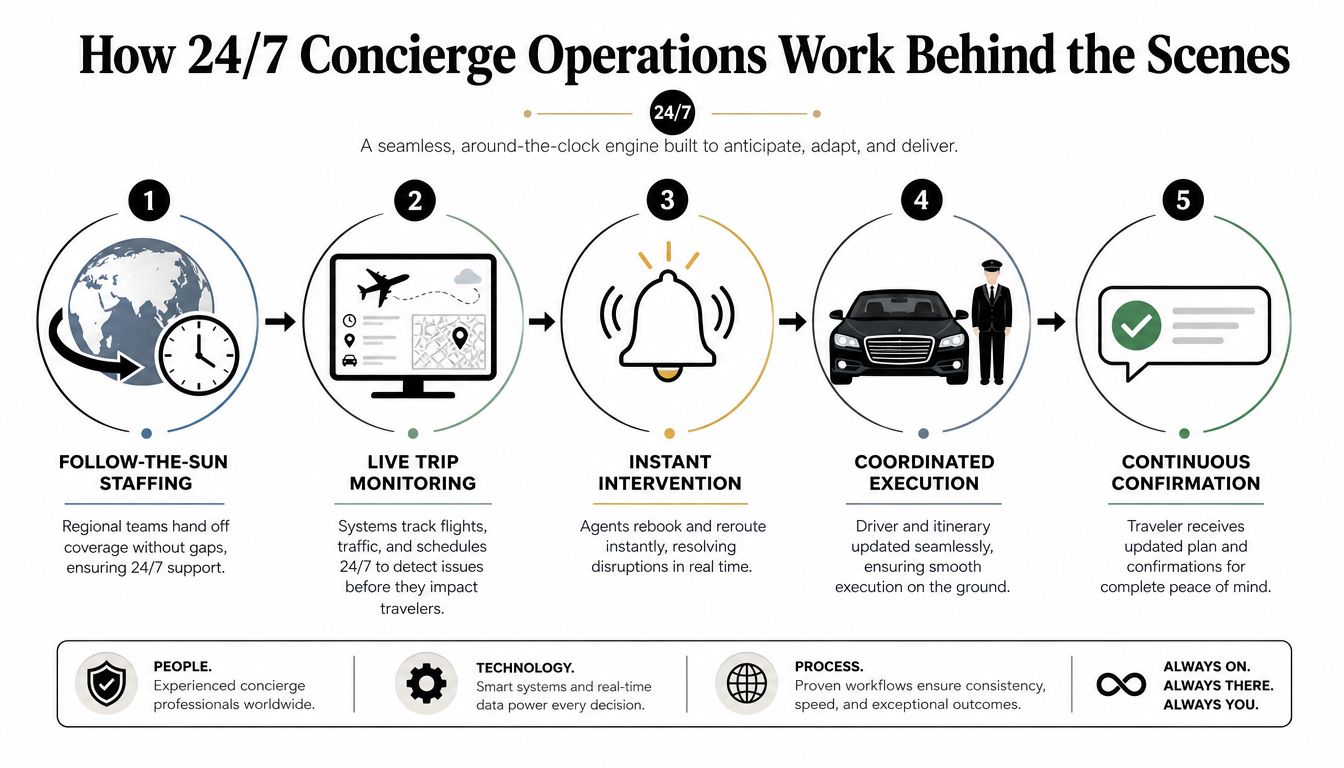
Follow-the-sun staffing can transfer active coverage between regional teams as local working hours change. The handoff only works when the outgoing operator records the current itinerary, open actions, vendor confirmations, traveler preferences, and unresolved risks. Otherwise, the traveler experiences a reset each time the time zone changes.
Cross-training matters for the same reason. An overnight agent may need to understand chauffeur dispatch, FBO procedures, hotel coordination, and corporate approval rules. If the agent can only record a request, the service remains available but not operationally useful.
A handoff should transfer responsibility, not merely information.
Vendor inventory adds another layer. A concierge team supporting executive movement needs current knowledge of vehicle availability, chauffeur location, airport access, FBO procedures, and local partner capacity. An old vendor list can't answer whether a suitable vehicle can reach the passenger within the required window.
When disruption occurs, the operator should update the plan in a controlled order. First, verify the new travel fact. Next, determine which reservations and transfers are affected. Then, secure the replacement capacity, notify each party, and confirm that the traveler has the same information as the providers.
This discipline prevents a common failure: one vendor receives the new arrival time while another continues working from the old itinerary. The resulting mismatch can cause a missed pickup even though every individual party believes it followed instructions.
During vendor evaluation, ask to see the workflow rather than a feature sheet. Look for a live trip record, named escalation levels, documented handoffs, a vendor confirmation process, and a clear rule for unresolved exceptions.
Real World Use Cases for Corporate and High Net Worth Travelers
A corporate roadshow may involve several meetings in multiple locations, with the executive moving directly from an airport to a client office, then to a hotel, then to another meeting. The concierge team isn't just booking vehicles. It keeps the sequence coherent, checks whether the next chauffeur has the updated timing, and alerts the travel manager when a delay threatens the schedule.
If the first meeting runs late, the team can assess the next transfer instead of waiting for the executive to notice the problem. It may adjust the pickup window, send the driver to a revised entrance, update the itinerary, and communicate the change through the preferred channel.
For a high-net-worth family, discretion and personalization may be more important than speed alone. The operation may include multiple residences, luggage movements, children with different needs, private dining, and separate activities. A consistent concierge record lets the team preserve preferences without repeatedly asking the family to explain the same arrangements to new vendors.

Private aviation creates a particularly clear test. The aircraft may arrive at an FBO rather than a commercial terminal, and the ground team must align with the actual passenger movement. A useful concierge operation coordinates the FBO, confirms where the vehicle will stage, verifies the passenger or lead traveler, and keeps the chauffeur informed if the aircraft timing changes.
Airline crew movements bring a different constraint. Crew transport must respect operational schedules, pickup points, luggage requirements, and duty-time considerations established by the airline. A last-minute aircraft or roster change can affect several crew members at once, so the operator needs a dispatch process that can update vehicles and communicate consistently.
What these scenarios have in common
Each use case contains the same underlying risk: a small change can spread across several connected services. The concierge creates value by maintaining the relationship between those services.
The outcome isn't a pleasant ride. It is a coherent, current, and confirmed movement plan that reduces the amount of logistics the traveler must manage personally.
Security Privacy and Accountability During Disruptions
A person answering the phone at 2 a.m. doesn't automatically have permission to change a passenger name, approve an additional vehicle, move a pickup location, or disclose an executive's itinerary. Availability without authority controls creates risk.
A mature operation defines who can approve which changes. Routine adjustments may fall within standing travel instructions. A high-stakes change may require the executive assistant, family office, corporate travel manager, aviation coordinator, or another named contact. The operator should know the difference before contacting a vendor.
Audit trails support that distinction. Each meaningful change should have a record showing the request, the person who authorized it, the operator who executed it, the vendors contacted, and the confirmation sent to the traveler. This record helps resolve disputes and prevents two operators from making conflicting changes during a handoff.
Human approval remains important even when technology assists with monitoring or routing. A system can flag an arrival change or suggest a new vehicle. A trained operator still needs to assess whether the alternative fits the traveler's security profile, luggage, timing, and authorization rules.
Privacy also becomes more complex across borders. A global network may involve teams and affiliates in New York, London, Dubai, Tokyo, and other markets, each handling sensitive travel details. The buyer should ask how the provider limits access, shares passenger information, stores preferences, and removes access when a partner no longer needs the data.
Useful questions include:
- Access control: Which staff members can view full itineraries, passenger names, or special instructions?
- Partner vetting: How does the provider approve local chauffeurs and transportation affiliates?
- Secure communication: Which channels carry sensitive itinerary or identity information?
- Change approval: Who can authorize a major itinerary modification outside normal hours?
- Incident handling: What happens if a vendor misses a security or privacy requirement?
A written agreement can clarify confidentiality expectations and permitted information handling. For a practical example of the documentation buyers should examine, review this client confidentiality agreement resource.
The strongest global operations standardize the rules while adapting the execution to local conditions. The vehicle, language, airport process, and partner may change by city. The requirements for discretion, confirmation, escalation, and accountability shouldn't.
Choosing the Right Service and Measuring What Matters
Selecting a provider should feel more like reviewing an operating partner than purchasing a hotline. Ask the team to describe what happens from the first disruption alert through final passenger confirmation. If the explanation stops at “an agent will assist,” you haven't learned who owns the actual work.
Use a short evaluation checklist:
- Response adherence: Does the provider measure performance against channel-specific targets?
- Execution quality: Does it track whether the requested change was completed, not just acknowledged?
- Itinerary accuracy: Does every affected driver, venue, FBO, and traveler receive the same current plan?
- On-time performance: Does the provider record pickup punctuality and explain exceptions?
- First-contact resolution: Can one operator resolve common requests without repeated transfers?
- Escalation control: Are approval thresholds and after-hours contacts documented?
- Fleet and chauffeur standards: Can the provider explain vehicle condition, chauffeur training, and local partner requirements?
- Integration: Can the team coordinate air movements, FBOs, hotels, meetings, and ground transportation in one workflow?
A useful scorecard should combine numbers with operational evidence. Response time matters, but it doesn't replace accuracy. A fast incorrect update can create more disruption than a slower, carefully confirmed change.
For executive travel, the decisive question is whether the provider can maintain a uniform service standard across borders. Review sample handoff records, escalation procedures, partner-vetting documents, and exception reports before relying on a worldwide coverage claim.
MLR Worldwide Service provides 24/7 concierge operations for last-minute bookings, itinerary changes, airport and FBO coordination, executive chauffeur movements, corporate roadshows, VIP transport, and airline crew logistics through a vetted global affiliate network. That model is designed for buyers who need one operating chain connecting air movements, ground transportation, and traveler communication across time zones.
Decision rule: Choose the provider that can show how it will execute your hardest disruption, not the provider with the most attractive availability promise.
If your team needs 24/7 support that connects executive ground transportation, FBO coordination, itinerary changes, and discreet chauffeur dispatch, visit MLR Worldwide Service to discuss your operating requirements. Ask for a workflow review focused on authorization, escalation, cross-border handoffs, and the measurable standards your travelers need.