
You've got the itinerary in one tab, the manifest in another, and three phones lighting up because a principal just changed terminals, hotels, and pickup timing before landing. In that moment, the confidentiality problem isn't abstract. It's the hotel lobby, the FBO ramp, the affiliate dispatcher in another city, and the chauffeur who can hear more than they should if the process is loose.
A client confidentiality agreement is what turns that pressure into a controlled operating standard instead of a handoff chain full of assumptions. In executive ground transport, the primary risk isn't only a leaked name, it's the combination of the principal's identity, the route, the timing, the security posture, and the network of people who touch the trip across cities and time zones. When that information moves through email threads, affiliate handoffs, and curbside conversations, the contract has to do more than look legal. It has to match the way the service is run.
Why Executive Ground Transport Demands Tighter Confidentiality
A chauffeur is standing in a hotel lobby, waiting for a CEO who's in town for a sensitive transaction. Someone at the front desk overhears a room number, a call comes in about a revised pickup, and a manager in the lobby mentions the meeting in a tone that's a little too casual. If there isn't a signed confidentiality clause, the fallout can go far beyond embarrassment. In high-stakes work, a leak can become a security problem, a reputational problem, and a client-retention problem all at once.
The trip itself is the sensitive asset
In executive and VIP transport, the itinerary often matters as much as the passenger. A route change, a delayed departure, a last-minute aircraft swap, or a hotel reassignment can expose patterns that the client never intended to broadcast. That's especially true when an affiliate in another city receives the manifest and doesn't know the full sensitivity of the assignment.
A generic commercial NDA usually treats confidentiality like a paper obligation. Ground transport doesn't work that way. The risk shows up at the curb, in the terminal, at the concierge desk, and in the affiliate network that sees the trip from booking to drop-off.
Practical rule: If a person can learn something useful about the principal from a pickup time, vehicle type, or hotel stop, the agreement needs to treat that information as confidential.
The market has already moved in this direction. Contract-data analysis from TermScout found that vendors commonly include confidentiality commitments for both sides at a near-equal rate of about 65%, and that 72% of vendor contracts make those commitments mutual. The same analysis found a combined no-protection rate of 8% after negotiation, which shows how embedded confidentiality language has become in commercial contracting TermScout contract-data analysis. That norm matters in ground transport because the service now depends on shared operational data, not just a one-way promise.
Why the old legal model is not enough
The legal duty of confidentiality has long existed in professional settings, but clients don't always hear it in the same way counsel or operations teams intend. In one legal-education review, 22.6% of surveyed lawyers said they never tell clients about confidentiality, 72.1% said they only tell clients generally that communications are confidential, and just 27.8% explain the exceptions San Diego Law Review review. That gap is exactly why the written agreement matters. It turns a broad expectation into a documented set of obligations that chauffeurs, affiliates, and dispatch teams can follow.
For operators, that means the contract isn't a legal ornament. It's the thing that decides whether a loose comment becomes a misunderstanding or a reportable incident. In executive transport, the best agreements reflect how the business really moves.
What a Client Confidentiality Agreement Actually Is
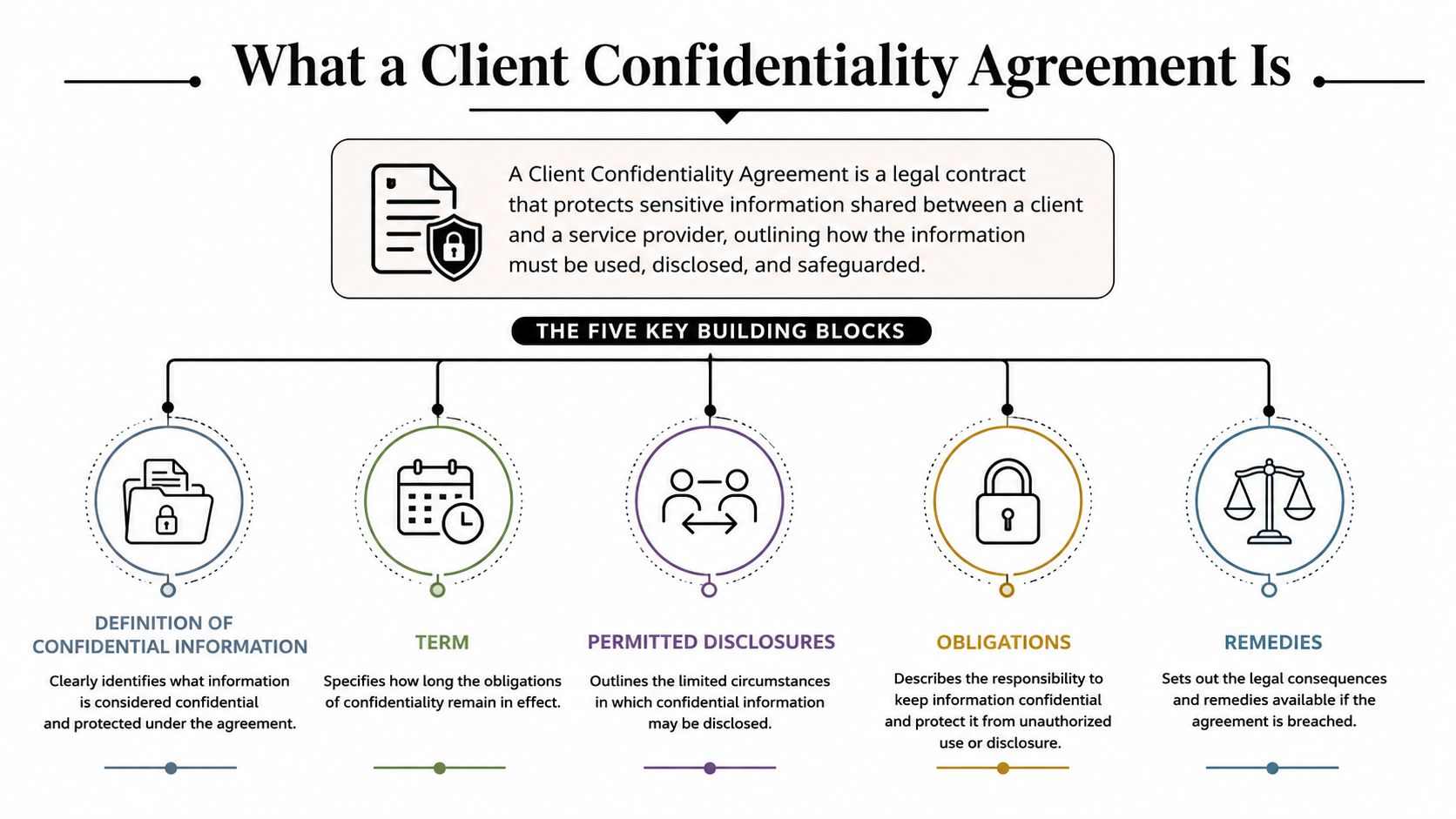
A client confidentiality agreement is a contract that says, in plain terms, who can see sensitive information, how they can use it, what they must keep secret, and what happens if they don't. In ground transport, that information can include the passenger's identity, route data, hotel details, security instructions, billing terms, and affiliate contact chains. The point isn't secrecy for its own sake. The point is limiting exposure so the service can operate without broadcasting private movements.
The five building blocks that make it work
The strongest versions usually start with a definition of confidential information. That definition needs to be specific enough to cover itineraries, manifests, security notes, pricing, and anything the client marks confidential, but not so broad that it becomes impossible to follow. If nobody can tell what's covered, nobody can enforce it cleanly.
Next comes permitted use. The recipient should only use the information to perform the transportation service, not to market, disclose, or repurpose it. That may sound basic, but a lot of bad drafting forgets that a driver, dispatcher, or affiliate can still misuse information without “sharing” it in the obvious sense.
Then come the exclusions. Publicly known information, independently developed information, and information already known before disclosure are common carveouts. Without them, the clause can look overreaching and invite pushback from counsel.
The contract gets stronger when it names the operational reality, not just the legal principle.
The remaining building blocks are third-party flow-down obligations and remedies. Flow-down language is what binds affiliates, subcontractors, and outside professionals like lawyers or consultants who may touch the data. Remedies matter because the agreement has to say what happens if the manifest leaks, the route gets passed around, or a chauffeur posts something they shouldn't. A return-or-destruction clause, a survival clause, and a governing-law clause help make the obligation enforceable after the ride ends, not just during the booking window.
For a ground transport provider, this is why it's often better to treat confidentiality as its own client-facing document instead of burying it inside a master services agreement. The client sees the promise clearly, the operations team can train to it, and the affiliate network can receive it in a usable form. That same structure also lines up with the operational controls in ISO 27001's confidentiality guidance, which emphasizes documented requirements, signatures, regular review, post-termination survival, return-or-destruction, and breach-notification duties ISO 27001 confidentiality guidance.
Essential Clauses Every Executive Transport Agreement Must Contain
The clauses that matter most in executive transport are the ones that close real operational gaps. A lot of paperwork looks complete until a chauffeur leaves a printed manifest on a seat, an affiliate forwards a trip sheet to the wrong contact, or a local coordinator thinks a court subpoena means they can answer a journalist's questions freely. The contract needs to anticipate those moments.
What belongs in the document
Start with a precise confidential information definition, then add exclusions so the clause doesn't overreach. Follow with permitted use language that limits use to performing the trip. After that, bind the recipient to protect the information with reasonable care and make sure the same obligation flows to affiliates, contractors, and advisors who might see the data.
A strong agreement should also spell out term and survival. A trip ends quickly, but the consequences of disclosure don't. The obligation to keep information confidential should survive the booking, the invoice, and the last airport drop. The same contract should require return or destruction of materials when the relationship ends, including manifests, passenger notes, and copies held by sub-providers.
For executive transport, breach notification is not optional. If a driver sends the wrong manifest, or an affiliate in another city gets a journalistic inquiry, the client needs to know fast enough to manage the risk. Remedies should include injunctive relief where appropriate, because some disclosures can't be undone with money alone. A governing-law and venue clause also matters, because a cross-border dispute can become slow and expensive if the forum is vague.
Operational insight: The best clause is the one a dispatcher can actually follow without guessing.
This is also where the structure from the earlier section becomes useful. A contract that defines the information, limits use, and pushes the same obligations down to affiliates is much harder to undermine when a chauffeur slips up. The due-diligence guidance in this confidentiality-and-due-diligence paper is useful because it focuses on the core anatomy of enforceable language rather than abstract theory confidentiality and due diligence paper.
If your transport program depends on service standards, this related overview of service-level agreements is worth reviewing alongside confidentiality terms, because the two documents should speak the same operational language.
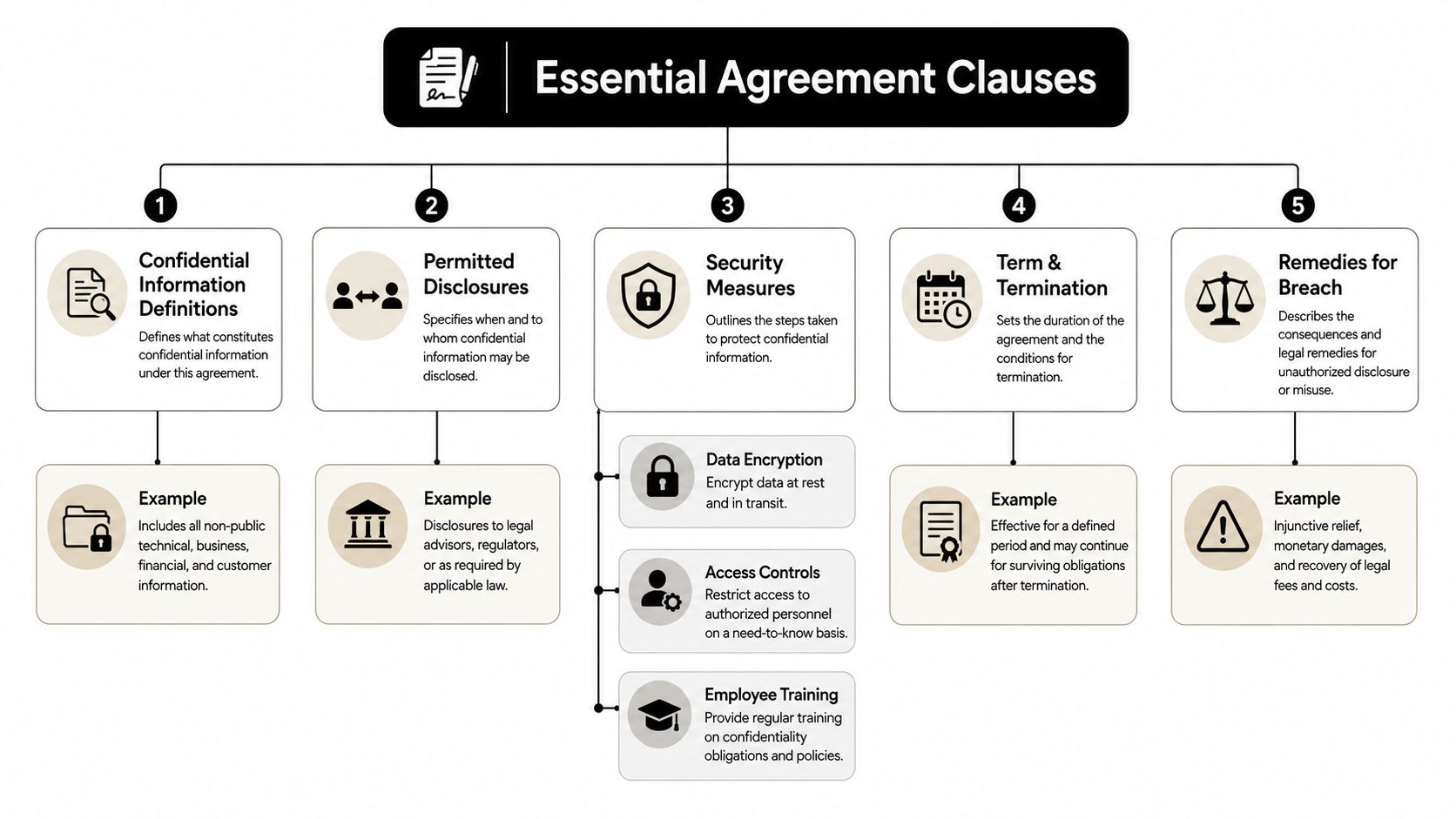
The clauses I'd consider essential in this niche are straightforward, even if the wording isn't. The agreement has to cover who is bound, what is protected, what can be done with it, what happens after the engagement ends, and what happens when someone breaks the rule. Everything else is secondary to those points.
Comparing Mutual One-Way and Multi-Party Agreement Structures
The wrong structure creates friction before the first pickup. If only one side is bound when both sides are trading sensitive details, the agreement doesn't match the relationship. If the principal, the primary transport company, and several affiliates all touch the same trip data, a one-party form is usually too thin for the job.
One-way, mutual, and multi-party
A one-way NDA works when the client is the only side disclosing sensitive information and the provider's exposure is mostly passive. That's common in simple local work where the transport company receives the itinerary and nothing sensitive flows back the other way. The risk of using the wrong form is obvious, because the provider may still need to disclose operational details to affiliates, insurers, counsel, or regulators, and a one-way form won't always address that chain cleanly.
A mutual NDA fits relationships where both sides are exchanging sensitive material. In executive transport, that might include the client sharing itineraries and security instructions, while the provider shares route data, vehicle details, and affiliate arrangements. Mutuality makes sense when both parties need protection.
A multi-party confidentiality agreement is usually the right choice for roadshows, family office travel, and programs that move across cities. It binds the principal, the primary provider, and the affiliate network in a single framework. That reduces the chance that one city's operator works from a weaker template than the rest.
| Structure | Best For | Key Risk If Used Wrong |
|---|---|---|
| One-way NDA | Single-city executive sedan work | Leaves reciprocal operational disclosures poorly covered |
| Mutual NDA | Two-way exchange of sensitive itinerary and route data | Can still miss affiliate flow-down if not drafted carefully |
| Multi-party confidentiality agreement | Multi-city roadshow or family office programs | More drafting effort, but fewer gaps across jurisdictions |
If your vendor program already relies on preferred supplier terms, this comparison with preferred vendor agreements helps frame when confidentiality should stand alone and when it should sit inside a broader supplier package. The decision rule is simple: if more than one entity will touch the trip data, make sure the structure names them.
Drafting Tips and a Workable Sample Template
Good drafting starts with the information, not the form. Before counsel writes a line, identify what needs protection in your operation. That usually means the passenger's name, assistants' names, pickup and drop-off points, flight details, hotel and residence data, billing terms, security instructions, and any affiliate exchange that could reveal the principal's movements.

A drafting sequence that actually holds up
Start with the structure. One-way, mutual, or multi-party changes who is bound, who can disclose, and how much of the affiliate chain must be pulled in. For executive transport, that choice is not academic, because the itinerary often moves through dispatchers, chauffeurs, guest services, and local partners who each see a different slice of the trip.
Next, write the definitions so they match the work your team performs. The agreement should identify the protected material in plain terms, then add exclusions for information already public, independently developed, or lawfully received from another source. After that, add the permitted-use restriction, the flow-down language, the survival and destruction obligations, and the remedy clause. If the document stops at a generic secrecy promise, it may read well and still fail when a chauffeur forwards a manifest to a local affiliate.
The biggest drafting mistakes are familiar. Overbroad definitions make the document hard to administer. Vague survival language lets someone argue the duty ended with the trip. Missing affiliate flow-down language leaves the weakest link unbound. If breach-notification timing is absent, the client may learn about a leak after the damage is already public. That is the point where a polished template stops helping and an operational problem starts.
For operations teams, the template needs to be readable enough that field staff and affiliate managers can follow it. For legal teams, it needs to be specific enough that there is no doubt who must act when information is disclosed or threatened with disclosure. That balance matters more than polished prose.
Drafting rule: If the clause cannot be explained to a chauffeur manager in one sentence, it probably needs tightening.
Sample language usually starts with something like this, adapted to the relationship:
- Definition: “Confidential Information” means all non-public information disclosed in connection with transportation services, including itineraries, manifests, passenger identity, security details, pricing, and affiliate arrangements.
- Use restriction: The recipient may use Confidential Information only to perform or receive the transportation services.
- Flow-down: The recipient must ensure that employees, contractors, affiliates, and advisors are bound by obligations at least as protective as this agreement.
- Return or destruction: On request or at termination, the recipient must return or destroy Confidential Information and certify completion if asked.
- Notice: The recipient must notify the disclosing party promptly after learning of unauthorized access, disclosure, or compelled disclosure.
Enforcement Mechanisms and Jurisdictional Realities
The hard part starts when someone ignores the clause. A chauffeur shares a photo, an affiliate forwards a manifest, or a local team gets served with a subpoena and isn't sure what to do next. In those moments, the value of the agreement depends less on elegant wording and more on whether the remedies and notice procedures were drafted for real-world use.
What happens after a breach
Standing usually belongs to the party whose information was disclosed, but the practical question is how fast that party learns what happened. If the contract requires prompt notice, the client can move quickly to contain the damage, preserve evidence, and decide whether to seek injunctive relief. If notice is vague, the disclosure may travel through the network before anyone with authority sees it.
The choice of governing law and venue matters too. A dispute handled in a familiar forum is usually faster to assess than one that forces counsel to untangle unfamiliar procedural rules in another jurisdiction. That's particularly important in VIP transport, where the provider may book the vehicle in one country, use an affiliate in a second, and serve a principal resident in a third.
The tension between confidentiality and legally compelled disclosure also deserves real drafting. Subpoenas, court orders, and public-record obligations can force disclosure even when everyone intended secrecy. The agreement should say how notice works, who coordinates with counsel, and what the recipient must do before handing over data. The practical guidance in the ACC paper is useful here because it highlights carveouts and notice procedures as an active compliance problem, not just a static contract issue ACC practical guidance on compelled disclosure.
A useful scenario is simple. A Dubai affiliate driver is contacted by a journalist asking about a billionaire's travel pattern. If the agreement has a strong third-party flow-down clause and a clear breach-notification window, the principal can learn about the contact within hours and decide on the response. If it doesn't, the story may spread before the operations team even realizes the question was asked.
Practical rule: A confidentiality clause that doesn't survive a subpoena, an affiliate handoff, or a local court order isn't complete.
Arbitration can be useful when the parties want privacy and speed, but litigation is sometimes the only path when urgent injunctive relief is needed. Cross-border VIP work usually benefits from a clause that says, clearly, which forum controls emergency relief and which forum handles the rest. That choice shapes the cost, the timing, and the position on both sides.
Operational Best Practices for Chauffeurs and Affiliate Networks
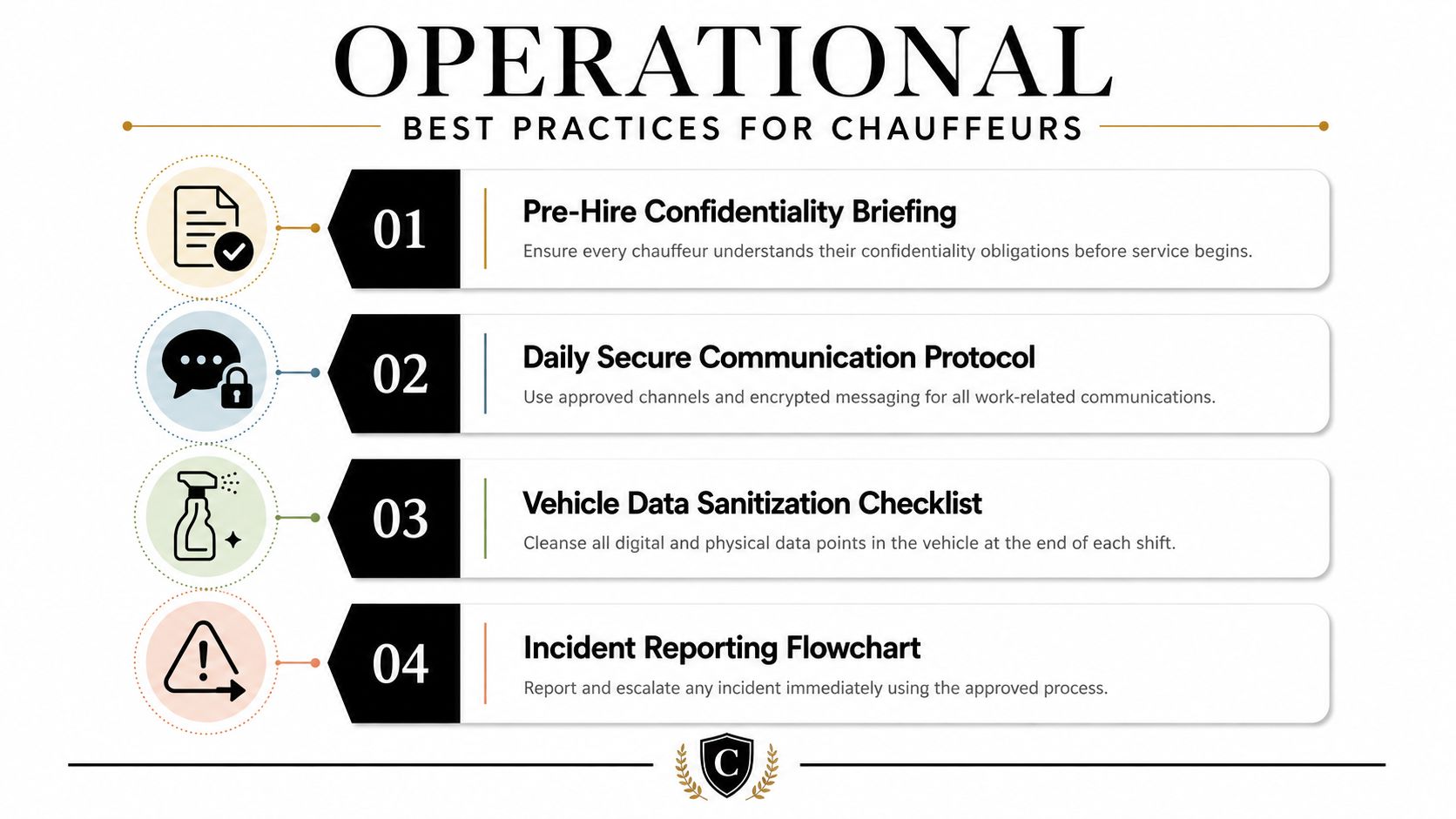
The contract only works if the chauffeur team can live by it. That means the operating playbook has to treat confidentiality like a daily discipline, not a once-a-year onboarding slide. The people who touch the trip need to know exactly what to do with a manifest, a call, a text, and a mistake.
What the field team should do differently
Start with a confidentiality briefing before the first pickup. The chauffeur should know what can't be repeated, photographed, forwarded, or discussed at the curb. That briefing should include affiliates too, because a weak partner in another city can undo the discipline of the home team.
Handle manifests like sensitive documents, not convenience files. Don't leave printed copies on the seat, don't use personal cloud accounts to share trip data, and don't confirm destinations casually at the kerb where a bystander can hear. For FBO work, the coordination script should avoid unnecessary details about gate access, tail references, or the timing of arrivals unless the party receiving it needs the information to perform the service.
A practical quarterly review should check four things. First, whether the confidentiality language still matches current routes and affiliate markets. Second, whether the team still knows where manifests are stored and who can access them. Third, whether new affiliates have signed flow-down obligations before they receive any trip data. Fourth, whether incident reporting still routes to the right manager fast enough to preserve control.
For onboarding, the rule is simple: no affiliate should receive a trip until it has accepted the same confidentiality standard the prime provider promised the client. The article on driver background checks is a useful companion to that process, because trust in the vehicle starts with who's behind the wheel and how they're trained.
If you're renewing a contract, use that moment to compare the paper against the way the work runs. New cities, new principals, and new subcontractors almost always introduce confidentiality gaps that weren't there on day one. A good operations lead closes those gaps before the client has to ask.
Putting It All Together and Preparing for What's Next
A stronger confidentiality program starts with three practical moves. Choose the agreement structure that fits the route network, draft clauses around how itineraries, manifests, and passenger identities are handled, and compare the contract with day-to-day operations every quarter. Cross-border data-governance pressure and privacy expectations in major VIP travel hubs are not easing, so the review cycle has to stay active.
The contract also has to match the work on the ground. If a chauffeur, dispatcher, or affiliate can still confirm destinations casually, share trip data from a personal cloud account, or pass manifest details to someone who does not need them, the paper is not doing enough. In executive ground transport, the confidential information is often the itinerary itself, the principal's identity, the security posture, and the affiliate chain that touches the passenger in each city.
Operational reviews should focus on where the breakpoints really are. Check whether the language still fits current routes and affiliate markets, whether the team knows exactly where manifests are stored and who can access them, whether new affiliates sign the same flow-down obligations before they receive trip data, and whether incident reports reach the right manager quickly enough to preserve control.
Renewal is the right time to tighten what day-to-day work has already exposed. New cities, new principals, and new subcontractors usually create confidentiality gaps that were not obvious at the start. A good operations lead closes those gaps before the client has to raise them.
MLR Worldwide Service supports executive ground transportation, airport transfers, FBO coordination, and affiliate-backed multi-city movements with discretion built into the workflow. If you are tightening confidentiality terms for principals, family offices, or roadshows, visit MLR Worldwide Service and align the contract with the way your trips move.