
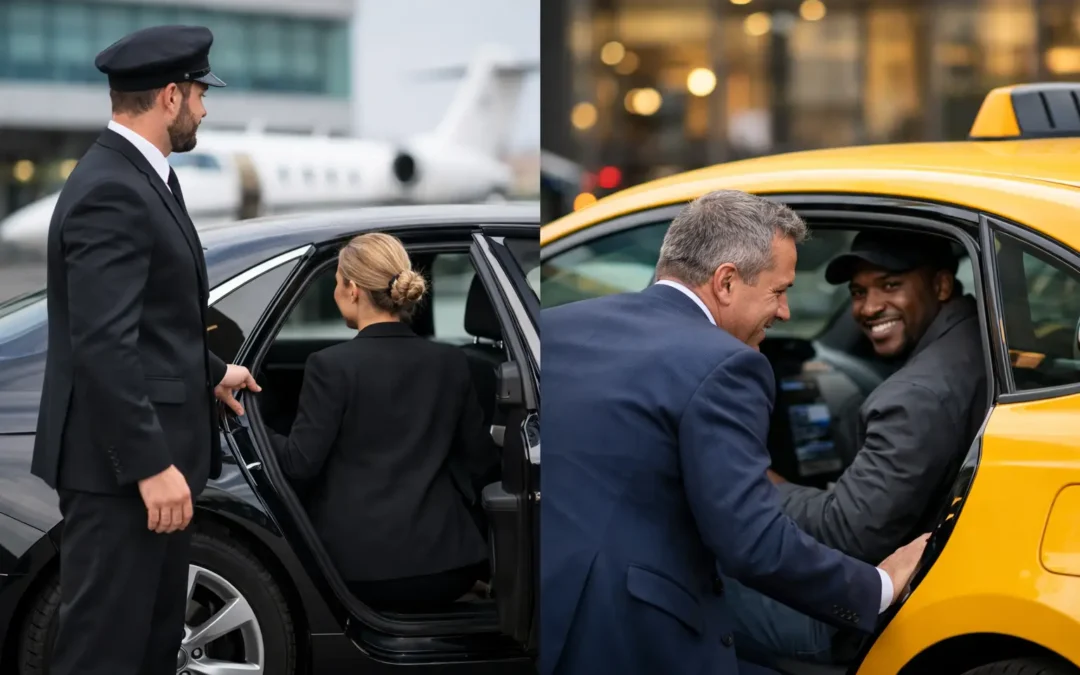
A chauffeur versus taxi service decision is rarely about getting from one address to another. For an executive arriving at an FBO, a principal moving between investor meetings, or an assistant managing a tightly timed itinerary, transportation is part of the day’s operational framework. The relevant question is whether the ride protects time, privacy, and professional standards when there is no room for avoidable friction.
A taxi remains a practical option for many point-to-point trips. It is widely available, generally straightforward to hail or book, and appropriate when flexibility matters more than consistency. Chauffeur-driven service is designed for a different set of expectations: planned execution, a dedicated professional, refined vehicles, and accountability across every stage of the journey.
Chauffeur Versus Taxi Service: The Core Difference
The distinction begins with the service model. A taxi service is typically transactional. A vehicle is assigned for a trip, the passenger is collected, and the ride ends at the destination. Service quality can be excellent, but it often depends on local availability, the individual driver, traffic conditions, and the dispatch environment at that moment.
A professional chauffeur service is managed before the vehicle arrives. The provider confirms flight details, pickup instructions, passenger preferences, luggage requirements, route considerations, and contact protocols. The chauffeur is assigned with the expectation of preparation, presentation, and discretion. For complex travel, a support team monitors the details behind the scenes and can coordinate adjustments when schedules move.
That difference is especially meaningful when one late pickup affects a board meeting, a private aviation departure, a roadshow schedule, or a client-facing event. A taxi solves transportation. A chauffeur service manages the transportation experience as part of a larger itinerary.
Reliability Is More Than an On-Time Arrival
Both taxis and chauffeur services can arrive on time. The more useful comparison is what happens around the arrival time.
For a taxi booking, the passenger may receive a vehicle when one becomes available in the area. This works well for routine urban travel, particularly where demand is predictable and timing is not critical to the minute. However, high-demand periods, weather disruption, large events, and airport congestion can introduce variables that are difficult to control.
With a chauffeur-driven booking, the pickup is planned as a committed assignment rather than a near-term request. Chauffeurs generally arrive early, monitor flights where applicable, and position themselves according to the agreed collection procedure. For airport and FBO transfers, that can mean coordinating the appropriate terminal, meeting point, aircraft tail information, or fixed-base operator access before the passenger lands.
For executive assistants and travel coordinators, this preparation reduces the need to chase updates. A capable provider communicates proactively, confirms changes clearly, and maintains a single point of accountability. The value is not simply a punctual vehicle. It is confidence that the itinerary has an owner.
Privacy and Discretion Change the Equation
A taxi can provide a quiet, private ride in the ordinary sense. Yet executive privacy requires a more deliberate standard. Senior leaders, public figures, private equity teams, legal counsel, and high-net-worth families may discuss sensitive matters in transit, carry confidential materials, or prefer not to draw attention at pickup and drop-off.
Professional chauffeurs are expected to understand the boundaries of their role. They do not initiate unnecessary conversation, request photographs, discuss passenger movements, or treat a recognizable client as a novelty. The best service is attentive without being intrusive. It recognizes that confidentiality is demonstrated through conduct, not merely promised in a policy.
Vehicle selection also matters. A refined sedan or SUV with a quiet cabin, tinted privacy glass where permitted, and ample space for calls and work creates a more controlled environment than a vehicle assigned at random. For VIP security transport, the requirements can extend further to vetted chauffeurs, advance planning, coordinated routes, and controlled arrival procedures.
Fleet Standards and Personal Presentation
Taxi fleets are built for broad public demand. Their vehicles may be clean, safe, and effective, but the passenger has limited control over the type, condition, or presentation of the vehicle that arrives. That is not a failure of the taxi model. It reflects a service built for immediate utility.
A chauffeur service allows the vehicle to match the occasion. An executive sedan may suit an individual airport transfer. A luxury SUV may be more appropriate for a family, security-conscious traveler, or passenger carrying substantial luggage. A van, mini coach, or coordinated fleet can support a delegation, event, or airline crew movement.
The chauffeur’s presentation is part of this standard. Professional attire, polished communication, assistance with luggage, and familiarity with the itinerary all influence how a guest experiences the journey. When a company is collecting a client, speaker, board member, or prospective investor, that experience also reflects on the host organization.
Flexibility Depends on the Type of Change
It is easy to assume a taxi is more flexible because it can be hailed on demand. For spontaneous, low-stakes trips, that is often true. If lunch runs long and the next stop is nearby, a taxi may be entirely sufficient.
But executive travel often involves a different kind of flexibility: a flight diverts, a meeting moves to another office, an additional passenger joins, or a principal needs to make an unscheduled stop before an evening departure. These changes require coordination rather than just vehicle availability.
A dedicated chauffeur provider can adjust the schedule, communicate with the chauffeur, source a replacement vehicle if the passenger count changes, and coordinate service in another city when necessary. For multi-stop days, hourly service also gives the passenger continuity. The vehicle and chauffeur remain available instead of requiring a new booking at each destination.
This does not mean chauffeur service is always the correct choice. For a short, unplanned ride in a familiar city, the premium may not be justified. The right decision should reflect the consequence of delay, the traveler’s profile, the complexity of the itinerary, and the impression the trip needs to create.
Cost Should Be Measured Against Exposure
Taxi pricing is generally lower for simple trips, which makes it an efficient choice when budget and convenience are the primary considerations. Chauffeur service costs more because it includes reserved vehicle time, higher fleet standards, chauffeur expertise, advance planning, and support infrastructure.
The better comparison is not fare versus fare. It is fare versus exposure. What is the cost of an executive missing a connection because no vehicle was available? What does it mean when a visiting client is met by a poorly presented car? How much staff time is spent resolving transportation changes across several cities?
For high-value travel, the premium pays for predictability and reduced administrative burden. This is particularly relevant for roadshows, corporate events, private aviation transfers, and travel involving confidential or highly visible passengers. MLR Worldwide Service approaches these assignments as managed mobility, with white-glove coordination designed to protect the client’s schedule and standards.
Choosing the Right Service for the Moment
A taxi is a sensible solution when the trip is local, immediate, uncomplicated, and low consequence. It offers practical transportation without the need for advance arrangements.
A chauffeur service is the stronger choice when timing is nonnegotiable, passenger privacy matters, the itinerary includes multiple stops, or the traveler needs a consistent experience across cities. It is also appropriate when a host organization wants every touchpoint to communicate professionalism and care.
The most effective travel programs do not treat these services as interchangeable. They match the level of service to the importance of the journey. When a ride carries a principal, a relationship, or a critical deadline, the vehicle is no longer just transportation. It becomes part of how the day succeeds.