

When you think about what keeps an airline running, you probably picture pilots in the cockpit or the massive logistical ballet of baggage handling. But there's another, often overlooked, piece of the puzzle that's just as critical: getting the flight crews where they need to be on the ground. This isn't just a taxi service; it's the lifeline that connects crews between airports, hotels, and layover bases. Get it wrong, and the entire operation can grind to a halt.
More Than Just a Ride: Why Flawless Crew Transport is a Strategic Edge

Treating crew transportation as a simple line item on a budget is one of the biggest mistakes an airline can make. It's really a strategic investment. When it runs like clockwork, it’s a powerful tool that safeguards flight schedules, helps manage crew fatigue, and protects your brand's reputation. At the end of the day, a well-rested and punctual crew is the foundation of any safe, reliable airline.
Think about it from the crew's perspective. A team just landed a 14-hour haul into a bustling hub like Dubai or Heathrow. Their legally mandated rest period doesn't start when the wheels touch down; it starts when they get to their hotel. A disorganized, late, or uncomfortable transfer chips away at that crucial rest time, which can directly affect their fitness for duty on the next flight.
The Domino Effect of One Small Glitch
A single breakdown in ground transport can spiral out of control fast. Let's say a driver gets lost or the van gets stuck in unexpected gridlock. That one delay can set off a chain reaction.
- Flight Delays: A crew showing up just 30 minutes late can be enough to miss a critical takeoff slot, creating a domino effect that ripples through the network for hours.
- Crew Timeouts: Push a crew past their duty limits due to a transport delay, and you could be looking at a full-blown flight cancellation while you scramble to find replacements.
- Skyrocketing Costs: The financial fallout is huge, from passenger compensation and crew overtime to extra airport fees.
- Damaged Reputation: Nothing erodes passenger trust faster than consistent delays. It’s a direct hit to your brand.
The sheer scale of this operation is staggering. With global passenger traffic hitting an estimated 9.5 billion in 2024 and projected to reach 9.9 billion in 2025, the pressure on logistics is immense. Behind every single flight are crews relying on prompt ground transport. You can dig deeper into these numbers with ACI's latest demand analysis.
When you shift your perspective and see crew transportation as a strategic advantage instead of just a logistical task, you start to unlock real gains in efficiency, safety, and reliability. It’s about protecting your most important assets: your people and your schedule.
Ultimately, a rock-solid ground transport system is your insurance policy against operational chaos. It ensures that no matter what’s happening on the ground—traffic, weather, last-minute schedule changes—your crews are in position, rested, and ready. This mindset elevates a simple ride into a core part of operational excellence, demanding the same level of precision as high-stakes executive travel logistics.
Building a Crew Transportation Strategy That Actually Works
Let's be honest: crew ground transportation is often treated as an afterthought, a logistical headache you deal with when things go wrong. But a truly resilient strategy isn't about just putting out fires. It’s about building a system from the ground up that anticipates needs, stays ahead of compliance, and flexes with the beautiful chaos of airline operations.
When done right, your ground transport becomes a seamless extension of your flight operations, not a source of last-minute panic.
It All Starts with Your Crew Management System
The real magic happens when your ground transportation platform talks directly to your crew scheduling and rostering software. Think about it: a flight is delayed, a gate changes, or a last-minute crew swap occurs. Instead of frantic phone calls and manual updates, the system automatically adjusts the pickup time and location. This isn't just about convenience; it's about eliminating the human error that leads to missed pickups and frustrated crews.
Modern airline operations run on data. With the aviation crew management market expected to hit $3.85 billion by 2029, airlines are clearly investing heavily in technology to navigate labor shortages and sky-high demand. Every minute of a crew member's duty day is precious, and integrating ground transport into this tech ecosystem is no longer optional. If you want to get a sense of where things are headed, it's worth exploring the latest trends in crew management and logistics.
A properly integrated system gives you a massive advantage:
- Smarter Dispatching: Vehicles are triggered based on actual landing times, not just what was on the schedule hours ago.
- Instant Rerouting: Did the flight divert? The system automatically reroutes the driver to the new arrival airport without missing a beat.
- Realistic Rostering: Planners can finally see accurate ground transit times, allowing them to build schedules that are not only efficient but also fully compliant from the start.
Keeping the Regulators Happy is Non-Negotiable
We all live and breathe by crew duty and rest regulations like FAA Part 117 or EASA FTL. A transportation delay that cuts into a crew’s mandatory rest period is more than just an inconvenience—it's a potential violation that can ground your next flight and trigger a costly operational domino effect.
Compliance has to be baked into your ground transportation plan. This means your provider needs to understand these rules as intimately as your own crew schedulers do. The clock on a crew member's rest doesn't start until they walk through their hotel room door. Your system must account for this, flagging any pickup that even comes close to jeopardizing that minimum rest time.
A truly resilient system does more than just move people. It acts as a final compliance check, alerting dispatchers when a delayed flight puts a crew’s rest in jeopardy. This gives you time to make proactive adjustments, not reactive apologies.
Hubs vs. Outstations: One Size Never Fits All
The logistical puzzle you need to solve at a major hub is completely different from the challenges at a remote outstation. A strategy designed for Heathrow or LAX will fall flat in a smaller, regional airport.
At the Major Hubs (JFK, LHR, DXB)
The biggest enemies here are traffic, sprawling terminal layouts, and sheer volume. You need a partner who uses dynamic routing technology to navigate rush hour and find the fastest path. Clear, pre-defined pickup zones and rock-solid communication protocols are essential to prevent crews from wandering around an arrivals curb looking for their ride.
At the Remote Outstations
Here, the challenge is a lack of options. You might be dealing with only one or two local car services, unpredictable road conditions, and a very limited supply of vehicles. The key is to lock in a reliable local partner well in advance. Your plan must include vetted backup providers and a clear "what-if" scenario for everything from a vehicle breakdown to a road closure.
This brings up a critical question: do you manage this complex web yourself or bring in an expert? The choice between an in-house fleet and an outsourced provider impacts everything from your bottom line to your operational focus.
The Big Decision: In-House Fleet or Outsourced Partner?
Deciding on the right operational model is a foundational step that will shape your entire crew transportation program. It's a classic build-versus-buy scenario, and each path has significant implications for your costs, risks, and daily operations.
To help you weigh the pros and cons, here’s a straightforward comparison of the two approaches.
In-House Fleet vs. Outsourced Transportation Provider
| Factor | In-House Fleet Management | Outsourced Transportation Partner (e.g., MLR Worldwide) | Key Takeaway |
|---|---|---|---|
| Cost Structure | High upfront capital expenditure (vehicles, facilities) plus fixed ongoing costs (salaries, insurance, maintenance). | A variable, predictable cost structure based on actual usage. No massive capital investment is needed. | Outsourcing turns a large fixed cost into a manageable variable expense, giving you much more budgetary flexibility. |
| Scalability | Very limited. Responding to IROPS, seasonal peaks, or network expansion is difficult and costly. | Highly scalable. A global partner can deploy more resources or adapt to new routes almost instantly. | For any airline dealing with fluctuating schedules, an outsourced partner offers unbeatable agility. |
| Liability & Risk | The airline shoulders all liability for vehicle accidents, driver conduct, and insurance compliance. | Liability shifts to the transportation provider, who is responsible for vetting, insurance, and safety protocols. | Partnering with a fully insured provider dramatically reduces your airline's risk exposure and administrative load. |
| Operational Focus | Pulls management attention away from core airline duties to focus on fleet logistics and driver management. | Allows your operations team to concentrate on what they do best—running an airline—not a ground transport company. | Outsourcing frees up your internal resources to focus on flying planes, not managing cars and drivers. |
Ultimately, the decision comes down to what you want your team focused on. Managing a fleet is a full-time business in itself. For most airlines, partnering with a specialist who lives and breathes ground transportation allows them to improve reliability and reduce risk, all while letting their own team focus on the core mission of the airline.
Executing Flawless Daily Crew Movements
Once your strategy is locked in, the real work begins. The daily execution of crew transportation is where a plan proves its worth. It's in the nitty-gritty of each transfer that you separate a smooth, professional operation from a logistical mess. This is about turning a blueprint into a predictable, high-quality experience on the ground, day in and day out.
A crew transfer isn't just a ride from point A to point B. It’s a carefully timed sequence that kicks off long before the aircraft even touches down. Let's break down what a successful transfer looks like in the real world.
The Anatomy of a Perfect Crew Transfer
Picture this: a wide-body aircraft carrying a crew of 15 is on final approach to Chicago O'Hare (ORD) after a long-haul flight. For them, the journey is ending. For their ground transport provider, the process has been underway for hours.
The moment that flight departed its origin airport, the transportation provider’s system, plugged into live flight tracking data, started its work. This isn't optional; it's the heartbeat of the entire operation.
Pre-Arrival Checks: About an hour before landing, the chauffeur does a final vehicle check. Is it spotless? Is the climate control set? Is there bottled water for everyone? After a 12-hour flight, these small comforts are anything but small.
Real-Time Adjustments: The flight lands 20 minutes early. Instead of making the crew wait, the system automatically pings the chauffeur, who adjusts their timing. They're already heading to the pickup spot before the crew has even started to deplane.
Navigating Airport Logistics: At a major hub like ORD, there are designated—and often chaotic—pickup zones for commercial vehicles. An experienced chauffeur knows the airport's layout, bypassing the public arrivals scrum and heading straight to the pre-arranged location. Clear communication through a dedicated app confirms the vehicle's exact spot for the crew captain.
This isn't luck; it's the result of a meticulously planned Standard Operating Procedure (SOP). The visual below breaks down the foundational pillars that make this kind of execution possible.
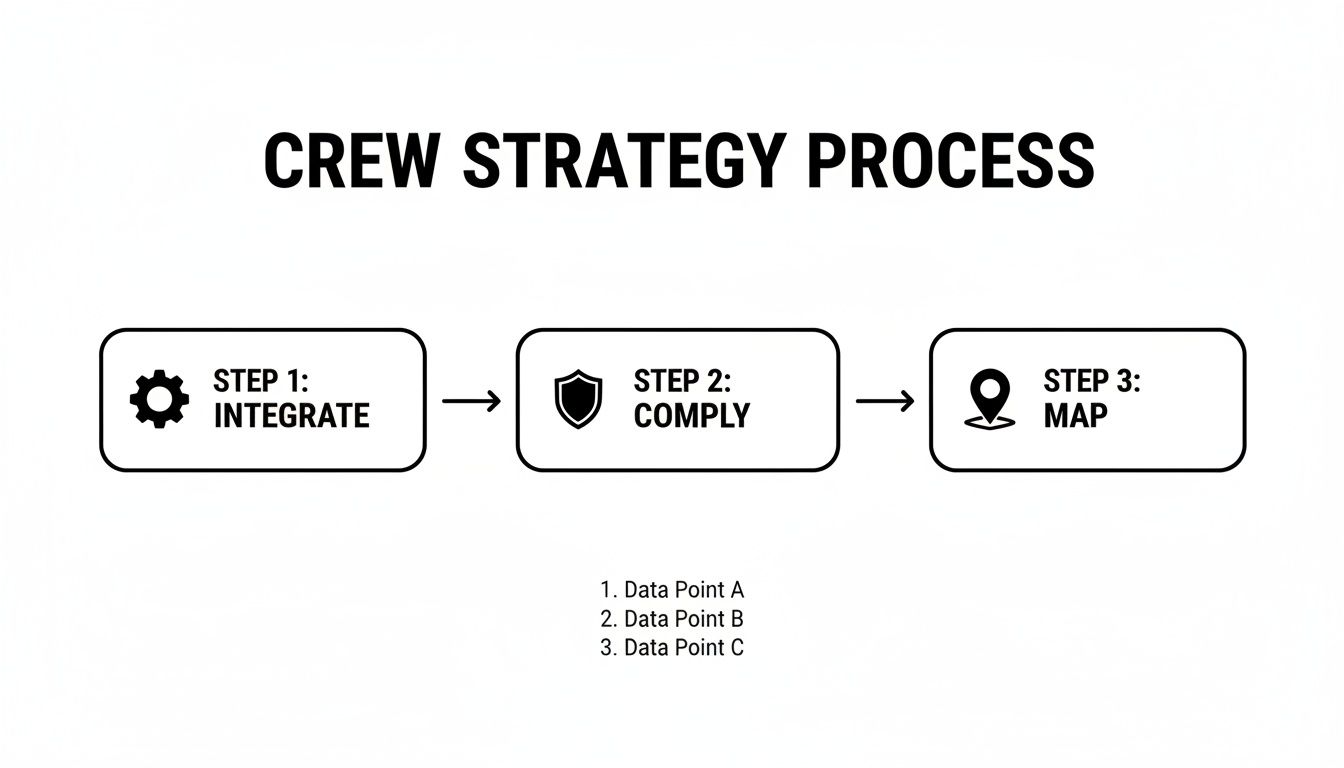
You can see how integrating systems, ensuring compliance, and mapping logistics aren't separate steps. They're all woven together into one fluid, dynamic process.
Upholding Security and Privacy
For that crew landing at O'Hare, security is paramount. Professional airline crew transportation providers know that discretion is a core part of the service. You'll notice their vehicles are typically unbranded, which helps the crew blend in and avoid unwanted attention.
The chauffeurs themselves are trained to be more than just drivers. They understand the critical importance of confidentiality. You will never hear them discussing crew schedules, hotel locations, or other sensitive details. This commitment to privacy is non-negotiable and ensures the crew feels safe from the moment they step off the curb.
The need for this level of precision is only growing. As the industry continues its post-pandemic rebound, the pressure is on. Global passenger traffic is expected to reach 9.7 billion by the end of 2025—that's 106% of 2019 levels. With crews of 10-20 people on wide-body flights, every minute counts. This is why airlines partner with providers who have the modern fleet and global network to maintain punctuality rates above 98%. For a deeper dive, you can check out this report on the evolving airline market and its challenges.
A Sample SOP Checklist for Every Trip
So, how do the best providers guarantee this level of service every time, whether in New York, London, or Tokyo? They rely on detailed checklists. This simple tool removes the guesswork and enforces a uniform standard of care.
A solid SOP checklist is your tactical toolkit for flawless execution. We’ve put together guides to help you master the complexities of airport transfers that you might find useful.
Key Takeaway: A perfect crew transfer should be invisibly efficient. The crew shouldn’t even have to think about their ground transport. It just happens—on time, every time—so they can focus on what matters most: getting the rest they need for their next flight.
Here’s a look at what a basic pre-trip and post-trip checklist should cover:
Pre-Trip Checklist
- Flight Number Verified: Double-checked against the airline schedule and live flight tracking.
- Crew Manifest Confirmed: Exact number of pilots and cabin crew confirmed to dispatch the right size vehicle.
- Vehicle Pre-Inspected: Interior clean, temperature right, and amenities like water and chargers stocked.
- Route Planned: Primary and backup routes mapped out using real-time traffic data.
- Chauffeur Briefed: Chauffeur has all trip details, including the captain's contact info and the specific pickup point.
Post-Trip Checklist
- Drop-Off Time Logged: Exact hotel arrival time recorded for compliance and accurate billing.
- Vehicle Swept: Chauffeur does a full sweep of the vehicle for any personal items left behind.
- Trip Report Filed: Digital report is submitted detailing the trip, noting any delays, and providing feedback for continuous improvement.
By sticking to these kinds of rigorous procedures, a transportation partner truly acts as an extension of the airline itself—embodying the same commitment to safety, precision, and professionalism. This meticulous approach is what turns a simple ride into a critical operational advantage.
Managing Disruptions and Irregular Operations
Let's be honest: no matter how meticulously you plan, things will go wrong. An unexpected snowstorm, a sudden mechanical issue, or a nationwide air traffic control snag can bring the most buttoned-up schedule to its knees. This is the world of Irregular Operations (IROPS), and your crew transportation system is right there on the front line.
In these moments, success isn't about preventing the disruption—it's about having a solid, flexible game plan to absorb the shock. A well-oiled IROPS response turns a potential operational meltdown into a show of control and professionalism, keeping crews safe, compliant, and ready to get back in the air.
The IROPS Communication Hub
When the plan falls apart, clear communication is everything. The first thing you need is a central hub for information. A storm of frantic, scattered calls between dispatchers, drivers, and crew members only creates more chaos and costly mistakes. A single, authoritative channel is non-negotiable.
This is where a modern transportation partner truly shines, using integrated platforms that act as a central nervous system. These systems push real-time updates to everyone involved, typically through a dedicated mobile app or direct SMS notifications.
- For the Crew: They get instant alerts about new pickup times, vehicle changes, or hotel reassignments right on their phones.
- For the Chauffeur: The system sends dynamic route adjustments and updated crew manifests directly to their device.
- For Operations: Your team gets a high-level dashboard view of every moving piece, allowing them to make smart, strategic decisions on the fly.
This approach cuts out the "he said, she said" confusion and ensures everyone is working from the same playbook.
An effective IROPS plan isn't a thick binder that collects dust on a shelf. It's a living, technology-driven process that's all about clear communication and rapid, informed decisions. The real goal is to absorb the impact of the disruption so the crew doesn't have to.
Real-World IROPS: A Chicago O'Hare Snowstorm
Let’s walk through a classic scenario. A massive snowstorm slams Chicago, grounding all flights at O'Hare (ORD) for the next eight hours. An incoming flight from Frankfurt, carrying a crew of 18, gets diverted to Indianapolis (IND), a solid 200 miles away.
A reactive, unprepared transport system would simply crumble. But a provider with a battle-tested IROPS framework kicks into gear instantly.
Here’s how a proactive response looks:
- Immediate System Alert: As soon as the flight tracking system flags the diversion, it triggers an automatic alert to the 24/7 operations team. The originally scheduled pickup at ORD is immediately canceled.
- Asset Reallocation: The ops team taps into its network. A motor coach that was on standby near IND is dispatched to the airport. The system confirms it has plenty of room for the entire crew plus their luggage.
- Crew Communication: A single, automated message goes out to the crew captain's phone. It confirms the diversion, provides the new pickup details at IND, and includes the chauffeur’s name and contact number. No frantic calls needed.
- Hotel Coordination: At the same time, the ops team is already working with the airline to lock down hotel rooms near IND, since the crew will now time out. The new hotel address is pushed directly to the chauffeur's navigation system.
Thanks to this coordinated response, the crew deplanes in Indianapolis to find their ride waiting and their rooms booked. What could have been a chaotic, stressful ordeal becomes a smooth, managed process.
The Need for a Flexible and Scalable Fleet
Your ability to handle disruptions hinges entirely on having the right vehicles in the right place at the right time. This is the Achilles' heel of relying on a small, local provider.
A true transportation partner maintains a deep, flexible fleet and a wider network of vetted affiliates. This network is your safety net, providing crucial backup capacity when you need it most. If your primary vehicles are stuck in weather-related gridlock, the provider can call on a trusted partner in another part of the city to handle an urgent pickup.
It’s this scalability that builds resilience. You can weather large-scale disruptions without a single point of failure because you have the ability to deploy exactly what's needed—from a sedan for a repositioning pilot to a bus for an entire stranded crew. That’s what a dynamic response is all about.
How to Choose the Right Transportation Partner

Picking your ground transportation provider is one of the most critical decisions you'll make for your entire operational chain. This isn't just about moving crews from point A to B. It’s a partnership that directly impacts your airline's punctuality, your budget, and the morale of your flight crews.
I've seen it happen time and again: a cheap provider quickly becomes the most expensive mistake when their missed pickups and delays start causing flight cancellations. You can’t afford that.
That’s why your vetting process has to be about more than just the price tag. It needs to be a deep dive into capability and absolute reliability. You're looking for a partner who operates like a seamless extension of your own team—someone who gets what’s at stake with every single transfer. This is about building a real, long-term collaboration.
Evaluating Core Capabilities and Global Reach
The first filter should always be the provider's operational footprint. An airline's network is vast and often unpredictable, so your partner has to match that scope with consistent, high-quality service everywhere you fly.
Look for a provider with a robust, heavily vetted affiliate network. This is non-negotiable. It’s the only way they can guarantee the same standards of safety, service, and discretion whether your crew is landing in New York, London, or a remote outstation in Tokyo. A partner with deep global connections means you aren't stuck managing dozens of local vendors yourself.
The real test of a global network isn't its size—it's the consistency. A true partner delivers the same reliable, professional experience at a tiny regional airport as they do at a major international hub. That uniformity is the bedrock of a successful crew transportation program.
Assessing Fleet Quality and Chauffeur Standards
The vehicles and the people behind the wheel are the most tangible part of the service. Don't just take their word on quality; you need to dig into the specifics of their fleet and training programs. Any provider worth their salt will be completely transparent about their standards.
Your evaluation has to cover these key areas:
- Fleet Condition: Are the vehicles late-model and meticulously maintained? Are they equipped for crew comfort and safety? Ask to see their maintenance logs and inspection protocols.
- Chauffeur Vetting: What, exactly, does their screening process involve? It absolutely must include comprehensive background checks, regular driving record reviews, and routine drug testing.
- Specialized Training: Are their chauffeurs trained specifically for airline crew movements? This means they need to understand airport layouts, FBO procedures, and the critical importance of privacy and punctuality.
A professional, well-trained chauffeur does so much more than drive. They are a calming, reliable presence for a tired crew, making sure the final leg of their duty day is safe and efficient.
The Technology That Drives Reliability
In modern airline logistics, technology is the glue holding everything together. A potential partner’s tech stack is a direct reflection of their ability to handle the fluid, dynamic nature of our schedules. A provider still relying on radios and phone calls for dispatch is going to fall apart the moment IROPS hits.
Their platform should offer a few key features, at a minimum:
- Real-Time Flight Tracking: The system has to automatically adjust pickup times based on actual arrival data, not the original schedule.
- Automated Dispatch: This is what ensures the right vehicle is assigned efficiently, minimizing wait times and guaranteeing availability.
- Crew Communication Tools: A simple app or automated SMS system that gives crews real-time updates on their ride's status is essential for a smooth, stress-free experience.
This tech backbone is what enables a provider to deliver the kind of on-time performance—often exceeding 98%—that airlines demand. For a deeper dive into the operational nuts and bolts, our guide on what is ground transportation offers some great insights.
Measuring Success with the Right KPIs
Finally, any strong partnership is built on accountability. Before you sign anything, you must agree on a crystal-clear set of Key Performance Indicators (KPIs) to measure success. This is how you shift the relationship from a simple service into a results-driven partnership.
Your vendor scorecard should track these critical metrics:
| Key Performance Indicator (KPI) | Why It Matters | Target Goal |
|---|---|---|
| On-Time Performance | The single most important metric. Measures pickups within a defined window (e.g., 15 mins). | > 98.5% |
| Incident Rate | Tracks any safety or service issues, from vehicle accidents to crew complaints. | < 1% of all trips |
| Crew Satisfaction Score | Gathers direct feedback from crews via simple surveys to measure service quality. | 4.8/5.0 stars or higher |
| Billing Accuracy | Ensures invoices are correct and free of errors, reducing administrative workload. | 99.9% Accuracy |
By focusing on these core areas—global reach, quality standards, technology, and measurable performance—you can forge a partnership that truly supports your airline's operational excellence.
Frequently Asked Questions in Crew Transportation
Even the most buttoned-up crew transportation plan runs into snags. Airline operations are a moving target, and managers are always asking how to better handle last-minute schedule changes or guarantee crew safety on the ground. This is where experience really counts.
Let's dig into some of the most common questions we hear from airline partners. These aren't textbook answers; they're practical insights from years of managing the controlled chaos of getting crews where they need to be, safely and on time.
How Should Our Partner Handle Last-Minute Changes?
In aviation, the only thing you can count on is change. A truly reliable transportation partner doesn't just tolerate this—they're built for it. It all starts with technology that’s plugged directly into real-time flight data. This means their system should automatically track arrivals and departures, adjusting pickup times on the fly without anyone needing to make a call for a simple 30-minute delay.
But tech can only get you so far. What happens when a flight diverts, a crew member times out, or a last-minute swap occurs? That's when you need a human. A dedicated 24/7 operations team is non-negotiable. They are your single point of contact who can immediately dispatch a different vehicle, reroute a driver, and keep the crew in the loop every step of the way.
The best providers operate on a hybrid model. Smart technology handles the predictable shifts, while a team of logistics experts manages the genuine curveballs. That's how you ensure a vehicle is always waiting, no matter what the schedule throws at you.
What Are the Must-Have Security and Privacy Measures?
Crew safety is non-negotiable, and that responsibility extends from the cockpit to the curb. The foundation of any secure operation is the people behind the wheel. You absolutely must work with a provider whose chauffeurs are not only thoroughly vetted and background-checked but also trained in defensive driving and the art of discretion.
Beyond the driver, all crew information—schedules, manifests, hotel details—must be transmitted and stored on secure, encrypted platforms. The vehicles themselves should be completely unbranded to maintain a low profile. GPS tracking is another essential, not for spying, but for operational awareness and as a safety tool.
For high-risk regions or sensitive movements, your partner should also be able to provide enhanced security measures and work directly with your airline’s own security team. A signed, legally binding confidentiality agreement for every single chauffeur isn't just a nice-to-have; it's the industry standard.
How Do We Make Sure Our Provider Complies with Duty and Rest Rules?
Staying compliant with regulations like FAA Part 117 or EASA FTL is a joint effort. It's on you, the airline, but your transportation partner plays a critical role. Don't just take their word for it—ask them to walk you through their exact procedures for ensuring drive times never eat into a crew's minimum rest period.
A sophisticated dispatch system should be able to flag potential issues automatically. For example, if a pickup is scheduled too close to the end of a rest period, it should trigger an alert for the dispatcher. By giving your provider controlled access to relevant rostering data, they stop being just a car service and become a vital part of your safety management system. They add another layer of verification, helping you catch potential violations before they happen. This is the difference between a simple vendor and a true operational partner.
Ready to partner with a team that understands the stakes of every crew movement? At MLR Worldwide Service, we combine advanced technology with 24/7 operational expertise to deliver the reliability your airline demands. Discover our specialized airline crew transportation solutions.
Composed with Outrank