

A board meeting runs late in Mayfair. The inbound flight lands early at Heathrow. One attendee needs to stop at a hotel before Canary Wharf, another has changed terminals for the departure home, and the principal wants to stay off the curbside scene outside the venue. At that point, the transport question isn't whether the car has soft leather or bottled water. It's whether the plan survives change without wasting executive time.
That's where most buyers misjudge London. They compare a chauffeur against a taxi or an app on headline convenience, then discover too late that the cost sits in missed handoffs, poor routing, weak communication, and exposure at the wrong place. A proper executive chauffeur service in London isn't mainly about speed. In central London, speed is often the wrong metric. Control is the metric.
The city rewards providers that can manage moving parts calmly. Congestion, security sensitivities, airport unpredictability, and multi-stop corporate schedules all punish reactive transport. If you book executive ground transport regularly, the right decision framework is simple: choose the option that protects time, reduces friction, and keeps the traveler focused on the job rather than the journey.
Beyond Speed When to Choose an Executive Chauffeur
A common mistake is using the same transport logic for every trip. If an executive is going from one known address to another with no luggage, no calls to take, and no schedule risk, several transport modes may work. But once the day includes airport timing, client hospitality, multiple stops, or a high-value traveler, the decision changes.
London traffic often removes any illusion that a private car is automatically faster. The stronger reason to use executive chauffeur service in London is dispatch reliability and itinerary management, especially for time-critical travel such as roadshows and FBO support, as noted by CityLux Chauffeurs on managed executive travel in London.
The right chauffeur booking is often the one that prevents the second problem, not the one that solves the first journey.
Trips where a chauffeur is the right call
- Airport arrivals with onward commitments. If the traveler is landing and going directly into meetings, a managed pickup reduces handoff risk.
- Multi-stop schedules. Taxis and ride-hail work trip by trip. Executive chauffeur service works itinerary by itinerary.
- Roadshows and investor days. Tight timing matters more than raw pace.
- High-visibility movements. Quiet arrivals and low-profile departures need planning, not just a car.
- Client hosting. If your company is receiving a guest, the transport becomes part of the relationship.
Trips where it may not be necessary
There are cases where a chauffeur is more service than the moment requires. A lone traveler making a simple journey across London with no timing pressure may be perfectly well served by rail or a black cab. Good travel management isn't about forcing premium transport onto every booking. It's about using it where the downside of failure is high.
That distinction matters at C-suite level. The traveler's time is expensive, but so is distraction. If a transfer requires active monitoring by an assistant after the booking has been made, the transport choice probably wasn't dependable enough.
Understanding the Executive Service Difference
Many assume they're buying a car and a driver. In practice, they're buying a managed ground movement.
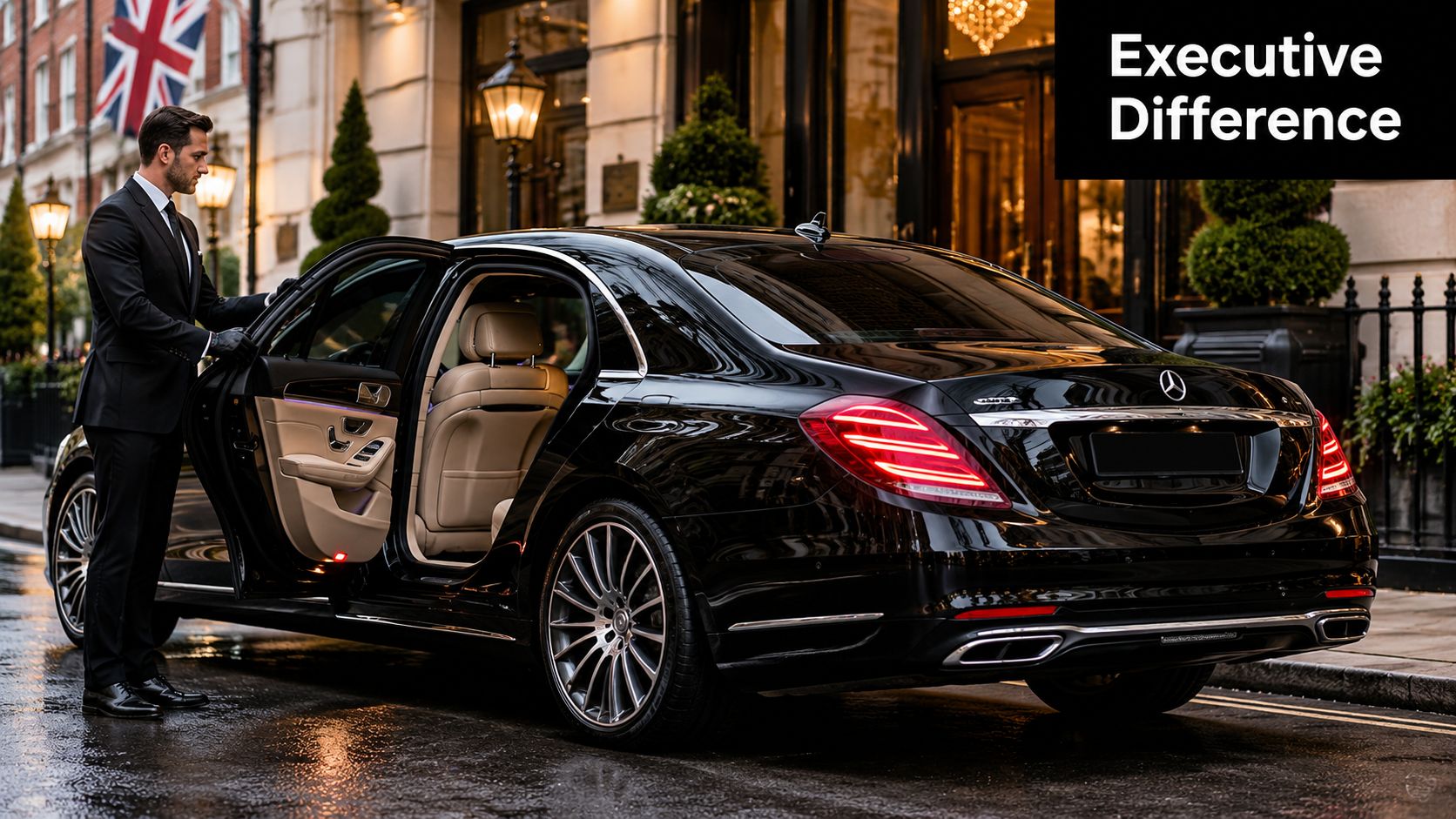
The business case for that managed layer is clear. The global chauffeur services market was valued at $46.8 billion in 2025 and is projected to reach $89.3 billion by 2034, with a 7.4% compound annual growth rate. Corporate clients account for about 41.5% of revenue, equal to $19.4 billion in executive ground transportation in 2025, according to DataIntelo's chauffeur services market report. That tells you this category is not a fringe luxury purchase. Corporate travel is its economic backbone.
What executive service actually includes
An executive booking should start before pickup. The provider confirms the itinerary, checks access constraints, aligns pickup timing to the nature of the appointment, and keeps an operations function ready for changes. That's the difference between a reactive trip and a managed one.
If you want a broader view of how this fits into business travel planning, this guide to ground transportation gives a useful framework for how professional services sit alongside air, rail, and event logistics.
Logistics partner versus driver
A standard car service typically responds to the request in front of it. An executive chauffeur operation should respond to the day as a whole.
That means looking at questions such as:
- Is the pickup point workable at that terminal, hotel, or venue?
- Does the traveler need waiting time built in because the meeting host is known for overruns?
- Should the car remain on site because rebooking in that district at that hour introduces risk?
- Is the assistant managing one executive or six?
Practical rule: If your itinerary can change without notice, book a service designed to absorb change, not one designed only to complete a ride.
The service layer clients notice most
The irony is that clients often notice the invisible parts only when they're missing. A poor provider leaves the traveler asking where the car is, whether the driver has the updated stop, or who is handling a delayed arrival. A good provider keeps those questions from surfacing at all.
That's why experienced travel managers usually evaluate executive chauffeur service in London less like hospitality and more like logistics. The polished vehicle matters. The managed process matters more.
Fleet and Chauffeur Standards You Should Expect
Vehicle choice should follow mission, not vanity. The wrong car creates friction fast, especially at airports and on long corporate days.
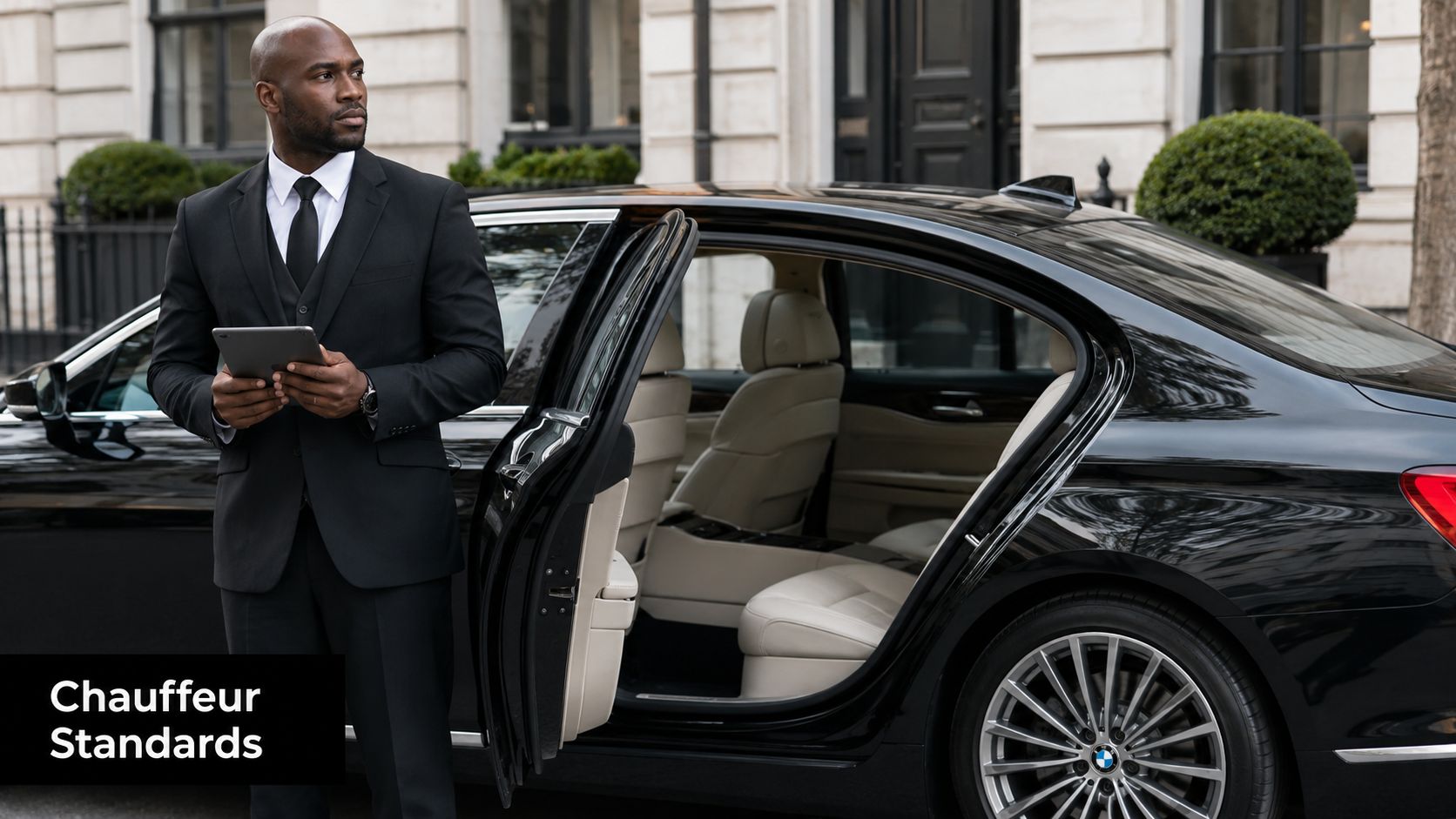
According to Addison Lee's executive services vehicle guidance, a standard executive saloon is typically sized for up to 3 passengers and 3 bags. Larger platforms such as the Mercedes S-Class, V-Class, or Audi A8 equivalents are better suited to airport transfers, VIP work, and multi-stop roadshows where comfort, luggage space, and protocol flexibility matter.
Match the vehicle to the task
A few practical examples make this easier:
- Executive saloon. Best for one senior traveler, sometimes two, with moderate luggage and a straightforward agenda.
- Mercedes S-Class or equivalent. Best when arrival standard, rear-seat comfort, and quiet cabin quality matter.
- Mercedes V-Class. Best for group airport arrivals, security support teams, or principals traveling with substantial luggage.
- SUV platform. Useful where ride height, presence, or specific venue access patterns matter.
Too many buyers book by badge. They ask for an S-Class because it signals status, then discover the luggage profile really required a V-Class. That usually leads to either discomfort or a second vehicle. Neither is efficient.
For operators, disciplined upkeep matters just as much as the spec sheet. If you're assessing service quality at fleet level, fleet maintenance best practices are a good benchmark for what a serious provider should be doing behind the scenes.
What the cabin should and should not feel like
Premium doesn't mean theatrical. It means the vehicle is clean, quiet, climate-controlled, properly presented, and ready for work. Device charging, water, and a spotless rear cabin are standard expectations. Heavy fragrance, flashy branding, or cluttered interiors are not.
A business traveler should be able to do three things comfortably in the back seat:
- Work privately
- Take a call without strain
- Arrive looking composed
If the car can't support that, it isn't configured for executive use.
Chauffeur standards separate premium from merely expensive
The chauffeur is not a driver in a suit. The role is part transport professional, part host, part risk filter. Good chauffeurs read pace, mood, and context. They know when to engage, when to stay quiet, where not to stop, and how to adapt a route without creating drama.
A polished chauffeur isn't trying to impress the passenger. He's trying to remove decisions from the passenger.
Look for these signals:
- Local route judgment. Not just map-following, but practical knowledge of access points, hotels, private entrances, and meeting districts.
- Presentation discipline. Uniform, posture, vehicle setup, and calm communication all count.
- Confidentiality. No unnecessary conversation about clients, schedules, or prior passengers.
- Security awareness. Especially important for residences, embassies, secure venues, and public-facing events.
- Operational maturity. The chauffeur should work smoothly with dispatch and not leave the client relaying basic updates.
The strongest providers train consistency into both fleet and chauffeur behavior. That consistency is what corporate buyers are really paying for.
Demystifying Chauffeur Pricing and Billing in London
Pricing confusion usually starts when buyers compare unlike services. A fixed airport transfer, an as-directed booking, and a full-day roadshow all solve different problems. They shouldn't be priced the same way.

London adds another layer. In central London, the Congestion Charge is £18 per day if paid on the day or in advance, rising to £21 if paid later within the permitted window. That mandatory access cost directly affects pricing, routing, and trip planning for executive work, as explained by Network Executive Chauffeurs on London charging impacts.
The three billing models that matter
Here's the practical breakdown.
| Model | Best For | Cost Structure | Pros | Cons |
|---|---|---|---|---|
| Point-to-Point Transfers | Airport runs, hotel to office, single journeys | Fixed fare for a defined route | Budget clarity, simple approval, easy to compare | Less flexible if stops or delays appear |
| Hourly or As-Directed Hire | Meetings across town, uncertain finish times, flexible schedules | Charged by booked time, usually with minimums | Adapts well to changes, keeps vehicle close | Can cost more than a simple transfer if underused |
| Full-Day or Multi-Day Service | Roadshows, events, executive visits, hosted client programs | Dedicated vehicle and chauffeur for a set period | Best control for complex schedules, fewer reset points | Requires stronger planning and clearer usage scope |
How to choose the right pricing model
Use point-to-point when the route is known and the requirement is straightforward.
Use hourly when the traveler may leave early, stay late, add stops, or need the vehicle to remain nearby. This is often the right answer for city-center executive work.
Use full-day when the schedule itself is the product. If the car will serve a sequence of appointments, venue changes, and waiting periods, trying to break that into separate trips usually creates more admin and more operational risk.
What transparent billing looks like
A reputable quote should make clear what is included, what can vary, and whether central London charging zones affect the price. If a provider gives an unrealistically neat figure without asking where the vehicle will be used, be cautious.
Buyer check: Ask whether the quote reflects central London access charges, waiting assumptions, and itinerary complexity before approving it.
Hidden friction usually appears in four places:
- Zone-based costs that were not discussed early
- Waiting time that was inevitable but not planned for
- Extra stops added casually during the day
- Vehicle mismatch that forces an upgrade or second dispatch
Transparent billing isn't about getting the cheapest number. It's about getting the right model for the day you're running.
How to Evaluate and Shortlist Providers
Most buyers spend too much time comparing car brands and too little time testing operational resilience. That's backwards. A provider can have excellent vehicles and still fail your executive because the back office is weak, the communications chain is sloppy, or the discretion protocols are thin.
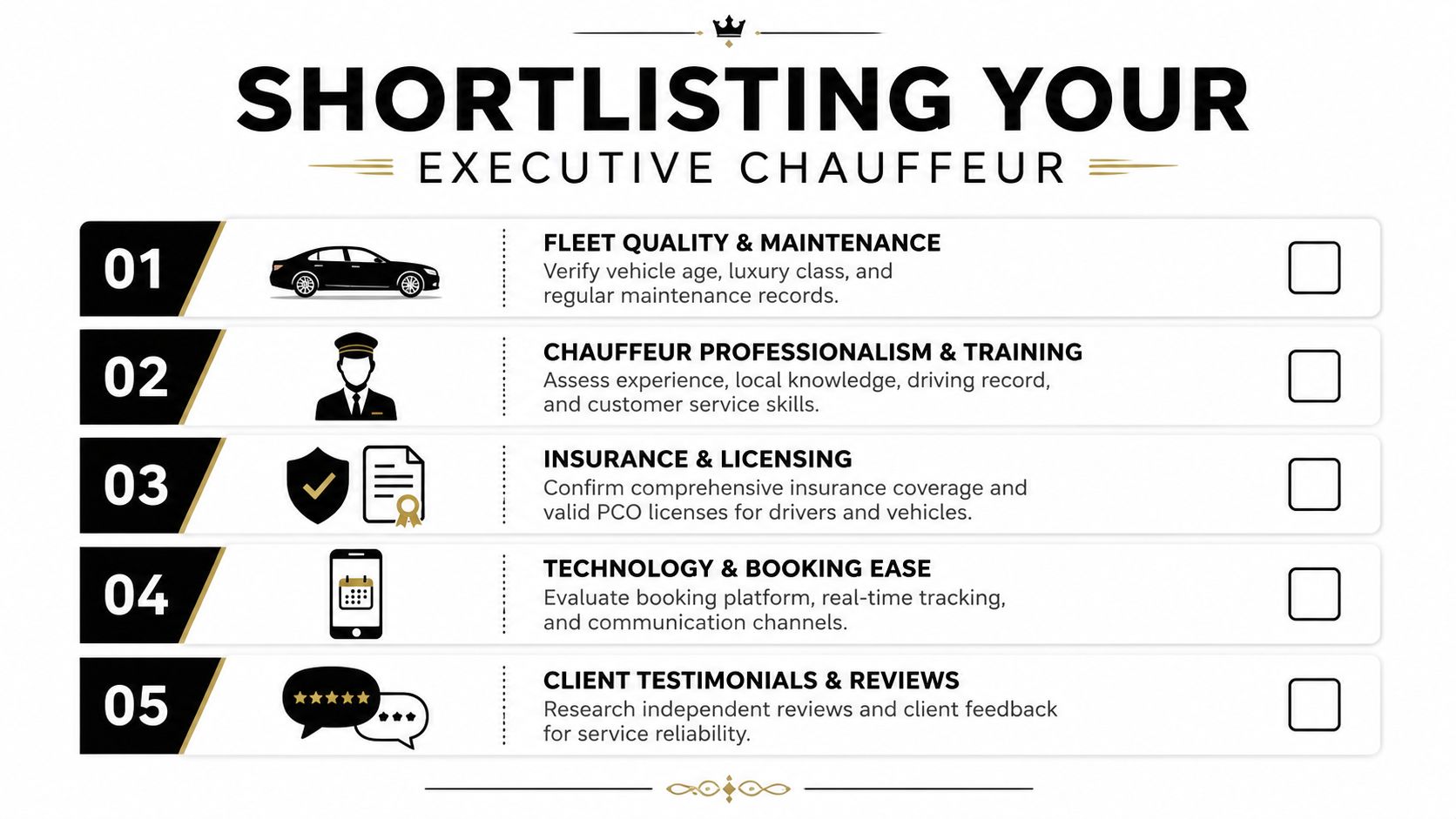
One of the most overlooked criteria is security and discretion. High-profile clients increasingly need low-profile operations, confidential route planning, and procedures that minimize exposure, according to Crown Lane's guidance on discreet chauffeur service for VIPs. That issue deserves the same weight as punctuality.
The shortlist should start with operational questions
When reviewing providers, ask how they handle live disruption. Not in marketing language. In practical terms.
For example:
- Who manages last-minute changes at night or on weekends?
- How are pickup instructions updated and confirmed?
- What happens if a meeting runs long and the next movement shifts?
- How is an arriving passenger supported if the phone battery is dead or roaming fails?
Those questions reveal whether the provider runs an operation or just allocates cars.
If you're comparing options in your area, this overview of executive car service providers can help frame what a professional corporate setup should include.
What serious buyers should score
I'd shortlist against five areas.
Service control
Can the company support bookings continuously, manage changes quickly, and communicate clearly with bookers as well as passengers? If not, small itinerary problems become executive problems.
Chauffeur quality
Look beyond politeness. You want maturity, discretion, and consistent standards under pressure. The best chauffeurs make difficult days feel ordinary.
Fleet suitability
A small but well-matched fleet is better than a glamorous list that isn't available when needed. Ask what's routinely deployed for executive airport work, roadshows, and VIP assignments.
Privacy handling
Who sees the itinerary? How much client information is shared? How are sensitive addresses and names handled internally? Providers serving senior principals should have thought this through.
Security and low-profile execution
Premium operators separate themselves. Ask specific questions.
- Arrival style. Can they support quiet, unbranded presentation where appropriate?
- Routing discipline. Do they consider exposure points, not just ETA?
- Venue coordination. Can they align with residence staff, hotel teams, security personnel, or event control?
- Waiting posture. Does the chauffeur know how to remain available without attracting attention?
If a provider answers every discretion question with “we're very professional,” you still don't know what they do.
One strong provider trait that often gets missed
Global consistency matters for corporate buyers. If your London team also books in New York, Dubai, or Tokyo, fragmented local vendors create fragmented standards. This is one area where firms with vetted affiliate networks or centralized operations models become easier to manage.
MLR Worldwide Service is one example of a provider structured around executive chauffeur work, airport and FBO support, roadshows, event logistics, and vetted global affiliate coordination. That model is useful for companies that want one standard across multiple cities rather than rebuilding the process each time.
The best shortlist usually ends up smaller than expected. That's good. At this level, you're not buying choice. You're buying confidence.
Putting It Together Sample Executive Itineraries
The easiest way to understand the value is to look at the day from the traveler's side.
Airport arrival with a meeting en route
A CEO lands at Heathrow in the morning and needs to review materials before a lunch in the City. The schedule looks simple on paper. In practice, the arrival time can move, baggage timing can shift, and the executive may need a quiet cabin immediately rather than a hurried curbside pickup.
With a managed chauffeur booking, the vehicle timing adjusts to the flight movement, the pickup point is clear, and the car is set for a working journey rather than just a transfer. The executive gets into a clean, quiet rear cabin, takes a call, reviews documents, and arrives composed. The win isn't glamour. The win is that no assistant had to troubleshoot the ground segment mid-morning.
Multi-day financial roadshow
An investor relations team has a full schedule across London with tightly sequenced meetings. Addresses are close on a map but operationally awkward because of traffic, access limits, and the way meetings overrun.
This is where a day-rate or multi-day structure earns its keep. The chauffeur stays with the schedule, not just the passenger. Bags remain secure in the vehicle, timing shifts are handled in motion, and pickup points are adapted based on where the party can realistically exit each building. By the second day, a good chauffeur already knows the team's pace, preferred entrances, and turnaround rhythm.
The roadshow succeeds when the principals stop thinking about transport entirely.
High-profile guest for an event
A guest speaker is staying at a London hotel, appearing at a private event, and leaving after limited press exposure. The issue isn't merely punctuality. It's where the vehicle stages, how the arrival is handled, and how much attention the movement draws.
A proper executive chauffeur service in London plans the route and timing around discretion. The chauffeur coordinates calmly with the venue contact, avoids unnecessary visibility, and keeps the movement low-profile. If the guest needs to depart quickly after the appearance, the vehicle is positioned accordingly. That's the kind of work that rarely appears in glossy marketing, yet it's exactly what discerning clients remember.
London Chauffeur Service FAQs for Executive Teams
How far in advance should executive teams book?
For known diary commitments, earlier is better because it gives the provider time to allocate the right vehicle and review the itinerary properly. For airport transfers or routine meetings, many firms can also support short-notice requests, but the more specialized the movement, the more lead time helps.
What happens if a flight is delayed or arrives early?
A managed provider should monitor the arrival and adjust the chauffeur dispatch accordingly. The key question for buyers isn't whether delays happen. They do. The question is whether the service model absorbs that change without forcing the traveler or assistant to start chasing updates.
How should last-minute itinerary changes be handled?
Send all changes through one clear booking contact or operations channel. That keeps the passenger from acting as the coordinator. Good providers confirm the revision, update the chauffeur, and restate the revised plan so everyone is working from the same instruction.
What is different about FBO pickups?
Private aviation movements need tighter coordination and cleaner communication than standard commercial arrivals. The provider should understand access rules, exact meeting procedures, and how to position the vehicle for a smooth handoff between air and ground.
Can chauffeur services retain client preferences for future trips?
Yes, and they should. Regular executive travel runs better when preferences are documented and applied consistently. That may include favored vehicle type, cabin temperature, preferred route style, conversation level, meeting-point habits, or specific discretion requirements.
What should an executive assistant include in the booking note?
Include the passenger name, mobile number if appropriate, exact pickup point, luggage profile, purpose of the trip if it affects timing, any security or privacy concerns, and whether the journey is fixed, flexible, or likely to change. The sharper the brief, the smoother the execution.
If your team needs a transport partner that can support executive travel, airport and FBO movements, roadshows, and discreet multi-stop itineraries, MLR Worldwide Service provides managed ground transportation built around operational control, privacy, and reliable communication.