
The message usually arrives when everyone else is already offline.
A CEO has landed early, the dinner moved across town, the return leg changed twice, and the assistant now has a pile of emailed confirmations, a car-service invoice with vague line items, two card charges that look similar but aren't, and one text that says, “Can you make sure all of this is reimbursable?”
That's where business travel expenses stop being an accounting chore and become an operations discipline. If you support executives, investor roadshows, board travel, private aviation transfers, or any itinerary where timing matters more than routine, you already know the hard part isn't only paying the bill. It's proving what happened, who approved it, why it was necessary, and whether the company can stand behind it if finance or tax asks later.
That pressure is growing because the spend itself is enormous. Global business travel spending reached a record $1.57 trillion in 2025, grew 6.6% year over year, and is projected to surpass $2 trillion by 2029, according to the GBTA business travel spending forecast. The same forecast noted that the top 15 markets accounted for $1.31 trillion of that total. This is concentrated spend, and in most companies, executive travel is the least forgiving part of it.
From Expense Chaos to Strategic Control
A new EA often starts with the visible problem. Missing receipts. Out-of-policy meals. Car invoices that don't match the diary. Finance codes that nobody can remember. Those are symptoms, not the system.
High-touch travel creates exceptions by design. Executives change plans in motion. Meetings run over. Security needs shift. Airport pickups become hotel-to-office-to-dinner-to-airport chains. Standard expense processes were built for predictable trips, not for a principal who can add three stops between two calendar invites.
What expense chaos looks like in practice
Most breakdowns happen in the handoff points:
- Booking without purpose fields means the reservation exists, but nobody can later explain why that segment happened.
- Card charges without itinerary context force finance to reconstruct the trip after the fact.
- Ground transportation billed as a lump sum leaves no way to separate the airport transfer from wait time, extra stops, tolls, or personal detours.
- Late submissions turn simple approvals into detective work.
When teams treat executive travel as a string of one-off transactions, they lose control fast. The spend becomes harder to classify, harder to approve, and harder to defend.
Practical rule: If someone has to “remember what happened” after the trip, the process is already too weak.
What strategic control actually means
Control doesn't mean squeezing every traveler into the cheapest option. It means the company can answer five questions quickly and consistently:
| Question | What a strong process captures |
|---|---|
| Why was the trip taken? | Business purpose tied to a meeting, event, or client need |
| What was booked? | Mode, supplier, route, dates, traveler |
| What changed? | Time-stamped approvals and revised itinerary notes |
| What was spent? | Itemized charges, not vague totals |
| Who validated it? | Manager, EA, travel desk, and finance checkpoints |
For EAs and finance leads, that shift matters. Once the workflow captures purpose, approvals, and clean supporting documents at the start, expense reporting gets easier at the end. You stop chasing scraps and start managing a controlled record of the trip.
Defining Your Core Expense Categories and Rules
Most confusion around business travel expenses comes from weak definitions. Employees think in terms of what was convenient. Finance has to think in terms of what was supportable.
The anchor rule is the IRS standard that travel must be ordinary and necessary, and the trip must be away from home primarily for business. The primary purpose test is what separates a deductible business trip from a mixed-purpose trip that needs allocation and stronger documentation, as explained in the IRS guidance on travel expenses.

The categories that matter most
In practice, I group expenses by how they're reviewed, not just by accounting code.
- Transportation to the destination includes flights, rail, or other travel required to reach the business location.
- Lodging during the business portion covers hotel or similar accommodation tied to the working itinerary.
- Trip-specific local transport includes airport transfers, rides between meetings, rail stations, and venue movements.
- Meals and incidental trip costs require clear business context and consistent policy treatment.
- Vehicle and mileage-related items need logs, route detail, and business purpose, not just a receipt.
That last category causes more trouble than many teams expect. Mileage and car-related treatment isn't a vague reasonableness test. It depends on substantiation and formula-based handling, which means sloppy records directly weaken the company's position.
The primary purpose test in real life
The hard cases aren't pure business trips. They're blended itineraries.
An executive flies out for meetings, stays an extra day, adds a personal dinner, or changes airports because family plans shifted. None of that is automatically disallowed, but it does change how the file should be documented. The business portion needs to stand on its own. Dates, destination, and purpose should be captured at booking, not invented when the expense report is due.
Trips don't become compliant because the traveler is senior. They become compliant because the record shows a business reason for each major cost.
What auditors and reviewers actually need
A workable file should answer basic factual questions without guesswork:
- Who traveled and in what business relationship
- Where they went
- When each leg occurred
- Why each major expense was incurred
- Whether any personal element was mixed in
If your policy language is broad but your booking forms don't require these fields, your company has rules without evidence. That's not enough for executive travel. High-touch itineraries produce unusual charges. The only defense is contemporaneous documentation that makes those charges understandable.
Building Your Bulletproof Travel and Expense Policy
Most policies fail for one simple reason. They read like legal disclaimers instead of operating instructions.
A strong travel and expense policy should let three people make the same decision independently: the traveler, the approver, and finance. If they all interpret the policy differently, you'll get friction, exceptions, and slow reimbursements.

The clauses every policy needs
A usable policy spells out the full trip lifecycle:
- Approved booking channels. State whether travelers must use a TMC, internal travel desk, EA coordination, direct supplier booking, or a defined exception path.
- Pre-trip approval rules. Require approval for premium cabins, short-notice bookings, private terminals, event transport blocks, and any itinerary with unusual routing.
- Reimbursement method. Decide where actual expenses apply, where fixed allowances apply, and where company-paid arrangements are mandatory.
- Non-reimbursable items. Spell these out plainly. If employees have to guess, they'll submit them.
- Submission deadlines. Short timelines preserve context and reduce missing support.
- Approval hierarchy. Define who approves traveler claims, executive claims, and exceptions.
I also recommend writing a separate annex for executive and VIP travel instead of burying those rules in the main policy. C-suite travel often involves security, privacy, and schedule-protection decisions that don't fit neatly inside a standard employee travel section.
Write policy for edge cases, not average cases
The average trip rarely breaks your process. Edge cases do.
Your policy should address situations such as:
- itinerary changes after ticketing
- meeting overruns that extend vehicle time
- mixed business and personal legs
- guest or spouse travel
- canceled segments with nonrefundable fees
- airport, FBO, and venue transfers arranged by an assistant rather than the traveler
Many templates often fall short. If you're building or refreshing your document, a corporate travel policy template for business travel programs can help structure the language, but you still need to customize it for your actual approval habits and supplier setup.
Keep the rules short enough to use
Dense policy creates side-channel behavior. People stop reading and start asking for favors.
Use a simple format:
| Policy area | What to define |
|---|---|
| Booking | Approved channels, timing, exceptions |
| Spend rules | What's reimbursable, what needs pre-approval |
| Documentation | Required receipts, notes, mileage logs, attendee details |
| Approvals | Manager, EA, finance, and executive exception path |
| Timing | Submission and reimbursement timelines |
Manager check: If an approver can't tell in under a minute whether a chauffeured invoice is acceptable, the policy is too vague.
The best policies are strict on evidence and flexible on justified business need. That balance protects the company without punishing travelers for operational realities.
The Modern Workflow for Capturing and Approving Expenses
The cleanest expense reports are built before the trip starts. Once a traveler is on the road, your system should make it easier to capture details in real time than to reconstruct them later from inboxes and memory.
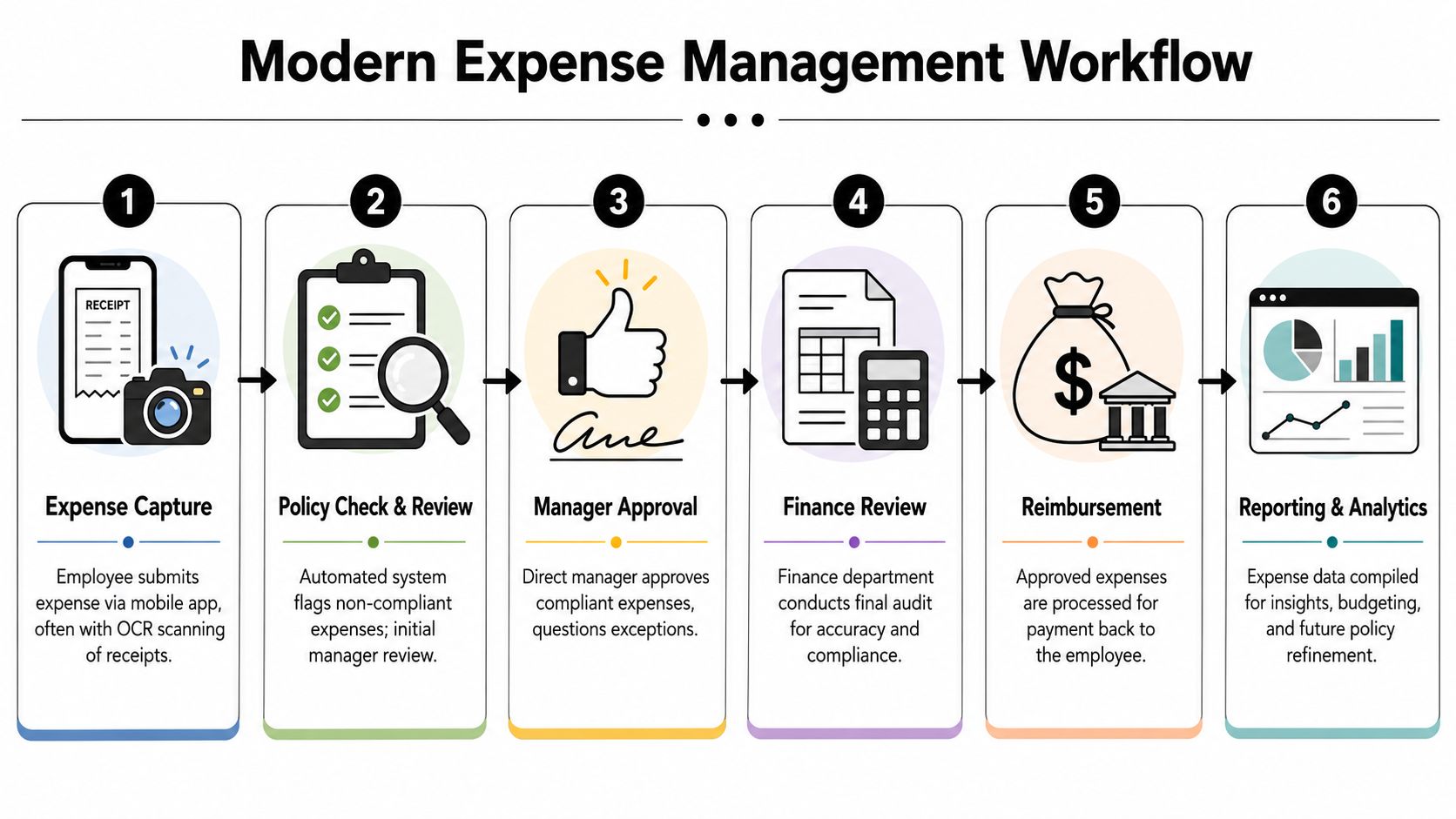
The workflow below is what finance teams should aim for. It doesn't require one specific platform, but it does require the booking tool, expense system, card feed, and approval chain to behave like one process.
Capture the expense at the moment it happens
A modern workflow starts with immediate capture. Travelers use a mobile expense app, a corporate card feed, or both. The system should pull in the transaction, prompt for receipt upload, and require a business-purpose note while the trip details are still fresh.
For assistants supporting executives, the same principle applies even when the traveler never touches the app. If the EA books the car, changes the hotel, and handles the air reissue, the file should still be assembled in real time. Waiting until month-end guarantees missing context.
Route the claim through the right review path
Not every expense needs the same approver. A routine dinner and a same-day multi-stop executive roadshow shouldn't enter the same queue with the same review logic.
Use a tiered review model:
- Traveler or delegate submission with receipt, coding, and purpose
- Manager or trip owner review for business necessity
- Finance review for policy compliance, coding, and exceptions
- Audit hold or follow-up for unusual items such as manual mileage, vague transport invoices, or mixed-purpose travel
Here's a useful explainer on the operational side of end-to-end corporate travel management solutions for approvals and spend visibility.
A short walkthrough helps illustrate how a digital flow should work in practice:
Build exception handling into the workflow
Automation is useful, but only if it knows when to stop and ask for judgment.
A solid workflow flags:
- duplicate-looking charges
- out-of-policy booking channels
- missing receipt images
- mileage claims without route support
- ground transport bills that show a total but no operational detail
Approval speed comes from better inputs, not from fewer controls.
The final step is reporting. Finance should review exception patterns, late submissions, frequent policy overrides, and recurring supplier issues. That's where the process improves. If the same problem keeps appearing, it isn't a traveler problem anymore. It's a workflow design problem.
Effective Cost Control Strategies for Corporate Travel
Most companies try to control business travel expenses by writing tighter reimbursement rules. That helps at the margins, but it won't solve the cost problem. The bigger gains come from how travel is sourced, booked, and managed before the expense hits the ledger.
That matters more now because trip-level cost pressure is real. Average per-trip business travel spending rose to $1,128, up from $834, which is a 35.3% increase, according to the U.S. Travel Association forecast and cited travel data. When each trip costs more, reactive policing becomes an expensive habit.
Why punitive controls underperform
Teams often respond to rising costs by lowering caps, denying edge-case expenses, or forcing employees to justify every deviation. That approach usually creates workarounds:
- travelers book outside approved channels
- assistants split bookings across suppliers
- approvers make one-off exceptions with no consistency
- finance spends more time disputing than managing
Those tactics may look disciplined, but they often increase the total cost of administration and reduce visibility.
What works better over time
Smarter control comes from program design.
Use vendor strategy where your volume is predictable. Preferred airlines, hotel groups, and ground suppliers make sense when they align with your most common routes and meeting cities. Centralize bookings for executive travel, roadshows, and group moves so someone with context can compare options before a costlier change becomes necessary.
A practical cost-control model usually includes:
| Lever | Why it works |
|---|---|
| Preferred vendors | Improves consistency, invoicing, and service recovery |
| Central travel desk | Reduces fragmented bookings and duplicate changes |
| Advance approval for high-cost items | Catches avoidable spend before ticketing |
| Clear exception routing | Prevents back-and-forth after the trip |
| Consolidated reporting | Shows where renegotiation is possible |
Cheap isn't the same as controlled. Controlled spend is visible, supportable, and aligned with business need.
For executive travel, that distinction matters. A lower headline fare or a cheaper car option can create downstream cost if it increases delays, no-shows, rescheduling, or manual cleanup. Long-term savings usually come from reducing friction, not just suppressing line items.
Managing Executive Ground Transportation Expenses
Ground transportation looks simple until it touches a C-suite itinerary. Then it becomes one of the most compliance-sensitive parts of the trip.
A taxi receipt with one pickup and one drop-off is easy. An executive car file can include airport meet-and-greet, FBO access, security coordination, wait time, route changes, multiple internal meetings, dinner service, and a late return. If the invoice only shows “car service,” finance has almost nothing to work with.

Why executive transport needs a different standard
Vehicle treatment is often formula-driven, not judgment-driven. CRA guidance for 2024 set business mileage reimbursement at 70 cents/km for the first 5,000 km and 64 cents/km thereafter, and IRS treatment relies on the federal mileage rate plus parking, ferry, and tolls, as summarized in this business travel expense guide covering mileage substantiation. The same guidance notes that receipts alone aren't sufficient. The amount, date, place, business purpose, and business relationship still need substantiation.
For executive ground transport, that means the invoice should do more than confirm payment. It should show the operational story of the trip.
What a defensible ground transport record includes
A clean file usually contains:
- Named service date and traveler or principal so the ride can be tied to a person and itinerary
- Pickup and drop-off locations for each leg, not just a city name
- Itemized wait time, tolls, parking, and extra stops rather than one bundled amount
- Business purpose or meeting reference when the route isn't self-evident
- Approver or booking source so finance knows who authorized the movement
This is especially important for roadshows, private aviation transfers, and itineraries where the principal never sees the paperwork. The EA and travel manager become the control point. If they don't require detailed invoicing, nobody downstream can reconstruct the trip accurately.
Choosing suppliers that support auditability
For high-touch programs, the supplier question isn't only about service. It's about documentation quality, centralized billing, and responsiveness when plans change. Some companies use a local patchwork of providers. Others move executive transport through a managed partner that can deliver consistent invoicing standards across cities.
One example is executive ground transportation support for multi-stop and VIP itineraries, where centralized coordination can reduce the usual gaps between booking, live trip changes, and post-trip billing.
If a supplier can't tell you exactly what happened on the ground, finance can't defend the charge later.
That's the dividing line. Standard travel spend is often about price and receipt collection. Executive ground transportation is about documented movement, controlled changes, and an invoice detailed enough to survive review.
Turning Travel Expenses into a Strategic Advantage
The companies that handle business travel expenses well don't rely on cleanup. They define categories clearly, build policies people can follow, capture evidence as the trip unfolds, and apply tighter standards where expenditures are most significant.
For EAs and finance leads, that changes the role completely. You're not just processing reimbursements. You're protecting compliance, reducing avoidable friction, and giving leadership the confidence to move quickly without creating expense risk afterward.
If your team manages executive itineraries with tight timing, multiple stops, airport coordination, or VIP handling, MLR Worldwide Service is one option for organizing the ground segment with centralized dispatch, detailed trip coordination, and billing that's easier for EAs and finance teams to reconcile.