
A board member lands late after a weather disruption. The driver assigned through a generic booking platform is circling the wrong terminal. The assistant is texting three people at once. Security is asking whether the pickup name matches the manifest. The next stop is a private dinner where arriving flustered is almost as damaging as arriving late.
That kind of failure usually gets blamed on “transportation,” but the car is rarely the actual problem. The weak point is the operation behind it. No one built a controlled handoff between air and ground. No one owned the backup plan. No one was monitoring the trip closely enough to adjust before the delay turned into a visible problem.
A real VIP transportation service is built for that moment. It treats the ride as the final link in a larger chain that includes timing, access, privacy, routing, and contingency management. The vehicle matters. The chauffeur matters more. The dispatch discipline behind both matters most.
Providers in this segment didn't grow out of a simple car-service model alone. The modern executive-chauffeur category expanded alongside private aviation and corporate roadshows, and it's still often understood through operator capacity more than a single registry. One concrete example is VIP Transport's logistics operation, which reports 150+ specialized fleet vehicles, GPS tracking, a 4.9/5 rating, and 40+ years of service. That kind of operating profile shows what the market has become: not a single ride, but a managed logistics network.
Introduction The Real Cost of Unreliable Travel
The expensive part of a failed transfer isn't the replacement car. It's the meeting that starts late, the principal who walks through the wrong public entrance, the investor who notices the disorganization, or the executive who loses an hour of preparation time managing chaos instead of focusing on the reason for travel.
In practice, unreliable ground transport creates three problems at once. It wastes time, increases exposure, and forces senior travelers to solve details they should never have to see. That's why experienced travel managers stop evaluating transportation as a commodity once the itinerary gets important enough.
Where ordinary service breaks down
A standard black car works when the trip is simple. One passenger. One address. Low consequence if timing drifts. The trouble starts when the movement has dependencies.
A busy airport pickup is a good example. A chauffeur may need to time curb access, coordinate meet-and-greet instructions, adjust for baggage delays, and keep the traveler moving without a visible pause. If any one of those handoffs is sloppy, the entire arrival feels exposed.
Practical rule: If a trip includes schedule pressure, public visibility, or multiple stakeholders, you're not buying a car. You're buying error prevention.
Why VIP service is an operational asset
The strongest providers think like logistics teams. They don't wait for a client to report a problem. They watch inputs, make decisions early, and protect the traveler's time by absorbing friction before it reaches the passenger.
That's the shift in mindset. Premium transport isn't valuable because the cabin is quieter or the leather is softer, though those things matter. It's valuable because the passenger can stay in executive mode from pickup to drop-off.
For boards, family offices, private aviation teams, executive assistants, and event planners, that changes the procurement question. The question isn't “what does the car cost?” It's “what's the cost of letting this trip fail?”
Beyond the Black Car What Is VIP Transportation
The easiest way to explain VIP transportation is to compare it to air travel. A standard ride is like booking a commercial seat for a simple route. A VIP transportation service is closer to a private charter with a managed flight plan. Both move you from one place to another. Only one is designed around control, flexibility, and consequence management.
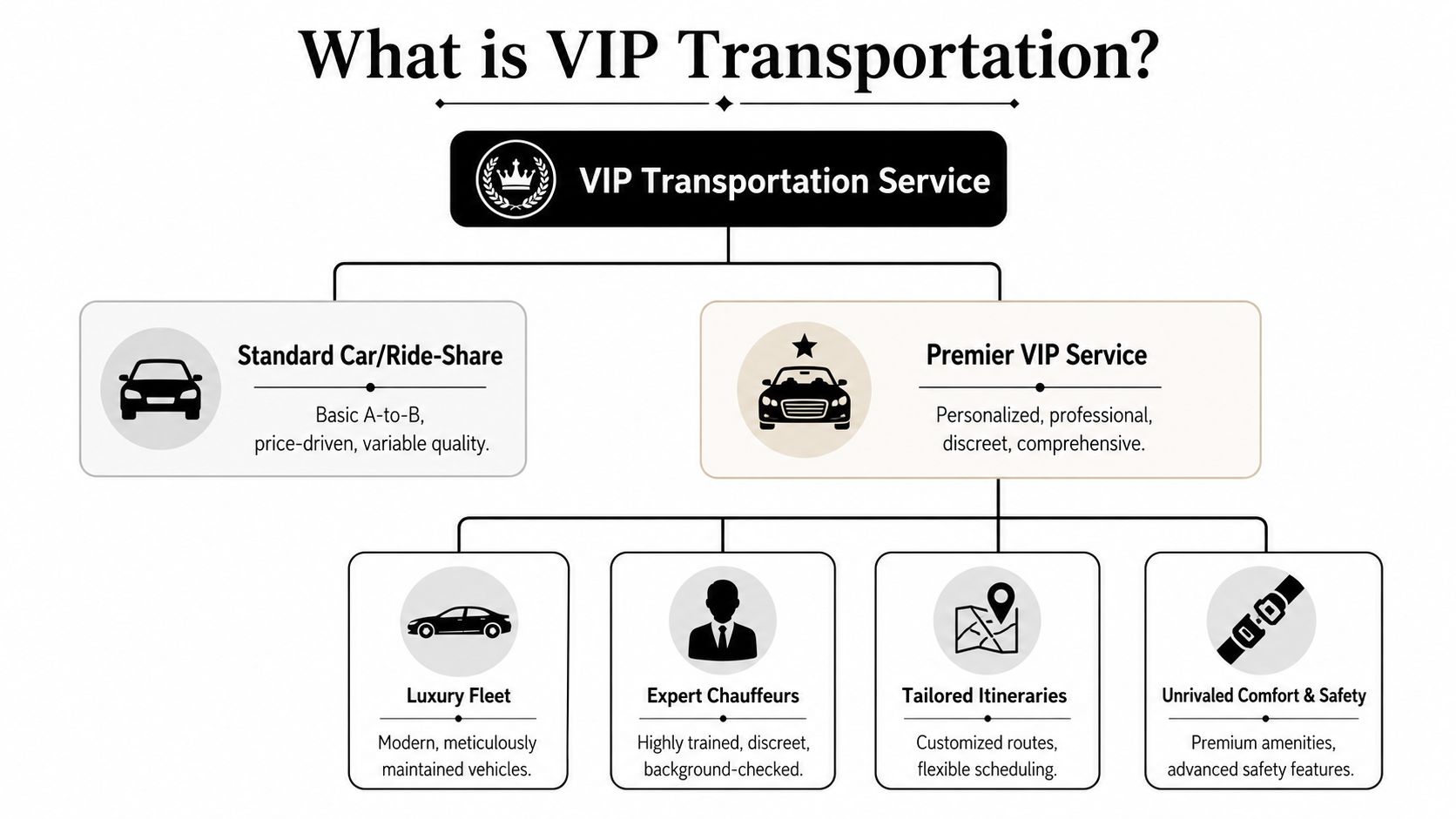
If you need a baseline definition of the broader category, this guide on what ground transportation includes is useful. VIP service sits at the top end of that category because the provider isn't just dispatching a vehicle. The provider is managing risk and continuity.
Three pillars that separate VIP service
Proactive logistics
Unlike most ordinary services, VIP transport starts before the wheels move. Dispatch reviews pickup points, route options, access restrictions, flight timing, and any likely choke points. If the principal is landing at an FBO, attending a conference, or moving through a high-traffic downtown corridor, the operation should already have a primary plan and a fallback.
That changes the feel of the trip. The client experiences a smooth arrival because the team did the hard work early.
Professional crew
A premium sedan with the wrong chauffeur is still the wrong service. The crew has to be vetted, punctual, composed, and able to read the room. Some clients want quiet. Others need help orchestrating a fast handoff with assistants, security personnel, or event staff. The chauffeur has to adapt without improvising sloppily.
This is one of the clearest differences between a managed service and app-based transport. In VIP work, the chauffeur is part driver, part host, part field operator.
Personalized execution
High-level travelers rarely run static schedules. Flights move. Meetings run long. Dinner locations change. Last-minute add-ons happen because business is happening in real time. VIP service accounts for that volatility without making the traveler feel like every adjustment is a favor.
Good VIP transportation is invisible when it works. The passenger shouldn't have to explain the same preference twice or ask whether the team saw the delay.
What clients are actually buying
A shorter comparison makes the distinction clear:
| Service type | Primary goal | Typical operating style | Weak point |
|---|---|---|---|
| Ride-share | Fast booking | Transactional, driver-based | Variable quality and control |
| Standard black car | Reliable transfer | Scheduled point-to-point service | Limited flexibility under pressure |
| VIP transportation service | Managed journey | Dispatch-led, detail-driven execution | Requires stronger provider discipline |
A lot of buyers focus first on the vehicle class. That's understandable, but it's not the deciding factor. The right purchase is a managed experience that keeps timing, privacy, and continuity under control even when the itinerary changes.
The Anatomy of an Elite Fleet and Crew
The visible part of VIP transportation starts with the vehicle, so that's where most buyers begin. It's a reasonable instinct. If the fleet looks tired, the operation behind it usually is too.
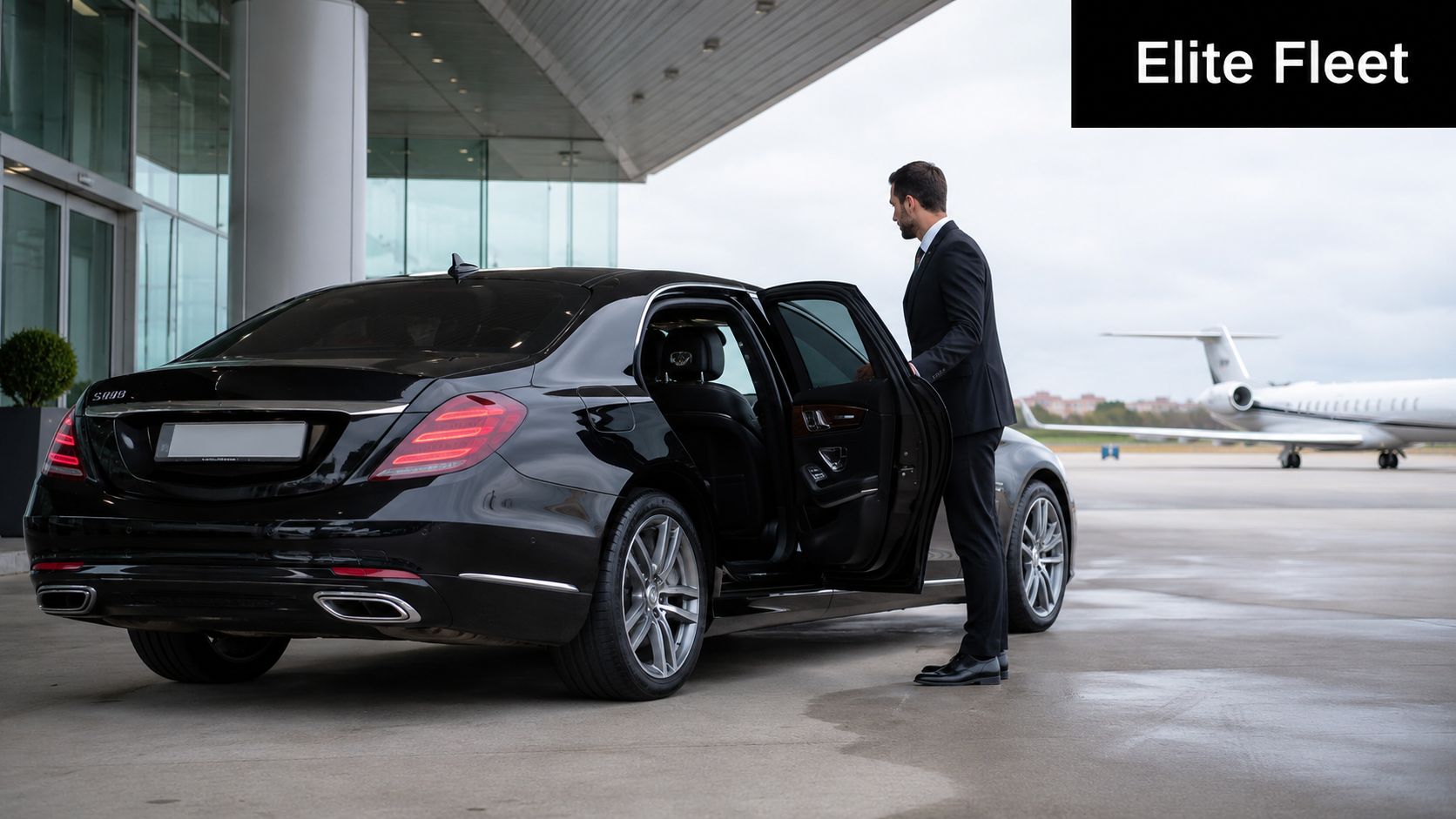
Still, the better test isn't whether a provider offers luxury sedans or premium SUVs. It's whether those vehicles are prepared the same way every time, regardless of city, weather, or booking volume.
What an elite fleet should prove
A premium fleet should be late-model, clean, mechanically disciplined, and configured for the actual use case. That last point matters. Airport transfers, roadshows, and executive group moves don't place the same demands on a vehicle.
The strongest operations support fleet readiness with software, not memory. According to industry commentary on the future of VIP transport, modern platforms use live traffic, weather, and security inputs for dynamic routing, while telematics trigger preventive maintenance alerts so vehicles stay available at peak performance. The practical takeaway is simple: better data improves ETA accuracy and lowers the risk of service failure on time-sensitive itineraries.
A provider that takes maintenance seriously should also be able to explain how those standards are enforced across the fleet. This overview of fleet maintenance best practices gives a good sense of the systems serious operators rely on.
What the cabin should deliver
The cabin doesn't need to feel theatrical. It needs to feel controlled. Executives notice the basics first.
- Clean presentation: No odors, no worn trim, no signs the vehicle just came off a previous job unprepared.
- Functional comfort: Strong climate control, charging access, and enough space for luggage, work materials, or security gear.
- Quiet consistency: The ride should allow calls, focus, or decompression without unnecessary interruption.
- Readiness for duration: Water, tissues, and other simple amenities matter more on a long or delay-prone day than decorative extras ever will.
The chauffeur is the service
A top vehicle can recover from traffic. It can't recover from a poor chauffeur. The person at the wheel controls punctuality, tone, and a surprising amount of perceived security.
What separates a professional chauffeur from a general driver isn't only technical skill. It's judgment. The best chauffeurs know when to speak, when to stay silent, where to stage without creating exposure, and how to adjust calmly when a client adds a stop with no notice.
Here's a quick visual look at the standard clients expect from the role:
The crew standards worth asking about
When vetting a provider, ask how chauffeurs are screened and trained. The answer should go beyond “experienced” or “professional.”
Look for evidence of these basics:
- Background vetting: A provider should be able to explain how chauffeurs are screened before assignment.
- Defensive driving discipline: VIP clients don't need aggressive driving. They need smooth, predictable control.
- Local operating knowledge: Airport procedures, venue access rules, hotel arrivals, and alternate routing all matter.
- Service composure: The ability to stay discreet and steady under pressure is part of the job, not a bonus.
The test is simple. If the vehicle signals quality but the chauffeur doesn't signal trust, the service isn't premium.
Security and Privacy Protocols for High-Profile Travel
For high-profile travel, privacy failures are usually process failures. The wrong pickup name gets spoken aloud. The chauffeur waits in a visible spot. A route change happens without verification. An itinerary gets shared too widely. None of that looks dramatic on paper, but each mistake increases exposure.
That's why the strongest VIP programs treat transportation as a security-sensitive workflow, not a hospitality add-on. Comfort matters. Risk control matters more.
Security starts before pickup
A secure movement begins with preparation. The provider should know who is traveling, who is authorized to receive trip details, where the pickup will happen, and what the arrival environment looks like. Busy airports, convention venues, hotels, and public event entrances all create different exposure points.
According to guidance on VIP transportation operations, top-tier service design must integrate identity control, access control, and route control into a single dispatch workflow. When those controls are connected, the provider can preserve punctuality while minimizing client visibility and transfer friction.
That one idea is more important than most buyers realize. If the dispatch team treats identity, access, and routing as separate tasks, handoffs break down. If the team manages them as one workflow, the client moves through the trip with less visibility and less confusion.
What practical privacy looks like
Privacy isn't just a non-disclosure clause tucked into a contract. It shows up in small, disciplined habits.
- Need-to-know itinerary handling: Trip details should stay limited to the people actively operating the movement.
- Controlled meet-and-greet procedures: Public signage, verbal confirmations, and curbside recognition all need to be handled thoughtfully.
- Secure communication channels: Dispatch, chauffeur, assistant, and security contacts should have a clear communication chain.
- Low-visibility staging: The right waiting location can reduce attention without compromising timing.
A secure transfer often looks ordinary from the outside. That's the point. The client moves smoothly because the operation removed unnecessary visibility.
Safety is operational, not cosmetic
Many firms market “safe luxury travel” as if the vehicle itself solves the issue. It doesn't. The safer system is the one that monitors the trip, confirms changes, and reacts early when conditions shift.
A useful reminder comes from the broader safety conversation around executive travel. As noted in this discussion of VIP and talent transportation, public-safety concerns around road travel remain real, and the strongest transport guidance increasingly emphasizes operational controls rather than premium vehicles alone. That aligns with what works in the field. Route awareness, chauffeur vetting, trip monitoring, and contingency planning do more for a client than polished trim ever will.
During-disruption discipline
Disruptions are where weak providers reveal themselves. Flight delays, public crowds, protests, venue lockups, weather, and last-minute schedule changes all happen. The question isn't whether a provider can promise a frictionless day. The question is how the provider contains disruption when the day stops cooperating.
A secure VIP operation should be able to do three things well:
| Risk moment | Weak response | Strong response |
|---|---|---|
| Flight delay | Waits for client update | Tracks and re-times vehicle assignment |
| Pickup change | Relays message loosely | Verifies identity and revises access instructions |
| Route issue | Leaves decision to chauffeur alone | Dispatch and chauffeur coordinate a controlled alternative |
For executives, family offices, and assistants managing sensitive travel, that's the core value. A serious provider protects schedule integrity and confidentiality at the same time.
Mastering Complex Itineraries and Global Reach
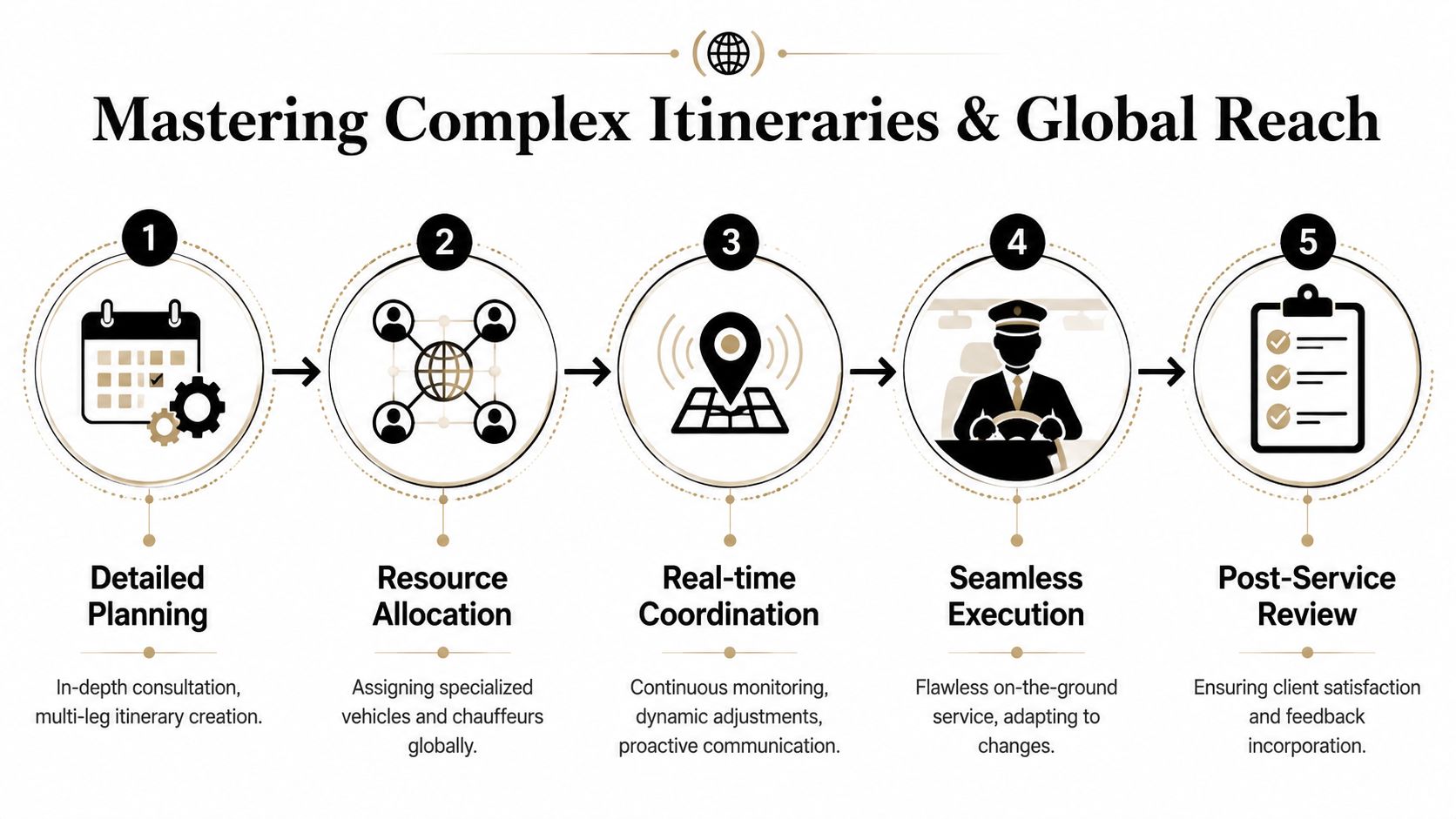
The hardest trips aren't airport transfers. They're the ones with dependencies stacked on top of dependencies. A roadshow across multiple cities. A leadership team arriving on separate flights. A private aviation itinerary that changes twice before noon. A conference where one vehicle delay can throw off an entire speaker schedule.
In those situations, a VIP transportation service functions more like an operations desk than a local car company.
A roadshow is the real test
Take a typical executive roadshow. The principal starts in New York for an early investor meeting, flies onward for a second set of appointments, then closes the day with a dinner where arrival timing affects more than optics. Along the way, flights shift, meetings overrun, and assistants revise pickup notes while the principal is already in motion.
For trips like that, this executive travel itinerary template is the kind of planning tool that helps align handoff points before the day starts. But the template alone isn't enough. The operation has to stay live after wheels-up.
What keeps a multi-stop program stable
The visible service may look simple. Underneath it, a reliable provider is constantly making small corrections.
According to industry guidance on premier transportation for complex movements, the value in roadshows and multi-stop itineraries is how dispatch handles flight delays, builds in buffer times, and uses a global affiliate network to reduce failure points across cities such as New York, London, and Dubai.
That matches operational reality. A single city team can be excellent and still fail in a cross-border program if its affiliate network is weak, inconsistent, or poorly supervised.
Why global affiliate quality matters
A global network isn't valuable because it's global. It's valuable only if service standards travel with the booking. Otherwise, every city becomes a new gamble.
Here's what experienced travel managers should look for in a networked program:
- Standardized briefing: Every affiliate should receive the same service notes, access instructions, and client preferences.
- Clear escalation path: If something shifts in one city, there must be one accountable operations channel.
- Consistent chauffeur profile: Clients shouldn't feel like service quality resets at each border.
- Local expertise with central oversight: The local team handles local realities, but the lead operator keeps the whole itinerary coherent.
Complex travel fails at the seams. The best providers pay obsessive attention to handoffs between city, airport, venue, and team.
The role of a 24/7 operations desk
For single-point trips, after-hours support sounds like a nice extra. For international itineraries, it's absolutely essential. Someone has to monitor flight activity, absorb time-zone changes, confirm revised arrival windows, and communicate cleanly with chauffeurs and coordinators who are not all working in the same market.
That's where a provider such as MLR Worldwide Service fits in. The company offers executive chauffeur services, airport and FBO transfers, roadshow support, event logistics, and global affiliate coordination across major business hubs. The important point isn't the service menu. It's the operating model behind it: one team managing continuity across multiple moving parts.
When buyers evaluate providers for global work, they should think less about “coverage” and more about control. Coverage tells you where a booking can be placed. Control tells you whether the itinerary will hold together.
How to Choose Your VIP Transportation Partner
The selection mistake most buyers make is choosing with the eye instead of the checklist. They look at the fleet gallery, compare vehicle classes, and assume the rest of the operation will be solid. Sometimes it is. Often it isn't.
The better approach is due diligence. Treat the provider the way you'd treat any business-critical partner that touches executive time, privacy, and schedule integrity.
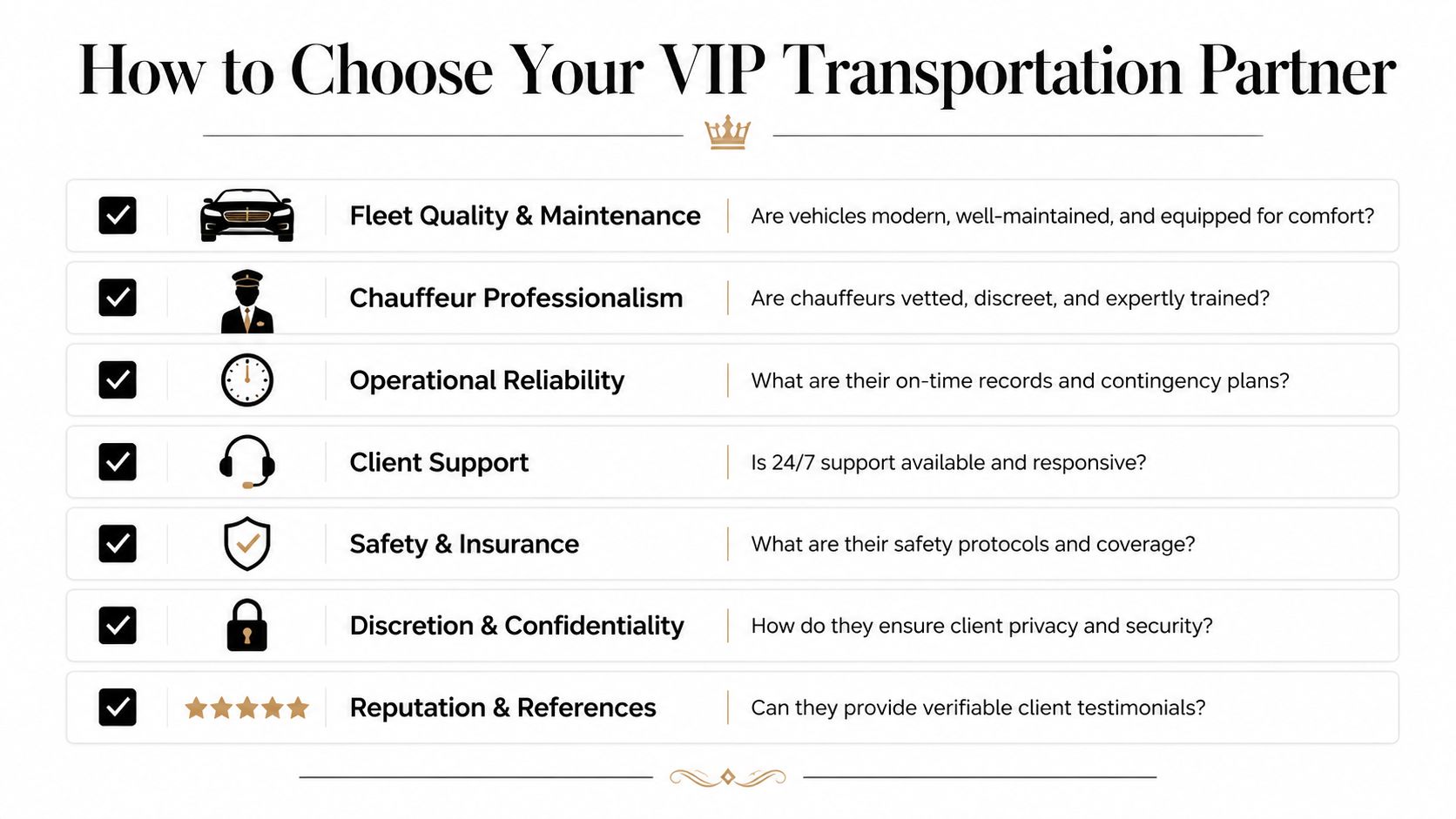
The questions that reveal the operation
Ask direct questions, and listen for operational answers rather than polished sales language.
- How do you vet chauffeurs and affiliates? You want a process, not adjectives.
- Who monitors active trips? If there's no clear operations function, the service depends too heavily on individual chauffeurs.
- How do you handle flight delays and last-minute changes? Good providers already have a workflow.
- What happens if a vehicle or chauffeur becomes unavailable? Contingency planning should be immediate and specific.
- How are client preferences stored and applied? Repetition is a sign the service isn't really managed.
- How do you protect itinerary confidentiality? Privacy should be procedural, not just promised.
- Can you show the booking and tracking platform? Visibility matters, especially for assistants and travel managers.
Cost should be evaluated correctly
VIP service costs more because the provider is holding capacity, managing volatility, and taking on more operational responsibility. That's not a branding premium. It's the cost of readiness.
In one major-market guide focused on New York City, VIP transportation pricing is described as 50–100% more than standard executive transportation. The same guide lists typical rates of $150–200/hour for a luxury sedan, $175–250/hour for an Escalade-class SUV, $225–300/hour for an executive van, and $350–500/hour for a Mercedes-Maybach S580. It also notes that security-coordinated movements can reach $500–1,500/hour, and that many high-profile clients spend $25,000–75,000 per month on VIP ground transportation.
Those figures shouldn't be read as universal pricing for every market. They are useful because they show the structure of the value. The client isn't paying only for metal, upholstery, and fuel. The client is paying for flexibility, privacy, standby capacity, and reduced failure risk.
A simple decision filter
If you need a fast way to screen options, use this table:
| If the provider says | What it usually means |
|---|---|
| “We have luxury vehicles” | Fleet quality may be good, but operations are still unknown |
| “We can handle anything” | Ask for the actual escalation process |
| “Our drivers are experienced” | Ask how they're vetted, briefed, and monitored |
| “We offer global service” | Ask how affiliates are selected and supervised |
The right partner should make you feel more informed as the conversation continues, not less.
Conclusion The True Value of Seamless Journeys
A genuine VIP transportation service doesn't sell a nicer ride. It protects time, attention, and discretion through disciplined execution. The fleet supports that promise. The chauffeur delivers it in person. Dispatch, routing, trip monitoring, and contingency planning are what make the promise credible.
That's why the strongest providers feel calm even when the traveler's day isn't. They've already built the process for delays, access changes, public pickups, multi-stop schedules, and cross-city handoffs. The passenger sees a smooth trip because the team behind the scenes has already absorbed the mess.
For executives and high-profile travelers, that difference is material. A well-run journey creates space to prepare, work, think, or arrive composed. A poorly run one steals energy before the meeting even begins.
Value, then, isn't luxury by itself. It's operational confidence. When transportation is handled at the right level, senior travelers don't spend their day managing movement. They spend it doing the work they traveled to do.
If your team needs a transportation partner that can support executive travel, airport and FBO pickups, roadshows, and coordinated VIP movements across major global markets, MLR Worldwide Service is one option to review. Evaluate it the same way you'd evaluate any serious operator: by the quality of its fleet discipline, chauffeur standards, dispatch control, and ability to protect your travelers' time and privacy.