

If you're arranging transportation for a CEO, board member, investor, or private aviation guest in Birmingham, you don't need a nice car. You need a no-fail operation.
The usual scenario is familiar. A principal lands with a compressed schedule, a dinner that can't start late, a site visit across town, and at least one call that has to happen in the car. If the driver misses the pickup point, doesn't understand airport flow, or shows up in a vehicle that looks polished online but tired in person, you've already lost time and trust.
That matters even more in a crowded market. The Limousine & Town Car Services industry in the United States grew at a 11.1% CAGR between 2021 and 2026 and is projected to reach $11.6 billion in 2026, according to IBISWorld's Limousine & Town Car Services industry profile. Growth is good for customer choice. It also creates noise. More listings don't mean more competence.
In Birmingham, that distinction matters. Some operators understand executive transport as logistics, risk control, and discretion. Others treat it like dressed-up rideshare. Those aren't the same service.
A proper Luxury Car Service Birmingham AL booking should protect three things above all else:
- Time: no confusion on pickup instructions, no dispatch gaps, no casual approach to schedule changes.
- Reputation: the vehicle, chauffeur, and communication style should reflect the caliber of the traveler.
- Continuity: if a meeting runs long, a flight moves, or a route changes, the service should adapt without drama.
If you're managing this category regularly, it's worth grounding your expectations in what ground transportation actually includes in a professional travel program. Executive transport isn't just a car reservation. It's part of the trip architecture.
Your Guide to Executive Travel in Birmingham
A Birmingham trip can unravel in small ways before anyone calls it a problem. The traveler exits the terminal and the chauffeur is parked in the wrong place. The sedan is fine, but not quiet enough for a call. The dinner transfer works, but the next morning's airport run is handled by a different driver with no context. None of that sounds dramatic. All of it creates friction.
That's why I tell assistants and travel managers to evaluate Birmingham ground transportation the same way they evaluate air, lodging, and security. Treat it as an operational decision.
What a high-stakes arrival actually requires
An executive itinerary usually has very little slack. The principal may need to go from airport to office, then to a client dinner, then back to hotel, all while keeping calls, documents, and timing intact. In that environment, a luxury car service isn't a hospitality extra. It's working infrastructure.
A serious provider should already think in terms of:
- Schedule compression: building around meetings that run long or move early
- Communication control: clear pre-trip instructions and direct updates
- Discretion: no overfamiliar behavior, no unnecessary conversation, no loose handling of names or destinations
- Local fluency: knowing Birmingham traffic patterns, venue access points, and pickup procedures
Practical rule: Book for the itinerary you actually have, not the simple version of it shown on a calendar invite.
The market itself is expanding, which makes discernment more important, not less. The U.S. sector's projected $11.6 billion size and 11.1% CAGR through 2026, as cited earlier from IBISWorld, signal sustained demand for premium reserved transportation. That demand brings in polished marketing. It doesn't guarantee execution.
Birmingham isn't short on options. It is short on transparency.
Birmingham now has newer luxury offerings in market, including LAMP, which launched on June 30, 2025 with two fully loaded 2025 Yukon Denali XL SUVs and positioned its service around white-glove chauffeur support and effortless online booking, according to the launch announcement covered by PR Newswire. That tells you something useful. Local demand is real, and customer expectations are moving upward.
What it doesn't tell you is whether a given provider can support a private aviation transfer, handle a multi-stop executive day, or document its chauffeur vetting. Those are the questions that separate a safe booking from an expensive guess.
Matching the Service to Your Itinerary
Most booking mistakes happen before the ride starts. Someone picks a vehicle based on appearance instead of use case. That's backwards. Start with the itinerary, the passenger profile, the amount of luggage, and whether work has to happen en route.
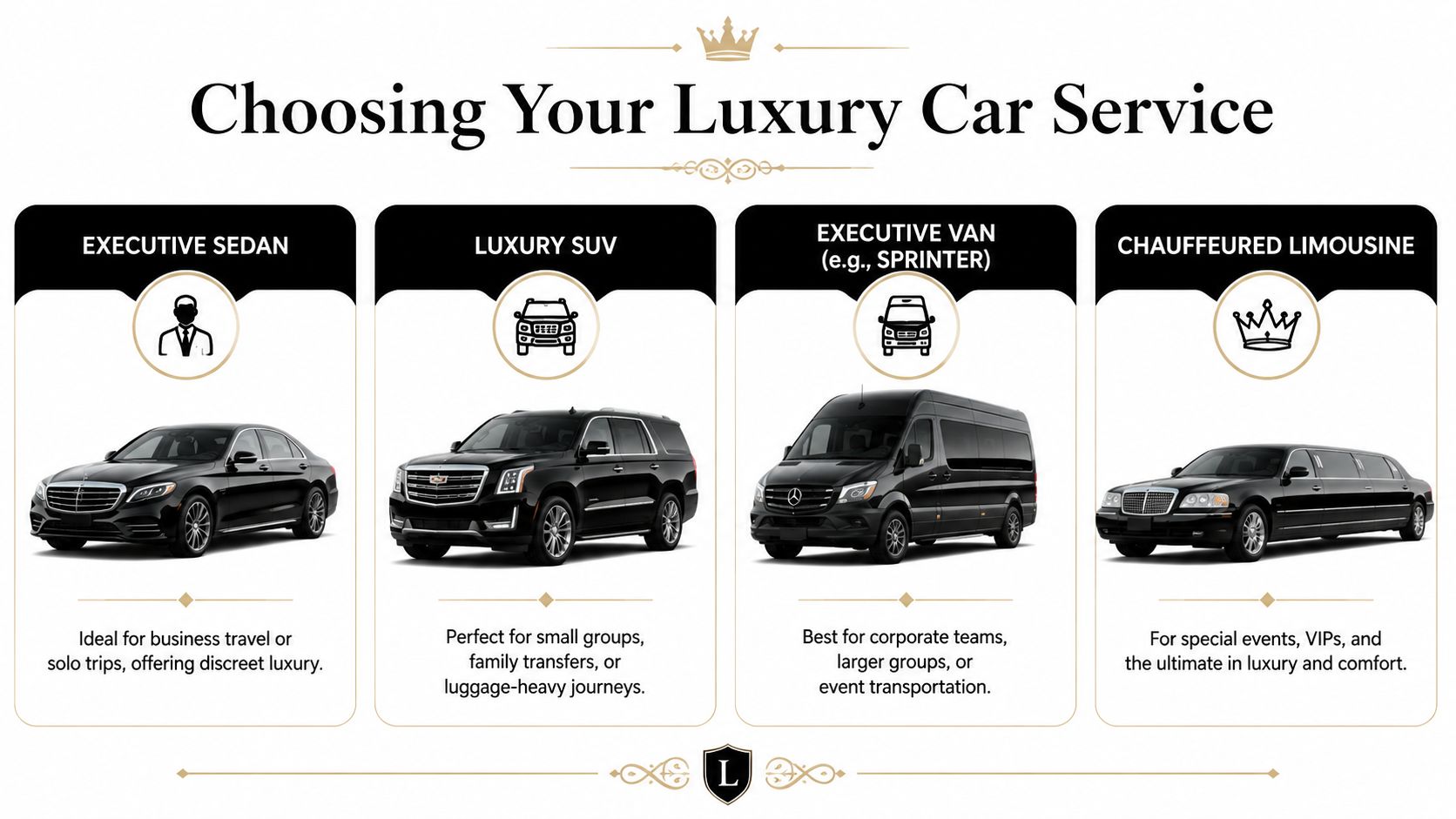
Choose by mission, not by marketing label
Here's the simplest way to think about vehicle selection in Birmingham.
| Service type | Best fit | Watch for |
|---|---|---|
| Executive sedan | One traveler, business calls, discreet hotel and office transfers | Tight luggage capacity, less flexibility for security or extra staff |
| Luxury SUV | Executive plus assistant, small family office party, airport transfers with substantial bags | Easier to overbook if multiple carry-ons and event materials are involved |
| Executive van | Corporate teams, roadshows, event transport, airport group coordination | Make sure service standards match the vehicle size, not just capacity |
| Chauffeured limousine | Ceremonial arrivals, entertainment, formal VIP presentation | Often unnecessary for serious corporate schedules |
A solo executive heading from BHM to downtown meetings usually doesn't need excess vehicle. A clean executive sedan often handles that assignment well, especially when privacy and efficient ingress matter more than visual presence.
A principal traveling with security support, multiple bags, or family office companions usually belongs in a luxury SUV. The extra space isn't indulgence. It's operational flexibility.
The right vehicle changes with the day
If the schedule includes multiple stops, gifts, presentation materials, or wardrobe changes, don't force the booking into the smallest vehicle that technically works. Tight capacity turns routine transfers into avoidable hassle.
Consider the assignment this way:
- Mobile office need: Pick a sedan or premium SUV with a quiet cabin and disciplined chauffeur service.
- Small-group movement: Use an SUV when you need room without drawing too much attention.
- Roadshow or team arrival: Reserve an executive van so the group arrives together and the coordinator isn't juggling several cars.
- High-visibility event: Use a limousine only when presentation is an integral part of the requirement.
A good travel manager doesn't ask, "What looks nicest?" They ask, "What reduces friction for this exact day?"
Avoid two common booking errors
The first is underbooking. People assume Birmingham is manageable, then forget luggage, venue access, weather, or the fact that one extra rider changes the entire comfort equation.
The second is overbooking for optics. Not every executive wants a statement vehicle. Many want speed, calm, and a chauffeur who knows when to stay quiet.
If you need broader context on how premium reserved transport is structured, this overview of luxury private car service is a useful baseline. The key is simple. Match the service to the work.
The Unseen Hallmarks of a True Luxury Experience
People obsess over badges, trim packages, and exterior photos. That's not where real quality shows up.
A true executive-grade ride is defined by what the passenger notices less. Less noise. Less vibration. Less explanation. Less uncertainty. The best trips feel uneventful because someone else has already handled the details.
Quiet is not cosmetic
In this category, cabin calm is a performance standard. The technical benchmark for luxury is an interior Noise, Vibration, and Harshness profile below 45 decibels at highway speeds, and maintaining that threshold has been associated with an approximately 18% reduction in client cortisol during transit, according to LAMP's published standard for luxury travel environment.
That matters if your traveler is reviewing board notes, taking a confidential call, or trying to arrive composed rather than overstimulated.
A noisy vehicle does three things badly:
- It degrades concentration
- It forces calls to become public
- It makes a short transfer feel longer
The chauffeur is part of the product
Luxury isn't leather alone. It's behavior.
The right chauffeur reads the situation quickly. They know when the client wants silence, when they need route confirmation, and when a subtle heads-up about timing is useful. They don't turn the trip into a personality exercise.
Here are the tells I watch for:
- Arrival discipline: the driver is staged correctly, early, and easy to identify
- Professional boundaries: polished greeting, minimal chatter, no unnecessary personal commentary
- Route confidence: familiarity with hotels, office towers, restaurants, private entrances, and event loading zones
- Adaptive judgment: if the principal changes plans, the chauffeur doesn't sound surprised
Operational test: If the service talks mostly about the vehicle and barely mentions how chauffeurs are trained, you're probably paying for appearance over execution.
Seamless booking matters because confusion compounds
A premium service should also feel orderly before the car arrives. Confirmation details should be clear. Chauffeur contact should be available when appropriate. Changes shouldn't trigger a string of avoidable phone calls.
That standard is especially important when the booking supports an executive assistant's credibility. If you have to keep chasing updates, the process is already failing.
Seamless Airport and Private FBO Transfers
Most Birmingham guides fall short, discussing airport transfers as if every traveler is arriving through the same process. They aren't.
A commercial terminal pickup at BHM and a private aviation pickup through an FBO are different assignments. Different access patterns. Different communication needs. Different tolerance for mistakes.
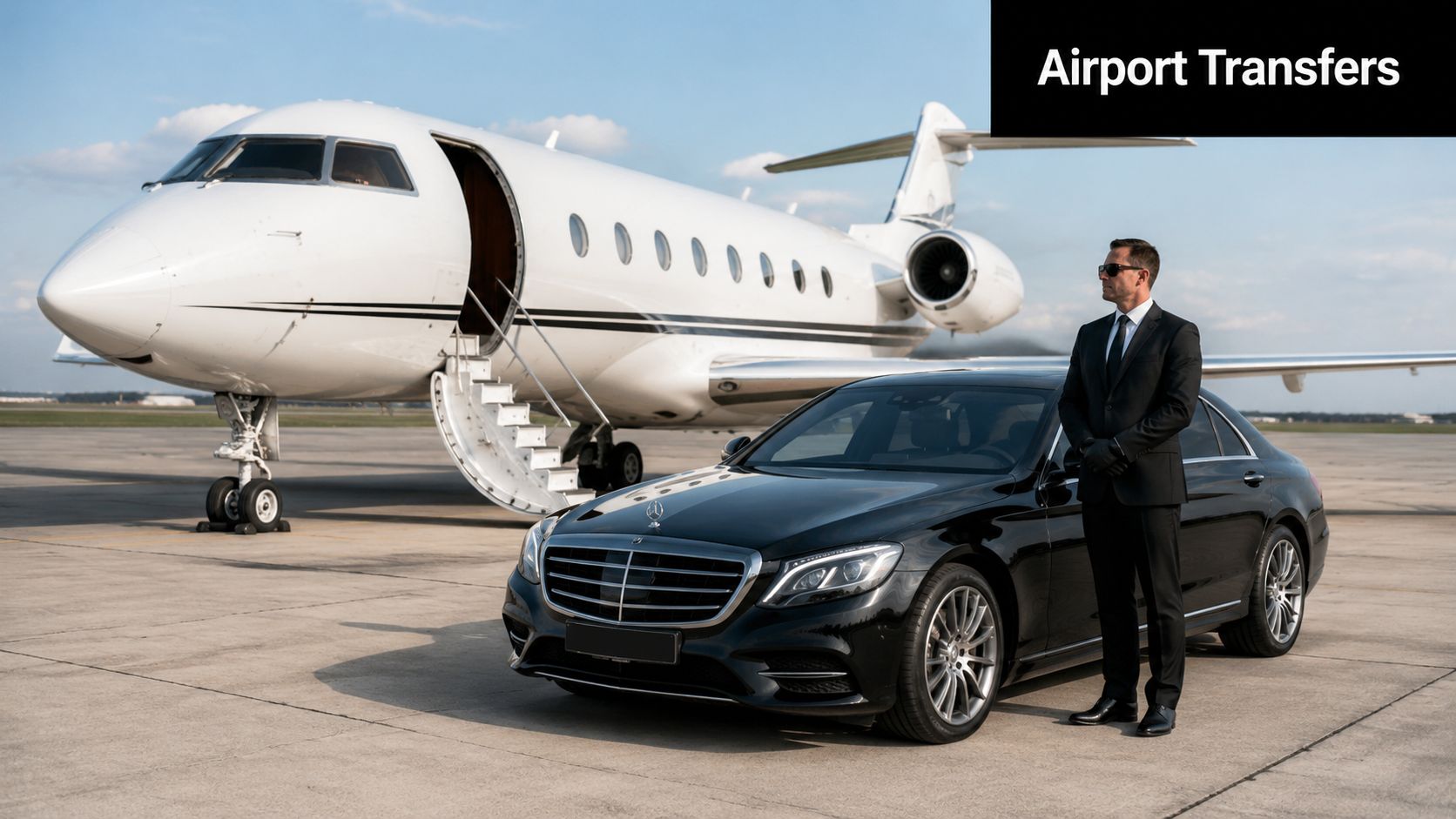
FBO coordination is not an add-on
Private flight activity in the Southeast increased by 18% over the last 12 months, yet less than 5% of Birmingham-based luxury car service listings mention FBO support or air-ground synchronization, leaving a clear service gap for private aviation travelers who need precision coordination. That's the opening many local providers still ignore.
If you're booking for a private aviation client, don't accept "we do airport transfers" as a sufficient answer. That's vague and usually means commercial terminal experience, not true FBO workflow.
A proper FBO transfer should account for:
- Real-time flight tracking
- Communication with the FBO desk
- Accurate tail or trip reference handling when required
- Secure, precise pickup instructions
- Immediate adjustment for early arrivals or delays
Standard airport habits create private aviation failures
Commercial-terminal operators often rely on fixed assumptions. Meet at baggage claim. Wait by a designated pillar. Call when you land. None of that reflects how private aviation clients move.
An FBO traveler may deplane quickly, clear directly to vehicle access depending on local permissions, and expect the chauffeur team to already know where the aircraft is parking and when wheels are down. Delay that handoff and you've exposed the principal to unnecessary waiting and unnecessary visibility.
If a provider can't explain its FBO communication process in plain language, don't use it for private aviation work.
Ask these questions before you confirm
Use this screening list when you're booking a Birmingham luxury car service for a jet traveler:
- Do you track the flight directly or rely on the passenger to text updates?
- Who communicates with the FBO if arrival timing changes?
- How do you handle early arrivals, diversions, or short-notice departures?
- What is the pickup procedure for VIP travelers who need minimal exposure?
- Can dispatch support the trip in real time if the air itinerary shifts?
For coordinators moving travelers through the airport ecosystem more broadly, Gateway Travel Centre is a useful reference point for how integrated travel support should function. The principle is the same in Birmingham. Ground service has to sync with the aircraft, not merely wait near an airport.
Booking Workflows for Corporate Accounts
If your team books executive cars one trip at a time with no account structure, you're creating extra work and losing control. Corporate ground transportation should run through a repeatable workflow.
That's not bureaucracy. It's how you stop billing confusion, missed preferences, and duplicate effort.
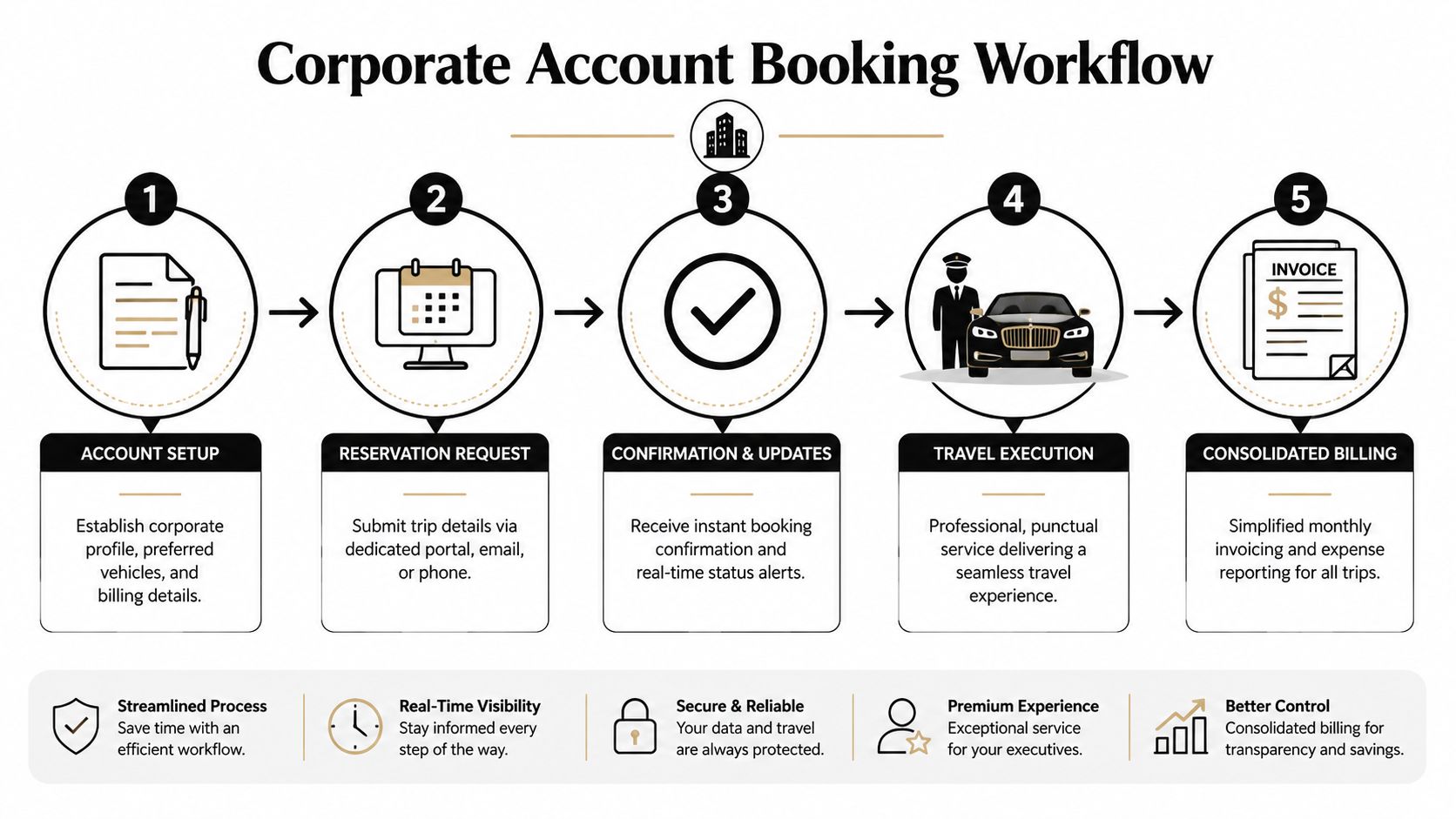
What a workable account setup looks like
A proper corporate account should capture the details your team shouldn't have to restate every time. That includes traveler preferences, billing instructions, authorized bookers, common routes, and escalation contacts.
Set it up with these priorities first:
- Billing clarity: one approved invoicing structure, not ad hoc receipts from multiple trips
- Traveler profiles: names, preferences, and recurring service notes stored accurately
- Booking authority: clear rules on who can reserve, edit, and approve
- Exception handling: a direct path for urgent changes, after-hours calls, and same-day revisions
If a provider only offers a generic reservation form and a customer service inbox, that may be enough for occasional personal transport. It isn't enough for executive operations.
The five-step process I recommend
Keep the booking process simple and auditable.
Open the account properly.
Confirm company details, billing contacts, payment terms, and key traveler profiles.Standardize request intake.
Have assistants or coordinators submit complete trip details every time, including flight data, luggage notes, and special handling requirements.Require written confirmations.
Every reservation should produce a clean record with service date, pickup time, location, vehicle type, and amendment trail.Track live execution.
The service should be reachable during the trip, not just before it.Review billing in batches.
Consolidated invoicing saves time and reduces disputes.
What to look for in a provider's workflow
The strongest providers make recurring bookings easier with account-level memory. That means your principal doesn't get a random experience every time.
One factual example in this space is MLR Worldwide Service, which provides executive chauffeur services, airport transfers and FBO support, roadshow and event logistics, and corporate reservation capabilities for scheduled ground transportation. That's the kind of service scope corporate buyers should compare when evaluating providers.
Good workflows protect the assistant as much as the traveler. Clear records make it easy to verify what was booked, what changed, and what was delivered.
Vetting Your Service for Safety and Professionalism
This is the part too many buyers skip because the website looks polished. That's a mistake.
A clean SUV and a smooth booking page don't tell you how drivers are screened, how vehicles are maintained, or whether anyone can help when plans break. In high-stakes travel, those details matter more than branding.
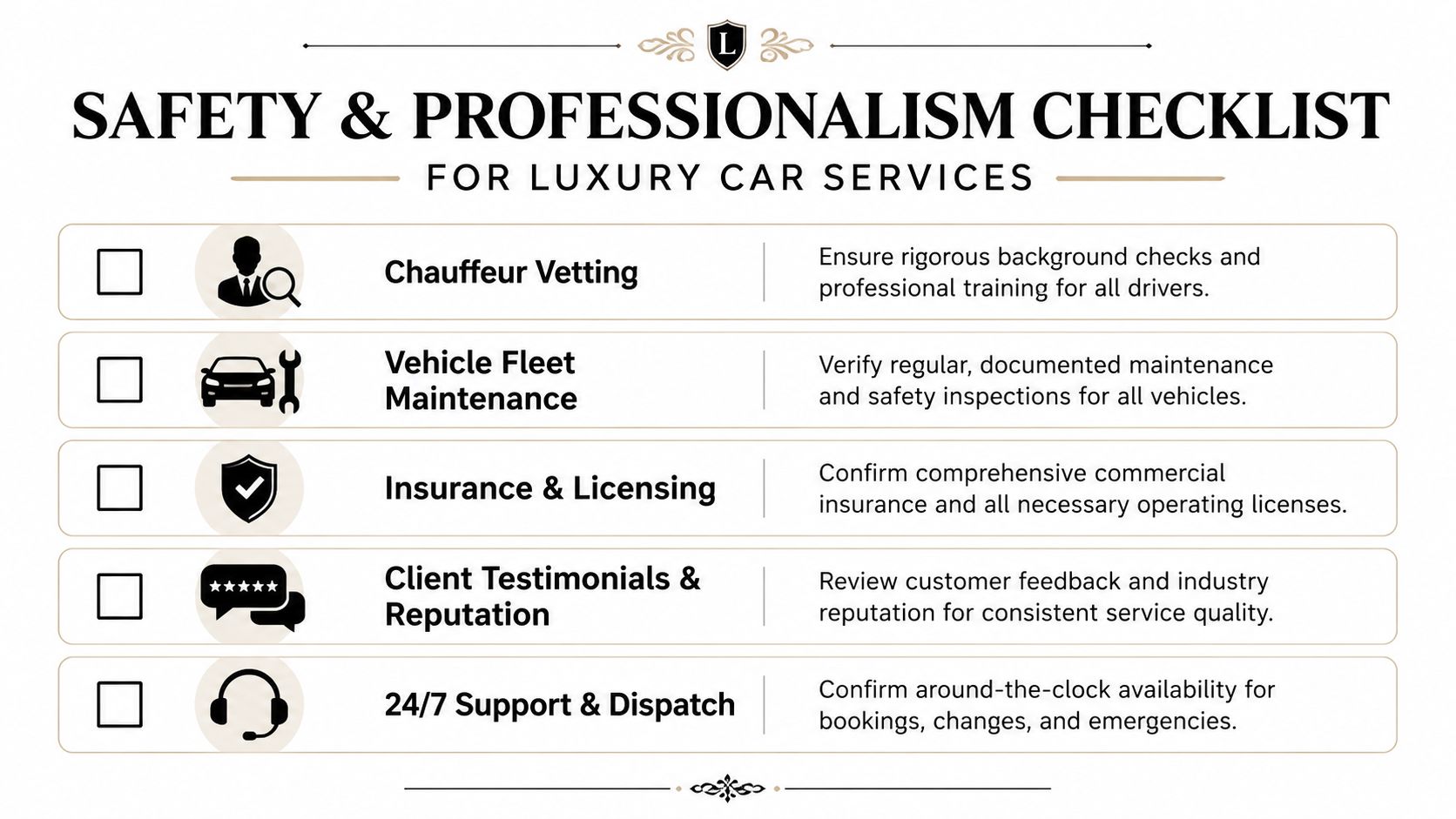
The market has a credibility gap
A 2025 Corporate Transportation Safety Audit found that 42% of corporate travel managers consider driver vetting and insurance transparency the top decision factor, yet only 12% of Birmingham luxury car service providers explicitly detail these protocols on their websites. That mismatch should change how you shop.
Assume nothing. Ask for specifics.
The due diligence questions that matter
Use these questions before you approve any new provider:
- Chauffeur vetting: What background checks are performed, and are they multi-state when relevant?
- Driving record review: How often are motor vehicle records reviewed?
- Training: What safety or service training do chauffeurs complete before handling executive clients?
- Insurance transparency: Will the company explain its commercial coverage clearly and provide documentation when appropriate?
- Fleet maintenance: How is maintenance tracked, and who takes a vehicle out of service?
- Dispatch availability: Is there live support after hours, or only a voicemail system?
A serious operator should answer those questions directly. If the response is vague, defensive, or overly sales-oriented, move on.
Reliability is operational, not cosmetic
Vehicle reliability also deserves scrutiny. In the executive transport sector, one benchmark used for fleet reliability is Mean Time Between Failures, with late-model vehicles in the 2025 to 2026 generation targeted to maintain a failure rate below 0.5% per 10,000 miles and some fleets using vehicles such as the 2025 Yukon Denali XL citing 45,000 miles MTBF, according to the market-specific benchmark summarized by Bham Now's coverage of Birmingham's new luxury transportation launch.
You don't need to become a mechanic to use that information. You just need to ask whether the company runs late-model vehicles, documents preventive maintenance, and has a backup plan if a vehicle is sidelined.
The right answer to "What happens if the assigned vehicle has an issue?" should never be silence.
Reputation still matters, but it comes last
Reviews are useful. They're not enough. Read them after you've checked operational fundamentals.
A trustworthy Luxury Car Service Birmingham AL provider should be able to demonstrate professionalism in three ways: documented process, disciplined communication, and verifiable standards. If you only evaluate aesthetics, you're not vetting risk. You're shopping decor.
Frequently Asked Questions
How is pricing usually structured for luxury car service in Birmingham
Most providers use some combination of point-to-point pricing, hourly service, and extended charter or day-rate structures. The right model depends on the trip shape.
For a single transfer, point-to-point usually makes sense. For a meeting day with uncertain end times, multiple stops, or standby needs, hourly booking is usually cleaner. If the itinerary spans a long business day or includes repeated movements, ask for the structure that best fits that operating pattern rather than trying to force separate one-off trips.
What should I do if the itinerary may change
Tell the provider up front that the schedule is fluid. That's not a minor note. It's core booking information.
Give them the meeting framework, not just the first pickup. If the traveler is flying privately or may leave early, confirm who monitors updates and who has authority to amend the reservation. Services built for executive work should handle schedule movement without turning every change into a problem.
Can I request the same chauffeur again
Usually, yes, when availability allows. For repeat principals, that can be valuable.
A returning chauffeur may already understand preferred routes, communication style, luggage handling, and pace. Just don't treat that as guaranteed. Good providers try to preserve continuity, but they should never promise a specific chauffeur unless they can indeed deliver.
How far in advance should I book
Book as early as the schedule allows, especially for major events, group moves, or high-demand periods. That said, the better test isn't whether a company can accept a reservation. It's whether they can support the complexity of the trip.
For airport and FBO work, earlier booking gives more time to lock in details and reduce avoidable confusion.
Can these services handle multi-day or out-of-state travel
Many can, but you need to confirm operating scope, chauffeur hours, vehicle assignment continuity, and billing terms before you assume anything. Multi-day work introduces fatigue, repositioning, overnight logistics, and schedule protection issues.
Ask how the company staffs those trips. A provider that's excellent for a local dinner transfer may not be structured for a regional executive itinerary.
What's the single biggest mistake buyers make
They assume luxury equals professionalism. It doesn't.
The vehicle matters, but the decisive factors are coordination, safety transparency, chauffeur discipline, and the provider's ability to adapt in real time. That's what protects the traveler and the person who booked the trip.
When the itinerary carries real consequences, book a provider that can support executive schedules, private aviation coordination, and corporate account workflows without guesswork. MLR Worldwide Service offers executive chauffeur service, airport and FBO transfers, group and event logistics, and 24/7 coordination for travelers who need disciplined ground transportation in Birmingham and beyond.