
Event logistics is the strategic coordination of the physical, operational, and resource elements that turn an event concept into a smooth attendee experience. For large-scale events, that work should begin 12 to 18 months in advance, and that lead time matters because 38% of event organizers regularly encounter technical problems that early, disciplined planning can often prevent.
If you're reading this while juggling venue calls, executive arrivals, hotel rooming lists, and a keynote that can't start late, you're already in the middle of logistics. The pressure usually doesn't come from the obvious items. It comes from the hidden dependencies. A delayed credential print run affects security access. A late SUV at the FBO disrupts the speaker briefing. One unconfirmed loading dock window can throw off staging, floral, and AV in a single morning.
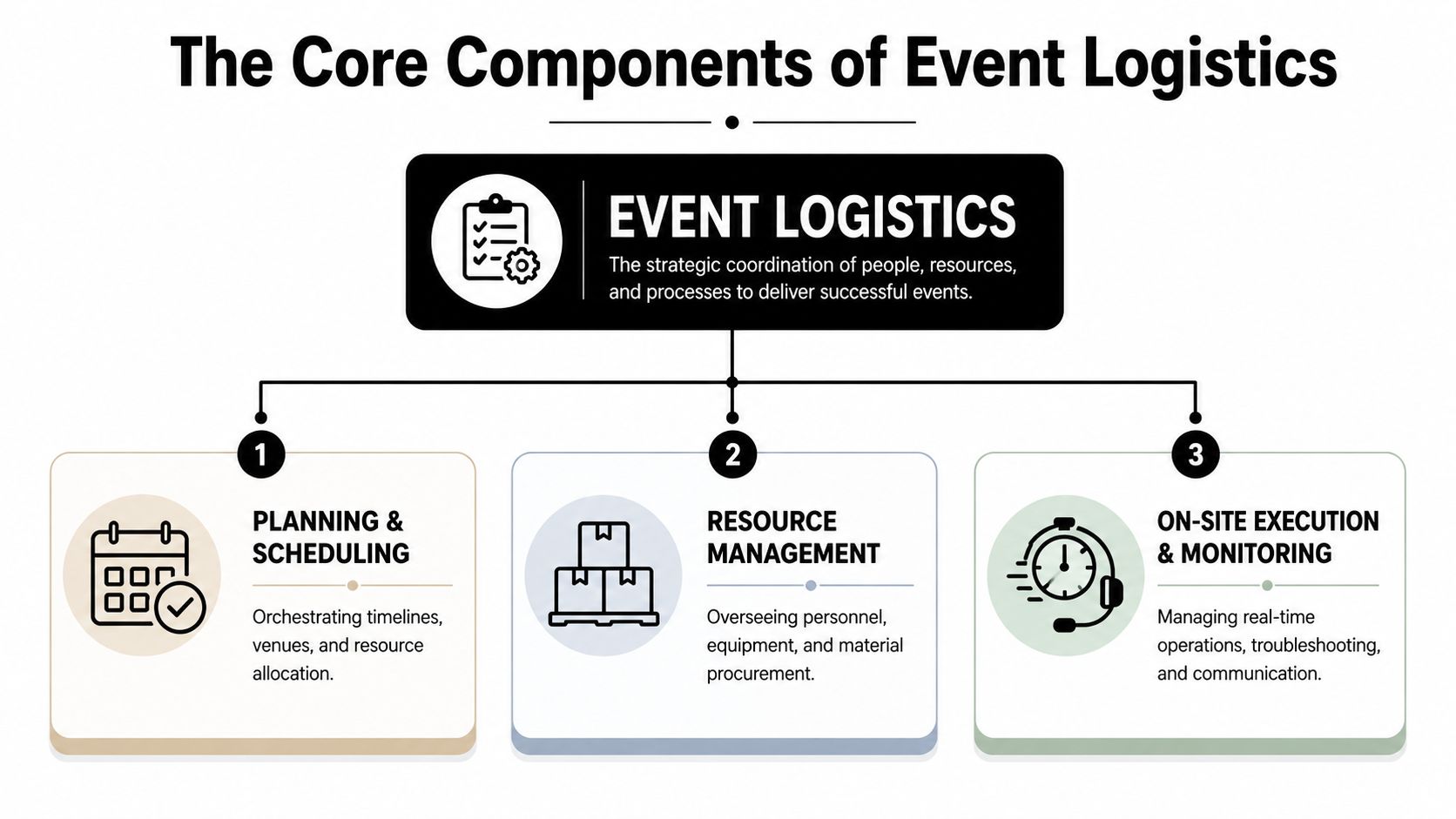
That is why what is logistics in event planning isn't a basic question. It's an operational one. Event logistics is the strategic coordination of all physical, operational, and resource elements that transform an event concept into a smooth attendee experience. When it's done well, attendees notice none of it. They just move through a day that feels polished, punctual, and calm.
For VIP and executive events, the standard is even higher. Guests may never see the transport manifest, security routing notes, backup vehicle grid, or the minute-by-minute communication chain between dispatcher, chauffeur, venue lead, and event producer. But those unseen systems are usually what determine whether the experience feels effortless or exposed.
The Unseen Architecture of Flawless Events
At a well-run executive summit, the details feel almost invisible. A principal lands, clears the airport smoothly, steps into the correct vehicle without waiting, arrives through the right entrance, and reaches a holding room already stocked, quiet, and secure. Bags are where they should be. Credentials are ready. The ballroom is set, mic-checked, and timed to the minute.
At a poorly run summit, nothing fails spectacularly at first. Small misses stack up. The pickup vehicle is in the wrong lane. Security doesn't have the updated manifest. A last-minute room flip delays rehearsal. Catering blocks the service corridor needed for AV cases. The event still happens, but the experience feels strained, and senior guests notice.
That difference is logistics.
According to Suomen Event Logistics on the key stages of event logistics management, event logistics is the strategic coordination of all physical, operational, and resource elements that transform an event concept into a smooth attendee experience, including transportation of materials, storage, customs clearance, and on-site handling so everything reaches the right place, at the right time, in the right condition.
Logistics isn't a checklist you finish. It's the operating system that keeps every moving part aligned under real-world pressure.
For corporate teams planning leadership meetings, investor days, product launches, or board retreats, that distinction matters. Event planning decides the purpose, format, and guest experience. Logistics protects the execution. It holds the budget line, shields the schedule, and reduces the kinds of avoidable mistakes that damage confidence.
This is also where many teams underestimate the stakes of premium movement. Executive guests don't experience an event only inside the venue. They experience it from touchdown to departure. Ground timing, access control, route discipline, and contingency handling are part of the event itself, just as much as staging and content are. Teams building that kind of end-to-end experience usually benefit from a stronger operational framework than a standard planning checklist, especially when aligning travel, arrivals, and venue timing across a complex corporate event planning process.
The Core Components of Event Logistics
Most logistical failures don't come from one big oversight. They come from weak coordination between systems that depend on each other. The cleanest way to understand event logistics is to break it into core components and treat each one as operational infrastructure, not admin work.
Professional standards for large-scale events call for logistics planning to begin 12 to 18 months in advance, and that long runway is practical, not excessive. Service Bureau's guidance on logistics planning for events notes that 38% of event organizers regularly encounter technical problems, including AV failures and equipment malfunctions, which early planning can help prevent.
Venue and site management
The venue is more than a location. It's a workflow environment.
A site plan has to account for guest flow, loading access, green rooms, security posts, holding areas, catering paths, media positions, and emergency access. For executive programs, I pay close attention to what guests should never have to cross. A CEO shouldn't be walking through a half-reset corridor with banquet carts and unpacked cases.
Practical rule: If your floor plan looks efficient on paper but forces VIPs, vendors, and general attendees through the same choke point, it isn't efficient.
Transportation and shipping
This covers both people and materials, and the two streams often collide. A venue may allow only limited delivery windows. A speaker vehicle may need curb priority at the exact time staging trucks are unloading. International programs add customs clearance, storage sequencing, and stricter handoff control.
A reliable transport plan answers specific questions:
- Who moves when: Arrival waves, rehearsal calls, and departure windows need named owners.
- What arrives where: Freight, signage, gifts, production kits, and registration materials need chain-of-custody discipline.
- What happens if timing shifts: Backup routing, holding zones, and alternate dispatch options need to exist before the day starts.
Staffing and vendor coordination
Events don't fail because people are incapable. They fail because people receive partial information too late.
Technical contractors, venue teams, chauffeurs, security, registration staff, catering leads, and producers need role clarity. They also need one communication structure. If everyone is texting separate updates into different threads, you've created delay.
The best vendor meeting is the one where every supplier leaves knowing their own role, the adjacent roles, and the escalation path when timing changes.
Equipment and technology
This pillar includes AV, staging, power, check-in systems, radios, printers, scanners, lighting, and event software. The point isn't just to have equipment on site. The point is to know where it is, who owns it, when it's tested, and what the fallback is if it fails.
For attendee handling, event management software and RFID can improve check-in and data collection when they are integrated into the operational plan rather than added as a late tech layer. Bad logistics often hides behind good-looking production plans.
Attendee management
Registration is only the first touchpoint. Real attendee management covers arrival timing, queue design, access control, room turns, directional signage, seating flow, and departures.
For VIP groups, attendee management becomes more selective. Some guests need direct-to-suite access. Some need private check-in. Some need staggered movement to avoid congestion or preserve privacy. The best plans don't treat all attendees the same just because they're headed to the same event.
Mastering the Event Logistics Workflow
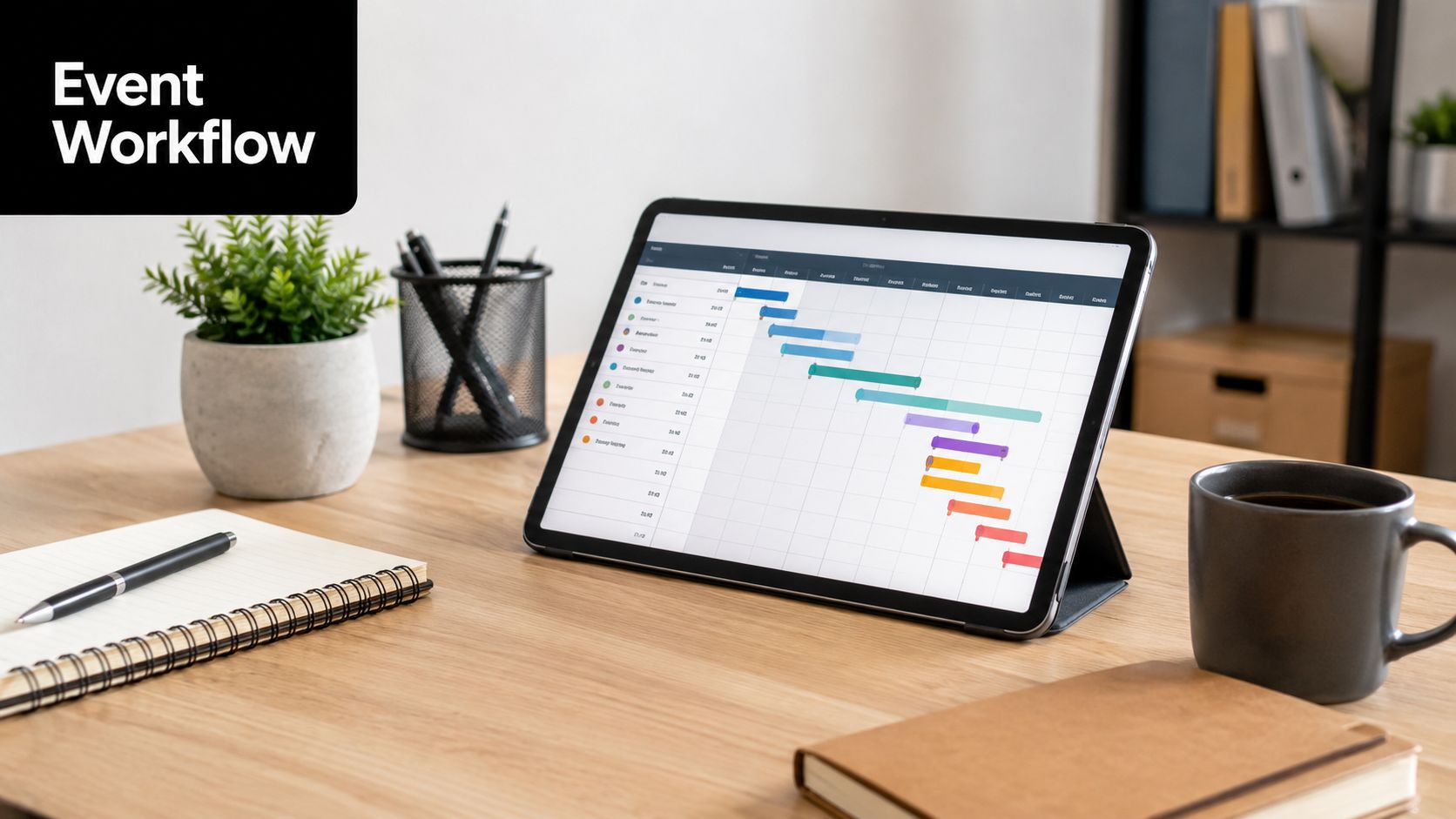
A sound logistics plan moves in phases. The work changes shape as the event gets closer. Early on, you're building structure. On site, you're managing tempo. Afterward, you're protecting assets, reconciling spend, and capturing lessons while they're still fresh.
Pre-event planning
A disciplined approach sets teams apart. The pre-event phase should produce a master timeline, budget controls, approved vendors, staffing assumptions, transportation maps, credential rules, and a written escalation path.
A few practices matter more than they first appear:
- Build the budget with protection: Contingency isn't optional when schedules, freight, travel, and production are all moving at once.
- Vet vendors operationally: A vendor can be excellent in one room and completely wrong for a high-security executive program.
- Lock the sequencing: Setup order, room access windows, vehicle staging, and rehearsal timing have to be coordinated together, not by department.
The planning document should also reflect real travel behavior. Executive arrivals shift. Flights move. Principals add stops. Teams that rely on static itineraries create chaos for themselves. A working group travel itinerary template helps only if someone owns live updates, distribution, and version control.
According to GEVME's event logistics planning guidance, risk mitigation requires comprehensive backup plans for venue, transportation, and technical equipment, along with regular reviews of logistics plans, clear role designation, and staff training. That's exactly right. Backup plans fail when they live in a binder no one updates.
On-site execution
Once the event opens, the job becomes real-time coordination. At this stage, the best logistics lead acts more like an air traffic controller than a scheduler. You monitor timing, absorb new information, and redirect resources without making the event feel unstable.
The run-of-show has to connect with actual operations. If registration is slowing, transport dispatch may need to hold the next group. If a principal adds a private meeting, security routing and room reset may change immediately. The event can stay calm only if the command structure is calm.
A useful reminder for teams managing live movement:
On site, I look for three signals first:
Communication discipline
One operations channel. Clear call signs or roles. No parallel decision-making.Physical bottlenecks
Elevators, service corridors, check-in points, backstage access, and vehicle lanes.Decision latency
The longer it takes to approve a change, the more expensive that change becomes.
Post-event closeout
Post-event logistics is where many teams relax too early. The audience may be gone, but the operation isn't over.
Equipment still has to be checked out and returned. Return shipping labels have to match the correct cases. Ground departures need monitoring until the final movement clears. Invoices need reconciliation against actual service delivered, not assumptions made before show day.
Post-event discipline protects future events. The notes you capture after teardown often prevent the same mistake from appearing in the next city.
A clean closeout includes inventory confirmation, vendor debriefs, incident logs, staffing feedback, and a final timeline review that records what changed in the field.
Logistics in Action for Executive Travel and VIP Events
Corporate roadshows, leadership retreats, investor events, and private aviation arrivals expose the part of logistics that standard event guides usually ignore. In these instances, transportation, security posture, privacy, and timing become inseparable.
Multi-city roadshows
A roadshow isn't one event repeated. It's a chain of interdependent movements. Delay the first morning departure and you can affect venue access, executive prep time, media windows, lunch service, and the evening transfer into the next city.
For this kind of program, a strong logistics lead manages more than calendars. They manage manifests, luggage handling, vehicle rotation, principal separation, route timing, and last-minute revisions. Ground partners matter because they often control the first and last live touchpoint of the day. Companies that evaluate ground transportation companies for executive and VIP movement usually look beyond fleet photos and focus on dispatch quality, local coverage, communication standards, and discretion under pressure.
FBO arrivals and executive ground control
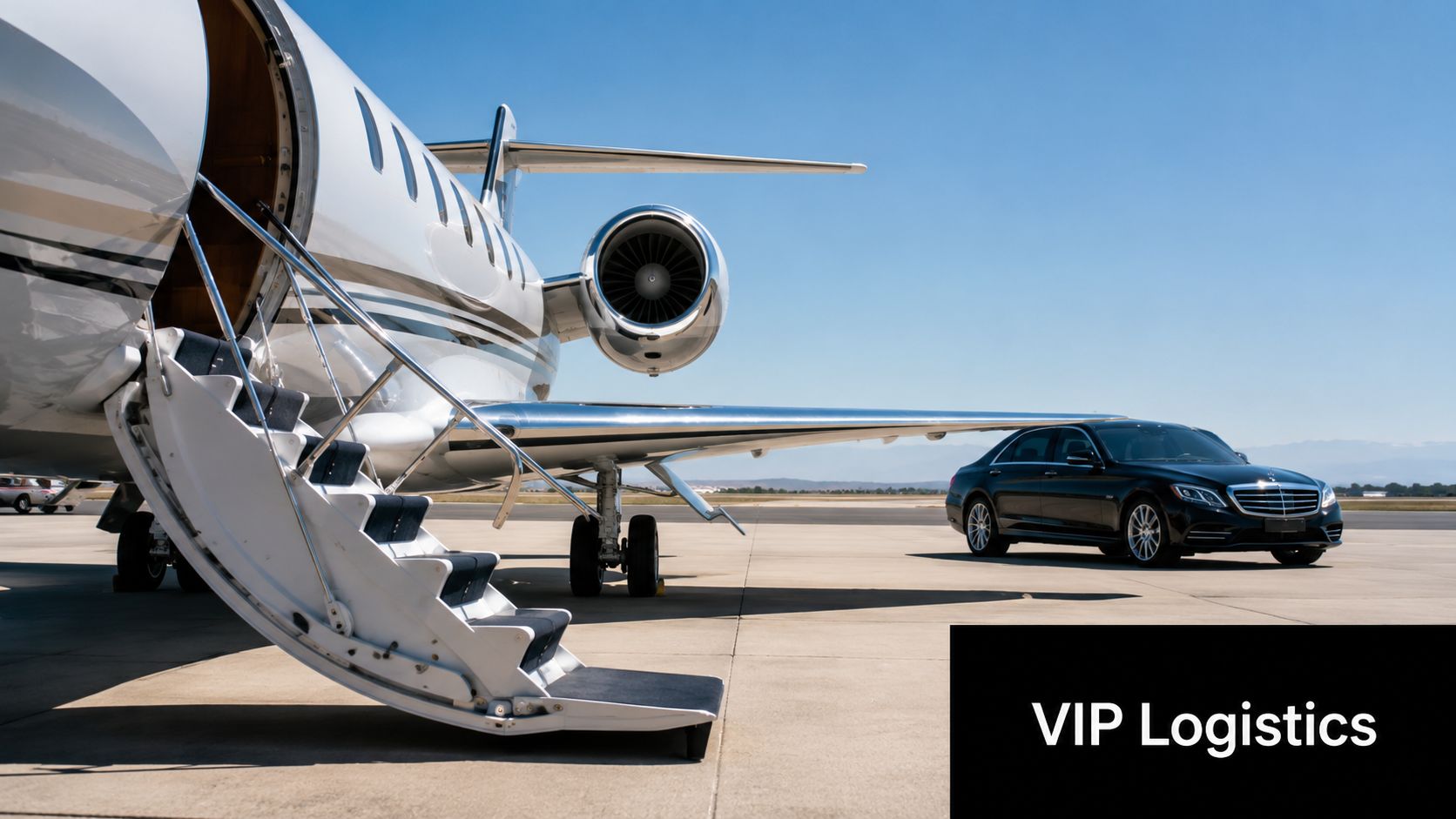
Private aviation creates a different operational rhythm. Guests may deplane quickly, expect direct vehicle-side movement, and require tighter privacy handling than a commercial airport arrival. The event schedule has to sync with real-time flight tracking, chauffeur positioning, security checks, and any changes to destination sequence.
Unseen logistics becomes visible to the guest if it goes wrong. A vehicle staged too far away feels careless. A chauffeur without the updated principal list creates friction immediately. A missed change in FBO timing can collapse a carefully managed arrival window.
A solid VIP arrival plan usually includes:
- Manifest discipline: One current list, clearly owned and time-stamped.
- Redundant vehicle coverage: Not because failure is expected, but because exposure is unacceptable.
- Discrete routing: Service entrances, private holding areas, and controlled guest interfaces.
- Live coordination: Dispatch, venue lead, security contact, and event operations working from the same current information.
One option in this category is MLR Worldwide Service, which provides executive chauffeur services, FBO support, corporate roadshow transport, and event logistics coordination across major hubs. In practice, that kind of partner is useful when an event team needs ground movement, real-time itinerary handling, and a consistent service standard across multiple cities.
Security and contingency management
Security isn't a separate layer added on top of hospitality. For VIP events, it's built into logistics decisions from the start.
That means thinking through arrival exposure, vehicle access points, credential control, green room privacy, principal movement between sessions, and what happens if a schedule changes suddenly. Good contingency management is quiet. The guest shouldn't see the alternate route, backup vehicle, or room pivot unless the plan is activated.
The best executive events feel effortless because someone has already planned for the moments that never happen.
Measuring Success with Key Logistics KPIs
A logistics plan isn't successful only because nothing caught fire. It succeeds when the operation runs on time, stays controlled under change, and supports the business outcome of the event. That requires measurement.
The broader event industry makes that discipline more important. The corporate events market is projected to reach nearly $600 billion by 2029 with a 10.6% CAGR, according to Swoogo's event industry statistics roundup. The same source notes that 60%+ ROI is achievable by using professional event management platforms with real-time tracking for critical deliveries, and that budgets should include a 10% to 15% contingency buffer for unforeseen expenses.
Operational KPIs that actually matter
For most corporate and VIP events, I track a compact set of indicators rather than a giant dashboard.
| KPI | What it measures | What to review |
|---|---|---|
| On-time performance | Whether vehicles, setup, rehearsals, and session starts hit their scheduled marks | Delays by vendor, location, or event phase |
| Budget vs actual spend | How well the team controlled logistics costs in live conditions | Change orders, rush fees, and contingency usage |
| Attendee flow | Whether check-in, transitions, and room access worked smoothly | Queue friction, congestion points, and timing mismatches |
| Incident rate | How many issues required intervention | Type, severity, owner, and time to resolution |
| Vendor scorecards | Which suppliers performed reliably under live pressure | Accuracy, responsiveness, professionalism, recovery ability |
What good tracking looks like
Good KPI tracking isn't complicated. It is disciplined.
- Capture timing in real time: Vehicle arrivals, setup completion, rehearsal readiness, and session opens should be logged as they happen.
- Separate preventable issues from true surprises: A weather shift is one category. An unconfirmed loading slot is another.
- Measure recovery, not just failure: A delayed executive pickup that is rerouted cleanly tells you something important about dispatch quality.
Numbers matter only if they improve decisions. A useful KPI tells you what to change before the next event, not just what went wrong at the last one.
For VIP events, I also recommend tracking private metrics that may never appear in a broader event report. Examples include principal wait time, manifest revision accuracy, route change response, and room-ready status at each executive touchpoint. Those details often reveal the true quality of the guest experience more clearly than general attendee feedback.
Your Essential Event Logistics Checklist
A strong checklist keeps the team aligned when the pace accelerates. Use this as a working document, not a ceremonial file.
Master Event Logistics Checklist
| Phase | Task | Status |
|---|---|---|
| Pre-Event | Confirm venue access windows, loading dock rules, and restricted movement areas | ☐ |
| Pre-Event | Finalize master production schedule with setup, rehearsal, event, and teardown timings | ☐ |
| Pre-Event | Approve vendor roster and assign one operational contact per supplier | ☐ |
| Pre-Event | Build transportation manifests for executives, speakers, staff, and VIP guests | ☐ |
| Pre-Event | Verify rooming lists, holding rooms, green rooms, and security-sensitive spaces | ☐ |
| Pre-Event | Confirm equipment lists, delivery windows, and backup inventory for critical items | ☐ |
| Pre-Event | Test registration systems, radios, printers, scanners, and communication tools | ☐ |
| Pre-Event | Create contingency plans for venue, transport, weather, and technical disruption | ☐ |
| On-Site | Conduct staff and vendor briefing with escalation paths and communication protocols | ☐ |
| On-Site | Walk guest routes, service routes, and VIP arrival paths before doors open | ☐ |
| On-Site | Confirm vehicle staging, chauffeur check-in, and live dispatch coverage | ☐ |
| On-Site | Monitor check-in flow, room capacity, and transition timing throughout the day | ☐ |
| On-Site | Log incidents, changes, approvals, and service recoveries in real time | ☐ |
| On-Site | Reconfirm departure manifests and special handling for VIP or secure movements | ☐ |
| Post-Event | Supervise breakdown, case counts, and return shipping preparation | ☐ |
| Post-Event | Reconcile actual service against vendor orders and approved changes | ☐ |
| Post-Event | Verify all guest departures, driver releases, and final transport closures | ☐ |
| Post-Event | Collect incident notes, staffing feedback, and vendor performance observations | ☐ |
| Post-Event | Archive final manifests, run-of-show versions, and post-event learnings | ☐ |
Frequently Asked Questions About Event Logistics
How do you handle last-minute manifest changes without causing confusion
Use one controlled source of truth. One person owns the live manifest, time-stamps every revision, and pushes updates only through the agreed operations channel. For VIP movement, the driver list, security contact, venue lead, and event producer should all receive the same version.
Which technologies usually deliver the most value
The tools that reduce blind spots. Event management platforms, registration apps, RFID for check-in and flow visibility, real-time delivery tracking, and reliable team communication tools tend to produce the most practical value because they improve timing, accountability, and response speed.
How do you manage staffing during peak event hours when people call out
Many teams are often underprepared in event logistics, as Whova's guidance on managing event logistics cites a 2025 industry report showing that 32% of event staffing failures occur during peak check-in times because teams underestimate demand surges and absences, while only 12% of event planning templates include a real-time staffing adjustment protocol.
The fix is operational, not theoretical:
- Cross-train staff: Registration, wayfinding, and guest services teams should be able to support each other.
- Maintain a backup pool: Don't rely on the published roster as if it will remain unchanged.
- Use live attendee data: Registration app activity can help you redeploy people as traffic shifts.
- Assign a staffing decision-maker: Someone has to own hour-by-hour adjustment calls.
What's the biggest mistake teams make with VIP logistics
They treat transport as a vendor line item instead of part of the guest experience. For executive and private aviation movement, the car assignment, timing buffer, route planning, and arrival protocol are part of the event itself.
When your event includes executive travel, VIP arrivals, private aviation connections, or multi-city ground coordination, logistics needs more than a general checklist. MLR Worldwide Service supports those high-stakes movements with executive chauffeur services, FBO coordination, corporate roadshow transport, and real-time itinerary management designed for teams that can't afford visible friction.