
Your principal lands after a long international flight. They have two bags, a carry-on garment case, a confidential call to join before leaving the airport, and a full afternoon of back-to-back meetings across the city. If the wrong vehicle shows up, the trip starts badly. A cramped cabin raises fatigue. Poor luggage planning creates curbside delays. Too much flash sends the wrong signal. Too little presence undermines the service standard they expected.
That's why travel managers keep asking a simple question that has a more operational answer than most car reviews give: what is a premium SUV?
In executive transport, a premium SUV isn't just a nicer car. It's a business tool. It has to load quickly, ride with minimal noise, protect privacy, handle changing routes, and let a senior passenger step out composed instead of drained. It also has to work for the people managing the trip, whether that's an EA, a corporate travel desk, an FBO coordinator, or a security detail.
The Strategic Choice in Executive Ground Transport
A premium SUV earns its place when the itinerary has consequences.
An airport pickup for a senior banker, a private aviation transfer with family members, a two-city roadshow with presentation materials, or a diplomatic arrival with security coordination all create the same question. Which vehicle gives the operator the fewest points of failure while still delivering the right experience?
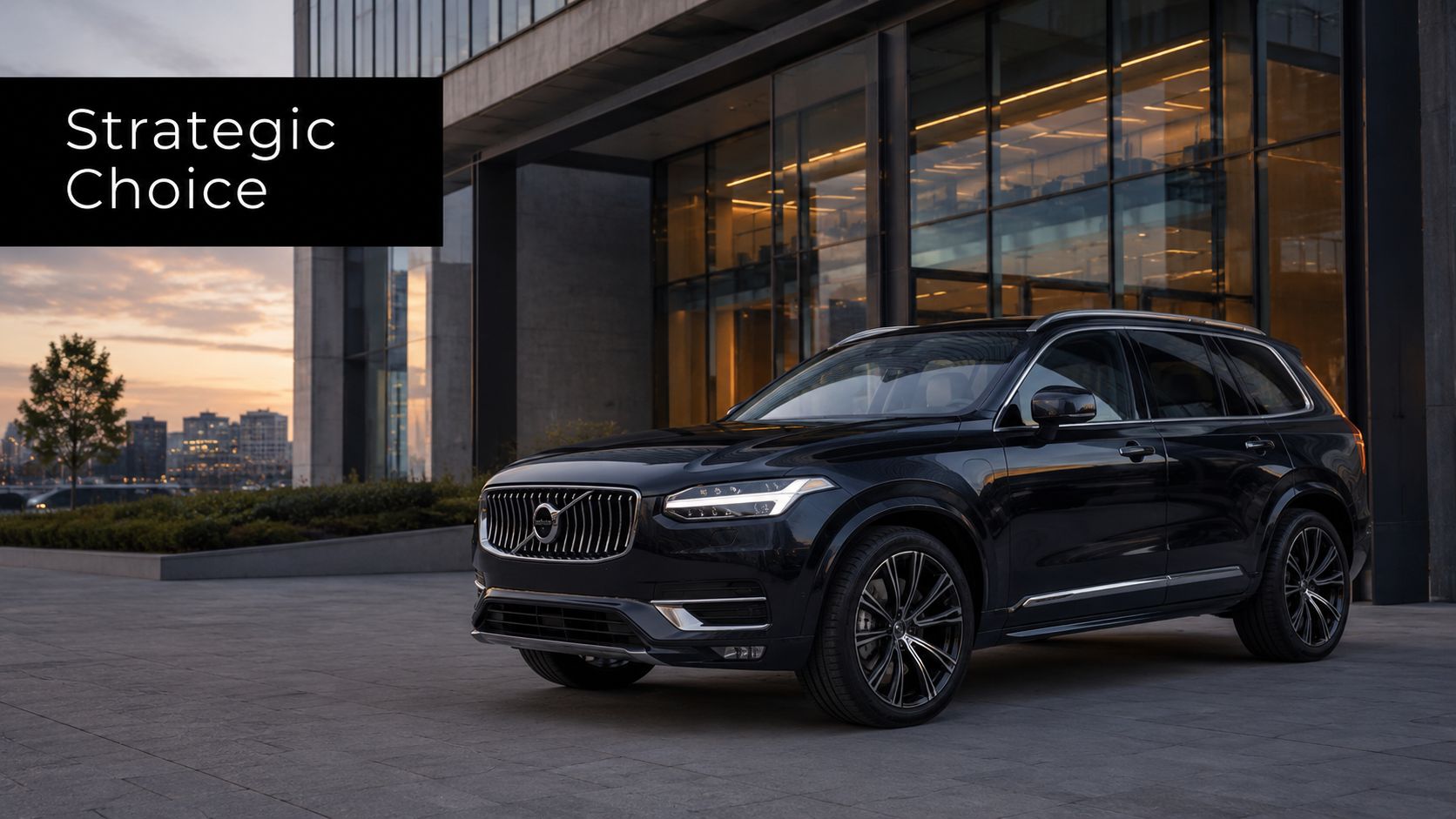
A lot of people still treat the vehicle as a cosmetic choice. In practice, it shapes timing, luggage flow, privacy, road presence, and how well a chauffeur can recover when the schedule changes. That's one reason premium SUVs have become more central to professional fleets. The global luxury SUV market was valued at USD 8.7 billion in 2024 and is projected to grow at a CAGR of 11.8% to reach USD 23.4 billion by 2034, according to GM Insights' luxury SUV market analysis.
Why the category matters in real operations
For a travel manager, the vehicle choice sits inside the larger chain of ground transportation planning. It affects airport meet-and-greet timing, parking access, terminal pickups, route flexibility, and the passenger's ability to work or decompress between stops.
A sedan can be excellent. A luxury van can be ideal. But the premium SUV often solves the most common executive brief because it balances space, prestige, all-weather capability, and flexibility better than either extreme.
Practical rule: If the passenger is senior, the itinerary is fluid, and luggage is more than a briefcase, the premium SUV usually gives operations more room to succeed.
“Premium” also doesn't just mean a German badge. In fleet terms, it means the vehicle performs to executive standards. That includes ride quality, rear-cabin comfort, discreet presentation, and enough utility to handle real travel instead of brochure scenarios.
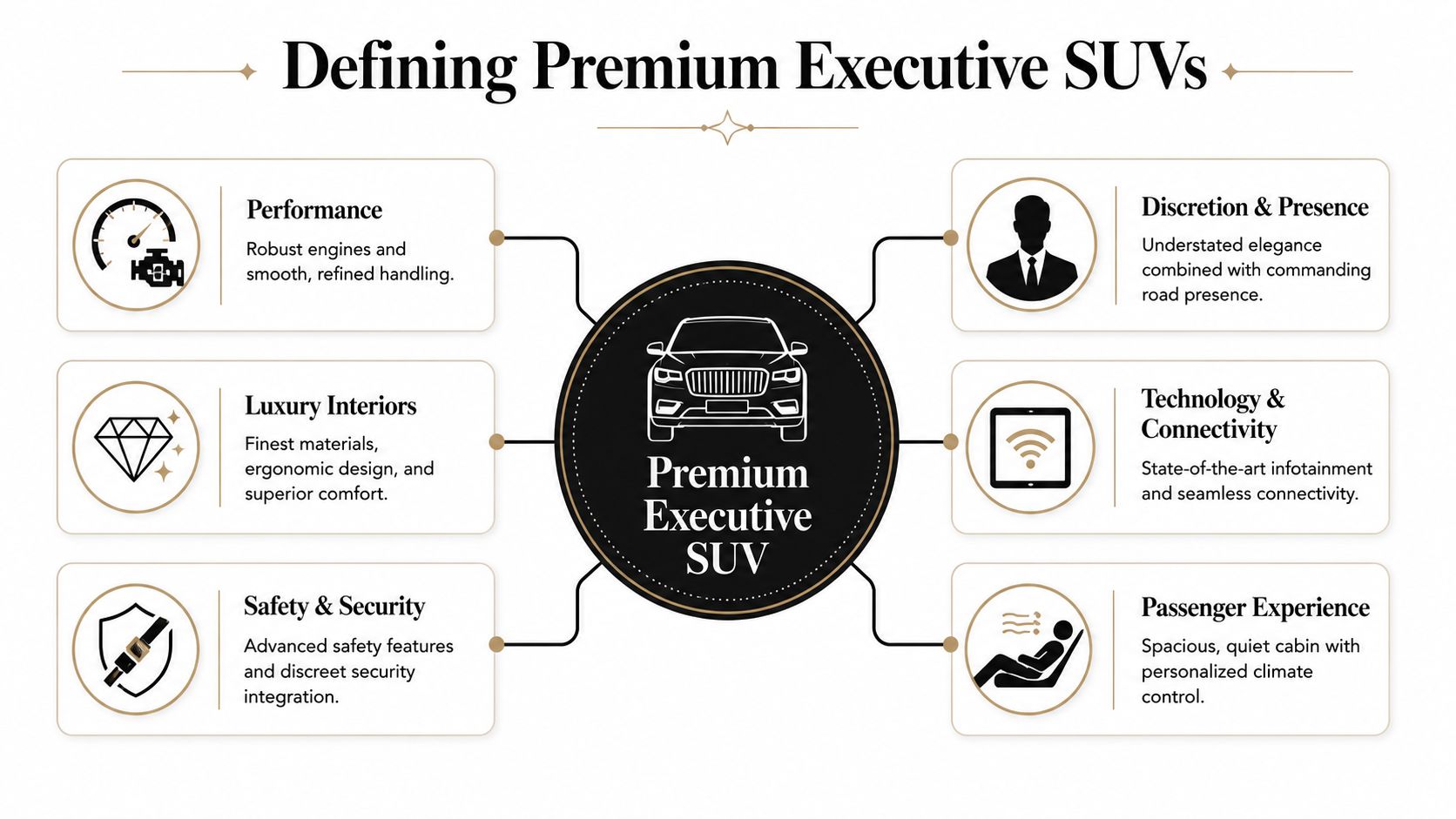
What Defines a Premium SUV for Executive Transport
Consumer articles usually answer this question from the driver's seat. Executive transport answers it from the rear cabin.
The right definition starts with four things: comfort under fatigue, smooth performance in live traffic, space that works for actual travelers, and technology that supports the trip without becoming the focus.
Comfort that reduces travel wear
Leather matters, but not for the reason marketing departments give. After a long flight, senior passengers notice seat support, cabin temperature stability, and noise control far more than decorative trim.
A premium SUV is typically benchmarked by features such as hand-stitched leather seating, multi-zone climate control, and advanced driver-assistance packages, and those features can reduce cabin noise by up to 40% and increase resale value by 15 to 25% over standard models, as noted by Clean Fleet Report's review of luxury SUV features. In practical terms, that quieter cabin helps a passenger take a call, review notes, or arrive less overstimulated.
For executive work, these comfort details matter most:
- Seat support: Wide cushions and well-shaped backrests help a passenger recover from hours in the air.
- Climate zoning: Rear passengers often want a different temperature than the front cabin.
- Ease of entry and exit: A useful step-in height matters when the client is in formalwear, fatigued, or carrying devices and documents.
- Cabin isolation: Road noise, tire slap, and harsh suspension all feel worse after a travel day.
Performance that feels composed, not dramatic
A premium SUV doesn't need to feel sporty. It needs to feel effortless.
The best ones merge cleanly, brake predictably, and stay composed over poor pavement, hotel ramps, airport loops, and downtown stop-start traffic. That combination comes from engine refinement, transmission tuning, and suspension quality. One technical definition in the market ties premium SUVs to high-output turbocharged or hybrid powertrains paired with adaptive suspension systems. The same source notes an example where a 3.3-L turbocharged inline-six engine in the CX-70 delivers 340 hp and 369 lb-ft of torque, and also states that vehicles equipped with such systems show 20 to 30% shorter braking distances compared with non-adaptive counterparts, according to the cited video reference on premium SUV performance.
For chauffeured service, the takeaway isn't the badge or the headline power figure. It's the behavior:
| Pillar | What works in service | What doesn't |
|---|---|---|
| Ride control | Settled suspension over broken pavement | Busy, jittery ride that tosses rear passengers |
| Acceleration | Smooth reserve power for merges and gaps | Hesitation under load with passengers and luggage |
| Braking | Progressive stops without nose dive | Abrupt brake feel that disrupts calls or laptop use |
| Handling | Stable lane changes and ramps | Excessive body roll that causes motion fatigue |
A true premium SUV should feel calm when traffic gets messy. If the vehicle feels busy, the passenger feels it too.
Space that supports the actual mission
Rear legroom matters, but luggage geometry matters just as much. A premium SUV should handle airport transfers without forcing trade-offs between people and bags. It should also provide enough cabin width that two senior passengers don't feel boxed in.
What travel managers usually need is simple:
- Room for people in business attire
- Space for luggage without stacking awkwardly
- A rear cabin suitable for calls, messages, and short document review
- Enough flexibility for an added passenger or changed route
Technology that helps the trip disappear
The best in-vehicle tech is the kind the passenger barely has to think about.
Rear USB power, dependable charging, intuitive climate controls, strong navigation integration, and driver-assistance systems all matter. Giant screens and flashy interfaces matter less than reliability. In executive transport, good technology reduces friction. Bad technology creates one more thing for the chauffeur or dispatcher to troubleshoot.
Premium SUV vs Sedan vs Van The Right Choice for the Mission
No vehicle class wins every assignment. The right choice depends on who's traveling, what they're carrying, and how the day is structured.
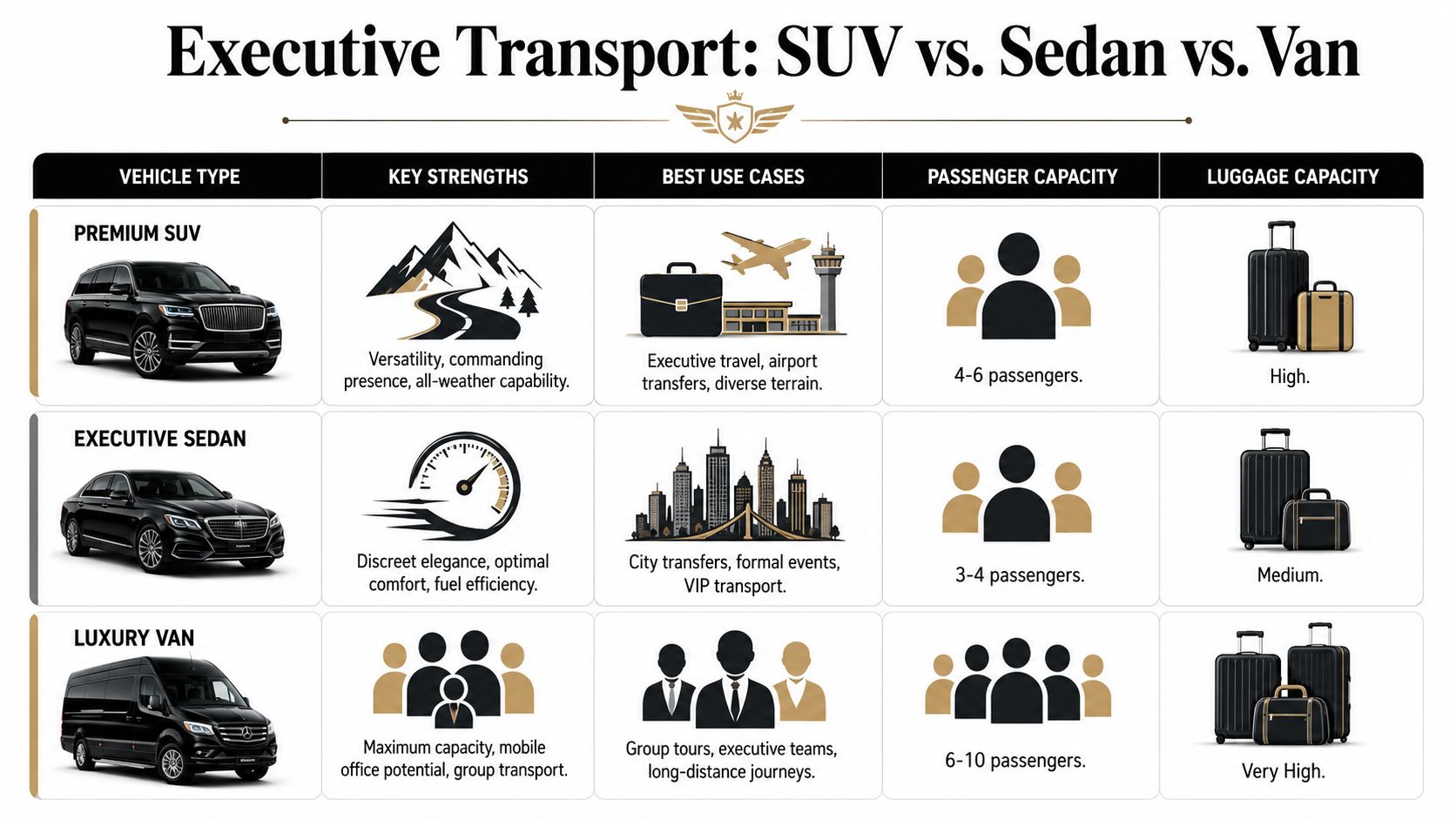
A premium SUV sits in the middle of the executive fleet for a reason. It's the broadest problem-solver. Still, there are times when a sedan is smarter and times when a luxury van is the clear answer.
When the sedan is the better tool
For a solo executive or a pair of passengers moving through dense urban traffic, an executive sedan often delivers the cleanest experience. It's easy to load curbside, presents well at formal venues, and suits short city transfers where luggage is limited.
Sedans work especially well for:
- City roadshows: Tight pickup points, hotel canopies, and valet-heavy destinations
- Formal arrivals: Board dinners, investor meetings, and evening events
- Low-luggage trips: Briefcases, handbags, and light carry-ons
What they don't do as well is absorb last-minute complexity. Once luggage volume rises or the passenger count expands, the sedan becomes unforgiving.
Where the premium SUV wins
The premium SUV is the best fit when the brief is mixed. Airport transfer plus meeting materials. Two executives plus checked luggage. Urban route plus poor weather. VIP passenger plus need for discreet presence.
It wins on versatility because it usually offers:
- Higher seating position for better ingress and egress
- More usable cargo room than a sedan
- Better adaptability for weather and road conditions
- More road presence without the footprint of a van
That makes it the all-rounder for executive transport. It can handle FBO pickups, central business district transfers, suburban meetings, and hotel-to-airport runs without feeling like the wrong asset.
Choose the SUV when the day includes uncertainty. It gives dispatch, chauffeur, and client more margin.
When the luxury van earns its keep
A luxury van or Sprinter-class vehicle is the right call when group movement is the mission. Teams traveling together, conference shuttles, media entourages, and long transfers with lots of baggage all point in that direction.
Here's a quick mission view:
| Mission profile | Best fit | Why |
|---|---|---|
| Solo executive, city meetings | Executive sedan | Efficient, discreet, polished |
| Two to four passengers, mixed luggage | Premium SUV | Best balance of comfort and flexibility |
| Executive team, event logistics, heavy baggage | Luxury van | Capacity and mobile workspace potential |
The mistake is assuming bigger always means better. A van can feel excessive for a board chair traveling with one associate. A sedan can feel inadequate for an investor arriving with luggage and security concerns. The premium SUV sits in the middle because many executive itineraries sit in the middle too.
Common Premium SUV Models in Chauffeur Fleets
The models that last in chauffeur fleets aren't always the ones that generate the most consumer buzz. Operators keep the vehicles that load cleanly, present well, hold up under mileage, and make rear passengers comfortable on imperfect roads.
Full-size American standards
The Cadillac Escalade and Lincoln Navigator remain common choices when presence and cabin volume matter most. They're often selected for airport work, VIP arrivals, and group moves where a sedan would fall short but a van would feel too commercial.
Why they stay popular:
- Commanding arrival presence: These vehicles look substantial without explanation.
- Usable three-row layouts: Helpful when the itinerary adds an extra passenger or assistant.
- Strong luggage practicality: Especially useful for long-haul arrivals and cruise or resort transfers.
Their trade-off is size. In tight city cores, narrow hotel drives, and congested event zones, that extra bulk can complicate loading and routing.
European fleet favorites
The Mercedes-Benz GLS, BMW X7, and Range Rover are common when clients expect a polished, understated image with high cabin refinement. These are often chosen for executive accounts where the rear-seat environment matters as much as exterior presentation.
They're valued for different reasons:
- Mercedes-Benz GLS: Quiet cabin, smooth road manners, and broad brand acceptance in executive settings
- BMW X7: Strong blend of performance feel and rear-seat comfort
- Range Rover: High-status image with excellent ride isolation when specified correctly
For many planners, these models hit the sweet spot between luxury perception and operational utility. If you want a broader look at vehicle categories used for senior passengers, this guide to best cars for executive travel lays out the wider scope well.
Value-led premium choices
A travel manager shouldn't assume premium starts and ends with traditional luxury brands. In practice, some operators and private clients increasingly look at Genesis, Mazda, and Buick entries because they can deliver the right cabin feel, technology, and professional appearance without chasing badge prestige.
This matters in procurement conversations. Sometimes the smartest fleet choice is the one that protects passenger experience while improving replacement economics and long-term consistency across markets.
Some of the best premium SUVs for service work are chosen because they're dependable and discreet, not because they're fashionable.
A final point from operations. The “best” model depends on the assignment. A Range Rover for a board-level arrival. A Navigator for a family office airport movement with baggage. A Genesis GV80 for a premium but less conspicuous corporate transfer. Fleet suitability is always contextual.
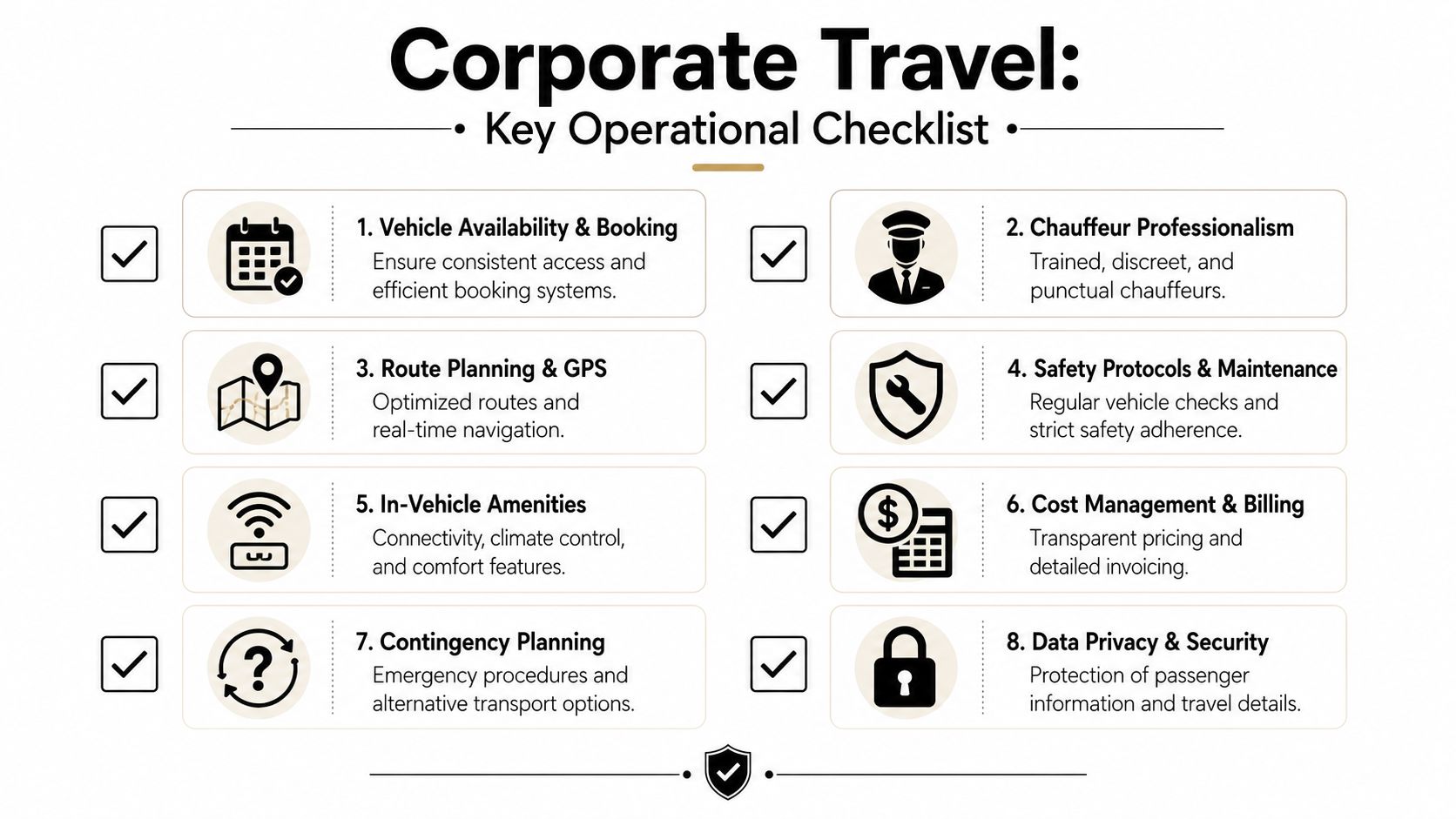
Key Operational Considerations for Corporate Travel
Travel managers usually win or lose the day not in the brochure specs, but in the operational details that determine whether the service runs smoothly from wheels down to final drop.
Capacity isn't a side issue
One of the biggest misunderstandings around premium SUVs is assuming they're mainly upscale five-seat crossovers. That misses what many executive bookings require. A key disconnect is that 26% of U.S. premium SUV buyers in 2025 prioritized 3-row seating, yet 78% of search results for “what is a premium SUV” focus on 5-seat models, according to Avis' premium SUV category discussion.
For corporate travel, that gap is more than academic. It affects whether a trip can stay inside one vehicle or has to split across two. It affects whether an assistant rides with the principal. It affects whether the chauffeur can load luggage without stacking bags in ways that slow down exits at each stop.
If you're booking for executive groups, ask these questions early:
- How many passengers are riding at the same time
- How many checked bags, carry-ons, and garment bags are coming
- Whether the third row must stay usable
- Whether any equipment, gifts, or presentation materials are traveling too
Privacy and recovery time
After a transatlantic or transpacific arrival, passengers often need quiet more than conversation. The best premium SUVs support that through cabin insulation, tinted rear glass where regulations allow, rear climate control, and enough separation from the road environment that the passenger can reset.
That matters for C-suite travelers because the car often serves as a transition space. It's where they collect themselves before a board meeting, return sensitive calls, or avoid one more public-facing interaction. A noisy or exposed cabin undermines that function.
The rear cabin should act like a buffer between the airport and the meeting room.
Privacy also has a procedural side. Chauffeurs should know when to keep conversation minimal, where to position the vehicle for the least exposed pickup, and how to manage door service without creating a scene. Vehicle choice supports that. So does operator discipline. This is one reason many firms rely on specialized corporate chauffeur services rather than treating executive transport like ordinary rideshare.
Security and route flexibility
A premium SUV often gives a security-minded traveler advantages that don't show up on a consumer spec sheet. The seating position improves outward visibility. The vehicle mass and structure can contribute to a more planted feel. The body format also tends to integrate more naturally with protective follow vehicles, luggage support, or altered routing when schedules shift.
That doesn't make every premium SUV a security vehicle. It does make the category useful when the travel plan includes:
- Unpublished schedules
- Hotel rear-entrance access
- FBO coordination
- Multiple stops with changing dwell times
- Executive passengers who prefer lower-profile movement
Long-day comfort and working conditions
Roadshow work exposes weak vehicles fast. If the rear seats are too upright, the Wi-Fi is unreliable, charging access is awkward, or the suspension is tiring, the passenger notices by stop three.
For long-duty assignments, the premium SUV should support all of these:
| Operational need | Why it matters |
|---|---|
| Rear charging access | Keeps phones and tablets ready between meetings |
| Stable ride quality | Reduces fatigue over a full day of stops |
| Quiet cabin | Supports calls and concentration |
| Clean entry and exit | Important with suits, dresses, and formal footwear |
| Flexible cargo area | Handles materials, gifts, and changing baggage load |
What doesn't work is booking on category name alone. “Premium SUV” can mean very different things across providers and markets. Travel managers need to verify the actual vehicle type, seating configuration, and luggage reality before confirming.
How to Select and Book the Right Premium SUV
The best booking requests are precise. They don't just ask for a premium SUV. They define the mission.
Start with the passenger profile. Is this a solo executive who wants a quiet airport transfer? A chairman traveling with an assistant and presentation cases? A family office principal arriving with family members and multiple bags? Once that's clear, the vehicle decision gets easier.
What to tell the provider
Give the operator the information that affects assignment quality:
- Passenger count at every leg: Not just the first pickup
- Real luggage count: Include carry-ons, garment bags, and oversized items
- Nature of the itinerary: Airport transfer, roadshow, point-to-point, standby, or multi-day
- Cabin priorities: Quiet ride, charging access, space to work, or low-profile presentation
- Security or protocol needs: Private aviation handling, discreet pickup point, or coordination with staff
If you leave those details vague, dispatch will fill in the blanks. Sometimes correctly. Sometimes not.
Brand matters less than fit
A lot of buyers still assume premium means one of the legacy luxury marques. That isn't always the smartest operational or financial choice. A common misconception is that premium must mean a traditional luxury brand, but non-luxury brands such as Genesis and Mazda now deliver comparable interior quality and tech at 30 to 50% lower prices, with gentler depreciation, according to the cited video analysis on premium SUV value.
For corporate clients, that matters in two ways. First, a well-selected nontraditional premium SUV can still meet executive expectations. Second, providers that choose vehicles by service performance rather than badge alone often build more resilient fleets.
Questions worth asking before confirmation
Ask direct questions. You'll get better outcomes.
- What exact model or equivalent will be assigned?
- How many passengers and how much luggage does that vehicle handle comfortably in real use?
- Is it a true three-row option if needed?
- What amenities are available in the rear cabin?
- Who manages schedule changes and after-hours coordination?
The right premium SUV booking isn't about spending more. It's about removing preventable friction from a high-value traveler's day.
For executives, assistants, and travel managers who need that level of precision, MLR Worldwide Service provides premium SUVs, executive sedans, luxury vans, and coordinated chauffeur support built around real operational demands, from airport and FBO transfers to roadshows, VIP movements, and multi-stop corporate itineraries.