

The request usually lands when the stakes are already high. An executive assistant is coordinating arrivals into Atlanta for a board dinner, a private aviation team needs a van positioned for an FBO pickup, or a family office is moving principals and staff between meetings, hotels, and a major event itinerary. Everyone wants the same thing. No missed handoff, no uncertainty at the curb, no awkward vehicle mismatch, and no driver who needs instructions at the moment the client steps out.
That's where most luxury van rental Atlanta searches go off course. They focus on leather seats, tinted windows, and passenger count. Those details matter, but they're not what prevents service failures. Instead, preventing service failures involves thorough attention to dispatch notes, pickup protocol, chauffeur standards, airport coordination, and contract language that closes off ambiguity before travel day.
Good executive ground transport feels easy because the planning wasn't easy. It was exact. Someone matched the van to the mission, confirmed where luggage would go, checked whether the travelers needed to work en route, aligned the airport or FBO handoff, and made sure the booking terms supported the itinerary instead of fighting it.
Why Flawless Atlanta Group Travel Starts Here
A typical Atlanta movement can look simple on paper. Airport pickup, hotel transfer, dinner transfer, next-morning departure. In practice, it rarely stays simple. Flights slide, principals split off from the main party, luggage volume changes, and one stop becomes three because someone adds a last-minute investor meeting.
That's why executive transport planning starts with risk, not style.
An airport transfer for a leadership team has different demands than a roadshow, a private aviation arrival, or a hospitality day built around a major event. The vehicle, the chauffeur profile, the wait-time assumptions, and the service window all change with the assignment. If you treat all of them as “group transportation,” you invite preventable mistakes.
What usually breaks first
The first weak point is often the handoff. The booking may look polished until the moment the traveler asks, “Who exactly is meeting us, and where?” The second weak point is vehicle fit. A van can seat the group and still fail the job if carry-ons fill the aisle, if the seat layout kills conversation, or if senior passengers need a more executive setup than a standard transfer configuration provides.
Then there's schedule design. A tightly timed itinerary with executives, family office staff, or VIP guests needs room for adjustment without turning every change into a billing dispute or dispatch scramble.
Practical rule: If the trip includes executives, investors, private aviation, or event credentials, plan the ground segment like an operational movement, not a casual rental.
What reliable planning looks like
The best bookings start with a short but disciplined brief:
- Traveler profile: Who's riding, and who matters most operationally.
- Movement type: Airport transfer, FBO pickup, all-day charter, roadshow, or event circulation.
- Baggage reality: Standard luggage, golf bags, presentation materials, gifts, security cases, or mixed loads.
- Service expectation: Quiet transfer, mobile workspace, or white-glove hosting.
- Change risk: How likely the itinerary is to shift during the day.
That's the difference between a van that merely arrives and a service that protects the traveler's time, privacy, and momentum.
Aligning the Vehicle to Your Mission
Choosing a Sprinter by seat count alone is one of the most common booking errors. Capacity is only the starting point. The better question is what the passengers need to do inside the vehicle and what the support team needs the vehicle to absorb outside of them.
In Atlanta, luxury Mercedes-Benz Sprinter van rentals commonly serve groups of 6 to 15 passengers, with configurations that include 6-Passenger Executive, 8-Passenger, 12-Passenger, and 15-Passenger Luxury Vans. They're used for corporate events, airport transfers, and the Augusta National Masters Golf Tour in 2026, and the same market reference notes minimum service durations of 10 to 14 hours for major events like the Masters, along with premium features such as GPS tracking, 24/7 concierge support, and all-leather seating, according to this Atlanta Sprinter rental guide.

Match the cabin to the assignment
A 6-passenger executive configuration works well when the passengers need space, privacy, and a more polished onboard environment. Think board members, principals, or clients who need a calm setting between meetings. A denser configuration may technically fit the group, but it can feel wrong if every rider is senior and carrying briefcases, garment bags, or presentation materials.
An 8-passenger setup often fits small leadership groups or mixed executive teams where comfort still matters, but the trip is more transfer-focused than meeting-focused.
The 12-passenger and 15-passenger options are usually better for team movements, event shuttles, and airport arrivals where the primary objective is moving more people in one clean motion without splitting the party.
For a useful reference point, this overview of luxury van rental services reflects the broader distinction between executive use and larger group movement.
Ask these questions before you book
A fast decision matrix helps:
| Trip condition | Better fit |
|---|---|
| Senior travelers need privacy and elbow room | 6-passenger executive |
| Small group with luggage and a polished arrival requirement | 8-passenger |
| Department transfer, offsite, or airport consolidation | 12-passenger |
| Larger event group or hospitality movement | 15-passenger |
That table only works if you also pressure-test the details.
- Luggage load matters: Six passengers with substantial luggage can require a different choice than six passengers with briefcases.
- Seating intent matters: Facing seats can support discussion. Forward-facing layouts can feel better for straightforward transfers.
- Service duration matters: Event-related reservations can come with longer minimums, especially around major golf hospitality travel.
- Tech expectations matter: If riders need to work, ask specifically about charging access, Wi-Fi availability, and where bags will sit once everyone boards.
Book for the real trip, not the headcount on the calendar invite.
What works and what doesn't
What works is describing the mission in one sentence. “Board arrival from ATL with carry-ons, hotel check-in, then direct to dinner.” Or “Twelve-person team offsite with luggage and presentation cases.” Providers can plan around that.
What doesn't work is saying “We need a luxury van for ten people” and assuming the rest will take care of itself. That's how polished bookings turn into compromised rides.
The Chauffeur Mandate for Executive Travel
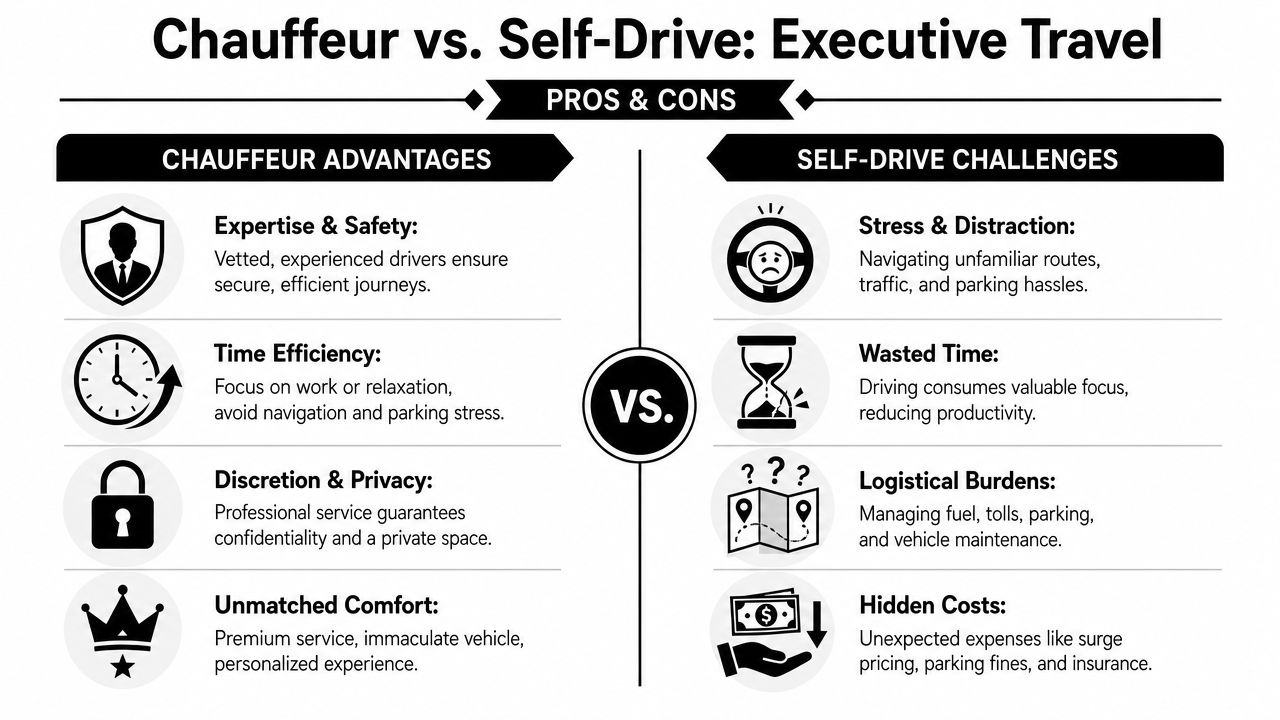
For executive transport, the self-drive question should be settled quickly. A luxury van may be rentable either way in some parts of the market, but executive travel and self-drive are rarely a good pairing. The issue isn't just convenience. It's control, liability, discretion, and who carries the operational load when the itinerary gets complicated.
The preference data is clear. The 2025 J.D. Power U.S. Vehicle Rental Study found that 68% of premium renters prefer professional chauffeurs over self-drive for luxury vans due to safety concerns and itinerary complexity, and the 2024 Corporate Travel Trends Report by Business Travel News found that 82% of corporate executives cited vetted, background-checked chauffeurs trained in FBO protocols as a key expectation, as summarized in this Atlanta executive van rental analysis.
Why self-drive breaks down fast
A self-drive arrangement can look flexible at booking stage. Then practical friction starts.
The designated driver has to handle Atlanta traffic, manage parking, watch timing, and remain fully accountable for a vehicle that's often carrying senior people, sensitive materials, or both. If the itinerary shifts, the person driving can't simultaneously handle executive support tasks, route changes, and traveler communication with the calm of a trained chauffeur and dispatch team.
For a business-oriented perspective on that standard, this page on corporate chauffeur services is useful reading.
What “vetted chauffeur” should mean in practice
Many listings often remain vague. “Professional driver” is not enough language for executive work.
A chauffeur assigned to VIP transport should be able to handle:
- Discreet arrivals: No confusion, no loud curbside searching, no unnecessary conversation.
- Itinerary discipline: Understanding sequence, timing, and passenger hierarchy.
- Airport and FBO fluency: Knowing where to stage, how to communicate with handlers, and when to stay flexible.
- Presentation: Clean vehicle, calm demeanor, polished appearance, and no improvisation in front of the client.
The chauffeur is not just operating the vehicle. The chauffeur is protecting the schedule.
The operational difference clients actually feel
Passengers rarely comment on what went right in dispatch. They notice outcomes. The van is exactly where it should be. The chauffeur knows the lead passenger by name. Bags are loaded without reshuffling the cabin. There's no debate about route, stop order, or whether the driver can wait on-site.
That's what a chauffeured service buys. It converts uncertainty into process.
By contrast, self-drive shifts that uncertainty back to the client party. Someone internal becomes responsible for timing, vehicle handling, pickup positioning, and every small problem that emerges during the day. For high-net-worth travelers, board-level groups, and private aviation arrivals, that's the wrong place to put friction.
A practical standard for executive bookings
If the trip involves any of the following, book a chauffeured van and make it a priority:
- Private aviation arrivals
- Board or investor movements
- Multi-stop city schedules
- Events with fixed entry windows
- High-visibility guests or family office principals
That standard removes avoidable risk before the vehicle is even assigned.
Mastering Atlanta Airport and FBO Logistics
Atlanta arrivals fail most often in the last few minutes. The reservation is confirmed, the flight lands, and then the pickup becomes vague. That's why airport and FBO planning should be treated as a handoff protocol, not just a pickup instruction.
The local market supports a fully digital, transparent booking process with pickup locations positioned near Hartsfield-Jackson Atlanta International Airport at 6000 N Terminal Pkwy, including dedicated Park-Ride Reserve spots at S Terminal Pkwy, College Park, GA 30333, according to this Atlanta van rental operations page.
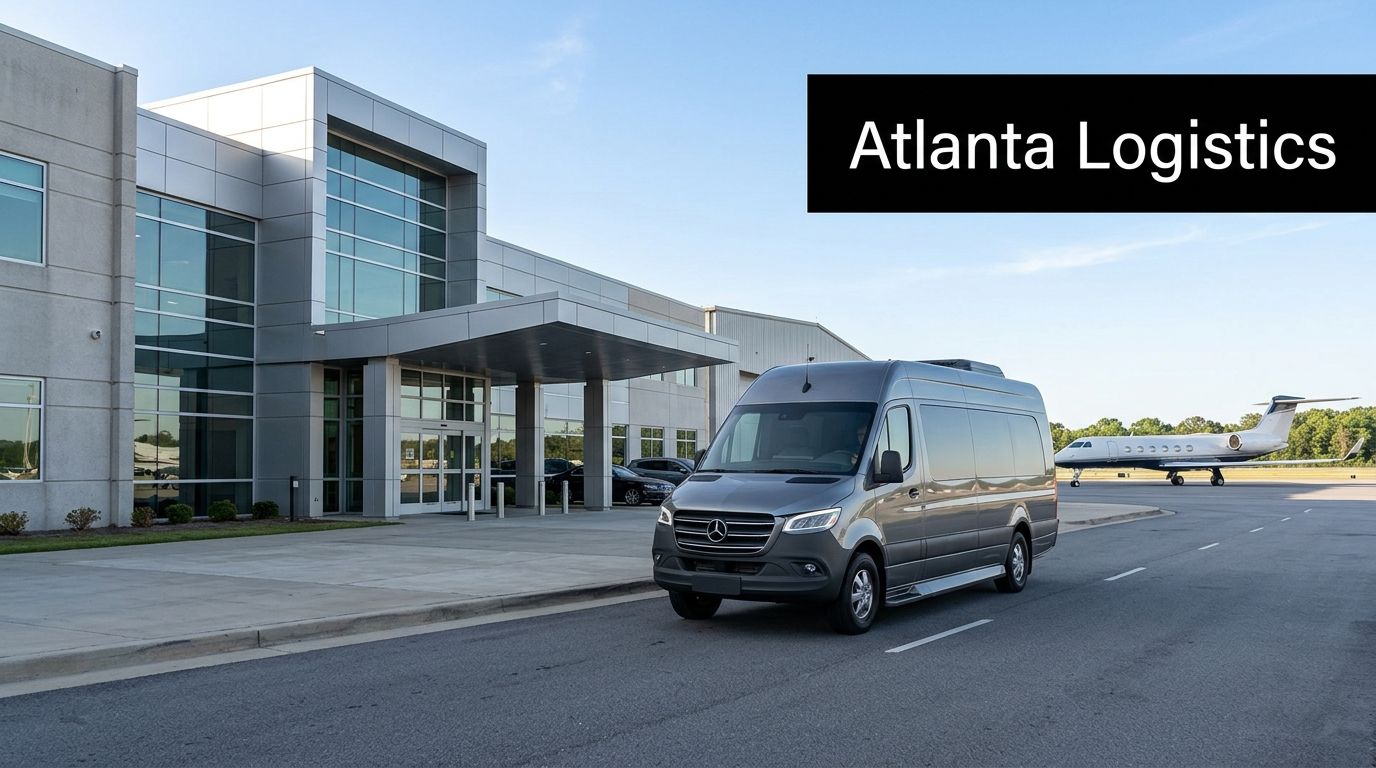
ATL pickups need exact instructions
Commercial terminal pickups work best when everyone knows three things before wheels touch down:
- Which traveler is the lead contact
- Which meeting point is being used
- How the chauffeur or dispatcher will communicate after landing
If those points aren't explicit, the group starts improvising by text from baggage claim, and that's where delay creeps in. Atlanta can punish vague curbside plans quickly. Keep the instructions short and operational: terminal, airline, arrival time, number of checked bags, and whether the group will want a direct curb pickup or a designated meeting area.
For travelers who routinely use the airport corridor, this guide to the Gateway Travel Centre area gives helpful local context around the airport-adjacent movement pattern.
FBO work is a different discipline
Private aviation pickup is quieter, but it's less forgiving. The chauffeur needs accurate tail-side or terminal-side instructions from the coordinating party, plus an understanding of who authorizes release, where baggage is handed off, and whether security staff or family office personnel are involved.
A clean FBO movement usually depends on these details:
- Aircraft identification and schedule updates
- Passenger name order
- Exact destination sequence
- Luggage profile
- On-site contact with authority to make changes
At an FBO, smooth service comes from pre-clearance and timing, not from reacting quickly after the aircraft arrives.
A good visual overview of executive transfer expectations helps when briefing your internal team:
What to send your provider in advance
Don't overcomplicate the dispatch note. Send a clean manifest-style summary instead.
- Flight details: Airline and flight number for commercial service, or tail and handler details for private aviation
- Passenger details: Lead name plus any passenger who requires priority handling
- Destination chain: Not just first stop, but all expected stops
- Luggage notes: Standard bags, oversized pieces, event materials, or golf equipment
- Communication plan: Who should be called if the principal's phone is unavailable
That level of preparation turns airport service from reactive to controlled.
Decoding Pricing and Your Service Agreement
A polished quote can still hide operational problems. In executive transport, the question isn't whether the number looks reasonable. The question is whether the quote matches the trip you're running.
The cleanest bookings come from providers who define scope well. You should know whether the reservation is a transfer, a fixed block of service, or a day charter with waiting time. If that's unclear, the billing can become unstable the moment the schedule shifts.
What an executive quote should clarify
A serious proposal should answer these points in writing:
| Contract point | Why it matters |
|---|---|
| Service type | Transfer and hourly service behave differently once plans change |
| Time basis | You need to know when billed time starts and stops |
| Wait assumptions | Airport delays and executive meetings rarely run exactly to plan |
| Vehicle assignment | “Luxury van” is too broad if your seating layout matters |
| Chauffeur inclusion | The service model should be explicit, not implied |
If any of that stays vague, ask before you approve.
Watch for vague “all-inclusive” language
“All-inclusive” can mean very different things depending on the operator. Sometimes it signals a clean, bundled quote. Sometimes it only means the obvious base items are included and everything dynamic gets added later.
Read for wording around:
- Overtime rules: What happens if the dinner runs long or the return is delayed.
- Garage-to-garage billing: Whether the clock starts before the vehicle reaches the pickup point.
- Waiting time: Especially important for airport, event, and meeting schedules.
- Parking, tolls, and access fees: These can be routine on certain movements.
- Event minimums: Major-event service windows may require longer commitments than a simple city transfer.
The point isn't to avoid every additional charge. The point is to know which ones are possible before the day begins.
A transparent contract doesn't just protect budget. It protects decision-making during the trip.
Terms worth confirming out loud
Even experienced travel managers benefit from a direct confirmation call before signing off. Ask the provider to summarize the reservation as they understand it. You'll catch mismatch quickly that way.
Useful questions include:
- If the flight is early, how is the pickup handled?
- If the principal adds a stop, does the same vehicle remain in place?
- If the group size changes, what's the reassignment process?
- If the lead traveler becomes unreachable, who can authorize changes?
- If the itinerary extends, is continuity prioritized or is service subject to vehicle availability?
Those aren't legal formalities. They're operational pressure tests.
Red flags that deserve a pause
Be careful when a provider can't give a specific vehicle configuration, can't explain airport staging, or avoids discussing how chauffeurs are assigned and briefed. Another red flag is a service agreement that reads like a generic car rental contract even though you're booking a managed executive movement.
For luxury van rental Atlanta bookings, the strongest agreements are the least theatrical. They're precise, boring, and easy to operationalize. That's exactly what you want.
The Final Pre-Trip Checklist and Conclusion
The best time to catch a service problem is before the chauffeur is dispatched. A short final review prevents most day-of confusion, especially when the passengers are senior, the schedule is dense, or the arrival point involves aviation staff, hotel teams, or event security.
Treat this as a quality-control pass, not a formality.
The final review before confirmation
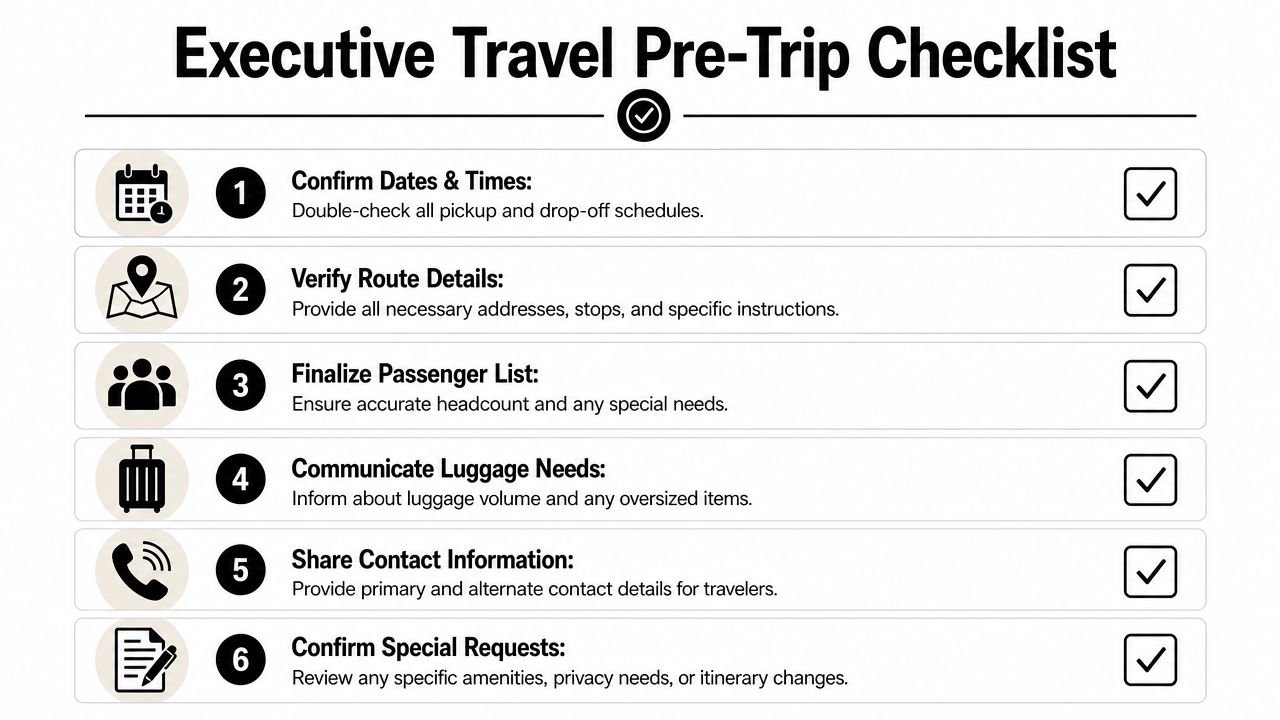
A reliable pre-trip check should confirm the following:
- Itinerary is final enough to dispatch: Pickup times, stop order, venue names, and any live-change risk are noted.
- Passenger list is current: Not every trip needs a full manifest, but the provider should know who the lead traveler is and who requires special handling.
- Luggage assumptions are real: This includes garment bags, presentation materials, event collateral, golf bags, or security-related equipment.
- Contact chain is clear: Primary and backup contacts should be named on both sides.
- Arrival protocol is specified: Commercial terminal, hotel porte-cochère, private residence, or FBO handoff all require different handling.
- Special requests are confirmed: Quiet ride, preferred temperature, privacy expectations, child seating, or route sensitivity.
The details that separate smooth service from “mostly fine”
A booking can look correct and still be fragile. That usually happens when the key details exist somewhere in email threads but not in the final dispatch record. The traveler assumes the chauffeur knows. The chauffeur assumes dispatch has updated the file. Operations assumes the planner already confirmed it.
That's how small misses happen.
Confirm the working version of the trip, not the original version.
A good final pass should also verify when chauffeur details will be released, how live changes will be handled, and who can make decisions once the trip is in motion. Those points matter more than another round of amenity discussion.
The real choice isn't just the van
By the time you finish vetting a luxury van rental Atlanta option properly, you've already learned the bigger lesson. You're not selecting a vehicle in isolation. You're selecting an operating standard.
The van matters. The Mercedes-Benz Sprinter remains a strong tool for executive group transport because it can bridge airport arrivals, event movement, and business itineraries in one polished platform. But the vehicle only performs as well as the planning around it.
For executive assistants, event planners, FBO coordinators, and travel managers, the winning move is simple. Choose the provider that makes ambiguity disappear before travel day.
If you need executive ground transport that's planned with that level of precision, contact MLR Worldwide Service for a customized consultation on luxury van movements, airport coordination, FBO support, and VIP itinerary management in Atlanta and beyond.