
A board member lands in an unfamiliar city. The venue changes before touchdown. A private dinner is added across town. The revised itinerary gets forwarded too widely, and one recipient now has details they were never supposed to see. On the ground, the assigned driver may be polished and punctual, but if that driver has never worked around protective detail, route changes, or communications discipline, the exposure starts before the principal reaches the curb.
At that point, transport is part of the security plan.
Experienced teams treat executive movement as more than a vehicle assignment. They are protecting time, privacy, and decision space while the schedule keeps shifting. They are also managing quieter risks that get missed in basic transport planning, such as who can see the itinerary in a dispatch system, who can infer patterns from repeated pickups, and whether a subcontracted driver was vetted to the standard the client assumes.
That broader view matters. Physical security is only one layer. A well-maintained sedan, a capable chauffeur, and even an armored platform do not solve loose information handling, exposed passenger data, or insider risk from poorly screened personnel. Companies that perform well in this field control the full chain, from booking and dispatch to communications, route management, and access to trip details. Readers looking for a practical baseline can compare that standard against this guide to worry-free executive transportation planning.
If the ground piece breaks down, the rest of the trip usually follows. Meetings start late, alternate entrances become improvised decisions, protective coverage gets compressed, and the principal loses attention that should stay on the business objective.
That is why serious buyers no longer evaluate secure transport as a luxury add-on. They evaluate it as a continuity function with direct consequences for safety, confidentiality, and execution.
The High Stakes World of Executive Travel
A lot of secure transport requests start with urgency, not drama.
An executive assistant gets a message late at night. The CEO needs to be in another country the next morning for a sensitive meeting. Arrival time is tight. There may be press interest. The venue hasn't been finalized. The principal wants discretion, not a visible security footprint. Everyone involved still expects perfect timing.
That scenario is common enough that experienced teams build for it. They don't ask whether the traveler wants a “premium vehicle.” They ask better questions. Who will know the route? Who can change it? How will updates be transmitted? What happens if the principal extends a stop unexpectedly or leaves through a different entrance?
What changes when the trip matters
On a routine booking, ground transport is measured by comfort and punctuality. On a high-stakes booking, those are only the baseline. The transport plan has to support continuity under pressure.
That means secure transport companies aren't just moving a passenger. They're protecting several things at once:
- Time integrity: Delays at the curb can create missed meetings, compressed schedules, and avoidable exposure.
- Information control: Itinerary details, names, flight movements, and hotel locations need tighter handling than most standard dispatch systems provide.
- Decision space: The traveler should be able to focus on business, not on whether the pickup is exposed or the route feels wrong.
- Operational flexibility: Last-minute stop changes happen. Good providers absorb them without creating chaos.
For many organizations, secure transport becomes integrated into governance. It sits alongside travel policy, executive protection, legal sensitivity, and duty of care.
Practical rule: If a missed pickup would create reputational, financial, or security consequences, book the ground segment as a controlled operation, not a convenience service.
The broader market supports that shift. As noted earlier, the secure logistics sector reached USD 87.96 billion in 2024 and is projected to grow to USD 154.1 billion by 2034, as reported by IMARC Group. Organizations aren't buying these services because they like extra formality. They're buying resilience.
A well-run program also reduces friction for the people coordinating travel. That matters more than many leaders realize. If you're building a smoother operating model for executives and VIPs, worry-free transportation planning for complex trips is often less about luxury and more about removing predictable failure points.
Why sophisticated teams plan early
Security teams usually prefer low drama and low visibility. The best secure transport plan often looks uneventful from the passenger seat. That's a sign that the work happened in advance.
The companies worth hiring treat movement as part of the protective envelope around the traveler. They coordinate arrivals, watch route changes, manage handoffs, and keep exposure limited. That's what separates a polished ride from a secure one.
Beyond Armored Cars Redefining Secure Transport
The biggest misunderstanding in this field is simple. People hear “secure transport” and think “armored vehicle.”
Sometimes an armored platform is appropriate. Often it isn't. In many executive movements, a conspicuous vehicle creates more attention than protection. It can signal importance, slow maneuvering, complicate access, and clash with the client's need for discretion. Security that announces itself isn't always security that works.
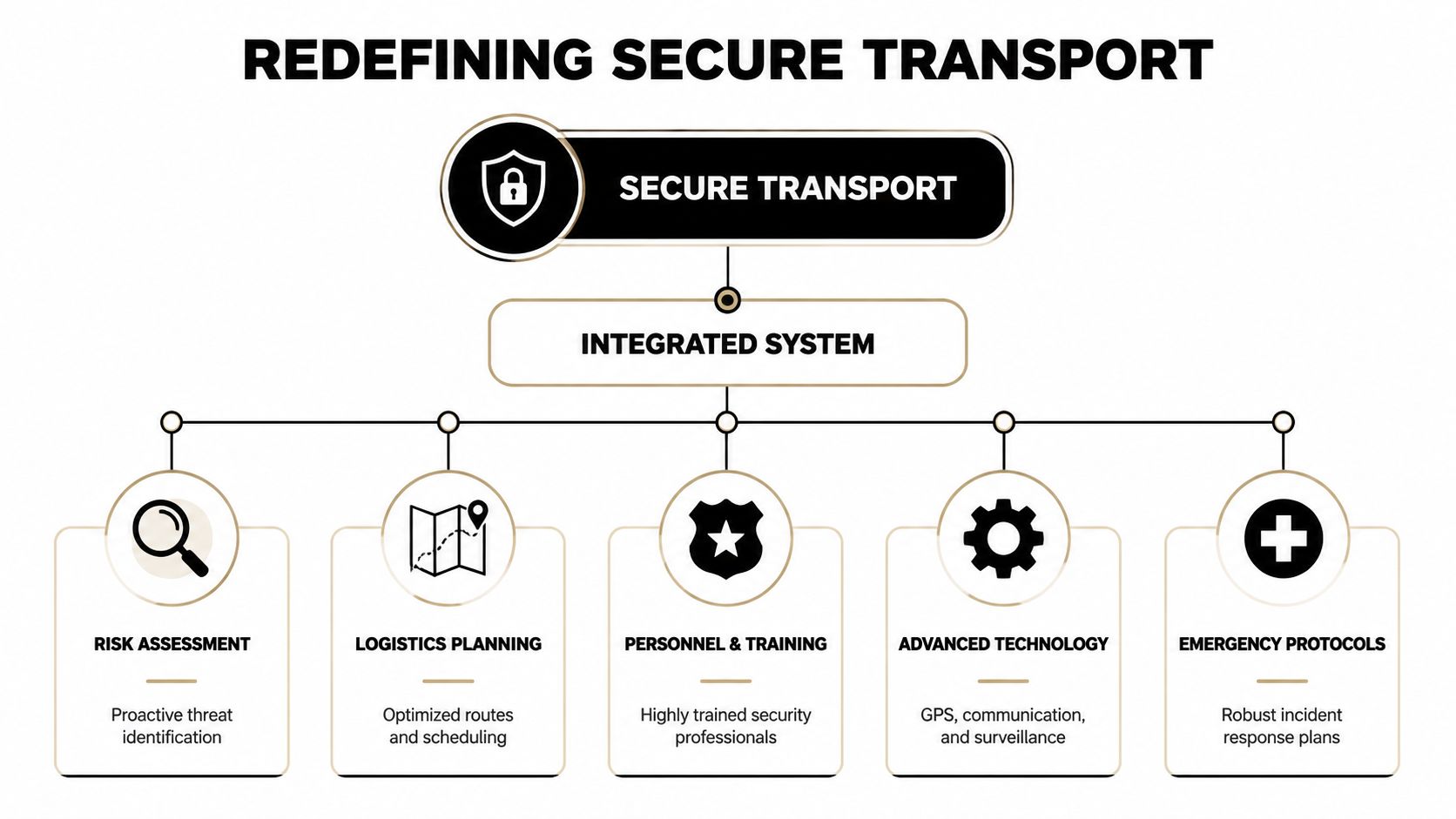
People come first
The strongest vehicle in the fleet won't compensate for the wrong chauffeur.
In secure transport, the driver isn't only a service professional. That person is part of the protective system. They need judgment, calm communication, route discipline, and the ability to follow tight protocol without making the client feel managed. A driver who overshares, improvises unnecessarily, or treats itinerary details casually creates risk even in a luxury vehicle.
That's why serious providers invest in trained personnel who can work within a larger plan. In practice, that means coordination with executive assistants, security teams, aviation handlers, and local affiliates without losing composure or confidentiality.
Process is what prevents most failures
Many transport problems don't come from dramatic threats. They come from bad process.
A secure operation should include pre-trip review, pickup-site assessment, route planning, alternates, arrival timing, venue coordination, and a clear response path if the principal changes course. The process has to work when everything is fluid, not only when the itinerary is fixed.
A good way to evaluate a provider is to ask what happens when the original plan breaks. If the answer is vague, the operation probably depends too heavily on individual improvisation.
Here's the basic distinction:
| Standard chauffeur service | Secure transport operation |
|---|---|
| Focuses on ride execution | Focuses on controlled movement |
| Assumes the itinerary is stable | Plans for changes and contingencies |
| Shares data through routine dispatch channels | Limits access to itinerary and route details |
| Measures success by service quality | Measures success by service quality and risk control |
Technology supports the system
Technology matters, but it only works when it's attached to sound personnel and process. Tracking, monitored communications, and active coordination can tighten execution and shorten response time when something changes.
A useful benchmark for operational seriousness comes from government transport at the highest level. The U.S. Department of Energy's Office of Secure Transportation has logged over 140 million miles of over-the-road experience since 1975 with zero fatalities or releases, according to the Office of Secure Transportation overview. The lesson isn't that private executive travel should mirror a nuclear transport mission. It's that the best operators treat safety and security as equal priorities.
Security works best as an integrated service. Vehicle choice is only one decision inside a much larger operating model.
That's why the better conversation starts with capability, not armor. If you're reviewing providers for global programs, it helps to compare how international chauffeur services are structured for complex executive movements rather than looking at fleet photos first.
When Is Secure Transport a Necessity Not a Luxury
Not every senior traveler needs a secure transport package on every trip. Overusing it wastes budget and can create unnecessary friction. Underusing it is worse.
The right question isn't “Is this traveler important?” The right question is “What are the consequences if this movement is disrupted, exposed, or mishandled?”

Three variables decide the answer
I usually assess need across three factors: the traveler, the destination, and the context.
The traveler profile matters because visibility changes exposure. A public CEO, board chair, family office principal, or executive involved in a sensitive transaction often carries more reputational and personal risk than a lower-profile manager on a routine internal trip.
The destination matters because local conditions shape the transport plan. Some cities demand tighter arrival control, stronger venue coordination, or more conservative route discipline. Even where the principal risk isn't violent crime, congestion, protests, paparazzi attention, or poor local provider standards can justify a higher level of control.
The context of the trip often decides the issue. A confidential acquisition meeting, a major forum, a contentious labor situation, a termination visit, or a roadshow with multiple public stops can make an otherwise ordinary transport requirement more demanding.
A practical decision matrix
This quick matrix helps travel managers make a defensible call:
| Variable | Lower need | Higher need |
|---|---|---|
| Traveler | Low-profile internal staff | Public executive, HNWI, principal traveler |
| Destination | Stable routine market with known logistics | Unfamiliar market, elevated exposure, unpredictable local conditions |
| Context | Simple airport-hotel-office movement | Sensitive meetings, event traffic, press visibility, multiple changing stops |
If one factor is high, tighten planning. If two are high, a secure transport approach is usually justified. If all three are high, treat ground movement as a controlled protective operation.
A simple example makes the point. A regional manager flying into a familiar business hub for one office meeting may only need a reliable executive transfer. A chief executive attending a high-profile economic event, then moving between hotel, venue, private dinner, and airport with schedule changes throughout the day, needs a much more disciplined structure.
Most risk decisions in executive travel are really consequence decisions. Ask what failure would cost, not just how likely it seems.
What tends to get missed
Organizations often focus on the trip itself and ignore the coordination around it.
Who's managing the handoff from aircraft to vehicle? Who approves stop changes? Does the provider know which locations should never be spoken aloud at the curb? Is anyone watching whether the route now passes a protest area or media cluster? Those questions are often more useful than debating whether the traveler is “important enough.”
The short video below is a useful reminder that transport planning is operational work, not only hospitality.
When secure transport is selected for the right reasons, it doesn't feel excessive. It feels proportionate. That's exactly what you want when explaining the decision to leadership, a family office, or an internal risk committee.
Inside the Layers of Modern Transport Security
A credible secure transport operation works in layers. Some are visible to the passenger. Many are not.
The visible layer includes the vehicle, the chauffeur, and the pickup choreography. The hidden layers include route governance, live coordination, communications discipline, and data protection. If one layer weakens, another should catch the problem before it reaches the traveler.
The physical layer
Vehicle selection should fit the mission, not ego.
For many executive movements, a discreet sedan or SUV is the right platform because it blends into the environment and avoids telegraphing the principal's importance. In other cases, a low-profile armored SUV may make sense. The mistake is assuming that more hardware always means more security. It doesn't. Wrong-fit hardware can reduce flexibility and attract exactly the attention you were trying to avoid.
The chauffeur is part of this layer, but not just as an operator. The strongest drivers manage arrivals discreetly, position the vehicle intelligently, avoid unnecessary conversation, and understand that curbside behavior can expose more than route movement.
The tracking and monitoring layer
Modern secure transport companies rely on a multi-layered defense that integrates GPS tracking, geofencing, and IoT sensors, according to JIT Transportation's overview of secure transport for high-risk freight. Those tools matter because they create live visibility into route adherence and signs of tampering or deviation.
In executive travel, the principle is the same even when the application is adapted differently. Operations teams need to know whether the vehicle is where it should be, whether it has strayed from the approved route, and whether a sudden stop or unexplained detour needs intervention. Technology doesn't replace judgment. It gives judgment something timely to work with.
A well-used monitoring stack supports:
- Route adherence: Teams can identify unauthorized deviations quickly.
- Exception handling: A delay, stop, or reroute can be verified instead of guessed at.
- Operational coordination: Arrival timing can be updated in real time with aviation, venue, or residential staff.
- Incident escalation: If something feels wrong, the team has immediate situational context.
The intelligence layer
Route planning is not just choosing the fastest line on a map. It's deciding which exposures to accept and which to avoid.
That includes primary and alternate routes, choke points, construction, event traffic, likely photography zones, and whether the arrival itself should be adjusted. In some cities, the route is less important than the final approach and departure path from the venue. In others, the curbside waiting position is the primary vulnerability.
The route isn't secure because it's short. It's secure because someone assessed what can go wrong along it.
The digital layer
However, many glossy providers fall short.
An executive's travel pattern can be as valuable as the person's physical location. If itinerary data, names, phone numbers, flight details, or live vehicle feeds are handled casually, the transport provider becomes a data exposure point. That risk is often more realistic than a direct physical attack.
At minimum, clients should expect tight access control around booking information, limited sharing of principal identity, disciplined communications channels, and procedures that prevent unnecessary distribution of route and schedule data. If a provider can talk at length about fleet trim levels but can't explain how it protects itinerary metadata, it isn't operating at a secure standard.
Vetting Secure Transport Companies A Practical Checklist
Most providers know how to sound reassuring. That's why the screening process has to move past marketing language fast.
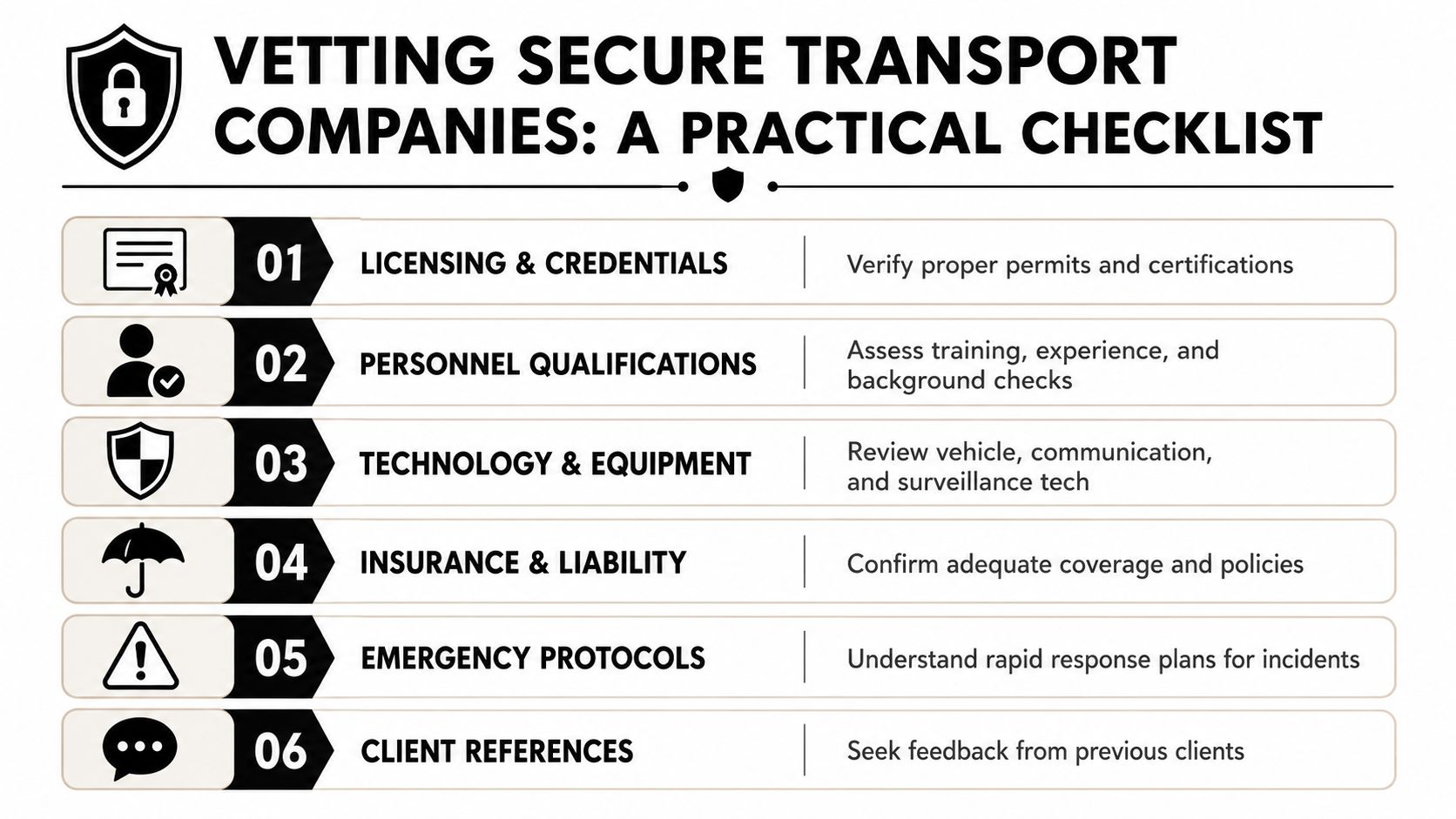
The central issue is trust under pressure. Can this company protect the principal's movement, protect the data around that movement, and do it consistently across cities and affiliates? If you don't press on the human side of the operation, you'll miss the biggest weakness.
A key concern for travelers is the trustworthiness of provider personnel, and the most important question for global firms is how every chauffeur in an affiliate network is verified, especially because insider threats such as compromised route data and unauthorized tracking remain under-discussed, as noted by the Equitable Growth discussion referenced in the transportation security context.
The questions that expose real capability
Start with direct operational questions. Don't ask whether drivers are “vetted.” Ask how.
- Background screening: What checks are performed before a chauffeur is cleared for executive or VIP assignments?
- Ongoing review: Is vetting a one-time event, or is there continuous monitoring, periodic recertification, or supervisor review?
- Affiliate equivalency: How do you ensure a chauffeur in one city meets the same standard as a chauffeur in another?
- Identity control: How do you confirm the assigned chauffeur is the person who arrives for the trip?
- Information discipline: Who can see the passenger name, route, and purpose of travel?
The answers matter as much as the confidence behind them. Vague assurances usually indicate inconsistent standards.
What to verify beyond the driver
A secure transport company should also be able to describe its operating controls in plain language.
Look for clarity in these areas:
- Dispatch security: Who has access to itinerary data, and how is that access limited?
- Communications protocol: How are trip updates sent when schedules change at the last minute?
- Incident response: What's the escalation path if a vehicle is delayed, compromised, or unable to complete the movement?
- Coordination capability: Can the provider work cleanly with executive protection agents, FBO staff, residential teams, and corporate security contacts?
- Route governance: Who approves route changes once the movement begins?
If the provider can't answer those questions without slipping into sales talk, keep looking.
Ask this directly: “How do you prevent the chauffeur or local affiliate from becoming the weak link?”
A simple scorecard for comparison
Here's a practical way to compare secure transport companies during procurement:
| Area | Weak answer | Strong answer |
|---|---|---|
| Personnel vetting | “All drivers are screened” | Explains checks, recertification, and assignment controls |
| Affiliate standards | “We use trusted partners” | Describes documented standards across markets |
| Data handling | “We value privacy” | Explains access limits and communications discipline |
| Contingency planning | “We handle issues as they arise” | Defines escalation paths and operational control |
| Coordination | “We can work with security” | Gives examples of structured handoffs and live updates |
One provider that fits naturally into this kind of review is MLR Worldwide Service's executive car service operation, particularly for teams that need vetted global affiliate coordination, 24/7 operations support, and managed executive movements across major hubs. The reason to include any provider in a shortlist should be concrete capability, not branding.
What doesn't work
Several red flags show up repeatedly in this sector.
- Overreliance on fleet imagery: A polished vehicle portfolio tells you almost nothing about security maturity.
- Generic “vetted network” claims: If there's no detail, assume the standard varies by city.
- No answer on digital handling: If route and identity data protections aren't discussed, they're probably weak.
- Driver substitution without control: Last-minute swaps happen, but they should trigger verification, not convenience.
- Confusing luxury with security: White-glove service is valuable. It is not the same thing as controlled movement.
The best procurement teams stay calm and specific. They don't ask a hundred questions. They ask the ten that a weak operator can't answer.
From Corporate Roadshows to Private Aviation
At 6:40 a.m., a CFO lands in one country, speaks in two cities, boards a private aircraft that evening, and crosses a border before midnight. The transport risk is no longer limited to the car door and the curb. Passenger names sit in booking systems, route changes move through phones and dispatch screens, and local legal rules change from one jurisdiction to the next. A provider that only supplies a polished vehicle will miss half the exposure.
That is why this part of the job separates mature operators from luxury transport vendors. Roadshows, FBO transfers, and crew moves all depend on timing and discretion, but cross-border work adds another layer. Customs holds, immigration questions, permit requirements, local insurance limits, and different privacy practices can disrupt movement or expose information if nobody owns the full chain.
Corporate roadshows
A roadshow compresses risk into a tight schedule. Meeting overruns, changed pickup points, and last-minute attendee additions are routine. The transport plan has to absorb those changes without widening the circle of people who know where the principal is going next.
The weak point is often digital, not physical. Revised itineraries get forwarded too broadly. Calendar invites reveal hotel names and meeting hosts. A driver app may show live movements to people who do not need access. Analysts at the Art of Procurement describe how transportation and logistics firms are addressing cyber exposure in their analysis of network security in logistics operations. For executive movement, the practical standard is simple. Share the minimum, confirm recipient identity, and limit real-time visibility to the people actively running the trip.
Good roadshow support also requires a rule for authority. Who can approve a route change? Who can add an unscheduled stop? If that is unclear, security decisions get made by the nearest person with a phone.
FBO arrivals and private aviation
Private aviation introduces a different problem set. The aircraft itself may be private, but the handoff points are not always controlled to the same standard. FBO staff, ramp personnel, catering teams, handlers, and ground transport partners can all see pieces of the movement.

For family offices and private principals, a primary concern is often pattern-of-life exposure. Repeated use of the same tail number, the same FBO, the same house staff contact, and the same driver pool can reveal routines over time. A disciplined operator rotates what should be rotated, verifies every handoff, and avoids casual data sharing with affiliates who only need a pickup time and a name.
Cross-border arrivals raise the stakes. Some jurisdictions require driver details in advance for airside or restricted access. Others do not. Insurance language also differs. A company may be properly insured for executive ground transport in one country and operating through a lightly screened subcontractor in the next. Buyers should ask one direct question: who carries liability at each leg, and who has checked that the local operating model matches the traveler's risk profile?
Crew movements and operational reliability
Crew transport looks less sensitive from the outside, but the consequences of mistakes are often more immediate. If a flight department crew misses rest timing, reaches the wrong terminal, or gets delayed in secondary screening because documentation was mishandled, the issue can affect departure legality and aircraft availability.
The security lesson here is operational. A serious transport company treats crew names, hotel details, and duty times as controlled information, not routine dispatch chatter. It also plans for the less glamorous failure points. Border delays. Vehicle breakdowns in remote airports. Local affiliate substitution at 2:00 a.m. Those events do not just test service quality. They test whether the provider has command of the operation or is reacting.
Across these use cases, the difference is not the vehicle. It is control of information, clarity of authority, and legal readiness across jurisdictions.
If your organization is comparing providers for executive movements, private aviation transfers, or international coordination, MLR Worldwide Service is one example to assess on those operational criteria, including affiliate oversight, FBO support, and managed executive transport across multiple hubs.