

Your phone starts buzzing before sunrise. A senior leader missed a connection in Frankfurt. Another traveler can't check into a hotel because the virtual card failed. Finance wants an explanation for rising air spend. HR needs confirmation that everyone in a storm-affected city has been contacted. If you're stepping into a travel manager role, that combination of logistics, cost pressure, and duty of care is the job.
That's why travel manager responsibilities can't be reduced to booking flights and hotels. The modern role sits at the intersection of procurement, operations, traveler support, risk management, and executive service. When the program runs well, most employees never think about it. When it runs poorly, everyone notices.
More Than Just Bookings The Modern Travel Manager
A travel manager earns their credibility in moments when the itinerary breaks. Cancellations, overbooked hotels, visa issues, misplaced travelers, missing ground transport, and executive schedule changes all land in the same place. Someone has to make fast decisions without losing control of policy, budget, or safety.
That's why the old idea of the travel manager as an internal booking desk no longer fits. According to a BCD Travel survey on how travel manager duties keep evolving, modern corporate travel managers allocate 53% of their time to managing Travel Management Company relationships, 47% to developing travel program strategy, and 47% to directly communicating with travelers. That mix tells you something important. The role is operational, but it's also strategic and heavily people-facing.
What the role actually owns
A strong travel manager is usually balancing three priorities at once:
- Cost control: keeping spend disciplined without creating a travel experience employees try to work around
- Traveler safety: knowing where people are, what support they need, and how to respond when something goes wrong
- Program efficiency: building processes that scale across approvals, bookings, expenses, reporting, and vendor oversight
The best programs don't optimize only one of those. A cheap program that strands travelers is a bad program. A white-glove program with no controls is also a bad program.
Practical rule: If a policy looks efficient on paper but creates exceptions every week, the policy needs work.
There's also a relationship layer that new hires often underestimate. Travel managers spend a large share of their time aligning internal stakeholders who want different things. Finance wants lower spend. Security wants tighter controls. executives want zero friction. Travelers want flexibility. Procurement wants an advantage. The role is to turn those competing demands into one operating system.
If you need a broader operating definition, this overview of what corporate travel management includes is a useful reference point. But in day-to-day practice, the job comes down to decision quality. Which exceptions deserve approval, which suppliers earn more share, which rules need tightening, and where service matters enough to justify higher cost.
The Five Pillars of Corporate Travel Management
The easiest way to understand travel manager responsibilities is to organize them into five working pillars. If one pillar is weak, the rest of the program starts to wobble.
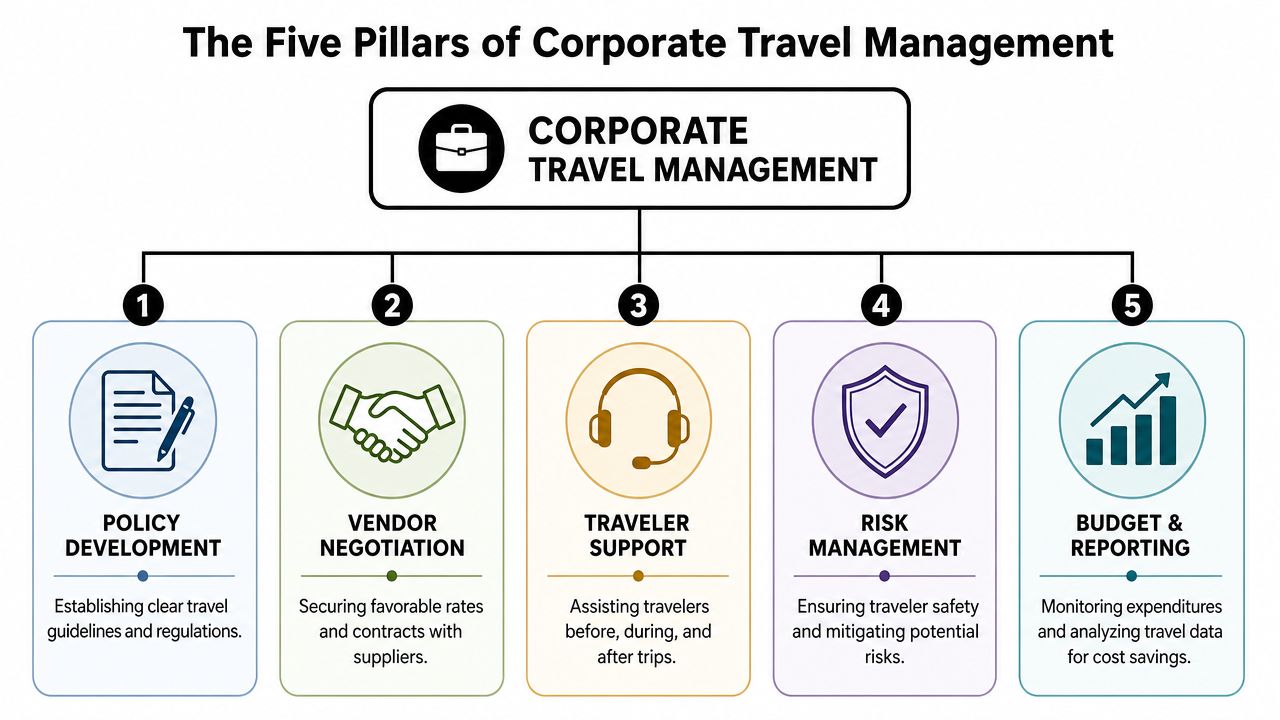
Policy development and compliance
Policy is the operating manual for your travel program. It defines booking channels, cabin rules, hotel rate limits, approval workflows, reimbursement standards, and exception handling.
Good policy is specific enough to guide behavior and flexible enough to survive real travel conditions. Bad policy reads like finance wrote it without talking to travelers. If employees need to break the rules to complete a normal trip, they will.
In practice, this pillar looks like:
- Clear booking rules: use approved channels, preferred suppliers, and documented approval steps
- Defined exception paths: traveler needs a higher room category for security, accessibility, or client-facing reasons
- Usable language: people should understand the rule on first read, not after three emails
Cost control and financial optimization
Cost control isn't just “spend less.” It's spend deliberately. The travel manager looks for waste, leakage, unnecessary fees, poor booking behavior, and missed supplier value.
That includes more than airfare. Hotel attachment, change fees, unused tickets, card controls, reimbursement behavior, and last-minute booking patterns all matter. Cost optimization also means knowing when not to chase the absolute lowest price. A cheaper itinerary with a risky connection can become far more expensive when it fails.
A useful cost lens is total trip cost, not line-item price. The lowest fare can still be the wrong decision.
Vendor and TMC management
Suppliers shape the traveler experience every day. Airlines, hotels, rail providers, car rental companies, chauffeured transport firms, payment providers, online booking tools, and the TMC all influence service quality and compliance.
This pillar involves contract discipline and active oversight. Don't assume a preferred vendor is performing well just because they're on the list. Review missed service levels, response times, data quality, escalation handling, and traveler complaints.
A travel manager should know:
- Which vendors deserve more volume
- Which ones need corrective action
- Which relationships look good in a quarterly review but fail under pressure
Duty of care and traveler safety
This is the part of the job that becomes visible during disruption. You need a way to locate travelers, communicate quickly, document decisions, and route emergencies to the right support partners.
Duty of care also starts before departure. A traveler who understands entry requirements, local conditions, hotel location risk, and after-hours support is less likely to become an emergency case.
Technology and data analysis
Technology should reduce manual work and improve control. It should not add another layer of friction that employees avoid.
Look for tools that help you enforce policy, centralize trip data, connect booking to expense, and surface exceptions quickly. Then use that data to answer practical questions: Where is spend leaking? Which routes justify renegotiation? Which teams book too late? Which vendors create more support tickets than they should?
Here's the simplest test for this pillar:
| Pillar use case | What good looks like |
|---|---|
| Booking | Travelers can book within policy without asking for help on every trip |
| Approval | Managers can approve quickly and see what's out of policy |
| Reporting | Spend, compliance, and exceptions are visible without manual spreadsheet cleanup |
| Support | Traveler itineraries and contact details are accessible during disruptions |
A Day in the Life of a Travel Manager
Most days don't unfold in a neat sequence. You start with a plan, then the inbox rewrites it.

A typical morning often begins with triage. Overnight bookings need review. A few trips are out of policy. One employee selected a non-preferred hotel because it was closer to the client site. Another booked a fare that looks high until you notice it avoided a risky late connection before a board meeting. Travel management is full of these small judgment calls.
Morning work is usually operational
You might spend the first block of the day doing things like:
- Reviewing exceptions: decide whether a policy breach is justified or whether the traveler needs a compliant rebook
- Checking disruptions: identify delays, cancellations, weather impacts, or strikes that could affect today's travelers
- Coordinating with the TMC: resolve ticketing issues, traveler changes, queue delays, or service escalations
- Answering traveler questions: baggage rules, airport transfers, profile updates, unused credits, visa documentation
By midday, the role usually shifts from reactive to analytical. You review recent spend, compare booking behavior across departments, and prepare notes for finance or procurement. If one business unit consistently books late, the problem may not be traveler behavior alone. It might be a broken internal approval chain.
Afternoons tend to be strategic
The stronger travel managers separate themselves from the purely administrative ones. They carve out time for supplier reviews, policy adjustments, and trend analysis instead of living only in same-day support.
A realistic weekly rhythm might include:
- Supplier meetings: discuss service failures, negotiated terms, traveler complaints, or market changes
- Policy maintenance: tighten one rule, relax another, or clarify language that's causing confusion
- Stakeholder reporting: brief finance, HR, security, or executive assistants on traveler activity and issues
- Program cleanup: remove duplicate traveler profiles, resolve card problems, close open cases, and audit unused ticket balances
The role gets easier when you stop treating every issue as a one-off. Repeated exceptions usually point to a process problem.
Late in the day, you may get the kind of request that defines the job. An executive adds two investor meetings and needs same-day ground changes. A regional team needs coordinated arrivals for a customer event. A traveler misses the last flight out and needs a hotel, rebooking, and manager notification. None of that is unusual. That's the work.
Measuring Success with Key Performance Indicators
A travel program looks healthy right up until leadership asks a simple question: what did the company get for the spend? If your answer is limited to ticket volume or total cost, the program will be judged as an administrative function. A stronger scorecard shows whether travel supports revenue, protects travelers, and stays within reasonable controls.
Savings still matter. They just do not stand alone. I judge performance across four areas: cost discipline, policy compliance, service quality, and risk response. That mix gives finance a clear view of spend, while also giving HR, security, and executive stakeholders a view of how the program performs under real operating pressure.
The metrics that matter most
Use KPIs that explain behavior and decision quality, not just end totals.
| KPI | What It Measures | Industry Benchmark/Goal |
|---|---|---|
| Cost savings | Whether supplier negotiations, policy controls, and booking behavior are reducing overall travel expense | Aim for sustained savings opportunities. Effective travel management can reduce expenses by up to 30% according to the GBTA estimate cited by Navan |
| Average cost per trip | The blended cost of air, hotel, ground, and related trip components | Goal depends on trip type, route mix, traveler seniority, and service expectations |
| Policy compliance rate | How often travelers book within approved guidelines | Goal is steady improvement and fewer exceptions with weak business justification |
| Online booking adoption | Whether travelers are using approved tools instead of booking outside the program | Goal is broad adoption for standard trips, with managed support for complex itineraries |
| Advance booking behavior | How early trips are booked and whether avoidable late booking patterns are increasing cost | Goal is earlier booking where the business can plan ahead |
| Unused ticket recovery | How effectively the program tracks and reuses air credits | Goal is to reduce expired value and tighten follow-up |
| Traveler satisfaction score | Whether travelers feel supported before, during, and after trips | Goal is stable satisfaction without giving up policy control |
| Response time on disruptions | How quickly support reaches affected travelers during delays, cancellations, or emergencies | Goal is fast intervention and clear communication |
| Executive ground transportation performance | Whether VIP and executive transfers run on time, follow protocol, and protect duty of care | Goal is reliable service, low failure rates, and tight coordination with assistants and security teams |
That last metric gets missed too often. For senior leadership, ground transportation is not a minor add-on. It affects punctuality, confidentiality, personal safety, and the company's image with clients and investors. A missed airport pickup for a sales rep is frustrating. A service failure involving a board member, investor roadshow, or high-profile client meeting can create operational and reputational problems in the same hour.
How to read the numbers correctly
A lower average trip cost can signal smart buying. It can also mean travelers are taking poor connections, losing productive time, or arriving too drained to perform well. High compliance can mean the policy is working. It can also mean travelers gave up asking for help and found workarounds outside the program.
Read KPIs in groups so you can see the trade-offs clearly:
- Cost + compliance: shows whether savings come from better booking behavior or from restrictive rules that create friction
- Satisfaction + exception volume: shows whether the policy works in real travel conditions
- Advance booking + approval cycle time: shows whether late purchases are a traveler issue or a management bottleneck
- Response time + disruption outcomes: shows whether support resolves problems quickly or just acknowledges them
- Ground transport service levels + executive complaints: shows whether your highest-stakes itineraries are being handled with the right level of control
This is also where policy design matters. If your numbers show recurring confusion around booking channels, class of service, or approval rules, tighten the language and remove ambiguity. A clear corporate travel policy template for standardizing approvals and exceptions often improves compliance faster than another reminder email.
Track trends over time. One cheap quarter can hide rising traveler frustration, weak adoption, or a support model that fails during disruptions.
Keep reporting concise. Senior leaders usually need a monthly or quarterly view that answers three questions: where spend is changing, where risk is building, and which corrective actions you recommend. That is the difference between reporting activity and managing a program like a business partner.
Essential Tools and Templates for Travel Managers
A travel program gets fragile when it depends on heroic manual effort. You want systems, not workarounds. The right stack reduces email traffic, shortens approval cycles, improves policy compliance, and gives you cleaner reporting when leadership asks for answers quickly.
The core software stack
Most corporate programs rely on a few categories of tools:
- TMC platforms: used for agent support, itinerary management, after-hours servicing, and complex trip handling
- Online booking tools: traveler self-service with policy guardrails, approval flows, and supplier displays
- Expense platforms: systems such as SAP Concur and Navan that connect spend capture, reimbursement, and audit visibility
- Risk management platforms: tools such as International SOS for traveler alerts, destination intelligence, and emergency support workflows
- Communication tools: Microsoft Teams, Slack, email automation, and mobile messaging for rapid traveler updates
The goal isn't to buy the most software. It's to make the workflow coherent. Booking, approval, payment, expense, and support should connect cleanly enough that travelers don't invent side channels.
The templates worth standardizing
Templates are underrated. They reduce confusion, speed up approvals, and make your data more usable later.
Keep a standard set ready:
Pre-trip approval form
Capture business purpose, destination, estimated cost, manager approval, and any exception request.Traveler profile checklist
Include legal name, loyalty programs, seating preferences, passport details where appropriate, emergency contact, and accessibility needs.Traveler feedback survey
Ask what failed, what support was missing, and whether the booking options matched the business need.Vendor performance scorecard
Track service reliability, responsiveness, invoice accuracy, escalation handling, and traveler sentiment.Emergency contact tree
List internal owners, after-hours support routes, and escalation contacts by region.
If you're rebuilding policy documents from scratch, this corporate travel policy template guide is a practical starting point.
One more point on tools. Don't overlook specialist ground providers when the trip is complex, security-sensitive, or executive-facing. For example, MLR Worldwide Service handles executive chauffeur services, airport transfers, FBO support, corporate roadshows, and real-time itinerary coordination through a 24/7 concierge operations team. That kind of provider fits best when standard ride-hail or unmanaged local transport creates too much operational risk.
Mastering Executive Ground Transportation Coordination
Executive travel exposes every weak point in a travel program. A minor delay becomes a visible failure. A missed pickup can derail a board meeting, investor roadshow, media appearance, or aircraft departure. Standard process is rarely enough.

Why executive ground is different
Senior leaders usually need more than a car reservation. They need timing precision, discreet handling, flexible routing, and clean communication between air and ground. The travel manager often becomes the coordinator between executive assistants, security, aviation teams, FBO staff, and the transport provider.
The trade-off is simple. Standard transport may cost less upfront, but it often creates more uncertainty. Executive schedules usually don't tolerate uncertainty well.
The higher standard typically includes:
- Punctuality under changing schedules: live monitoring of arrival changes, meeting overruns, and revised departure times
- Discretion: chauffeur conduct, low-friction pickups, and minimal public exposure
- Vehicle fit: sedan, SUV, van, or secure transport based on passenger count, baggage, and profile
- Airport and FBO coordination: correct pickup point, tail number awareness where relevant, and tight handoff timing
A practical SOP for executive transport
For new travel managers, a simple standard operating procedure helps prevent avoidable mistakes.
Step 1: Vet the provider
Confirm service area, fleet consistency, insurance documentation, chauffeur standards, after-hours coverage, and escalation process. Ask how they handle diversions, early arrivals, and security-sensitive requests.
Step 2: Build the movement brief
Share passenger name, mobile contact, manifest if needed, pickup window, luggage notes, route priorities, and any privacy or security instruction. For executive travel, preferences matter. Quiet ride, preferred vehicle type, bottled water, no branding, or direct tarmac coordination should be documented once and updated as needed.
Step 3: Confirm communication ownership
Decide who gets live updates. Sometimes it's the executive assistant. Sometimes it's aviation ops. Sometimes it's the travel manager only. Too many people in the chain can create contradictory instructions.
Step 4: Prepare for same-day changes
You need one channel for revisions and one person who can authorize them. Last-minute changes happen constantly in executive travel. The failure point is usually not the change itself. It's fragmented communication.
Step 5: Close the loop after service
Review whether the pickup timing, chauffeur conduct, routing, and billing matched expectations. Save notes for the next trip.
Executive ground transportation isn't a commodity purchase. It's a continuity function for high-value schedules.
If your program includes private aviation, investor meetings, or tightly sequenced city stops, this guide to executive ground transportation reflects the level of coordination you should expect from a premium provider.
Handling Escalations and Travel Emergencies
A travel emergency is the moment when policy turns into practice. The calmest travel managers are usually the ones who already decided, in advance, how an escalation should work.
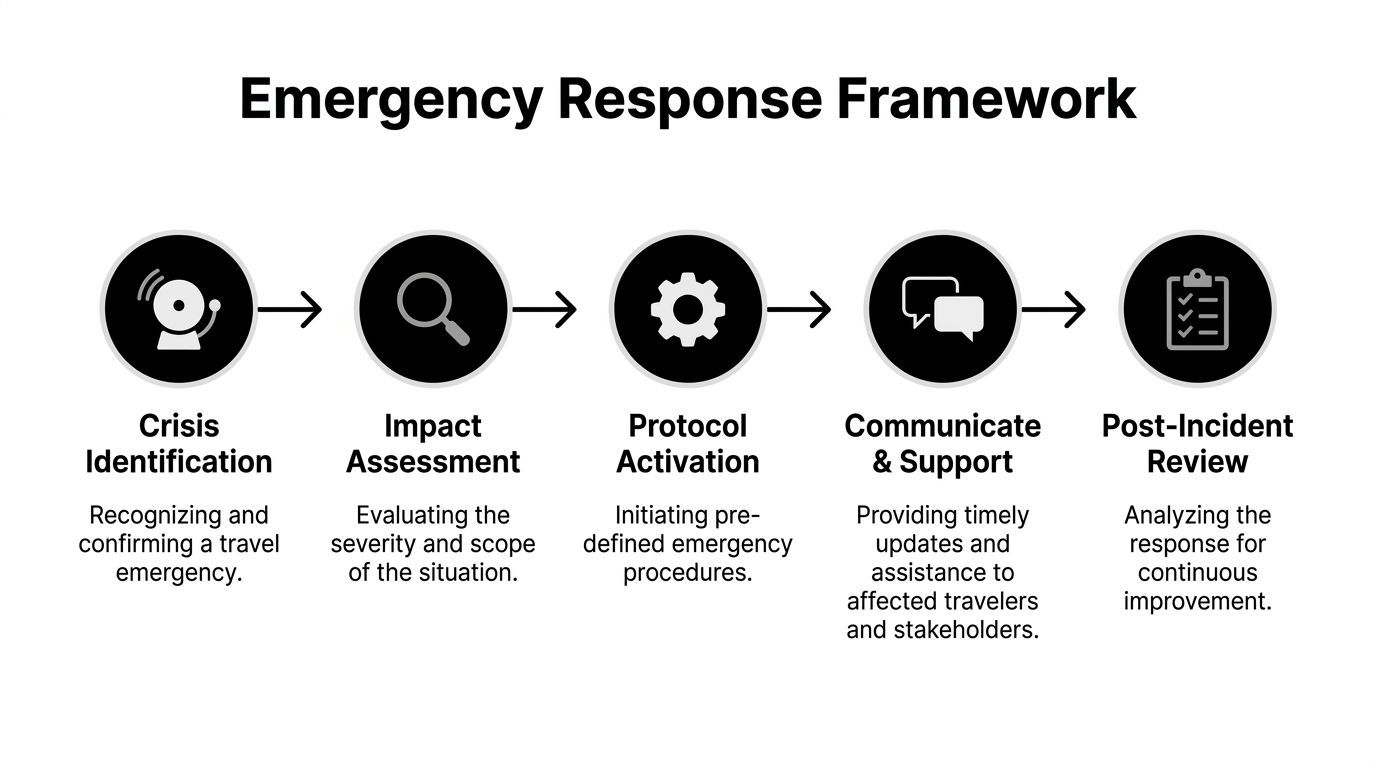
Keep the response framework simple enough to use under pressure.
The response checklist
- Identify the incident: confirm what happened, who is affected, and whether the issue is medical, security-related, logistical, or document-related
- Assess impact: determine traveler location, urgency, onward travel risk, and who internally needs immediate notice
- Activate support: contact the TMC, risk provider, security partner, hotel, airline, or ground operator based on the incident type
- Communicate clearly: send short updates to the traveler, manager, HR, security, or executive support team as appropriate
- Document the case: record decisions, timings, contacts, and unresolved items for follow-up
For individual incidents like lost passports or missed connections, speed and clarity matter most. For larger disruptions such as severe weather or civil unrest, traveler tracking and message discipline matter more. Either way, one owner should coordinate the case from start to finish.
During a disruption, travelers don't need long policy explanations. They need to know who is helping, what happens next, and when they'll hear from you again.
After the incident, review what failed. If the same emergency creates confusion twice, your process still isn't ready.
If your travel program includes executive movements, private aviation connections, roadshows, or high-touch airport transfers, MLR Worldwide Service can support the ground side of that operation with coordinated chauffeur service, FBO support, and real-time itinerary management that fits into a broader corporate travel program.