
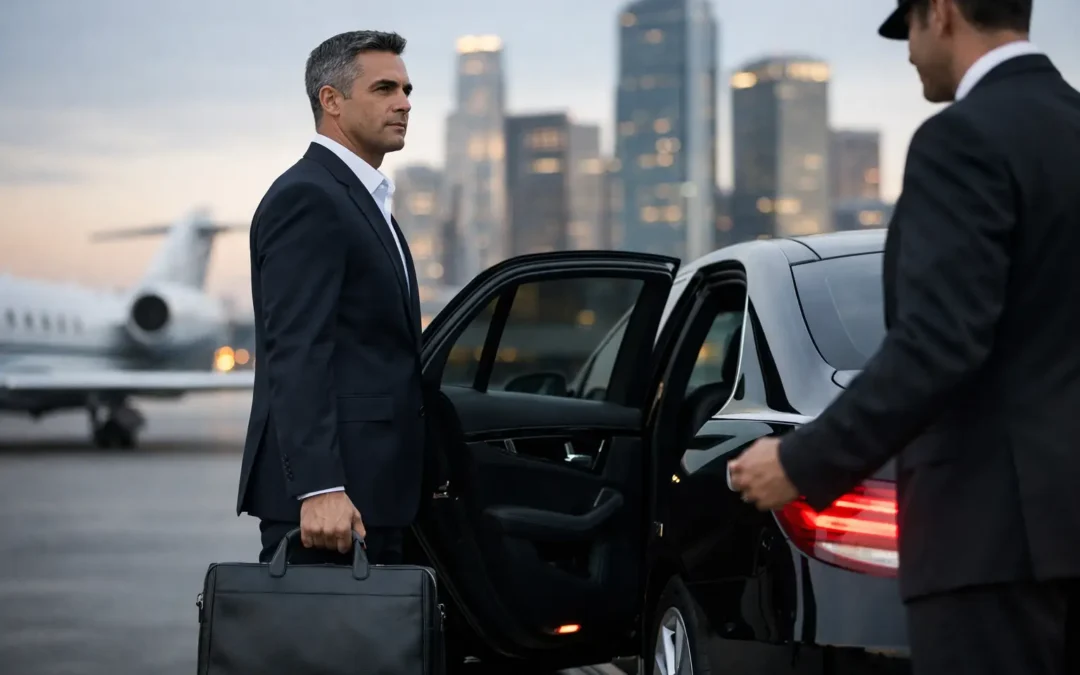
A chief executive lands 40 minutes early at a private terminal. A board meeting moves across town. Security requirements change before the aircraft door opens. In this environment, the future of executive ground travel is not defined by a newer vehicle or a faster booking screen. It is defined by whether a transportation partner can absorb complexity without transferring it to the traveler, executive assistant, or flight department.
For high-value travelers, ground transportation has become a critical extension of the executive itinerary. The vehicle is a private workspace, a recovery space between flights, and often the first controlled point of arrival in an unfamiliar city. The standard is shifting accordingly: punctual pickup remains essential, but it is only the beginning.
The Future of Executive Ground Travel Is Managed Mobility
Executive mobility is moving away from the transactional model of requesting a car for a single trip. The more valuable model treats each movement as part of a larger operational plan, accounting for aviation schedules, meeting timing, hotel access, local traffic patterns, security preferences, luggage requirements, and the people traveling alongside the principal.
That distinction matters most when the itinerary changes. A delayed commercial flight, an early arrival at an FBO, a last-minute roadshow stop, or an added guest can expose the limits of a basic ride-hailing or local dispatch arrangement. A managed transportation program anticipates likely points of friction and gives clients a clear line of support when plans need to be revised.
For executive assistants and corporate travel teams, this means less time spent confirming details across multiple providers. For the traveler, it means arriving prepared rather than managing logistics from the back seat. The value is not simply transportation. It is time protection.
The chauffeur becomes an informed service professional
Technology will continue to shape the booking and coordination process, but the chauffeur’s role will become more significant, not less. Premium travelers do not need an automated message when a situation requires judgment. They need a trained professional who understands arrival protocols, preferred routes, luggage handling, appropriate communication, and the importance of remaining calm under pressure.
The strongest chauffeur services will invest in briefing standards rather than relying only on navigation tools. A chauffeur assigned to a board-level client should know the pickup location, flight status, vehicle preference, passenger count, relevant access instructions, and the degree of interaction appropriate to the client. Absolute discretion is not a feature added at the end of the trip. It is present in every decision made before the vehicle arrives.
Intelligence Will Improve Execution, Not Replace Judgment
Artificial intelligence, real-time aviation data, predictive traffic analysis, and integrated itinerary tools will become standard components of executive ground transportation. Their greatest contribution will be earlier visibility into potential problems.
A system that identifies a gate change, tracks an inbound aircraft, flags a road closure, or recognizes that a multi-stop itinerary is no longer practical can help operations teams respond before an executive is inconvenienced. This is particularly valuable for private aviation travelers, corporate roadshows, airline crews, and events where one late vehicle can affect an entire schedule.
Yet automation has limits. Flight data may show that an aircraft has landed, but it cannot always account for a principal who needs to remain onboard, a customs delay, a change in aircraft parking, or a confidential request made moments before arrival. The future belongs to providers that pair intelligent systems with 24/7 human oversight.
Communication will become more selective and more useful
Premium service should not create a stream of unnecessary notifications. Senior leaders and their support teams need concise, relevant updates: chauffeur assigned, vehicle positioned, flight monitored, itinerary revised, or issue resolved. They do not need to chase a dispatcher for confirmation or interpret vague status messages.
This is where concierge-level coordination has a clear advantage. The right team understands who should receive updates, how much information they need, and when direct contact with the traveler is appropriate. For an executive assistant, a quiet confirmation that the vehicle is in position can be more valuable than a dozen automated alerts.
Privacy and Security Will Set a Higher Standard
As executive travel becomes more connected, privacy becomes more demanding. Vehicles increasingly hold sensitive conversations, devices, documents, and travel patterns. The standard for premium ground travel must include careful handling of passenger information, disciplined chauffeur conduct, and operational processes designed to minimize unnecessary exposure.
Privacy also extends beyond data. It includes avoiding conspicuous behavior at hotels, residences, private terminals, and event venues. It means understanding when a principal requires a discreet arrival, when a security team needs to coordinate movements, and when an alternate pickup point is the better choice.
For certain travelers, secure transportation will require closer coordination with corporate security, executive protection teams, and venue personnel. This does not mean every trip should feel restrictive. It means the service provider has the capability to adjust the operating plan when the risk profile changes.
The trade-off is clear: greater security requires more detailed planning and, at times, less flexibility around vehicle placement or departure timing. A trusted provider makes those constraints manageable by communicating early and executing without unnecessary disruption.
Fleet Expectations Will Become More Purposeful
Luxury will remain central to executive transportation, but fleet selection will be less about appearance alone. The appropriate vehicle depends on the mission: a discreet executive sedan for one principal, an SUV for luggage and security personnel, a premium van for a leadership team, or a coordinated fleet for a conference or roadshow.
Clients will increasingly expect vehicles that support the way they work and travel. That includes immaculate interiors, reliable climate control, charging capability, strong connectivity where available, and sufficient space to take calls or review materials in comfort. For long transfers, ride quality and cabin privacy may matter more than making a visual statement.
Electrification will also influence fleet strategy, especially in cities with emissions restrictions and clients with formal sustainability commitments. Electric luxury vehicles can be an excellent fit for planned urban movements, hotel transfers, and certain airport routes. They are not automatically the best choice for every itinerary.
Charging access, weather, route distance, luggage capacity, and the availability of qualified vehicles all affect the decision. A responsible provider will recommend the vehicle that protects the itinerary, rather than treating sustainability as a promise detached from operational reality.
Global Consistency Will Matter More Than Local Familiarity
An executive may require transportation in New York on Monday, London on Wednesday, and Dubai the following week. In each city, local knowledge is indispensable. But local knowledge without shared service standards creates an uneven client experience.
The future of executive ground travel depends on globally coordinated service with local execution. That means consistent chauffeur vetting, fleet expectations, communication protocols, invoicing practices, and escalation procedures across destinations. It also means respecting local conditions rather than forcing a single operating model onto every market.
A pickup at a private terminal in Los Angeles will not follow the same process as an arrival at a major international airport in Europe. Traffic, access rules, language, security considerations, and local hospitality norms all differ. The client should not need to understand those differences. Their transportation partner should.
For multinational organizations and frequent private aviation travelers, this consistency reduces risk. It also gives travel managers a single accountable relationship rather than a patchwork of regional providers with varying standards.
The New Measure of Premium Service Is Recovery
No transportation operation can prevent every disruption. Weather closes roads. Aircraft divert. Meetings overrun. Event venues change access procedures. The differentiator is how quickly and quietly the provider recovers.
Recovery requires more than a backup vehicle. It requires a live operations function with authority to make decisions, a qualified affiliate network, precise traveler profiles, and enough situational awareness to propose solutions rather than merely report problems. When a flight diverts or an executive is held in a meeting, the ideal response is already in motion before the client has to ask.
This is why price alone is a poor measure of executive transportation value. The lowest initial quote may not account for after-hours support, flight monitoring, contingency planning, qualified chauffeurs, or the ability to reposition resources on short notice. For a routine airport transfer, those distinctions may appear minor. For a time-sensitive executive movement, they can determine whether the day remains on schedule.
MLR Worldwide Service sees this shift clearly: the most effective executive mobility programs combine refined vehicles with disciplined coordination, informed chauffeurs, and support that remains available when the itinerary stops being predictable.
The road ahead will be more connected, more data-driven, and more responsive. But the enduring expectation will remain straightforward: when an executive steps outside, the right vehicle, the right chauffeur, and the right plan should already be in place.