
An executive lands at LaGuardia with two bags, a laptop case, and a calendar that does not forgive delays. The terminal looks polished, but the curb still decides how smooth the trip becomes. At LGA, that last mile is where privacy, punctuality, and baggage handling either hold together or fall apart.
For corporate travel teams, the problem is not getting a car. The problem is getting the right car, at the right curb, with the right level of discretion, every time. LGA airport transportation has to be treated as an operational decision, not an afterthought, because the airport still runs on road access rather than rail, and the ground experience reflects that reality.
Understanding LGA Transportation Challenges
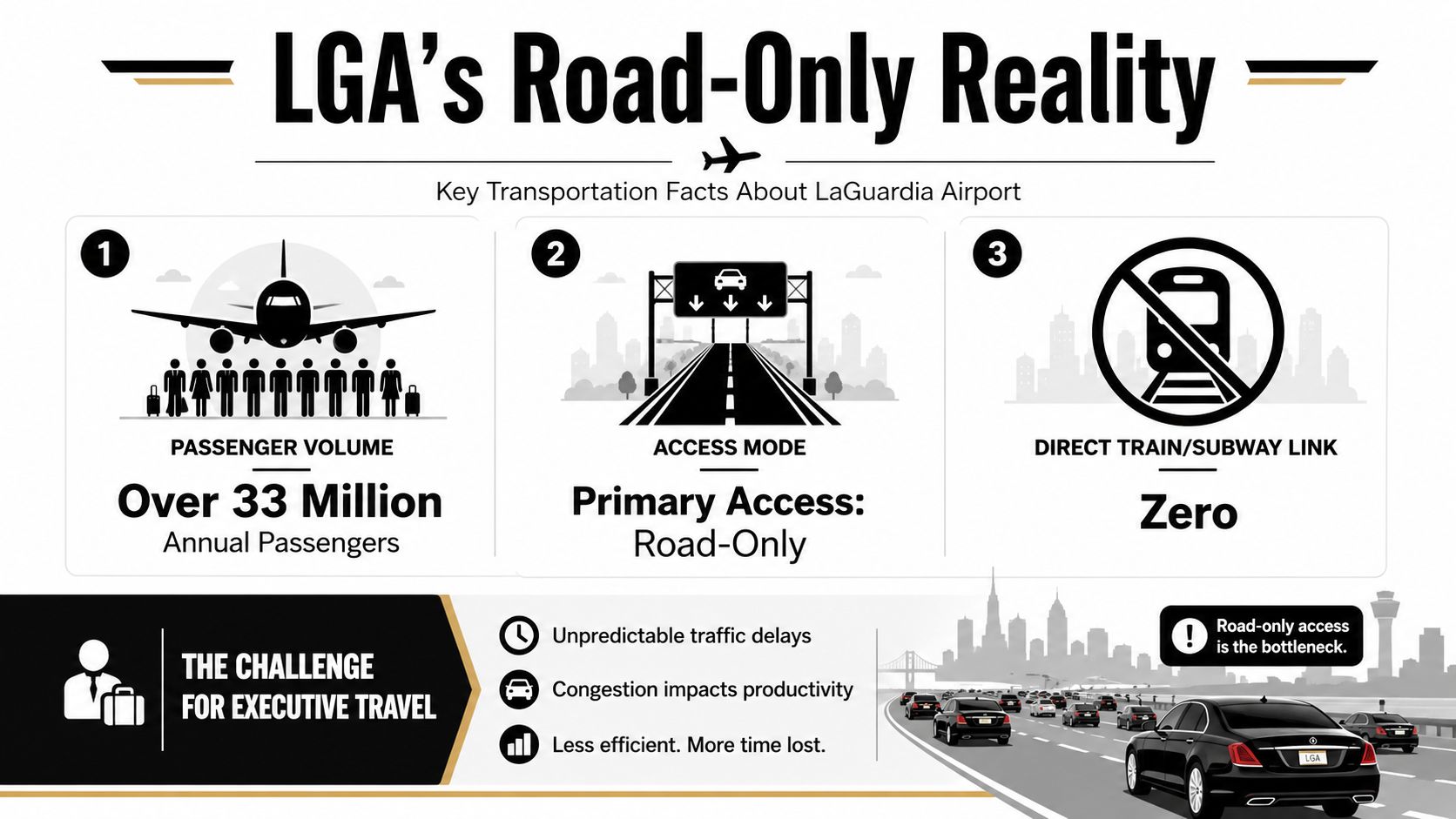
LaGuardia is busy enough to punish casual planning. In 2024, the airport handled more than 33 million passengers annually, with about 16.77 million arrivals and 16.77 million departures, and its busiest month was July at roughly 3.40 million passengers (Road Genius statistics on LGA). That scale keeps the curb under constant pressure, and it makes pickup timing, baggage handling, and vehicle access matter more than they do at quieter airports.
Why road access changes the equation
LGA has no direct subway or train service, unlike JFK and Newark, so travelers rely on taxis, ride-hailing, buses, and private car service for the final leg (Black Car NYC's LGA guide). That single fact drives the transportation decision. If your traveler carries multiple bags, has a mobility constraint, or needs to reach a meeting in Manhattan without delay, the ground move is part of the trip, not an add-on.
The airport's public-transit setup reinforces that road-first reality. LGA says five different bus routes serve the airport and connect passengers to the subway, Metro-North Railroad, and the LIRR (LGA public transport). That works for budget travel and light bags. It is a poor fit for executives who need a direct handoff from curb to destination, and it adds friction that privacy-sensitive travelers should avoid.
For teams that need a broader view of airport access patterns, the MLR Worldwide Service gateway travel guide is useful background, but the operational point stays the same. C-suite travel planning at LGA should start with the curb, not the terminal.
Practical rule: If the traveler cannot absorb uncertainty at the curb, do not make public transit the default plan.
Most generic LGA airport transportation advice assumes every traveler has the same luggage, the same schedule, and the same tolerance for transfers. Executive travel does not work that way. The right choice depends on discretion, baggage load, and whether the traveler needs a direct, reliable last mile.
Understanding LGA Transportation Environment
LaGuardia works like a road-first airport, so transportation planning has to be specific. That point is clearer when you look at broader airport activity, including the freight and passenger pressure that keeps the curb busy and makes last-mile timing less forgiving. A traveler with several bags, limited mobility, or a meeting schedule that cannot slip should treat the ground transfer as part of the trip, not as a separate detail.
What the airport's setup means for executives
LGA does not lack transportation options. It lacks direct rail access, so travelers still choose between road-based convenience and transit that adds steps. The subway extension has been discussed, but the airport still depends on buses for mass transit today. MLR Worldwide Service's USA gateway travel overview gives useful background on why that matters for business itineraries that depend on predictability.
For executives, that setup creates three clear pressure points. Curbside pickups get crowded fast. Luggage handling becomes a real variable, especially for travelers with multiple bags. Privacy also depends on how visible the pickup point is and how long the traveler has to wait outside. For C-suite travel, those tradeoffs are enough to rule out weak options.
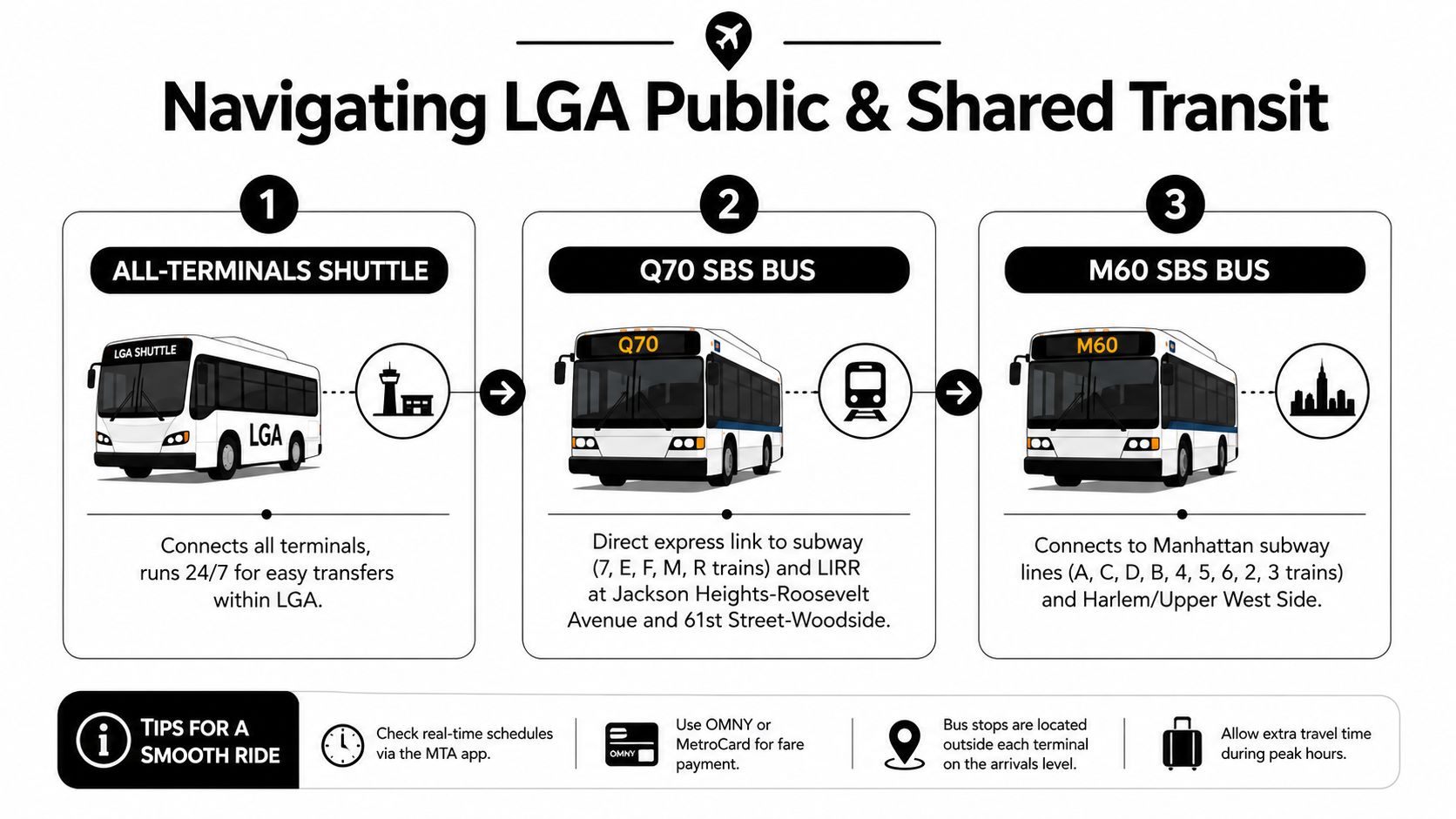
The airport's all-terminals shuttle shows the same pattern inside the airport footprint. It runs 24/7 at 15-minute frequency during peak hours and 20-minute frequency off-peak. That is a practical service for terminal movement, but it still requires coordination. A VIP who misses the shuttle window is still losing time in transit instead of staying in a private vehicle. LGA all-terminals shuttle
The right LGA airport transportation choice should follow the traveler's baggage load, mobility needs, and privacy requirements, not just the lowest fare. That is the practical rule at a road-access airport. If the traveler cannot tolerate uncertainty at the curb, choose a direct option and book ahead.
Transport Options Overview and Comparison
The cleanest way to choose LGA airport transportation is to judge each option on time, cost, and control. For executive travel, those are the three variables that matter. A direct car trip from LGA to Manhattan usually takes 25-45 minutes by car. Yellow taxis are around $35-55, ride-hailing is around $30-65, and fixed-price car service is quoted at $140 in the guide noted earlier. That range gives you a quick read on the tradeoff before you compare comfort or privacy.
Comparison of LGA Transportation Modes
| Mode | Travel Time | Estimated Cost | Pros | Cons |
|---|---|---|---|---|
| Public transit | Varies by transfers | Lower-cost option | Budget-friendly, connects to subway network | Multiple transfers, poor fit for heavy luggage or tight schedules |
| Airport shuttle | Varies by route | Shared-service pricing | Predictable for terminal moves, useful for internal airport transfers | Shared stops reduce privacy and speed |
| Yellow taxi | 25-45 minutes by car to Manhattan | $35-55 metered | Direct, easy to find at curb, familiar to travelers | Queue visibility, variable comfort, luggage space can be limited |
| Ride-hailing | 25-45 minutes by car to Manhattan | $30-65 | Convenient app booking, flexible pickup | Vehicle and driver quality can vary, curbside uncertainty |
| Fixed-price car service | 25-45 minutes by car to Manhattan | Around $140 | Predictable pricing, better for planning | Higher cost, not all providers offer the same service standard |
| White-glove chauffeur service | Varies by itinerary | Typically premium | Door-to-door planning, discreet pickup, baggage help | Requires advance coordination |
The table points to a clear conclusion. If the traveler is alone, carrying light luggage, and does not care about pickup exposure, a taxi or ride-hail is acceptable. If the traveler has multiple bags, arrives late, or goes straight into a board meeting, privacy and reliability outrank small savings.
How to read the tradeoffs correctly
Taxis and ride-hailing are fine for simple point-to-point trips, but they still put the traveler at the mercy of curbside conditions. Public transit can move people into the city at lower cost, but it asks too much of a traveler who is on a tight schedule or managing luggage in transit. Fixed-price service removes pricing uncertainty, yet the actual experience still depends on the operator, not the fare.
Decision rule: Choose the option that protects the itinerary, not the option that looks cheapest in isolation.
For most executives, the right answer is private chauffeured service for the first and last mile, with transit used only when the schedule is loose and baggage is minimal. That is the practical center of LGA airport transportation for travelers who value control, privacy, and a clean arrival experience.
Public and Shared Services Explained
LGA's public and shared options work in specific situations, and they work best when the traveler has time to spare. The airport's all-terminals shuttle runs around the clock with predictable peak and off-peak frequency, so terminal-to-terminal movement is straightforward once the schedule is known. That makes it a practical internal transfer tool, not a premium curb-to-city solution.
The routes that matter
The airport bus links are the main public connection to the wider transit network. The Q70 SBS bus and the M60 SBS bus are the routes most travelers use to reach the subway network, and LGA states that these services connect passengers to the subway, Metro-North Railroad, and the LIRR through the broader bus system. That structure works best when cost is the main priority.
For baggage-heavy travelers, the weakness is obvious. Every transfer adds a handoff, and every handoff adds friction. Even when the route is technically simple, the traveler still has to move bags, wait at stops, and manage platform changes. That is acceptable for a solo traveler with a backpack. It is a poor fit for an executive with a roller bag, briefcase, and back-to-back meetings.
When shared transit still makes sense
Use the shuttle and bus network when the traveler meets one of these conditions.
- The itinerary is flexible: The traveler can tolerate transfer time without risking a missed meeting.
- Luggage is light: One carry-on and a small personal item are manageable on shared transit.
- Budget matters more than privacy: The trip is not sensitive, and the traveler is comfortable in public spaces.
- Terminal movement is the goal: The shuttle is useful for moving between terminals, especially when a connection is involved.
A short video overview can help travelers see the route structure before they depart.
For corporate teams, public transit has a narrow use case. It is not the default answer for LGA airport transportation when privacy, baggage handling, or mobility are on the line.
For executives who need a controlled transfer rather than a public curbside process, a private option such as MLR Worldwide Service's executive car service in NYC is the cleaner choice.
Private Chauffeured Services for Executives
For high-value travelers, the right answer is usually a private chauffeur, not a curbside search. Yellow taxis are available, and ride-hailing is convenient, but neither one guarantees the same level of control over vehicle quality, meeting point, or baggage support. A professional black car removes that uncertainty before the traveler ever reaches the curb.
Why private service wins on reliability
A pre-booked chauffeur service gives the travel manager control over the handoff. The car is assigned in advance, the pickup point is set, and the driver is expecting the flight rather than reacting to it. That matters at LGA because the airport's road-first layout already creates friction, and any avoidable uncertainty adds to the delay.
A common mistake is treating all private rides as interchangeable. They are not. A metered taxi is on-demand and functional. A ride-hail app is convenient, but the vehicle and driver can vary. A professional black-car provider is built for executive expectations, including better coordination, better presentation, and less visible pickup behavior.
Operational truth: The executive doesn't need transportation. The executive needs a controlled transfer.
A service like MLR Worldwide Service's executive car service in NYC fits that model. It is a private transfer built around door-to-door planning, which is the right fit for LGA.
What executives should expect from the service model
The strongest private services add value before the car even arrives. They monitor the flight, coordinate the curbside meeting point, and reduce the need for the traveler to deal with airport congestion or crowded pickup zones. That matters for travelers who arrive with multiple bags or need a careful handoff after a long flight, a detail many generic guides still gloss over. The point is simple. Private chauffeur planning solves the part of the trip that public curbside options handle least well.
Privacy is the other advantage. A black car or pre-arranged chauffeur keeps the movement discreet, avoids the visibility of public queues, and lowers the chance that a sensitive arrival becomes common knowledge. For executives, that is not a luxury feature. It is part of the travel risk profile.
How the options stack up
- Metered taxis: Useful when speed matters and the traveler is comfortable with standard service.
- App-based ride-hail: Good for convenience, but less consistent in vehicle presentation and curbside certainty.
- Black car fleets: Better for planning, privacy, and executive comfort.
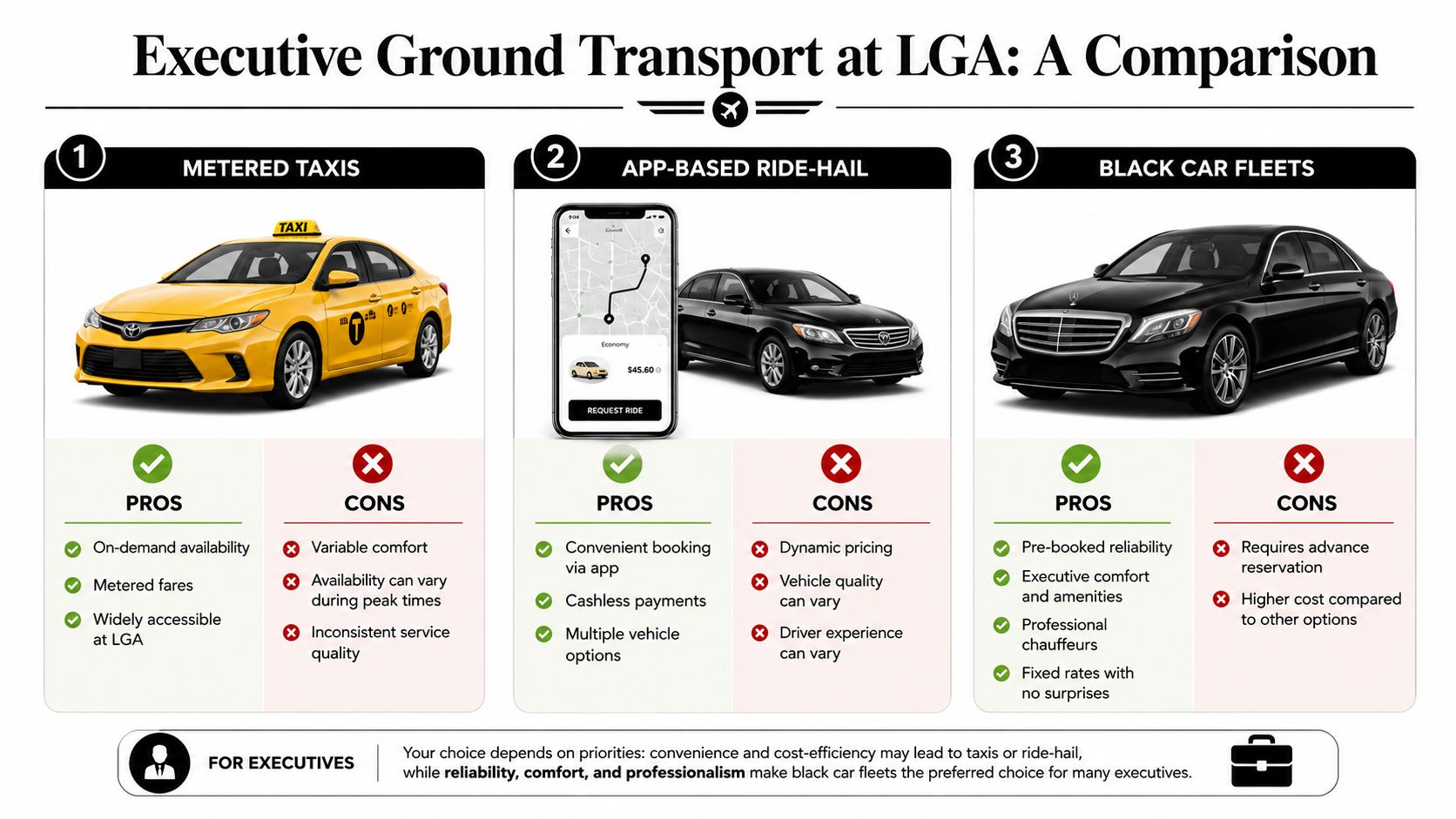
For C-suite travel, the conclusion is direct. If the schedule matters and the traveler's privacy matters, standard curbside options are the fallback, not the plan.
Booking Logistics and Cancellation Strategies
Good ground transport is booked like an asset, not ordered like a pizza. If the itinerary is fixed, reserve early and lock in the pickup details before the flight day. If the itinerary is fluid, choose a provider that can handle schedule changes without forcing the traveler back into the curbside scramble.
Build the booking around the traveler, not the reservation form
The first step is to define the trip's failure points. Is the traveler landing late? Carrying multiple bags? Traveling with an assistant or family member? Moving through the airport after a long-haul flight? Each of those conditions changes the ideal vehicle and pickup method.
Then decide how much flexibility the provider needs to preserve. Corporate accounts matter here because they can simplify recurring trips, passenger name changes, and last-minute shifts. The best arrangements also let travel managers set preferences once, then reuse them across repeated airport transfers instead of rebuilding each booking from scratch.
A clean booking process should always answer these questions:
- Who is the primary traveler? This avoids confusion if the assistant books on behalf of an executive.
- What luggage is being carried? Vehicle choice should match the load.
- Where is the pickup point? A precise curb location prevents missed connections.
- What happens if the flight changes? The provider should already know.
- What is the cancellation policy? No one should learn this at the curb.
Cancellation strategy should protect the schedule first
Do not optimize only for refund language. A cheap reservation that fails when the flight shifts is more expensive than a flexible premium booking that absorbs changes cleanly. If a provider offers an operations desk, flight tracking, or concierge recoordination, that's worth more than a slightly lower rate. The reason is simple, the cost of one failed executive transfer is higher than the difference between a few service tiers.
For multi-leg trips, assign the same provider across arrivals, hotel transfers, and outbound departures whenever possible. That keeps the traveler's experience consistent and reduces communication errors. For VIP movements, consistency is part of the service, not a nice-to-have.
Booking standard: If the client can't explain the pickup in one sentence, the booking isn't ready.
The best LGA airport transportation plans are boring in the right way. The driver knows the flight, the traveler knows the meeting point, and the operations team knows who to call if the schedule shifts.
Security Privacy and Terminal Logistics
High-level travelers often assume every airport pickup offers the same level of privacy. At LGA, that is a mistake. The airport depends on road access and public transit options, so door-to-door discretion is harder to guarantee when a trip relies on public or highly visible shared services.
Why curbside visibility matters
Taxi lines move quickly, but they are public. Ride-hail pickups are convenient, but they still place the traveler in a visible queue. Shared shuttles are practical, but they add stops and can expose movement patterns that a discreet traveler may not want to broadcast. None of those options are wrong. They are a poor fit for sensitive itineraries.
Terminal logistics are a key issue. A well-run chauffeur service cuts down the time spent standing outside, handling bags, or explaining the next step to airport staff. It also helps the traveler move from terminal to vehicle with less exposure. For senior executives, family office principals, and private-aviation passengers connecting through New York, that privacy is part of the value.
The airport's transfer setup reinforces the need for planning. Public and shared options can be predictable, but predictability is not the same as discretion. If the traveler needs a quieter, more controlled path from curb to car, private service is the better choice. For a closer look at how timing visibility supports these moves, see MLR Worldwide Service's real-time transportation visibility resource.
What good protection looks like in practice
A strong provider does three things well. It meets the traveler on time, handles the bags without drama, and keeps the transfer from becoming a public event. That matters even more when the traveler is arriving after a long flight, carrying documents, or moving with a mobility aid. The wrong pickup environment turns a simple transfer into an operational problem.
For sensitive movements, the recommendation is straightforward. Use a provider that treats privacy as part of the service design, not as an optional extra. That is the standard executives should require from LGA airport transportation.
Conclusion
LaGuardia is a road-first airport with heavy passenger volume, visible curb pressure, and no direct rail link. Those facts make some transfer modes acceptable for casual travelers, but they make reliability and privacy the deciding factors for executives. The airport shuttle and buses have their place, taxis and ride-hail can work for standard point-to-point trips, and fixed-price black cars add predictability, but none of those options beats a well-coordinated private chauffeur when the schedule is tight and the traveler matters.
The right choice comes down to control. If the traveler has multiple bags, a mobility constraint, or a meeting that starts the moment they arrive, then the transfer has to be pre-booked, discreet, and managed by a provider that understands airport timing. That is why white-glove chauffeur service wins for high-net-worth and corporate travel at LGA. It protects the schedule, reduces curbside exposure, and removes avoidable friction from the day.
For executives, the standard should be simple. No scrambling, no visible uncertainty, no compromise on privacy. Plan LGA airport transportation as part of the trip strategy, not as a ride request after landing.
A CTA for MLR Worldwide Service.