
You've just landed at PHL, your phone has service again, and the first question is already on the table. Do you join the taxi line, open a rideshare app, walk to SEPTA, or get a car waiting before you step outside? For a corporate traveler, that decision matters more than the terminal coffee, because the wrong choice costs time, privacy, and control.
Philadelphia International Airport is not a small local airport. In 2024 it handled 30,896,572 passengers and 319,938 plane movements, ranking 21st nationally for passengers and 25th for movements according to PHL's own fast facts. That scale changes the feel of the curb. The airport is busy enough that ground transportation from Philadelphia Airport is never just a convenience question, it's a sequencing question.
The First Ten Minutes After Landing at PHL
A senior executive lands, checks the arrival board, and keeps moving. Bags take a little longer than planned, the phone reconnects near the curb, and ride apps start showing whatever the airport is willing to feed them at that moment. The smartest traveler doesn't improvise at that point, because PHL has already made the first decision for you by splitting ground access into strict curbside zones.
That zoning matters. Taxis and limousines are on the South Commercial Roadway, with taxi zone 5, limo and van zone 6, and rideshare zone 7. SEPTA buses sit in Arrivals Road zone 1, while courtesy shuttles occupy zones 2 through 4. If you don't know where you're going before you clear the jet bridge, you burn time just orienting yourself. PHL has built a system that works well when you've preselected the mode, and poorly when you're still deciding at the curb.
Practical rule: at PHL, your destination choice starts before your vehicle choice. Downtown, rail, airport connector, New Jersey, or an FBO pickup all require a different plan.
That's why transportation from Philadelphia Airport feels rushed during peak banks. PHL's 2024 passenger total was large enough to keep the curb active all day, and the airport's 3,856,233 international passengers in 2024 point to a traveler mix that includes plenty of long-haul and business-linked arrivals who can't afford casual guesswork. If you're moving on a tight itinerary, the airport itself is the bottleneck, not the city beyond it.
For a traveler who wants a meet-and-greet handoff instead of a curbside scramble, the arrival process is easier when the car is already staged. A pre-arranged option like VIP airport transfer service removes the least efficient part of the arrival, the moment where a tired traveler has to make a same-minute routing decision.
SEPTA, Buses, and the Public Transit Playbook
SEPTA Airport Regional Rail is the public option that makes sense for an executive with time to spare. It runs between Center City and the airport every 30 minutes, takes about 25 minutes, and serves A, B, C/D, and E/F. That's the route to know if you want a direct, predictable connection into downtown without dealing with curbside volatility. PHL's own transportation page points to this rail link as the cleanest fixed-schedule choice for air-to-city movement.
The bigger advantage is what happens at 30th Street Station. SEPTA notes a direct connection there to Amtrak Northeast Corridor and Keystone Service, which is exactly why the rail option matters for travelers stitching together air and intercity rail. If you're flying into Philadelphia and heading straight to another Northeast destination, rail can be the least messy public option. It's not luxurious, but it is orderly.
PHL Public Transit Options at a Glance
| Option | Route / Terminals | Typical Use Case |
|---|---|---|
| SEPTA Airport Regional Rail | Center City, stops at A, B, C/D, E/F | Fast, predictable trip to downtown or 30th Street Station |
| SEPTA bus 37 | Airport bus service | Local access where bus routing fits the itinerary |
| SEPTA bus 108 | Airport bus service | Budget-minded connection with a bus transfer plan |
| SEPTA bus 115 | Airport bus service | Situational regional access, not the fastest choice |
The buses are real options, but they're not the default for a traveler carrying a laptop bag, a carry-on, and a schedule. They make sense when a route aligns neatly with where you're staying or where your transfer is already planned. Otherwise, rail is the benchmark and buses are the backup.
Bottom line: if you're headed to Center City or a rail connection, SEPTA is the public-transit answer. If you're headed anywhere more complicated than that, public transit starts to lose its edge.
Taxis, Rideshare, and Rental Cars From PHL
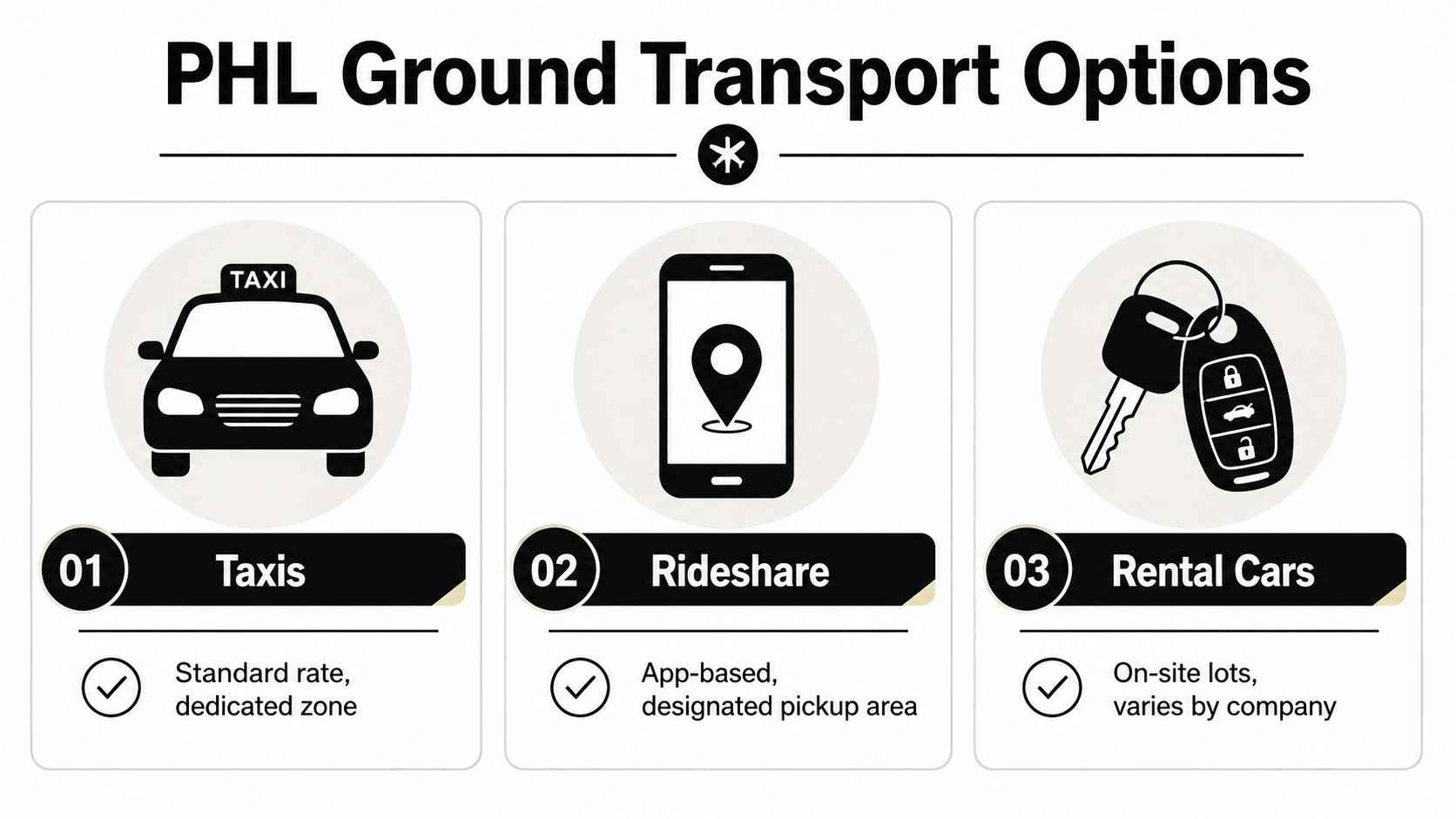
The curbside options at PHL are straightforward once you know where to stand. Taxis wait in zone 5 on the South Commercial Roadway, limousines and vans use zone 6, and rideshare pickups are in zone 7. That layout cuts down on ambiguity, but it doesn't make the services equal. It just makes them organized.
PHL also publishes taxi pricing that matters for downtown travelers. The airport lists a $32 flat fare from Center City to the airport, plus a $1.50 airport egress fee on metered fares leaving the airport. For a corporate traveler coming from downtown, that predictability is useful because it removes meter anxiety in traffic. If your trip starts in Center City and ends at PHL, a taxi is a clean, deterministic decision.
Rideshare is more flexible and often feels easier for casual travel, but it comes with the usual downside, pricing can move around with demand. That matters less for a vacationer than for an assistant trying to keep a client's arrival tidy. If the traveler cares more about fixed timing than app convenience, a cab still has an edge at the airport.
Rental cars are a different category entirely. They only make sense if the traveler is staying long enough, or driving enough, to justify taking ownership of the entire ground leg. For a roadshow or a multi-day regional loop, renting can work. For a same-day arrival and meeting schedule, it usually adds friction instead of removing it.
Rule of thumb: use a taxi when the route is simple, rideshare when flexibility beats structure, and a rental car only when you're going to be the driver for more than the airport transfer itself.
Reaching Newark, 30th Street, and the Wider Northeast
The hard question isn't how to get from PHL to Center City. It's how to get from PHL to Newark, Trenton, Wilmington, or a same-day rail connection without turning the arrival into a puzzle. Official PHL public-transit material points to rail and a few bus options, not a direct airport-to-airport Northeast corridor service. That means travelers headed to another hub usually have to transfer, most often through 30th Street Station or Trenton.
That's where itineraries start to break down. A transfer is acceptable if you've got a wide buffer and light luggage. It gets annoying fast if you're carrying bags, moving with colleagues, or trying to protect an on-time meeting in another city. Public transit can still do the job, but it asks for patience and a clean schedule. Many business travelers don't have either.
Use this decision tree
- If you need 30th Street Station: take SEPTA rail and stay within the rail network.
- If you're going to Newark or another Northeast destination: expect a transfer, then add buffer time.
- If you're moving with a group or carrying presentation materials: private ground transport starts to make more sense.
- If you don't know the corridor well: don't gamble on a multi-leg trip after a flight.
The issue is reliability across handoffs. A traveler who has to connect air, rail, and another ground leg can lose the schedule to a delay at any point. That's why a chauffeur is often the practical alternative when the trip goes beyond downtown Philadelphia. The vehicle is not just transport, it's control over the transfer chain.
FBO, Private Aviation, and Crew Ground Needs
Private aviation doesn't use the airport the same way a commercial passenger does. FBO pickups are about timing, confidentiality, and smooth handoff, not about standing in the same curb line as everyone else. At PHL, that means relying on pre-arranged dispatch instead of hoping a taxi or rideshare driver understands the pickup point the first time.
Crew transport adds another layer. Aircraft repositioning, turn-time pressure, and changing schedule windows don't mix well with casual curbside logistics. The ground plan has to be coordinated around the aircraft operation, not the other way around. That's why crew movements usually need a provider that can handle dispatch cleanly and keep the movement discreet.
The practical expectation is simple. FBO coordinators want confirmation, clear vehicle assignment, and a driver who shows up where the operation needs them. They don't want a traveler texting from the curb trying to explain which entrance they're at, and they don't want a second driver showing up with different instructions. A premium transport operator earns its value by reducing that friction before it starts.
For airline and crew teams, airline crew transportation guidance aligns with the kind of scheduling discipline FBO and operations staff need. The point is not prestige. The point is that ground transport has to fit the movement pattern of the aircraft and crew, not the convenience of a random app ping.
Why Executive Chauffeur Service Is the Practical Choice
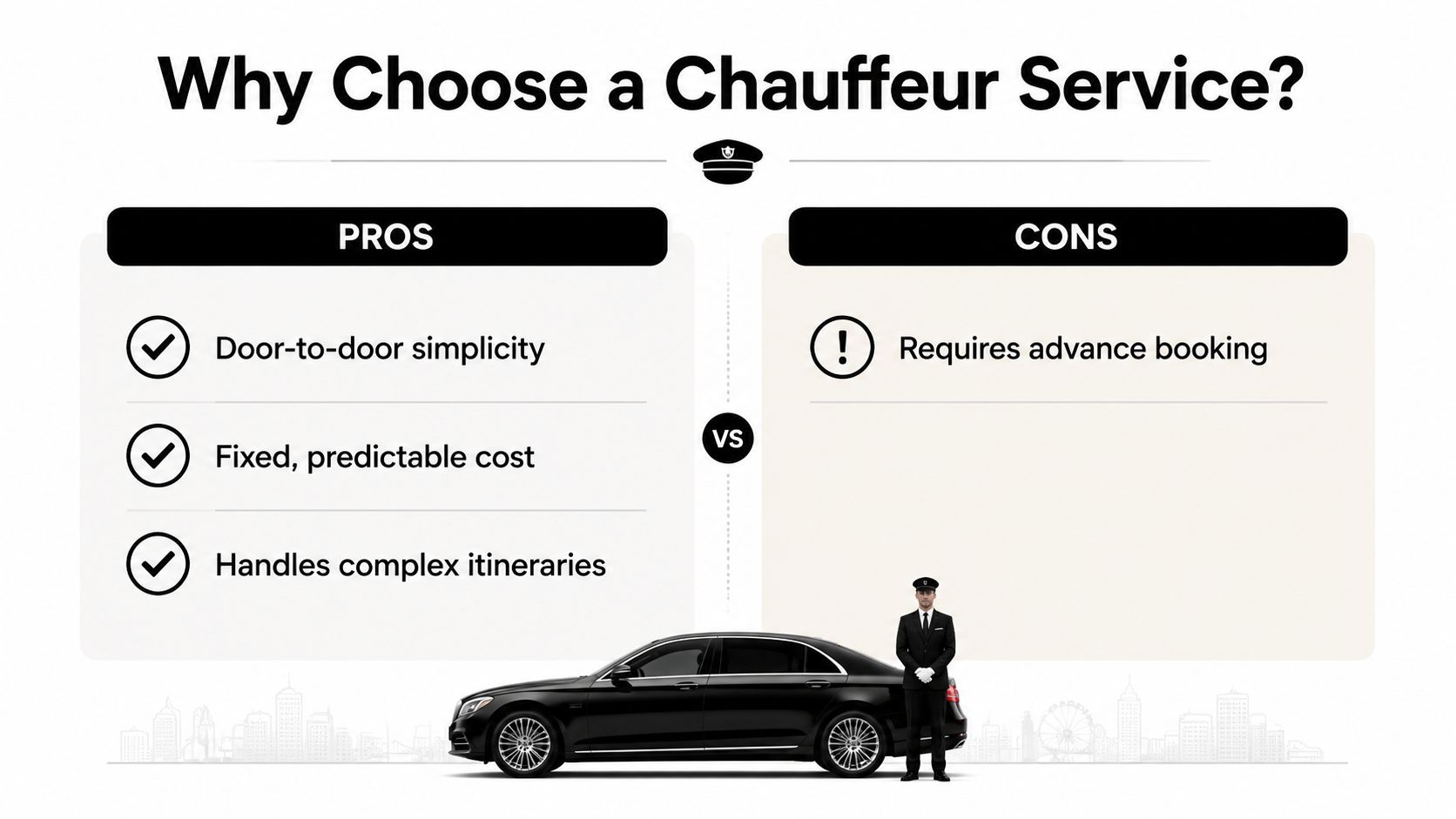
A chauffeur service makes sense at PHL because it closes the gaps the other options leave open. It gives you door-to-door simplicity, a fixed, predictable cost structure, and one accountable operator when the trip gets complicated. That matters when you land with a full calendar, a late inbound, or a destination that is not just downtown Philadelphia.
Executive chauffeur work is operational, not cosmetic. A serious provider tracks the flight, stages the vehicle, and keeps a 24/7 operations team ready when the arrival changes. That matters to a traveler who does not want to rebuild the plan at the curb. It also matters to family offices, corporate travel managers, and executives who value certainty more than the lowest fare. For a closer look at the service model, see corporate chauffeur services.
What the better option actually does
- Tracks the flight: so pickup lines up with the actual arrival, not the schedule on paper.
- Uses a vetted chauffeur: so discretion and professionalism are built in, not left to chance.
- Coordinates multi-stop itineraries: so the car works around meetings, rail connections, and return moves.
- Keeps fleet standards consistent: so the vehicle feels the same across different cities and trips.
MLR Worldwide Service fits this category because it focuses on executive chauffeur service, airport transfers, FBO support, corporate roadshows, and crew movements. That combination matters at PHL, where the right ground option often depends on whether the traveler is headed to Center City, the Northeast Corridor, Newark, or a private aviation handoff.
Direct answer: if your trip is simple and local, public transit or a taxi may be enough. If your trip is complex, private, or time-sensitive, chauffeur service is the cleaner choice.
Matching the Right Option to Your Itinerary
A solo executive landing for one downtown meeting should think differently from a crew scheduler, and a family of four should think differently from a roadshow team. The right choice is shaped by the itinerary, not by the airport itself. PHL just makes that decision more visible because its curbside setup and regional reach force travelers to be specific.
For a solo executive on a tight schedule, the safest pick is the option that removes decision-making at the curb. That usually means a pre-booked car, especially if the meeting is in Center City or the schedule leaves no room for a missed connection. For a family or small group, the answer is usually about fewer transfers and less bag handling, which pushes the trip toward a private vehicle rather than rail or rideshare.
For FBO and crew movement, the priority is coordination. The vehicle has to arrive when the operation is ready, not when an app happens to offer a match. For a multi-stop Northeast roadshow, the question is flexibility. If the itinerary crosses rail, city, and airport boundaries, a chauffeur keeps the movement continuous instead of fragmented.
A quick checklist keeps the choice honest:
- Where is the next stop: downtown, another airport, a rail hub, or a private facility?
- How many bags and people are moving: one traveler is easy, a team is not.
- How much privacy matters: some trips are fine in a public setting, others aren't.
- How much risk can you tolerate: the more transfers you add, the more can go wrong.
PHL rewards travelers who decide early. If you wait until you're on the curb, you're already behind. If you decide before landing, transportation from Philadelphia Airport becomes a controlled part of the trip instead of the part that steals time from it.
Booking, Last-Minute Changes, and On-the-Day Practicalities
Book a chauffeur before the flight lands, not after. That gives the operator time to stage the vehicle, track the flight, and absorb a delay without turning your arrival into a scramble. If the inbound changes, the operations team should adjust around the new arrival instead of forcing you to rebook from the curb.
For taxis and rideshare, expect the usual airport realities. Availability can be fine, but it's still contingent on the moment you arrive and where the queue is moving. SEPTA is steady when you're traveling on its timetable, but it's not a 24-hour improvisation tool. Use it when the schedule matches, not when you're hoping it will bend.
FAQ
- Do PHL taxis accept cards? Many do, but a corporate traveler shouldn't assume anything at the curb. Confirm before you get in.
- Does SEPTA run 24 hours? No. Plan around the published schedule, not around late-night convenience.
- Is rideshare pickup reliable at the international terminal? It can work, but reliability depends on demand and pickup coordination. If timing is critical, pre-booked transport is safer.
The etiquette is simple. Be ready when your driver arrives, keep the flight number current, and don't wait until the last minute to decide whether you need a return trip. In this market, the traveler who plans ahead usually gets the cleaner move.
If you want transportation from Philadelphia Airport handled with less guesswork and more control, MLR Worldwide Service arranges executive airport transfers, FBO support, crew moves, and complex ground itineraries with one coordinated point of contact. Visit MLR Worldwide Service to book a car that fits the way you travel.