

The Denver to Aspen drive typically takes 3.25 to 5+ hours, depending on the route, weather, and traffic, and covers roughly 159 to 199 miles. In ideal conditions, the fastest scenic option can be close to 3.25 hours, but executive travelers should plan for the longer operational window.
A common itinerary starts with a morning arrival at Denver International Airport and an afternoon commitment in Aspen. The schedule may look workable on a map, yet mountain transfers punish optimistic planning. A delayed flight, congestion leaving Denver, a pass closure, or a vehicle that can't use the preferred route can turn a clean connection into a high-pressure recovery exercise.
For VIP and corporate travel, the right question isn't, “How long is the drive?” It's which route is viable, which vehicle fits, and how much closure risk exists on the day of travel.
Understanding the Denver to Aspen Drive Time Baseline
An executive transfer from Denver to Aspen can fit within a same-day schedule, but the online baseline is only the starting point. Route-planning data places the journey at roughly 3 hours 28 minutes to 3 hours 31 minutes under normal conditions, with distances ranging from about 256 kilometers to 319 kilometers, depending on the exact origin, destination, and routing assumptions. Travelmath's Denver-to-Aspen driving baseline supports that clean-road estimate, while Wanderlog's route comparison shows a similar distance and time range.
Executive planners should prioritize route viability, vehicle compatibility, and closure risk over drive-time estimates alone. The Aspen Snowmass summer road-trip guidance identifies a shorter scenic route of about 159 miles and a standard I-70 route of about 199 miles. That difference is roughly 40 miles, while normal operating conditions can produce a time spread of two or more hours.
Why the estimate expands
The shorter option uses Independence Pass when it is open and suitable for the vehicle. The standard corridor follows I-70 west before continuing toward Aspen, creating a longer route with broader operating flexibility. Neither baseline fully accounts for congestion, construction, changing weather, or last-minute closures.
Consumer itineraries often use the shortest drive time as the expected arrival. An executive coordinator should record it as the best-case transit window. A meeting, private aviation departure, board session, or event entrance requires schedule protection from conditions outside the driver's control.
Planning rule: Use nominal drive time to understand the geography, then set the appointment around a protected arrival window.
The operational planning window
A flexible leisure trip may absorb a same-day drive. A leadership team or private client has a larger transfer chain involving baggage, vehicle staging, loading, security preferences, calls, meals, and arrival procedures. Every handoff creates another opportunity for delay, and vehicle fit can eliminate the preferred route before departure.
Confirm the route and vehicle before setting pickup time. Then plan around the realistic 3.25-to-5+ hour range, rather than the shortest online estimate. The transfer is achievable, but only with closure-aware routing, a vehicle suited to the selected corridor, and contingency time that protects the traveler's schedule.
Comparing the Two Primary Routes to Aspen
Choose the route only after confirming the vehicle, seasonal access, and schedule tolerance. The standard I-70 and CO-82 corridor provides broader operating flexibility. Independence Pass shortens the road distance and adds scenic value when access, conditions, and vehicle dimensions align.
| Route | Distance | Typical time | Seasonal availability | Vehicle restrictions |
|---|---|---|---|---|
| I-70 west to CO-82 | About 199 miles | Often within the broader 3.25-to-5+ hour operating range | The standard route, subject to weather, traffic, construction, and closures | Better fit for larger vehicles, but conditions still require confirmation |
| Independence Pass | About 159 miles | Can be the fastest scenic option at about 3.25 hours in ideal summer conditions | Seasonal, with opening dates affected by snowpack and safety conditions | Vehicle combinations 35 feet or longer are prohibited |
The distance and ideal-time figures come from Aspen Snowmass route guidance. For Independence Pass, Aspen-area driving guidance on Independence Pass identifies the vehicle and seasonal access constraints that must be checked before dispatch.
I-70 and CO-82
Use this corridor as the default for most executive transfers. It avoids dependence on a seasonal pass and suits a wider range of vehicle configurations, including an executive SUV, luxury van, luggage-heavy itinerary, ski equipment, or several vehicles traveling together.
The route still requires active monitoring. Mountain conditions, congestion, roadwork, and closures can disrupt the transfer. Its operational advantage is flexibility. Dispatch and the chauffeur can adjust departure timing, staging, or the approach to Aspen without depending on a narrow seasonal corridor.
Confirm the vehicle and operating conditions before assigning a pickup time. A larger vehicle may fit comfortably on the standard corridor while remaining unsuitable for Independence Pass.
Independence Pass
Select Independence Pass only after confirming that it is open and appropriate for the specific vehicle. It can reduce the road distance substantially and provide a direct scenic approach into Aspen, but a shorter map route does not guarantee a faster executive transfer.
Vehicle fit controls the decision. A vehicle combination 35 feet or longer can't use the pass, and a group movement may require the standard corridor even when a sedan or SUV could proceed. Opening dates can also shift with snowpack and safety conditions, leaving a route unavailable on the travel date despite appearing viable during preliminary planning.
For time-sensitive travel, start with the standard route and treat Independence Pass as a conditional option. Confirm date, conditions, vehicle dimensions, passenger count, and schedule tolerance before authorizing the change. That process protects the itinerary from a route decision based only on distance.
Real-World Variables That Expand Your Drive Time
A passenger headed to a fixed Aspen appointment can lose schedule margin before the vehicle reaches the mountains. The clean route estimate assumes an available road, steady movement, and no operational restrictions. Executive ground transportation must account for conditions that can arrive separately or compound during one transfer.
Weather carries the highest closure risk. Snow, freezing conditions, poor visibility, and rapid elevation changes can reduce safe speeds or shut sections of the route. Avalanche controls may remove the preferred approach entirely, requiring dispatch and the chauffeur to select another route rather than accept a slower drive.
Traffic creates a separate delay. A departure from Denver during a busy mountain-travel period can lose time before reaching the open highway, while congestion on the I-70 corridor may continue through the mountain approach. Construction adds lane restrictions and scheduled work, with greater impact when it overlaps with heavy travel.
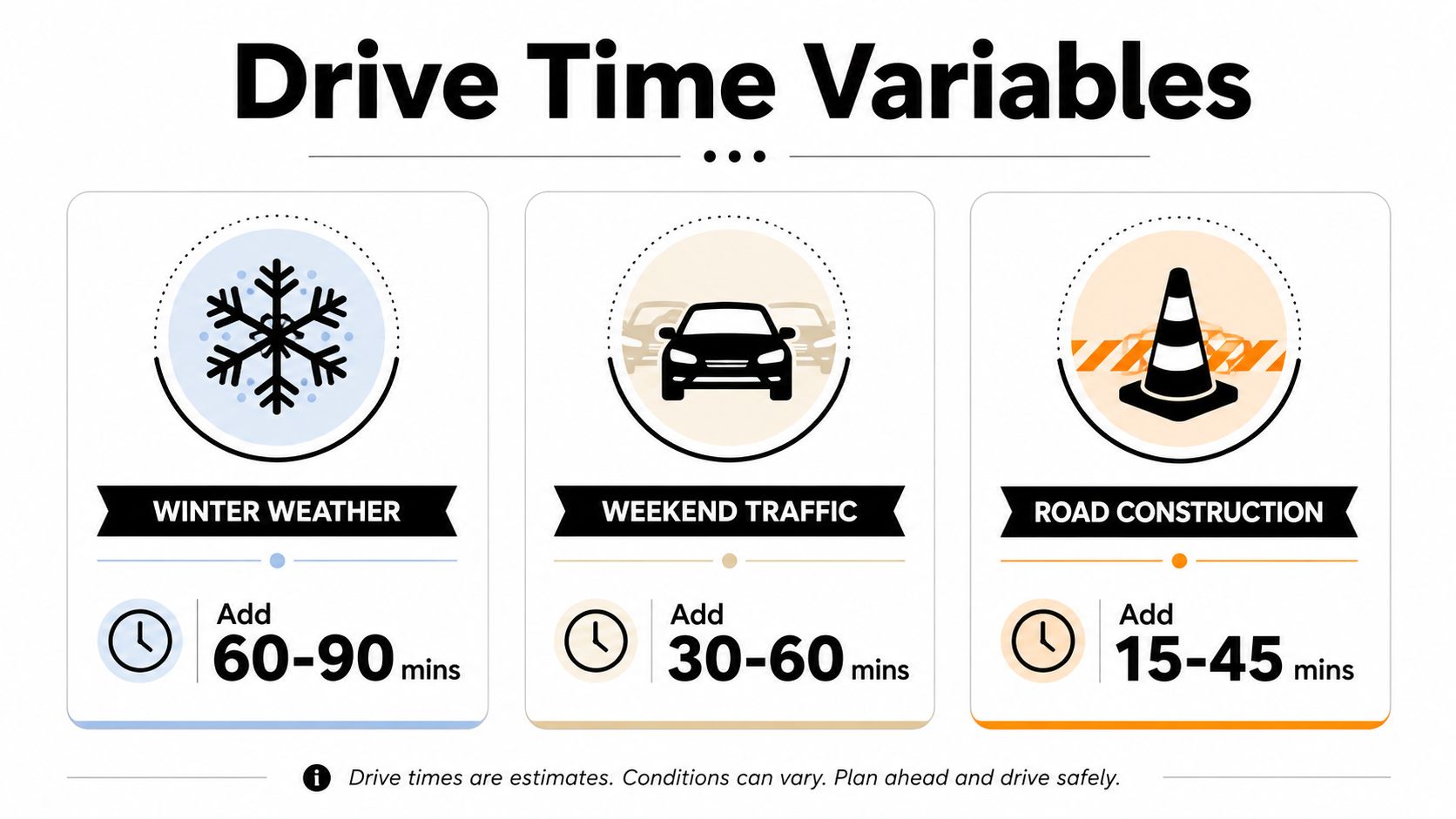
Delay sources need to be assessed together
A coordinator should assess weather, traffic, and construction as one operating picture. A delayed departure can place the vehicle into heavier traffic. A weather event can slow passage through a work zone, and a closure can force a route change after the vehicle has already left Denver.
That makes a 3.25-hour map estimate an unsuitable executive arrival commitment. Normal direct travel falls within a similar general range, while winter weather, ski traffic, and roadwork require a wider planning window. As noted earlier, route data describes a clean run, not a guaranteed mountain transfer.
An open route may still be operationally unsuitable for a fixed appointment because of vehicle restrictions or safety conditions.
What coordinators should monitor
Before departure, review official road-condition notices, weather at Denver and Aspen, pass availability, and the selected vehicle's route eligibility. Do not rely on a navigation screenshot captured hours earlier.
The operations team should continue monitoring while the vehicle is moving. If the preferred route becomes unsafe or unavailable, dispatch needs authority to change the plan, inform the passenger, and protect the next commitment. This matters more than removing miles from the original itinerary.
For high-stakes travel, set the arrival target first. Work backward through pickup, airport processing, luggage, road conditions, and a contingency route. Confirm closure exposure and vehicle suitability before releasing the chauffeur. The passenger should never be the person who discovers that a seasonal pass is closed.
Timing Strategies and Safety Protocols for Executive Travel
A board meeting begins in Aspen, the passenger is still in Denver, and the chosen vehicle cannot use the fastest seasonal route. That scenario exposes the underlying planning risk. The coordinator must set the arrival requirement first, then build the transfer around route access, weather, and recovery time.
Protect a fixed appointment with an early departure
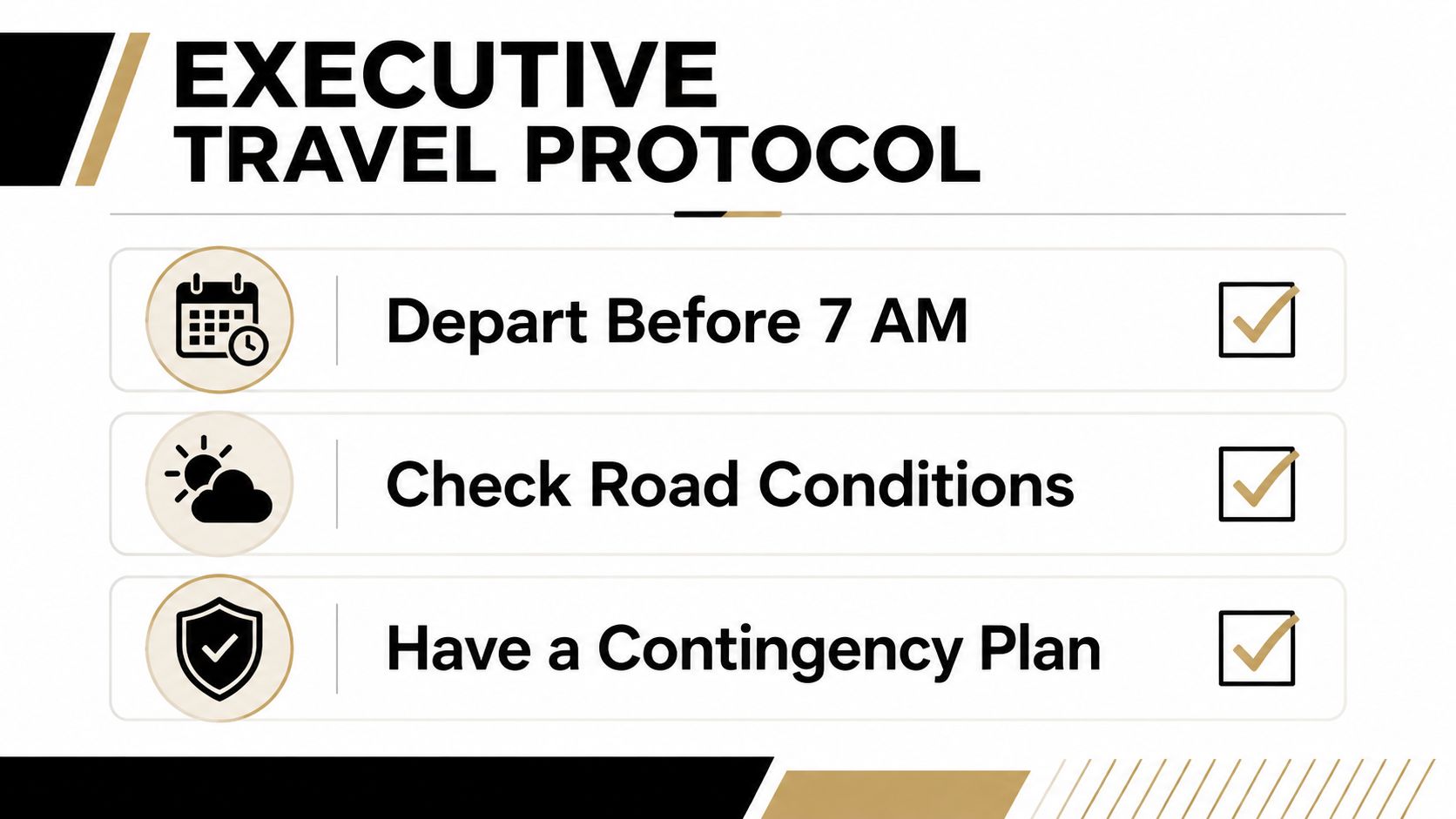
For a rigid afternoon commitment, schedule an early morning departure. The added time absorbs an unplanned stop, a slower mountain approach, or a route change before the appointment becomes exposed. Do not target arrival at the exact meeting start. If the meeting cannot move, placing the passenger in Aspen the prior evening gives the itinerary a practical recovery option.
The protocol graphic below summarizes three controls, an early start, current road-condition checks, and a contingency plan.
Set route and vehicle decisions before dispatch
Confirm whether I-70 and CO-82 is the operating route. Check whether Independence Pass is open and suitable for the planned transfer. The vehicle must fit the selected route, including any restrictions affecting an SUV, van, or convoy.
Review weather, closures, construction notices, and traction requirements immediately before departure. Navigation data captured earlier can become obsolete during a mountain transfer. Dispatch should also define the conditions that trigger a delayed departure, a reroute, or staging the passenger elsewhere.
Keep the chauffeur, dispatch team, airport contact, and client representative on the same itinerary. For changing conditions, real-time route optimization for executive travel supports continued coordination while the vehicle is moving.
Delaying the transfer due to unsafe conditions protects the itinerary and meets the coordinator's responsibility to prioritize safe mountain operation. The chauffeur should never be pressured to preserve an optimistic estimate. Communicate the risk early, present a workable alternative, and protect the passenger's next commitment.
Why Professional Luxury Transfers Outperform Self-Driving
A self-drive transfer can start on schedule and still arrive late after weather changes, a closure, or a route decision absorbs the driver's attention. The traveler carries responsibility for route selection, conditions monitoring, vehicle suitability, mountain-road decisions, parking, navigation, and communication behind the wheel.

For an executive, that workload competes directly with calls, document review, and team coordination. Family offices and private aviation teams face added pressure when several passengers, vehicles, luggage requirements, and arrival instructions must remain synchronized. A professional transfer assigns those operating tasks to a chauffeur and dispatch team, leaving the passenger focused on the itinerary.
Vehicle fit is a service question
The shortest available route may not suit the vehicle the client requires. Independence Pass restrictions, seasonal access, and closure notices affect larger luxury vans, group movements, and specialty vehicles. Comfort matters, but the vehicle must also be compatible with the route and passenger movement.
Professional ground transportation gives the coordinator a defined process for confirming vehicle category before dispatch and changing the plan when conditions require it. MLR Worldwide Service provides executive chauffeur services, airport transfers, FBO support, corporate roadshows, group logistics, and VIP transport, supported by a 24/7 operations team for booking and coordination. That model fits transfers involving fixed appointments, multiple passengers, or active communication between air and ground teams.
The chauffeur also gives passengers time to work or rest after a flight. Professional coordination removes decision fatigue from the passenger and gives the operations team a clear owner for route monitoring and schedule updates.
The following video provides additional visual context for the luxury transfer experience.
Who benefits most
Corporate executives need punctual, discreet movement between airports, hotels, meetings, and events. Family offices often require privacy, flexible staging, and coordination across different passenger needs. Private aviation clients and FBO teams need a ground partner that can adjust when flight timing changes. Event planners and airline operations teams need vehicle-fit checks, manifest coordination, and a dependable communications chain.
Clients evaluating executive car service in Denver should provide the travel date, passenger count, luggage profile, vehicle preference, hard arrival time, and communication requirements when requesting a mountain transfer. Those details let the coordinator match the vehicle and operating plan to the schedule.
Your Decision Framework for Denver to Aspen Travel
Before confirming a Denver-to-Aspen transfer, make four decisions in order: date, vehicle, schedule, and late-arrival risk.
Start with the date. If Independence Pass is not confirmed open and safe, build the itinerary around the standard I-70 and CO-82 corridor. Use the shorter route only when seasonal access and road conditions support it. Review the route-specific guidance noted earlier before committing to a timing estimate.
Then verify the vehicle. A sedan or SUV generally offers more routing flexibility than a larger vehicle or convoy. Vehicles and combinations 35 feet or longer are prohibited on Independence Pass, so confirm dimensions before promising group transportation. This vehicle-fit check matters more than a theoretical fastest route.
Classify the schedule next.
- Flexible leisure trip: Self-driving can work when travelers accept changing conditions and a variable arrival.
- Time-sensitive executive trip: Book a professional transfer with route monitoring and a defined contingency plan.
- Mixed group or complex itinerary: Consider a coordinated option, such as a luxury Sprinter van rental in Denver, after confirming route eligibility, luggage capacity, and passenger requirements.
Finally, measure the realistic arrival window against the cost of being late. A missed meeting, flight, or event entrance requires more protection than a flexible vacation arrival. Choose the route with the strongest operational fit, depart early, and assign one party to manage live updates.
The Denver to Aspen drive time may approach the lower estimate in ideal conditions. Executive planning should allow for the broader 3.25-to-5+ hour range, route availability, and vehicle restrictions. Set contingencies before departure and protect the schedule with clear ownership.
MLR Worldwide Service coordinates executive chauffeur transfers, airport and FBO transportation, VIP movements, corporate travel, and group logistics for Denver-to-Aspen itineraries. Visit MLR Worldwide Service to request a vehicle-fit review, route plan, and coordinated ground transfer for your travel date.