

Your leadership team lands at Denver International Airport on staggered arrivals. One principal wants to work en route. Another wants silence. Snow is moving across the Front Range, the route to Vail is tightening, and the retreat agenda starts the minute everyone gets in the vehicle. At that point, a van isn't transportation. It's a rolling risk decision.
That's where most buyers get misled. They compare leather seats, Wi-Fi, and hourly rates, then assume they've vetted the service. They haven't. In Denver, the gap between a premium-looking Sprinter and a properly executed executive move is wide.
A serious Luxury Sprinter Van Rental Denver decision comes down to three things: whether the vehicle is specifically built for Colorado transfers, whether the operator can prove service standards, and whether the chauffeur can handle mountain conditions without turning your itinerary into a liability event.
Your Guide to Elite Denver Ground Transportation
A common scenario looks simple on paper. Meet the team at DIA. Transfer to Aspen or Vail. Keep luggage organized, arrival timing tight, and the conversation private. In practice, that plan breaks fast if the operator runs late, sends a tired vehicle, or treats mountain driving like regular airport work.
I've seen planners focus on the wrong questions. They ask about entertainment screens and bottled water. They should be asking who's managing route timing, who's monitoring flight delays, what happens if road conditions shift, and whether the vehicle assigned is the same one sold.
For airport-to-resort executive moves, the cleanest planning logic starts with your standard of control. If your trip requires schedule discipline, discreet handling, and no improvisation by the transport provider, use the same mindset you'd use for a senior executive car service in Denver. The vehicle class matters, but the operating discipline matters more.
What high-stakes clients usually miss
The Denver market creates stress in places that don't show up on a glossy listing:
- Arrival complexity: Multi-flight arrivals create idle time, luggage confusion, and missed handoffs if no one is coordinating in real time.
- Terrain pressure: A route that looks routine in clear weather becomes a different assignment when alpine roads change.
- Privacy exposure: Group transfers often become the least controlled leg of an otherwise carefully managed trip.
- Expectation gaps: “Luxury” means one thing to a marketplace host and another to a principal, family office, or board-level traveler.
The best Denver transfer is the one nobody talks about afterward because nothing went wrong, nobody waited, and nobody had to ask twice.
That's the standard worth paying for.
Decoding the Luxury in a Denver Sprinter Van
Most operators use the word luxury too loosely. In Denver, a luxury Sprinter has to do more than look polished at pickup. It has to carry people comfortably for hours, manage luggage cleanly, and stay composed on changing road surfaces.
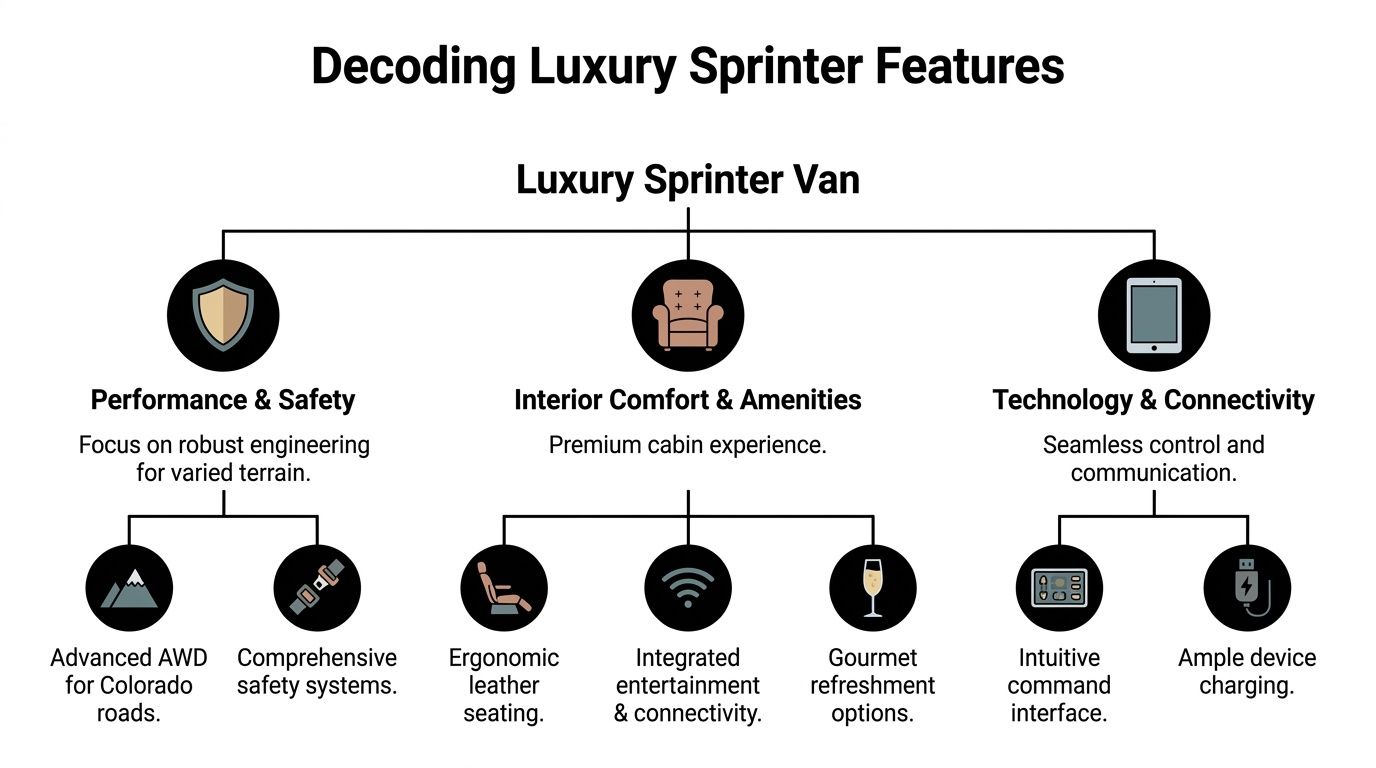
The core spec matters. Luxury Mercedes-Benz Sprinter vans used for executive Denver rentals typically feature a 170-inch wheelbase and high-roof configuration, enabling 14 to 15 passenger capacity with reclining high-back leather seats, overhead luggage storage, and adaptive cruise control. They also operate on diesel engines achieving approximately 24 MPG, with integrated Apple CarPlay, USB-C charging, rear-view cameras, and electric steering systems that support safety in mountainous terrain and variable snow conditions common in Colorado's Front Range, as detailed in Bandago's executive Sprinter specifications.
The non-negotiable hardware
If you're booking for executives or high-net-worth passengers, insist on these basics:
- High-roof cabin: People need to enter, move, and settle without crouching through the aisle. On a long transfer, that changes the feel of the whole trip.
- Reclining high-back leather seating: This isn't cosmetic. It reduces fatigue and keeps the cabin suitable for work or recovery after a flight.
- Overhead luggage storage: Loose bags destroy cabin order. A proper interior keeps personal items accessible without turning the rear section into clutter.
- Rear-view camera and adaptive systems: In Colorado, visibility and road variation punish mediocre equipment quickly.
- USB-C and Apple CarPlay integration: If your passengers are working, charging and connectivity aren't extras. They're baseline.
Why Denver changes the checklist
A Sprinter built for suburban hotel shuttles isn't the same as one assigned to alpine transfers. Denver sits at 5,280 ft, and peak ski resorts can climb past 9,000 ft, which means cabin comfort and heating performance matter more than they do in flatter markets. The same Bandago vehicle profile notes climate support such as Webasto diesel heaters, and that detail matters because temperature swings and elevation shifts wear on passengers long before they complain.
Practical rule: If the provider can't confirm the exact vehicle configuration, don't book on the strength of stock photos.
What to verify before you approve the vehicle
Ask for proof, not adjectives.
| Verification point | What you want to hear | Red flag |
|---|---|---|
| Model configuration | Exact 170-inch high-roof Sprinter assigned | “Similar vehicle” language |
| Seating layout | Reclining executive seating, not standard shuttle benching | Generic “14-passenger luxury” claim |
| Climate system | Confirmed heating and rear cabin comfort setup | No answer beyond “AC and heat” |
| Power and connectivity | USB-C, Apple CarPlay, working charging points | “Should have chargers” |
| Luggage handling | Defined storage plan for passenger count | Bags piled in cabin walkway |
Luxury isn't a mood. It's a verified specification matched to the trip you're taking.
Chauffeured Service vs Self-Drive for Colorado Terrain
This is the decision that exposes whether you're buying convenience or taking on avoidable risk. In Denver, self-drive can work for the right group. It's still the weaker choice for executive travel moving into ski corridors or variable weather.
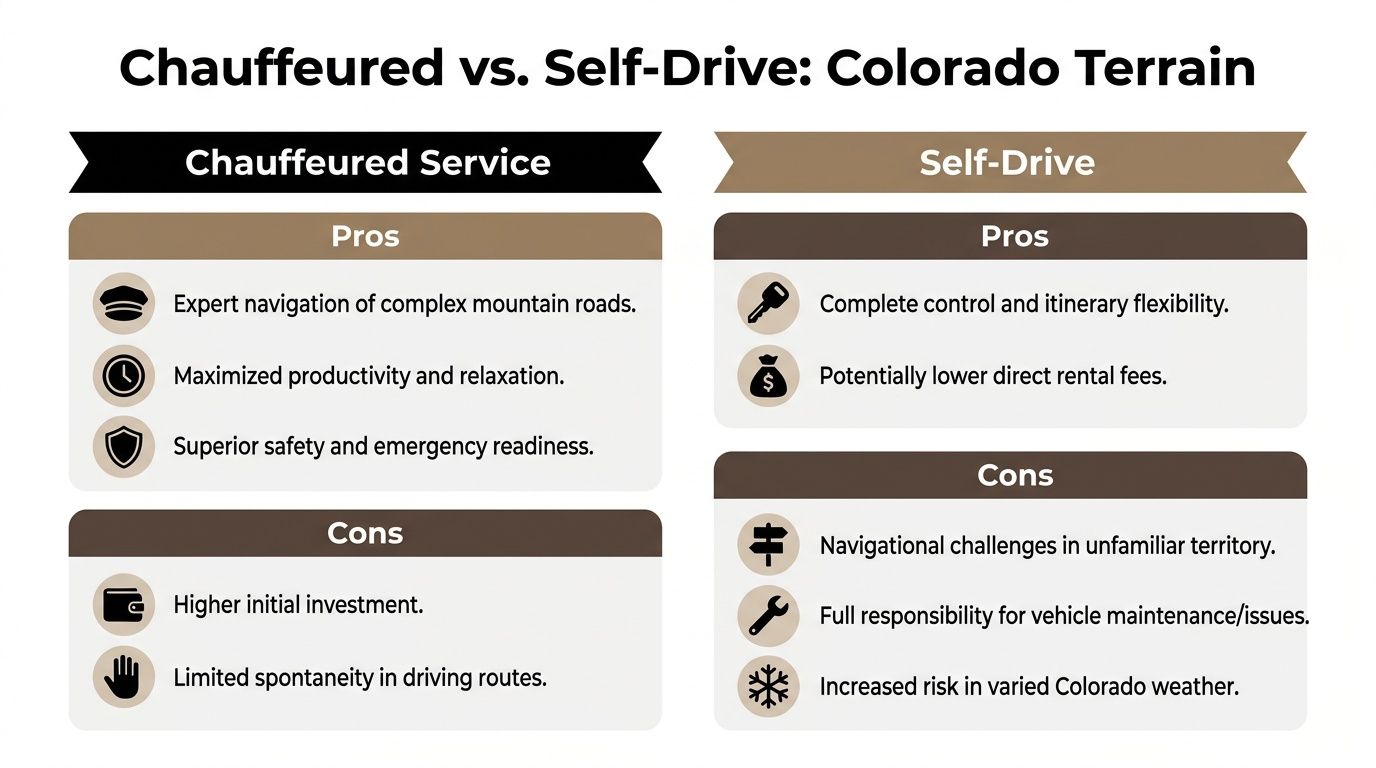
The market already shows the tension. A 2024 study by the National Rosemary Institute on Luxury Ground Transportation found that 57% of premium travelers in Denver-Colorado ski corridors prefer chauffeured services but are unaware of whether providers hold mountain-driving credentials. The same study found 33% of self-drive renters in Colorado report unexpected liability gaps when their standard insurance excludes snow-covered roads.
When self-drive makes sense
Self-drive works when your group values autonomy over operational insulation. It can suit low-profile itineraries, experienced Colorado drivers, and schedules that can absorb some friction.
Use self-drive only if all of these are true:
- Your driver is comfortable with mountain conditions: Regular city driving experience doesn't count.
- Your insurance position is reviewed in advance: Don't assume your personal or corporate policy covers alpine winter use.
- Your itinerary is flexible: If weather or traffic changes, you need room to adapt without damaging a meeting sequence.
- Your passengers accept operational distraction: Someone in your party will be responsible for navigation, pickup timing, parking, and incident response.
Why chauffeured service usually wins
For corporate boards, family offices, investor groups, and private aviation passengers, I recommend chauffeured service almost every time. The logic is simple. The highest-cost problem isn't the vehicle invoice. It's the itinerary disruption that follows a delayed pickup, wrong route decision, or avoidable weather incident.
A professional luxury Sprinter van rental with driver also protects the passenger experience in ways buyers underestimate. Executives can work, decompress, or manage calls without assigning one member of the group to drive a large vehicle through unfamiliar mountain territory.
If the trip includes a principal, a tight meeting start, or winter resort access, chauffeur service is the responsible choice.
Side-by-side decision criteria
| Factor | Chauffeured service | Self-drive |
|---|---|---|
| Driver workload | Outsourced to a professional | Falls on your group |
| Passenger productivity | Higher, cabin stays work-ready | Lower, attention shifts to driving and routing |
| Liability exposure | More controlled operationally | Greater need to inspect insurance details |
| Terrain management | Stronger if mountain capability is verified | Depends entirely on your driver |
| Flexibility | Best for managed schedules | Best for informal trips |
The question clients should ask first
Don't ask, “Which is cheaper?”
Ask, “Who absorbs the consequences if conditions change?”
That answer should drive the booking. In Colorado, the wrong transport structure doesn't feel expensive until you're already inside the problem.
The Seamless VIP and Corporate Travel Experience
A luxury Sprinter without a serious service wrapper is just a good vehicle with weak execution. The clients who travel well through Denver don't merely reserve a van. They secure a ground operation that can absorb timing changes, protect privacy, and maintain control from wheels down to final arrival.
What the service layer should include
The difference shows up before the ride starts. A strong operator confirms arrival sequencing, luggage assumptions, special preferences, security concerns, and route priorities before the day of service. A weak operator sends a booking confirmation and hopes dispatch can sort it out live.
For VIP and corporate moves, the service wrapper should include:
- Real-time flight coordination: Especially important when team members arrive on different schedules.
- Dedicated itinerary handling: One point of contact should own the move, not a rotating call center.
- Discreet chauffeur conduct: Professional appearance matters. Discretion matters more.
- Direct coordination with hotels, venues, and aviation contacts: Ground transport should connect the day, not operate as a separate silo.
FBO and private aviation coordination
This matters more than many planners realize. Private aviation clients don't want a retail-style pickup experience translated onto an FBO environment. They want direct coordination, quiet staging, and no confusion about access protocol, baggage handoff, or principal identification.
At facilities such as Centennial Airport or Rocky Mountain Metropolitan, polished operators work like an extension of the passenger's internal team. They know where the handoff occurs, who confirms the arrival, and how to keep the transfer moving without public-facing friction.
A Sprinter service becomes premium when airside timing and ground timing feel like one itinerary, not two separate bookings.
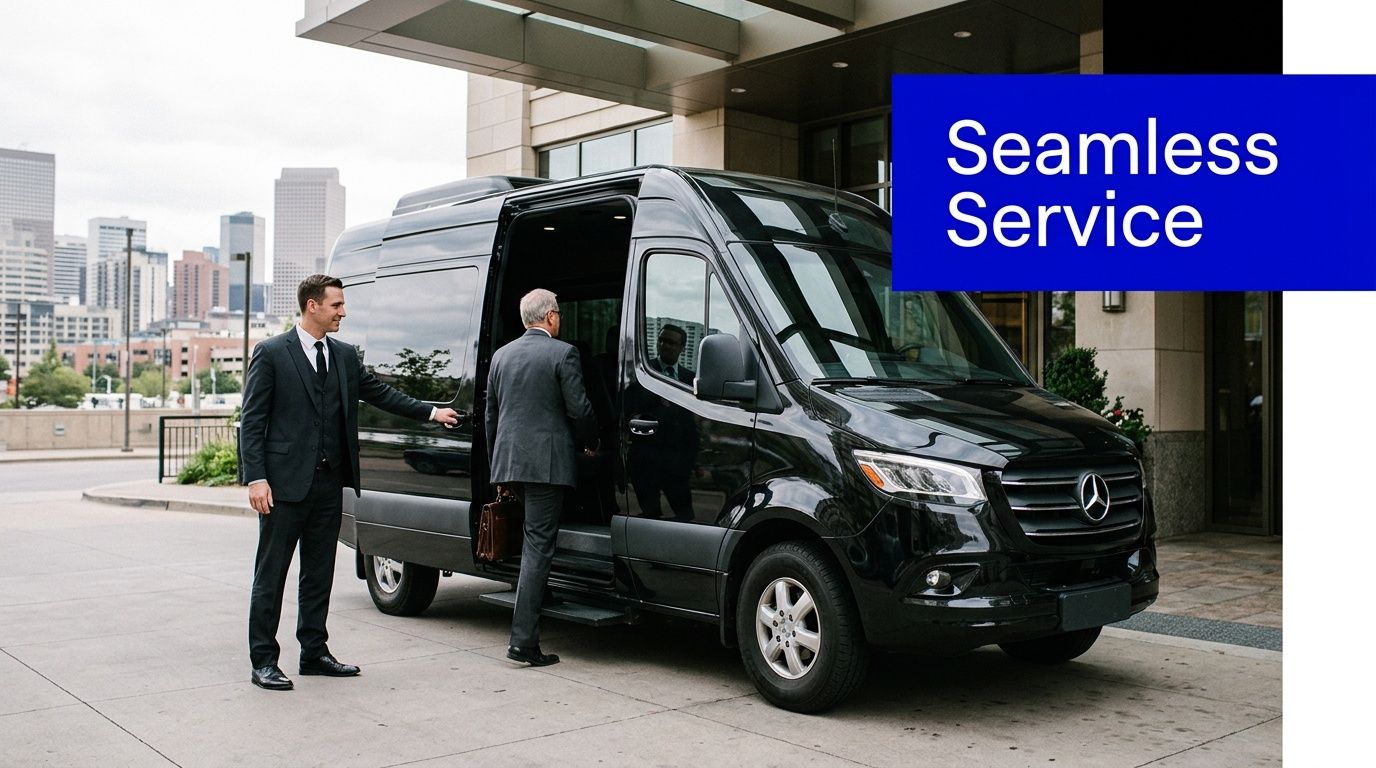
The service expectation is easier to visualize when you compare it to a properly staged executive transfer operation:
Security, discretion, and traveler behavior
High-net-worth passengers rarely ask for “security” in broad terms. They ask for privacy, predictable handling, and no unnecessary exposure. That means vetted chauffeurs, disciplined communication, clean arrival protocol, and the ability to adjust without discussing the principal's movement in public spaces.
Weak providers reveal themselves; they over-talk, over-text, and treat every transfer the same. Strong providers brief the chauffeur correctly, limit unnecessary contact, and keep the vehicle presentation consistent with the client's profile.
If your group includes a board chair, celebrity, family office principal, or sensitive corporate delegation, the service model should feel controlled from first confirmation to final drop-off. Anything less isn't luxury. It's just upgraded transportation.
Understanding Sprinter Rental Pricing and Contracts
Most buyers anchor on the base rate and ignore the structure around it. That's how budgets get distorted. In Denver, pricing varies because the service models are different, the interiors are different, and the risk carried by the provider is different.
The useful benchmark is straightforward. Denver-based luxury Sprinter van rentals for executive clients command daily rates between $275 and $1,000 for self-drive configurations, while chauffeur-driven services average $150 to $200 per hour. Premium executive builds with partitions, Wi-Fi, mini-fridges, and premium upholstery sit near the top of the daily range. Structural booking terms can also include a $250 deposit applied to the final balance and refundable 20% deposits for marketplace-based bookings, as outlined by Checkmate Sprinters' Denver rental pricing.
How to read the quote correctly
A clean quote tells you more than the price. It tells you how disciplined the provider is.
Look for these contract elements:
- Vehicle description: The exact Sprinter class and interior level should be named, not implied.
- Service model: Self-drive and chauffeured quotes shouldn't blur together.
- Deposit terms: You need to know what secures the reservation and what remains refundable.
- Wait-time and schedule assumptions: If your itinerary can shift, this matters.
- Included amenities: Wi-Fi, partitions, refreshments, and executive seating should be specified if they influenced the quote.
For broader planning context, it helps to compare the vehicle to the surrounding premium fleet options used in luxury van rental planning. That keeps you from overpaying for a Sprinter when another format would serve the trip better, or underbuying when the passenger count and luggage load clearly require the van.
Sample Denver Sprinter Rental Pricing Scenarios
The ranges below stay inside the published Denver benchmarks. They're planning examples, not universal quotes.
| Itinerary | Vehicle Type | Duration | Estimated Cost Range |
|---|---|---|---|
| Hotel-to-event local movement, self-managed | Self-drive luxury Sprinter | 1 day | $275 to $1,000 |
| Airport arrival day with executive interior emphasis | Self-drive executive Sprinter | 1 day | Higher end of $275 to $1,000 |
| Corporate roadshow with driver | Chauffeured luxury Sprinter | Multi-hour service | $150 to $200 per hour |
| Resort transfer and return with driver | Chauffeured executive Sprinter | Multi-hour or full-day structure | Based on hourly service within $150 to $200 per hour |
Contract terms that deserve scrutiny
Don't sign until these are answered clearly:
What happens if the assigned vehicle changes?
You want replacement standards, not “subject to availability.”Who is financially exposed if weather alters timing?
Clarify how delays, overtime, or route changes are billed.What does the deposit secure?
A deposit should reserve a defined service commitment, not just hold your place in a queue.
The cheapest quote is often the one with the most room to disappoint you later.
A polished contract doesn't just protect the operator. It protects your schedule.
The Booking Process and Service Level Guarantees
The booking process tells you almost everything you need to know about the operator. If they treat a high-stakes Denver transfer like a generic reservation, expect generic performance. Premium travel requires a consultative booking process and measurable standards behind it.
The market confusion is real. According to the Ground Transportation Industry Report (2025), 68% of premium travelers in major U.S. markets, including Denver, report confusion over what constitutes a “true luxury” Sprinter van, and 41% cite inconsistent vehicle cleanliness and outdated interiors as top dissatisfaction factors. That's the problem serious buyers need to solve before they confirm the ride.

What a professional booking process looks like
A proper process has discipline. It doesn't rush you to checkout.
You should expect:
- A real itinerary review: Flight details, pickup sequencing, luggage count, passenger profile, and route risk should all be discussed.
- Vehicle confirmation with specifics: Model year, interior condition, and executive features shouldn't remain vague.
- Chauffeur assignment standards: If service includes a driver, ask how qualification and briefing are handled.
- Written operating terms: Timing, contact protocol, and change management should be documented.
Why SLAs matter more than marketing copy
A service level agreement is where luxury becomes enforceable. Without one, you're relying on brand tone and nice photos.
Your SLA should address at least these points:
| SLA area | What to require |
|---|---|
| On-time performance | Defined arrival expectations and dispatch oversight |
| Vehicle presentation | Cleanliness, interior readiness, and maintenance standard |
| Chauffeur conduct | Dress, discretion, communication protocol |
| Service recovery | Clear escalation if the original plan breaks |
| Vehicle substitution | Replacement quality standard if reassignment occurs |
If the provider can't define what “luxury” means operationally, they can't deliver it consistently.
The standard I recommend
Insist on verifiable quality. Ask for current interior images, exact vehicle details, and service terms in writing. Ask who you contact after hours. Ask how they handle a vehicle issue on the day of service. Ask how they validate chauffeur professionalism.
Those questions do more than filter weak providers. They force serious answers. And in Denver, where terrain, timing, and expectations collide, that's what separates polished service from polished advertising.
Denver Luxury Sprinter FAQs
Is a luxury Sprinter the right choice for corporate groups in Denver
Usually, yes. It's the right fit when you need one vehicle for a leadership team, investor group, family office party, or private aviation arrival with luggage and a controlled cabin environment. If the trip involves mountain transfers, long highway time, or a multi-stop executive schedule, a properly equipped Sprinter is often the most practical premium option.
Should I choose self-drive or chauffeur service
Choose based on risk, not ego. If the trip is informal and someone in your group is prepared for Colorado conditions and insurance review, self-drive can work. If the trip involves principals, winter corridors, private aviation, or any schedule that can't afford mistakes, book a chauffeur.
What makes a Sprinter genuinely luxury in Denver
Not branding alone. You want a verified executive interior, the correct high-roof configuration, a clean and current cabin, proper luggage handling, and a service team that can execute the itinerary without improvising. If a provider can't verify those points, you're buying hope.
How far in advance should I book
For important dates, book as soon as the itinerary is stable enough to reserve. Executive builds and quality chauffeurs aren't interchangeable assets. Waiting limits your control over vehicle quality and service standards.
What should I ask before signing
Ask these five questions:
- Which exact vehicle am I getting?
- What happens if that vehicle becomes unavailable?
- Who manages itinerary changes after hours?
- What service standards are guaranteed in writing?
- If a chauffeur is included, how is mountain-driving competence assessed?
Are marketplace listings good enough for VIP travel
Sometimes, but only after real verification. Marketplace convenience doesn't equal executive readiness. If the listing leads with price and broad amenity language but avoids current photos, condition detail, or service accountability, keep looking.
What's the biggest mistake buyers make
They shop for features instead of operational certainty. Leather seats, charging ports, and a clean exterior don't protect a schedule. A disciplined provider does.
If you need executive-grade ground transportation that treats Denver logistics with the seriousness they deserve, MLR Worldwide Service is built for exactly that standard. Their team handles corporate transfers, VIP movements, airport and FBO coordination, roadshows, and group logistics with the control, discretion, and around-the-clock support high-stakes travelers expect.