

Your delegation's flights are booked, the hotel has the rooming list, and the event schedule is already circulating. Then the airport details surface. One executive lands internationally, another flight arrives later, several passengers have large cases, and someone needs wheelchair-accessible boarding. A vehicle count based only on headcount won't protect the movement. A group airport transfer is a coordinated logistics operation, not a collection of ordinary rides.
The risk is easy to underestimate because the vehicle booking happens weeks before anyone reaches the curb. The successful plan accounts for passenger profiles, luggage volume, arrival type, customs, accessibility, driver positioning, communication, and recovery procedures before dispatch begins.
Why Group Airport Transfers Fail Before the First Passenger Lands
A corporate delegation arrives on three staggered flights. The planner has booked vehicles for the total headcount, yet the manifest lists only names and seats. Later, the luggage profile reveals exhibition cases, presentation equipment, garment bags, and multiple checked suitcases. Three travelers need accessible boarding, while the international passengers are still clearing customs.
The first vehicle reaches the airport too early and waits. The second lacks room for the equipment. The accessible vehicle was not requested with enough lead time. At the arrivals curb, early passengers search for a driver while dispatch looks for replacement capacity.
The breakdown begins with incomplete scope, before any chauffeur reaches the airport.
Headcount is only the beginning
A group transfer has four separate planning variables:
- People: Passenger names, arrival flights, contact details, and mobility needs.
- Cargo: Checked luggage, carry-ons, equipment, cases, strollers, and other bulky items.
- Timing: Flight schedules, arrival type, baggage collection, customs, and consolidation windows.
- Movement: Vehicle staging, curb access, driver communication, and destination sequencing.
Airport transfers serve recurring flows of passengers, visitors, and employees, alongside occasional premium travelers. Research on airport mobility estimated the global opportunity at $60 billion to $70 billion in 2021, with airport transfers and car rental representing substantial portions of the broader category, as documented in the National Academies airport mobility research. The market's scale does not simplify a specific movement. It increases the value of disciplined planning.
For independent corporate and VIP groups, the hidden gaps are usually operational. Luggage may exceed a vehicle's usable cargo capacity even when every passenger has a seat. Wheelchair-accessible boarding can require advance vehicle and crew coordination. International arrivals need customs and baggage time built into the plan, while staggered flights require a clear decision on whether vehicles wait, rotate, or split the movement.
Why bundled-tour advice falls short
Bundled-tour instructions often assume a fixed group, a shared itinerary, and transfers tied to official start or end dates. Independent corporate and VIP teams operate differently. Travelers arrive on separate flights, change schedules, carry specialized equipment, and expect one coordinator to own the movement.
Research on group airport transfer limitations in bundled travel shows the gap between package-tour arrangements and independent travelers. The practical questions are specific: Who waits for a late executive? Which vehicle carries the accessible passenger? Can the luggage fit without removing seats? Who authorizes a second dispatch?
Operational rule: If the operator has only a passenger count and pickup time, the booking is not fully scoped.
Assessing Group Size and Luggage Requirements Before Booking
A staggered corporate arrival can look simple on a passenger list and still fail at the curb. One executive brings a folding wheelchair, another has two hard cases, and an international flight clears customs later than scheduled. Build the transfer brief around what must move, not only who must move. A dependable quote depends on the relationship between passengers, luggage, equipment, and vehicle layout.
Send the operator a working worksheet before discussing vehicle classes or price. Include:
- Passenger identity and flight details. Record each traveler's name, mobile number, airline, flight number, arrival time, terminal if known, and domestic or international status. For split arrivals, identify the flight each person belongs to and whether the group should travel together or in separate waves.
- Luggage by type. Separate rolling carry-ons, checked suitcases, hard-shell cases, garment bags, golf bags, instrument cases, and exhibition or audiovisual equipment.
- Accessibility requirements. State whether a passenger uses a folding wheelchair, powered wheelchair, mobility scooter, walker, or other equipment. Explain whether the traveler can transfer into a standard seat.
- Family needs. Add child seats, booster seats, strollers, and any required seating arrangement.
- Special handling. Note pets, fragile materials, customs-sensitive equipment, or items that cannot be stacked in a luggage compartment.
Build a cargo profile, not a luggage guess
A passenger may occupy one seat but require far more usable cargo space than another traveler. A team carrying laptops and small carry-ons fits differently from one carrying checked hard cases and trade-show materials, even with the same headcount. Coventry Transportation group-transfer guidance likewise supports confirming the passenger manifest and luggage estimate before the reservation is finalized.
Ask the operator to confirm three separate capacities:
- Passenger seating capacity
- Usable luggage capacity
- Accessible equipment capacity
An advertised passenger maximum does not prove that the entire group will fit with its cargo. Check whether seats must be folded, whether mobility equipment occupies a dedicated area, and whether late-arriving passengers require a separate vehicle rather than an extended curbside wait.
Accessibility changes the booking timeline
Accessibility affects vehicle sourcing and crew planning. Lift-equipped or wheelchair-accessible inventory may be limited, and some providers require 72 hours' notice for an accessible vehicle. Treat that lead time as a booking input, especially when flight arrivals are spread across multiple terminals or days.
Request written confirmation of:
- The vehicle's accessible boarding method
- The number and type of mobility devices it can carry
- Whether the passenger remains in the mobility device during travel
- Ramp or lift dimensions
- Assistance expectations at the terminal
- Backup arrangements if the assigned vehicle becomes unavailable
For international arrivals, add customs and baggage clearance time before assigning a vehicle to the next flight wave. The worksheet should end with a clear vehicle-fit decision: one vehicle, several vehicles, or a mixed fleet. That decision prevents the expensive error of booking a vehicle that seats the group but cannot carry the people and cargo together.
Selecting Vehicles and Crew for Your Transfer Fleet
Vehicle selection is a capacity problem disguised as a comfort decision. A sedan may be ideal for one executive, an SUV may suit a small leadership team, and a Sprinter van may create a practical balance between shared travel and maneuverability. A minibus or motorcoach can consolidate passengers, but its luggage layout, terminal access, and boarding process may create constraints that a smaller fleet avoids.
The right question isn't, “How many seats does this vehicle have?” Ask instead, “How many passengers and how much cargo can this vehicle move under our airport conditions?”
Compare effective capacity
A full-size coach may appear efficient for a large delegation, yet luggage bays can become the limiting factor when passengers carry checked bags, equipment, or hard cases. The same principle applies to vans. A published passenger maximum doesn't confirm that every seat remains usable once luggage occupies interior or rear storage space.
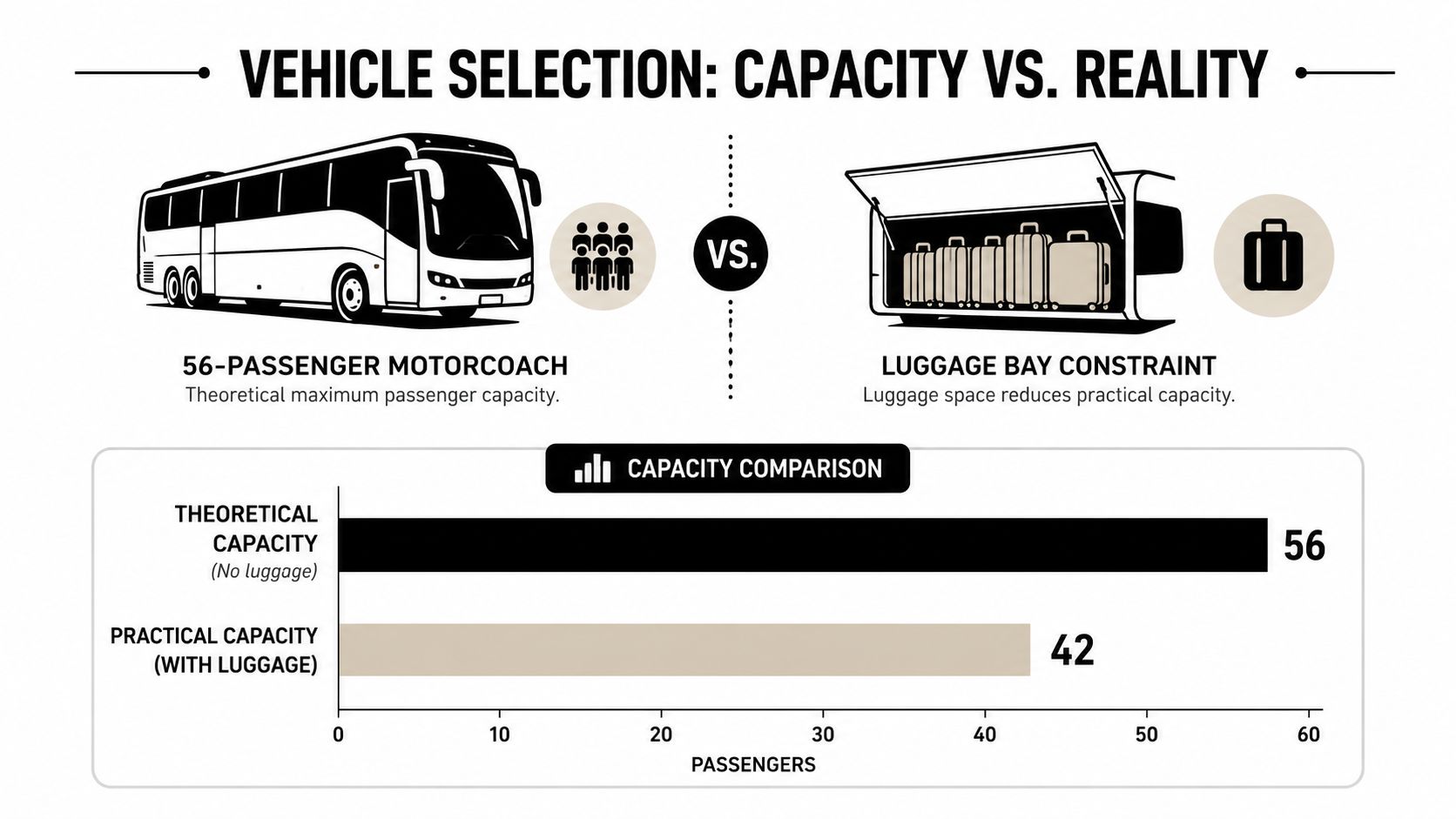
Use a vehicle comparison based on the movement's actual profile:
| Vehicle class | Works well for | Main constraint |
|---|---|---|
| Sedan | Individual executives or very small parties | Limited luggage and no group redundancy |
| SUV | Small VIP teams with moderate luggage | Cargo space can disappear quickly |
| Sprinter van | Corporate groups, families, and event movements | Seating and luggage configuration vary |
| Minibus | Medium-sized groups needing shared travel | Access, staging, and luggage layout require review |
| Motorcoach | Large groups with standardized luggage | Bay capacity, boarding time, and terminal restrictions |
For planners evaluating a premium van option, luxury Sprinter van rental with driver can be one reference point when comparing vehicle layouts, driver service, and group comfort requirements.
Consolidation versus a split fleet
One large vehicle simplifies passenger communication and can reduce the number of drivers. It also creates a single point of failure. If that vehicle is delayed, full, inaccessible, or caught in terminal congestion, the entire group is affected.
A split fleet offers flexibility. You can assign an accessible vehicle, place equipment separately, and match vehicles to staggered flights. The trade-off is coordination. Every driver needs the same manifest, destination instructions, radio or messaging protocol, and release authority.
A practical fleet may combine executive SUVs for principals, passenger vans for general travelers, and a dedicated cargo or accessible vehicle. That arrangement costs more coordination than one coach, but it often protects the schedule and passenger experience.
Specify crew requirements in the RFP
Driver quality is operationally relevant. Request experience with airport curb rules, private aviation terminals, executive movements, luggage handling, and multi-vehicle dispatch. For an FBO movement, confirm that the chauffeur understands ramp access credentials and the handoff between the flight department, ground handler, and transport team.
Designate a lead driver for every multi-vehicle movement. The lead driver receives final release authority, confirms the group's destination, and escalates exceptions to dispatch. Without that role, drivers may depart independently, leaving the coordinator to reconstruct the movement after it has fragmented.
Building a Timeline That Accounts for Real Airport Delays
A flight's scheduled landing time signals the earliest possible curbside pickup, while actual arrival requires time for deplaning, baggage, customs, regrouping, and movement to the meeting point. Staggered corporate and VIP arrivals add another constraint: a vehicle may need to wait for a later traveler without disrupting earlier releases.
Use arrival type to set the buffer
Independent European group-transfer guidance recommends 30 to 45 minutes after domestic or Schengen arrivals, 60 to 90 minutes after international arrivals, and 75 to 120 minutes for large groups with luggage, according to Alvora Travel's airport transfer guidance. Treat these as planning buffers, not promises. Baggage delivery, customs, mobility assistance, terminal congestion, and passenger communication can extend the dwell time.
Build the timeline from the passenger's actual release point:
- Flight status confirmed
- Aircraft at the gate or passengers released
- Baggage and customs progress checked
- Group contact confirms consolidation
- Vehicle dispatched from the holding area
- Ground coordinator moves the group to the curb
- Drivers load, verify headcount, and depart
Accessibility requests and unusual luggage need confirmation before arrival, because assistance and loading space can add lead time. A large group may also require separate luggage handling or a second dispatch window.
Keep vehicles in an approved waiting area while passengers remain inside. Send them to the terminal only after the group is ready. This limits curbside waiting exposure and gives dispatch room to adjust for delays.
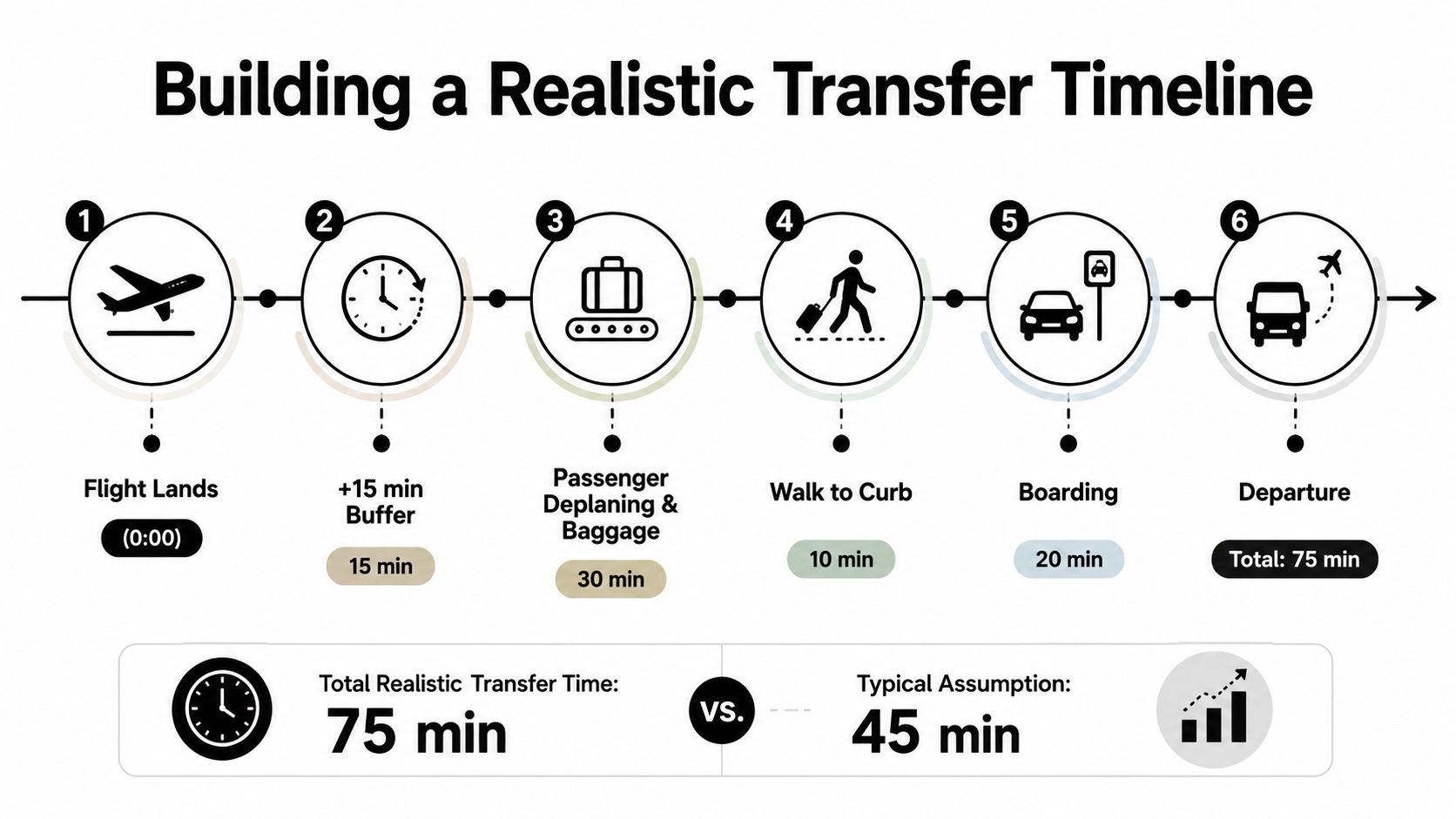
Coordinate staggered arrivals by release group
For a delegation arriving on three flights, create three operating groups rather than one oversized arrival block. Each group needs a flight monitor, assigned vehicle, meeting instruction, and consolidation rule.
A workable sequence looks like this:
- Before landing: Dispatch validates the manifest, vehicle assignments, driver contacts, and airport meeting point.
- At touchdown: The flight monitor updates the shared operations channel and confirms whether the aircraft is at a gate or remote stand.
- During baggage and customs: The coordinator checks passenger progress instead of sending drivers to the curb on schedule alone.
- At group release: Dispatch sends the assigned vehicle forward and alerts the marshal.
- After boarding: The marshal confirms passenger count, luggage status, and destination before release.
- Between waves: The lead coordinator reconciles the remaining manifest and adjusts later dispatches.
Booking lead time matters when several vehicles or specialty equipment are involved. The KPI guidance from Detailed Drivers' corporate transportation metrics identifies 95% to 98% on-time pickup within a 5-minute window as a commonly used benchmark, with no-shows below 0.5%. Treat results below 90% on-time pickup or booking lead times above 4 hours as escalation signals.
A structured group travel itinerary template keeps flight, passenger, vehicle, and contact data in one working document, especially when arrivals split across release waves.
Understanding Pricing Structures and Contract Terms
A quote may look fixed until a flight is late, a second dispatch window opens, tolls change, or the assigned vehicle cannot handle the luggage. The pricing model decides which party absorbs that uncertainty, so compare the structure against the actual arrival plan rather than the headline rate.
Compare the main pricing models
| Pricing structure | Protects the operator from | Protects the client from | Best fit |
|---|---|---|---|
| Per-vehicle flat rate | Route and vehicle commitment | Unpredictable base movement cost | Defined pickups with clear release conditions |
| Hourly minimum | Underused vehicle time | Repeated dispatch windows | Roadshows, standby, and complex schedules |
| Per-passenger pricing | Capacity fluctuations | Paying for unused seats | Standardized shared movements |
| Not-to-exceed agreement | Unclear final scope | Uncontrolled invoice growth | Corporate programs requiring budget discipline |
Per-vehicle pricing is easy to compare, but it may exclude waiting, parking, tolls, extra stops, or separate dispatches for staggered flights. Hourly pricing gives clearer control over a long operating window, although the client can pay for unused time. Per-passenger pricing suits standardized shared routes, yet reconciliation becomes harder when travelers arrive in separate waves, need accessible equipment, or require different vehicles.
Read the waiting and cancellation language
Ask the operator to define when the clock starts. Is waiting measured from scheduled landing, actual landing, gate arrival, or the vehicle's arrival at the pickup zone? Does the grace period change for domestic, international, and private-terminal arrivals? Are customs delays treated as normal operating variance or billable waiting?
The contract should also address:
- Split-arrival fees: Whether separate flight waves create additional dispatch charges
- Late changes: How added passengers, vehicles, stops, or equipment are priced
- Fuel and tolls: Whether they are included, capped, or passed through
- Gratuities: Whether they are included in the quoted rate
- Cancellation: The notice period and portion of the reservation cost retained
- Force majeure: How airport closures, severe weather, and carrier disruption are handled
- Substitution: What happens if the assigned vehicle or chauffeur becomes unavailable
Accessibility requests need their own lead-time rule. A contract should state when equipment must be confirmed and what happens if a suitable vehicle is unavailable. That detail matters more for independent corporate and VIP groups, where a late change can affect one vehicle without changing the rest of the fleet.
Match the pricing plan to the operating design. A fixed rate works when arrivals are predictable and release conditions are clear. A not-to-exceed structure gives the client budget control while allowing defined exceptions for waiting, tolls, or replacement vehicles. A service-level agreement framework can help turn vague service promises into measurable responsibilities, escalation paths, and reporting requirements.
Request an all-in scenario, not only the lowest base quote. It should show the cost of extra waiting, a separate arrival dispatch, tolls, gratuity, and a replacement vehicle. Comparing those outcomes before approval exposes the trade-offs and reduces the chance of an unexpected invoice.
Running On-the-Day Operations and Curbside Logistics
The operating plan becomes real when a flight status changes, a passenger's phone is off, or terminal traffic prevents a vehicle from reaching the expected curb. The coordinator's job is to control decisions before passengers feel the disruption.
Assign one person to the curb
A ground coordinator or curbside marshal should own passenger movement. Drivers should focus on safe vehicle positioning and loading, while the marshal matches names, luggage, and vehicles.
The marshal's duties include:
- Confirming the approved meeting point
- Carrying clear signage where permitted
- Calling the group contact when passengers are released
- Directing travelers to the correct vehicle
- Checking luggage before doors close
- Confirming the final headcount
- Releasing vehicles in the planned sequence
A shared messaging channel works for a small executive team. Larger events need a dedicated dispatch channel, radio network, or formal communications structure. The exact tool matters less than the chain of command. Every participant should know who can change the pickup point, hold a vehicle, authorize a split, or call a backup provider.
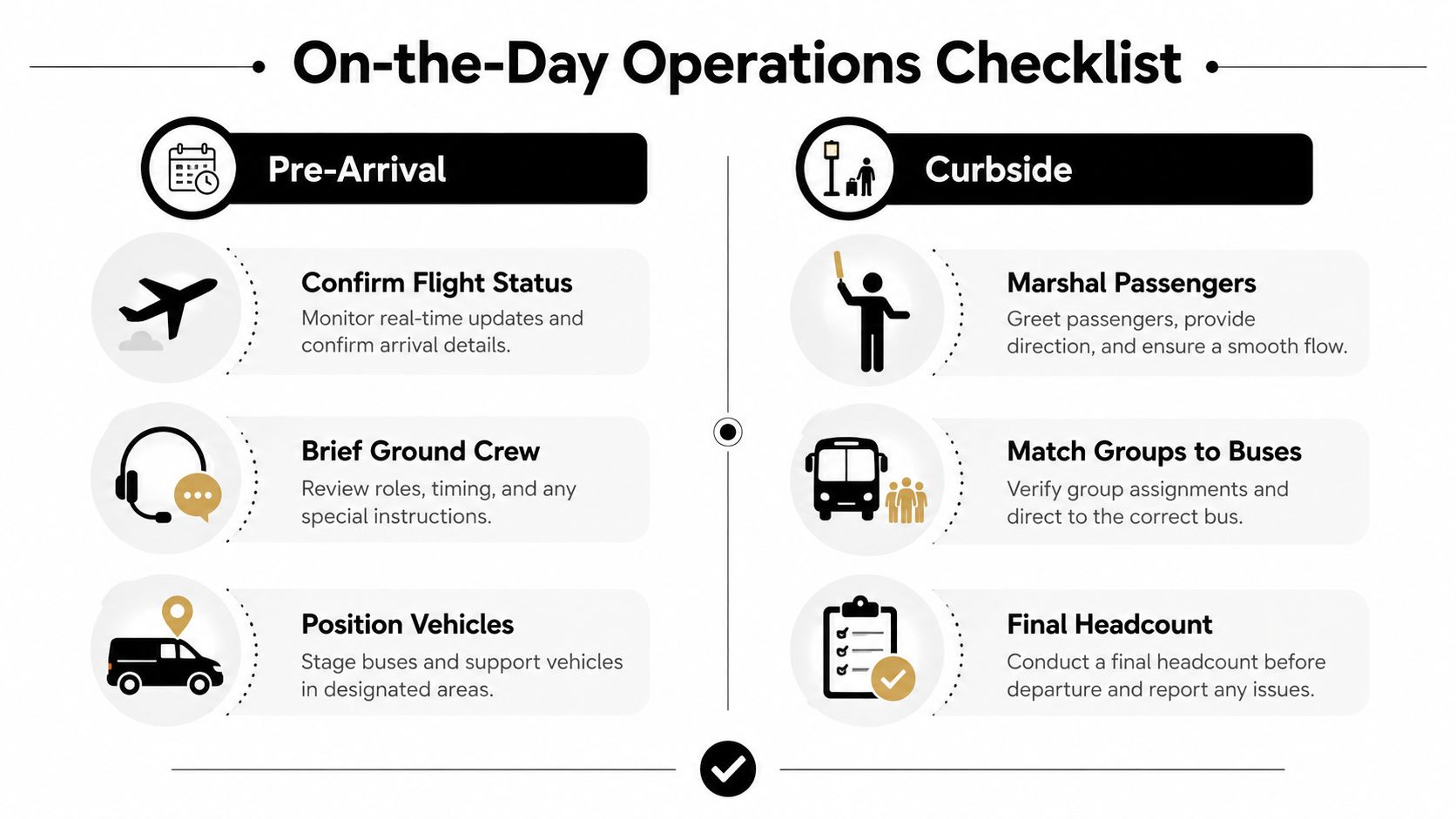
Monitor flights, but don't automate judgment
FlightAware, airline operational feeds, and airport updates can signal delays or early arrivals. Those tools should inform dispatch, not replace confirmation from the ground coordinator. A flight may land, but passengers may remain onboard, wait for mobility assistance, or spend extended time at baggage claim.
Send the passenger contact a clear message before travel with the meeting point and operator instructions. Share driver details only when dispatch has assigned the vehicle and the driver is moving toward the meeting area. Sending too many updates creates confusion, while sending none leaves travelers guessing.
For private aviation, confirm ramp access, FBO credentials, ground-handler procedures, and the handoff point between the flight department and chauffeur. A private terminal may shorten the passenger path, but only if the transport team has coordinated access and knows exactly where the aircraft-side transfer ends.
Use a release checklist
A disciplined release sequence should confirm:
- Driver briefing completed
- Flight status checked
- Vehicle position approved
- Ground coordinator in place
- Passenger group released
- Luggage matched
- Accessibility needs verified
- Headcount confirmed
- Destination reconfirmed
- Driver receives release instruction
- Departure time logged
- Remaining manifest reconciled
A vehicle shouldn't leave because the first passengers are seated. It leaves when the assigned group, luggage, destination, and release authority are confirmed.
Contingency Planning and Post-Event Reporting
A polished transfer plan does not prevent every failure. It reduces the number of decisions made under pressure. Independent corporate and VIP groups create extra variables: passengers may arrive on separate flights, luggage may exceed the planned vehicle capacity, accessibility support may need advance coordination, and customs may extend the release time.
Use a response matrix before the arrival window:
| Event | Immediate response | Escalation trigger |
|---|---|---|
| Missed passenger | Hold the manifest, contact the traveler, and separate the decision from the main group's departure | No response or an incompatible connection |
| Luggage exceeds capacity | Keep passengers together, identify affected items, and request cargo or replacement capacity | Doors cannot close safely or equipment is unsecured |
| Vehicle problem | Stop release, notify dispatch, and move passengers to a safe holding point | Replacement timing threatens the destination schedule |
| Terminal gridlock | Shift to the approved alternate meeting point and send a marshal | Curb access remains blocked |
| Split arrival delay | Keep later-wave passengers assigned while releasing ready groups when contract rules allow | Waiting cost or driver hours exceed the agreed operating plan |
Keep the communication sequence short. Dispatch notifies the ground coordinator, lead driver, client contact, and backup provider when escalation is required. Travelers receive one clear instruction, rather than conflicting messages from several drivers and planners.
Use the incident clock
Record when the disruption is identified, who owns the decision, what instruction was issued, and when the situation will be reviewed again. The Detailed Drivers KPI guidance emphasizes measures such as on-time pickup, no-shows, flight-monitoring coverage, and booking lead time. These measures become useful when the operation also records why exceptions occurred.
A post-event review should convert incidents into decisions, not repeat the dispatch log. Show stakeholders the planned service, the operational variance, the passenger or client impact, and the corrective action owner. Separate controllable failures, such as late manifest changes or unclear meeting instructions, from external conditions such as customs congestion or restricted curb access.
For recurring corporate programs, compare similar airport, vehicle, and arrival conditions rather than combining every movement into one average. Use the findings when reviewing contract terms. Repeated luggage substitutions may support a revised vehicle mix. Persistent split-arrival waiting may justify staged release rules or separate transfer pricing. Late accessibility requests may require an earlier approval deadline in the booking process.
Post-event discipline: An incident that is not logged becomes a recurring incident.
Close each report with owners and deadlines. If luggage planning failed, update the manifest template. If passengers missed the meeting point, revise the message and signage. If accessibility sourcing was late, add an earlier approval checkpoint. The report then becomes an operating tool for the next group airport transfer, not a document filed after the problem has passed.
MLR Worldwide Service coordinates airport transfers, FBO support, executive vans and minibuses, centralized dispatch, and on-site group logistics for corporate and VIP movements. Visit MLR Worldwide Service to discuss a transfer plan built around staggered arrivals, luggage requirements, accessibility needs, and real-time operational control.