

A client is standing at an FBO, the aircraft has landed, and the chauffeur is nowhere in sight. The travel manager is calling while the executive is asking whether the roadshow schedule can still be saved. In that moment, a polished apology script has little value. The client needs a clear diagnosis, a credible replacement plan, and one person with authority to make it happen.
Service recovery options work when they match the failure, the trip's importance, and the customer's actual loss. A vehicle mismatch may call for an immediate upgrade. A missed pickup may require a replacement vehicle, direct management contact, and a carefully calibrated commercial remedy. A preventable communication failure may need less compensation than proof that the dispatch process has changed.
Service recovery research supports a disciplined approach. Recovery can improve satisfaction, purchase intentions, and positive word of mouth, but inadequate recovery can deepen dissatisfaction, and recovery rarely restores the experience to the level of flawless delivery (service recovery research review). The practical lesson is straightforward: contain the disruption first, restore the journey second, and prove that the organization learned afterward.
The Failure Modes That Hit Premium Ground Transport
A premium operator shouldn't log an incident as “bad service.” That description is too vague to guide dispatch, billing, training, or an account review. The trip record needs a shared failure vocabulary that tells the next person what went wrong and what kind of remedy is likely to work.
Vehicle failures usually involve the wrong class, a mechanical issue, cleanliness, missing amenities, or a vehicle that doesn't match the approved specification. A chauffeur failure can involve appearance, conduct, route knowledge, luggage assistance, discretion, or an inability to manage a difficult pickup. Timing failures include a late arrival, missed flight monitoring, an early arrival with no visible vehicle, or a pickup window that wasn't adjusted after a schedule change.
Itinerary disruptions create a different operational problem. The vehicle may be present, but the driver has the wrong drop-off, a changed terminal, an incorrect FBO, or a handoff to a third-party provider that wasn't coordinated. Communication failures often sit underneath the visible incident: the client has no chauffeur contact, the license plate is wrong, the dispatcher is silent, or different stakeholders hold conflicting information.
Use one taxonomy across every handoff
Dispatchers, account managers, chauffeurs, and corporate travel teams should select the same primary category on the trip ticket. Add a secondary cause only when it changes the remedy, such as “timing failure, caused by missed flight update” or “vehicle failure, caused by affiliate mismatch.”
| Failure Category | Common Sub-Types | Typical Frequency |
|---|---|---|
| Vehicle | Wrong class, mechanical issue, poor cleanliness, missing equipment | Logged according to the operator's own incident history |
| Chauffeur | Appearance, professionalism, route knowledge, luggage or pickup handling | Logged according to the operator's own incident history |
| Timing | Late pickup, missed flight tracking, early arrival no-show | Logged according to the operator's own incident history |
| Itinerary | Wrong destination, terminal change, FBO error, vendor handoff | Logged according to the operator's own incident history |
| Communication | No contact, wrong plate, silent dispatch, conflicting updates | Logged according to the operator's own incident history |
The taxonomy matters because the remedy should correct the operational defect, not merely acknowledge the customer's frustration. A wrong vehicle class points toward an upgrade or replacement. A missed pickup points toward immediate transport protection and escalation. A silent dispatcher points toward ownership and communication controls.
Practical rule: Record the failure in the language used to make the next decision. “Client unhappy” is a sentiment. “Missed FBO pickup, chauffeur unreachable, replacement required” is an action brief.
How to Triage a Service Failure in the First Ten Minutes
The first ten minutes should follow a fixed sequence. Dispatchers under pressure tend to jump straight to compensation or start calling several people at once. That creates noise, delays the replacement decision, and leaves the client without a reliable update.
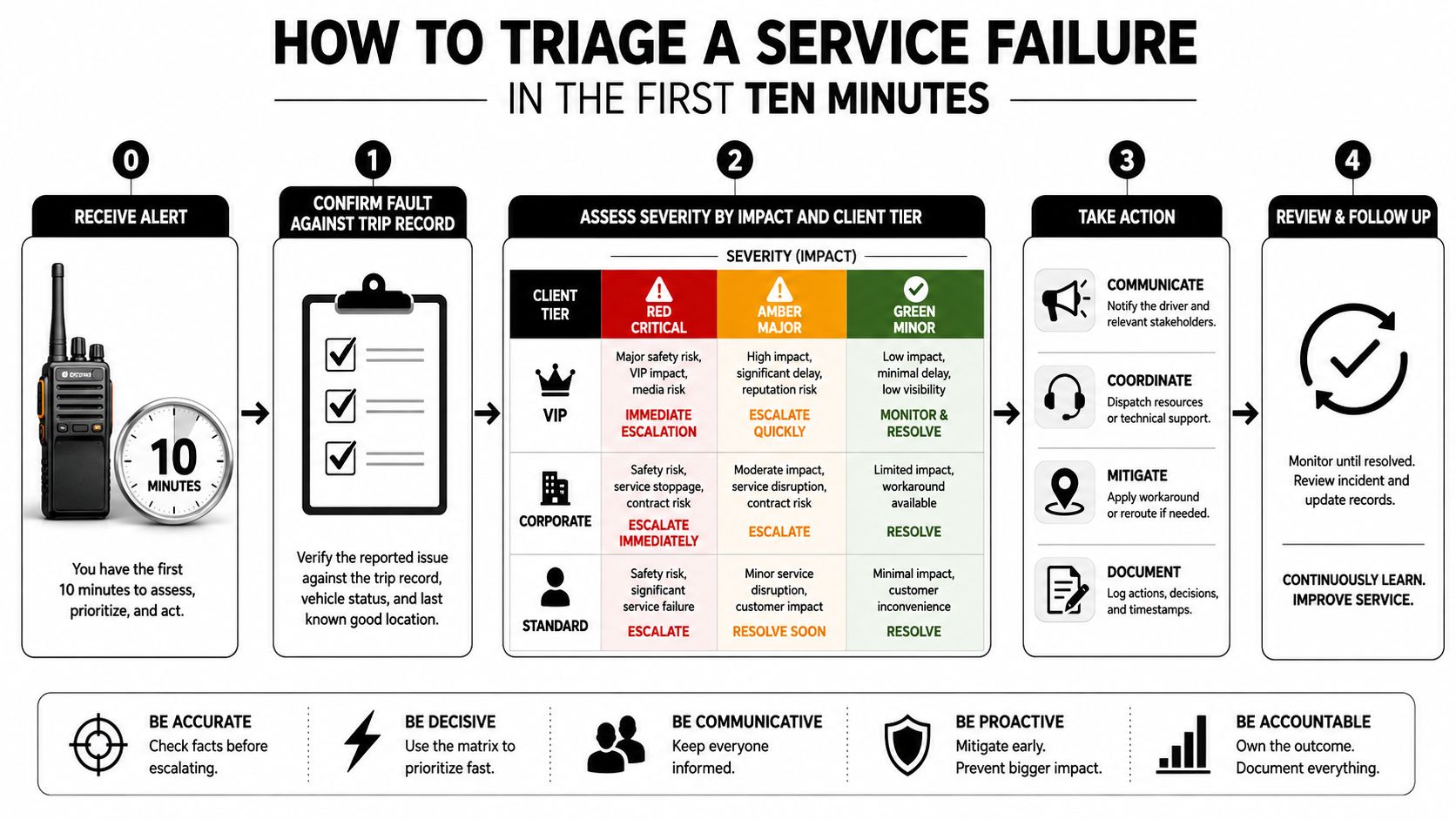
Protect, verify, communicate, remediate
Start by protecting the passenger from further exposure. If the vehicle is unsafe, the chauffeur is uncontactable, or the client is waiting in an exposed airport location, move the passenger to a safe and practical holding point while the response begins. Don't ask the client to keep searching for a vehicle that operations haven't confirmed.
Then verify the fault against the trip record. Check the booking time, passenger name, flight or FBO details, vehicle class, chauffeur contact, live location, notes, and any recent change. Call the chauffeur once through the primary channel and confirm whether the issue is real, recoverable, or caused by mismatched information.
Use a traffic-light rule:
- Red, critical: The client is stranded, safety is in question, a protected connection is at risk, or the trip involves a high-priority executive, VIP, crew movement, or security concern. Dispatch a backup while facts are still being gathered.
- Amber, major: The current vehicle or chauffeur can continue, but the experience or schedule is materially compromised. Reroute, swap, or upgrade after confirming the fastest workable option.
- Green, minor: The issue is uncomfortable or below specification but doesn't threaten movement or safety. Correct it on the current trip and notify the account owner.
Make the dispatch decision
Send a backup when the current vehicle can't safely or credibly complete the journey, when the chauffeur can't be reached, or when the remaining schedule leaves no recovery buffer. Reroute the current vehicle when its location is verified, the issue is logistical, and the revised path still protects the passenger's next commitment. Upgrade on the spot when the vehicle is available, the mismatch is clear, and the upgrade removes the problem faster than a swap.
The communication order should be equally firm: protect the client, gather facts, issue one clear update, then execute the remedy. Document the decision and owner in the incident record. Operators can also align this workflow with their documented emergency response procedures.
A short operational explainer can reinforce this sequence for new dispatchers:
Matching the Right Remedy to the Specific Failure
A missed pickup at JFK shows why blanket gestures fail. Suppose a corporate executive arrives at an FBO, the assigned chauffeur doesn't make contact, and the passenger has a tightly sequenced roadshow ahead. The account manager later offers a credit, but the client still had to solve the immediate transport problem and absorb uncertainty during the most time-sensitive part of the itinerary.
The correct response starts with movement, not money. A dispatcher confirms the passenger's location, sends a verified replacement vehicle, provides the new chauffeur's name and plate, and gives the account lead ownership of the executive's onward schedule. Only after the journey is protected should the operator decide whether a fee waiver, goodwill credit, or broader commercial remedy is proportionate.
Proportional remedies protect trust and margin
A vehicle mismatch is different. If a booked executive SUV arrives as a lower class but remains safe and usable, an immediate vehicle-class upgrade for the next leg may resolve the defect. If the client is carrying a group or sensitive equipment, the operator may need a vehicle swap rather than a verbal assurance.
A chauffeur conduct issue may call for a chauffeur replacement, a manager call, and a training review. An itinerary error may require direct coordination with the destination, venue, or affiliate. A communication breakdown often needs a named contact for the remainder of the trip, not an automatic financial concession.
| Failure Type | Standard Tier Remedy | Premium Tier Remedy | Maximum Remedy |
|---|---|---|---|
| Vehicle mismatch | Correct vehicle class on the next available movement | Immediate swap or higher class vehicle | Full trip review and commercial adjustment |
| Mechanical issue | Backup vehicle and updated arrival information | Priority replacement with manager ownership | Trip charge review plus documented safety investigation |
| Chauffeur issue | Chauffeur correction or replacement | Immediate replacement and account-lead contact | Formal incident review and broader account remedy |
| Missed pickup | Verified backup and direct client update | Backup, itinerary protection, and manager escalation | Commercial remedy calibrated to actual disruption |
| Itinerary error | Corrected route and destination confirmation | Replanned movement with all stakeholders aligned | Review of affected trip legs and service charges |
| Communication failure | Named dispatcher and confirmed contact path | Continuous monitoring with proactive updates | Account-level process review |
Research on recovery supports the use of multiple remedies rather than a single generic gesture. Recovery performance can improve customer outcomes, but the quality and proportionality of the response matter, and short-response recovery has performed strongly in relevant service settings (service recovery satisfaction analysis).
A credit can't put an executive back on schedule. Restore the schedule first, then price the failure fairly.
Remedy stacking should have limits. Combine operational fixes when the first fix doesn't fully remove the disruption, but don't add compensation automatically to every minor defect. The duty manager should consider client tier, contractual SLA, trip criticality, actual delay, repeat failures, and whether the operator caused the problem.
Communicating With the Client at Each Stage of Recovery
A recovery call from the FBO can determine whether a vehicle failure becomes a contained disruption or an account complaint. The chauffeur needs to keep the passenger moving. Dispatch needs to coordinate the remedy. Management needs to restore confidence with the traveler and corporate coordinator. Each stage therefore requires its own purpose, channel, and level of detail.
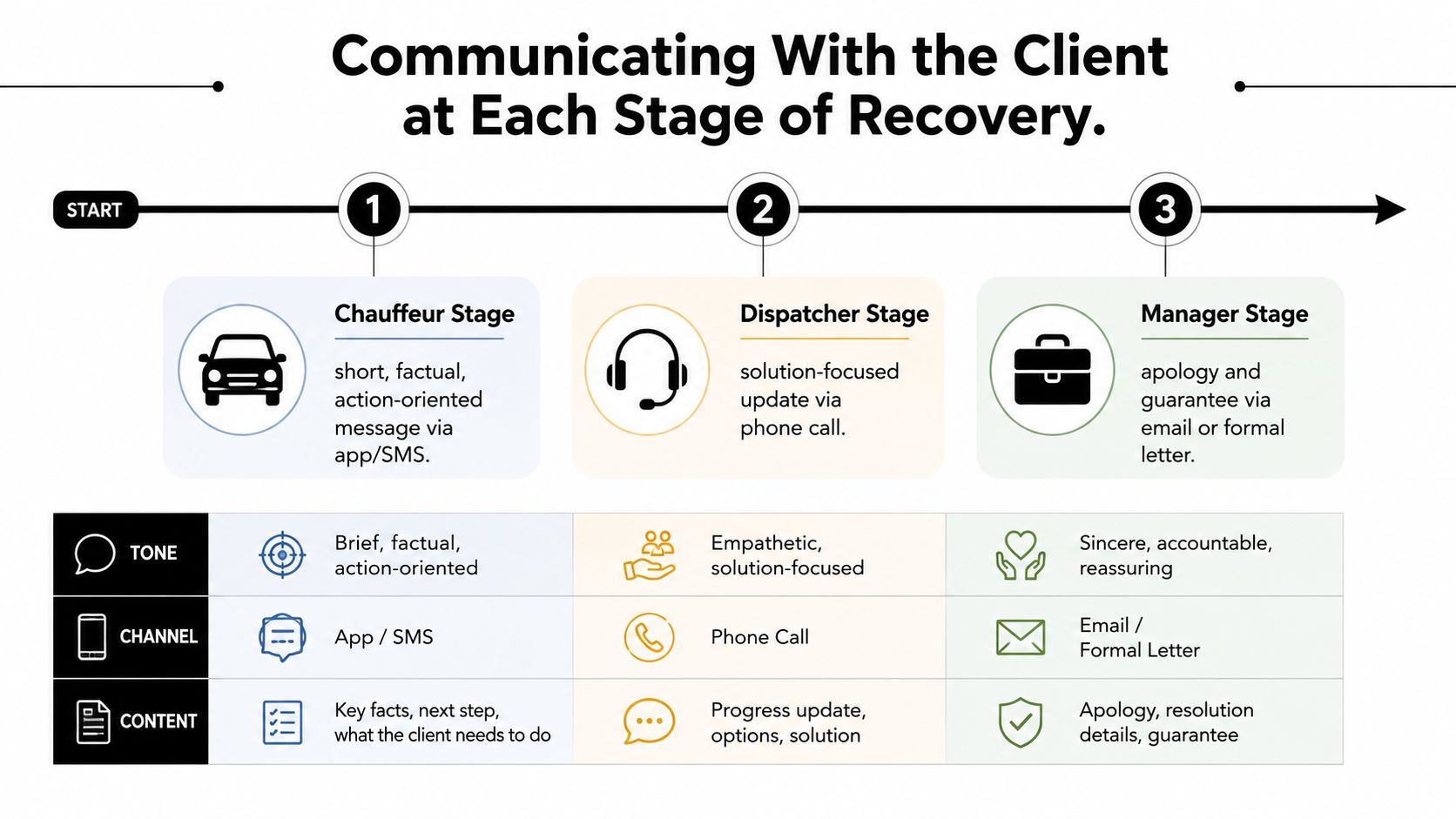
The chauffeur stage
The chauffeur should stick to location confirmation and vehicle ETA. A useful message acknowledges the problem, identifies the action underway, and avoids guessing about fault: “I understand you're waiting at the FBO. Dispatch is sending a replacement SUV to your location. I'll remain available by phone and will confirm the vehicle details as soon as they're assigned.”
Internal disputes and compensation terms belong with dispatch or management. The chauffeur can use the app or SMS for concise instructions, then switch to voice when the passenger is distressed, the location is unclear, or safety is affected. The immediate measure is whether the passenger receives clear direction and reaches the next movement without further confusion.
The dispatcher stage
The dispatcher owns the operational conversation and should match the channel to the complexity of the failure. A phone call is more effective than a text thread when several vehicles, drivers, or trip legs require coordination. Confirm the passenger's location, state the selected remedy, give the next update point, and ask whether a hard deadline changes the plan.
The dispatcher should acknowledge the failure briefly, then move directly to the confirmed remedy and next update point. “We missed the pickup confirmation. A replacement is assigned, and I'm monitoring it directly. Your next scheduled movement is still under review, and I'll update you when I have a verified arrival time” gives the client a usable plan without defensive detail. Track the promised update and the actual arrival against the account SLA.
The manager stage
The post-trip message belongs to a named account lead or manager. Email gives the traveler and corporate coordinator a written record. Summarize the incident without spin, state the remedy provided, explain any commercial adjustment, and identify the preventive action assigned.
Research on distributive and procedural justice can matter more than polished interactional language in recovery decisions. A 2025 study based on 638 responses found negligible impact from interactional justice compared with the stronger role of fair outcomes and fair processes (service recovery justice research). Courtesy still shapes how the message is received, while a fair result and credible process determine whether confidence returns. The manager should close with the owner and due point for the preventive action, so the account can judge recovery by follow-through rather than tone alone.
Escalation Paths and Service Recovery SLAs
A dispatcher shouldn't have to negotiate authority during an active failure. The escalation path must name the owner, define the decision rights, and specify when the next person takes control. Without that structure, incidents remain in the wrong queue while employees wait for approval.
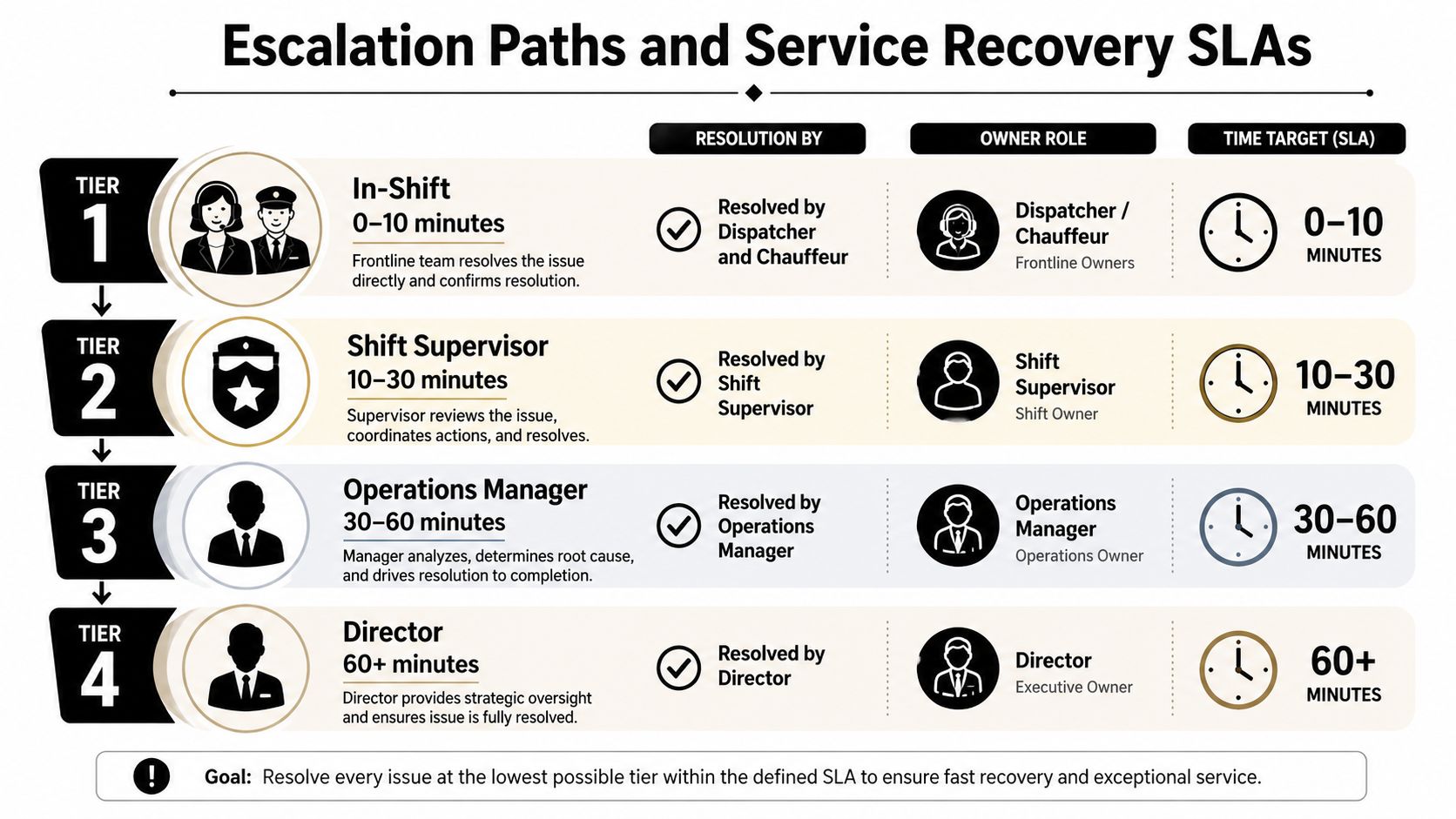
Assign ownership by elapsed time
Tier 1, in-shift response: The dispatcher and on-duty chauffeur lead handle confirmed vehicle, timing, and routing failures from the moment they are reported through the first ten minutes. They can contact the client, locate a backup, reroute the current vehicle, and record the incident.
Tier 2, shift supervisor: The supervisor takes ownership when the first response hasn't stabilized the trip or when a compensation decision exceeds dispatcher authority. This tier covers the period from ten to thirty minutes and should approve chauffeur swaps, vehicle upgrades, and defined commercial remedies.
Tier 3, operations manager: The operations manager takes over from thirty to sixty minutes when the incident affects a priority client, multiple trip legs, an affiliate, or a serious schedule dependency. The manager should coordinate internal teams rather than send the client back through another handoff.
Tier 4, director: A director becomes involved after sixty minutes, or sooner for safety concerns, security issues, executive exposure, or a failure with significant account consequences. The director owns the relationship-level decision and ensures the incident receives an accountable postmortem.
Set the handoff format
Every escalation should carry the same compact brief:
- Incident: What failed, where, and when.
- Passenger: Client tier, location, needs, and hard deadline.
- Trip status: Current vehicle, chauffeur contact, replacement options, and verified timing.
- Action taken: What has already been promised.
- Decision needed: The approval or intervention required.
- Next update: Owner and time for the next client communication.
The first contact, interim update, and resolution targets should appear in the account's service-level agreement rather than living only in a dispatcher's memory. Teams reviewing service-level agreements should define escalation authority, update ownership, and exceptions for safety or security incidents.
Escalation is not a failure of the dispatcher. It is a control that prevents one person from carrying an incident beyond their authority.
Closing the Loop With Root-Cause Analysis and Follow-Up
An immediate fix protects the trip. It doesn't prove the operator corrected the process that caused the failure. A replacement vehicle can arrive successfully while the same missing flight update, affiliate handoff, or vehicle allocation error remains in the system.
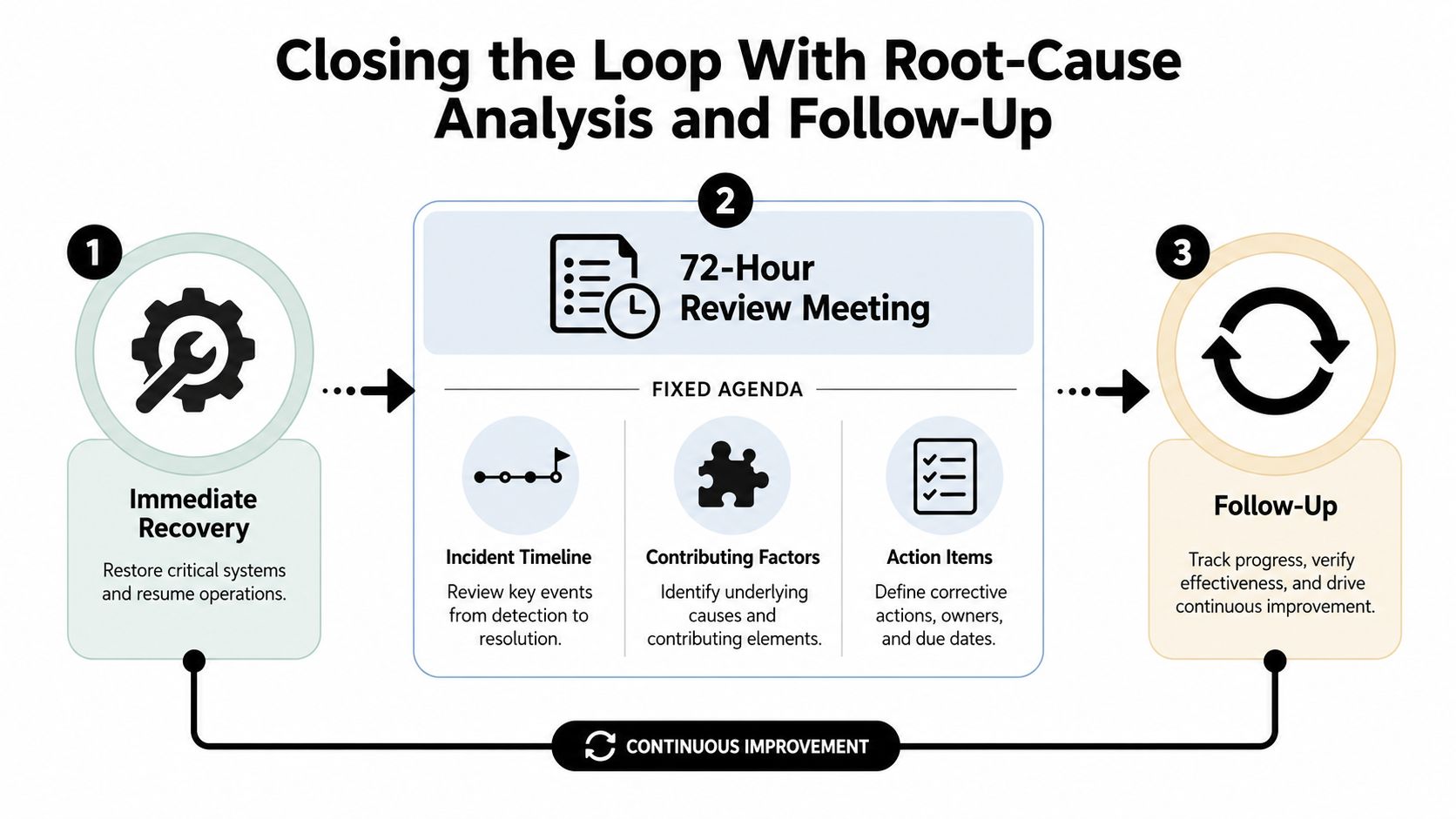
Hold the review while the facts are fresh
The post-incident review should examine the incident timeline, not search for a convenient scapegoat. Bring the trip record, dispatch messages, vehicle location history, chauffeur notes, client communications, and affiliate details into one review. Then ask what happened, what the team expected to happen, and where those two paths separated.
A fixed agenda keeps the meeting practical:
- Incident timeline: Establish the reported fault, first contact, decisions, updates, remedy, and close.
- Contributing factors: Separate chauffeur, vehicle, dispatch, technology, vendor, weather, venue, and client-change factors.
- Remedy assessment: Identify which action restored movement and which action failed to address the customer's concern.
- Process change: Assign one owner, one due date, and one verification method.
The process change may be a revised FBO pickup checklist, a mandatory plate confirmation, a vendor scorecard action, a dispatch alert, or targeted chauffeur coaching. If no named person owns the change, the review has produced commentary rather than control.
Make learning visible to the client
A 2025 follow-up recovery study found that the service recovery paradox wasn't observed after a satisfying immediate fix, but did emerge when customers saw subsequent process changes that demonstrated organizational learning (follow-up recovery research). The implication is useful for corporate transport: speed closes the immediate incident, while visible improvement can influence whether the client believes the operator is dependable next time.
Use a deliberate follow-up cadence. Send a 24-hour check-in to confirm the client's account of the experience and any unresolved consequence. Provide a one-week status note when a process change is still being implemented. Bring recurring themes to a quarterly review with the corporate travel manager, supported by incident trends and completed actions.
Feed every finding into the right operating system. Chauffeur-related causes belong in training and performance coaching. Dispatch causes belong in playbooks and quality audits. Vehicle and affiliate causes belong in maintenance controls, allocation rules, and vendor reviews.
KPIs and Dashboards That Prove Recovery Is Working
A recovery program needs metrics that connect an incident to a management decision. Raw complaint volume can look stable even while trip volume, account complexity, or repeat failures are changing. A dashboard should show how quickly the team contained the issue, what it cost, whether the defect returned, and whether the client relationship recovered.
The most useful operational measures are:
- First-contact resolution rate: The share of incidents stabilized without another escalation or client chase. A declining result points to weak dispatcher authority, incomplete trip data, or poor backup coverage.
- Mean time to remediation: Time from confirmed fault to a workable remedy. Rising time should trigger a review of dispatch coverage, vehicle availability, or approval delays.
- Repeat-failure rate: Track recurrence by chauffeur, vehicle, route, vendor, and failure category. This identifies patterns that a total incident count hides.
- Compensation cost as a share of trip revenue: Review the measure by account and failure type, then investigate both over-compensation and underpowered remedies.
- Post-failure satisfaction, repurchase intent, and word of mouth: These are stronger recovery outcomes than a simple “satisfied” checkbox. One longitudinal study reported postrecovery satisfaction of 16.03 compared with 13.41 before failure, repurchase intent of 21.97 compared with 20.14, and word of mouth of 15.42 compared with 9.74, with a large effect size of η² = .45 (longitudinal service recovery study).
Build two views for two audiences
The weekly operations dashboard should be detailed enough for action. Show incidents by category, mean remediation time, open escalations, compensation cost, repeat failures, vehicle and chauffeur patterns, and unresolved root-cause actions. Each metric should have an owner and a threshold that triggers a review.
The monthly corporate scorecard should be narrower. Present incident rate by service category, recovery time, client-impacting failures, completed preventive actions, and account-level commercial remedies. Corporate travel managers don't need every dispatch note. They do need evidence that the operator identifies patterns and closes them.
| KPI | How to Calculate | Cadence | Decision It Triggers |
|---|---|---|---|
| First-contact resolution | Incidents resolved without further escalation divided by total incidents | Weekly | Adjust dispatcher authority or escalation coverage |
| Mean time to remediation | Total time from confirmed fault to workable remedy divided by incidents | Weekly | Improve backup supply, routing, or approval speed |
| Repeat-failure rate | Recurring failures by chauffeur, vehicle, route, or vendor | Weekly and monthly | Coach, maintain, replace, or renegotiate |
| Compensation cost ratio | Recovery compensation divided by trip revenue | Monthly | Review remedy bands and margin protection |
| Recovery outcome movement | Compare post-failure satisfaction, repurchase intent, and word of mouth with the selected baseline | Monthly or quarterly | Retain, repair, or redesign the account experience |
| Root-cause closure | Completed corrective actions divided by assigned actions | Weekly | Escalate overdue owners and process changes |
Use live trip visibility as an operational input, not as a vanity display. A platform or workflow that gives dispatchers current vehicle status, chauffeur contact, and itinerary context can support real-time transportation visibility, but visibility only creates value when someone has authority to act on the information.
The executive question is simple: Did the recovery protect the client, did the remedy match the failure, and did the organization change afterward? A dashboard that answers those questions earns credibility in an account review.
MLR Worldwide Service provides 24/7 concierge operations support, executive chauffeur transportation, airport and FBO coordination, contingency handling, and real-time trip monitoring for corporate and VIP movements. If your team needs structured service recovery options backed by proactive communication and escalation control, visit MLR Worldwide Service to discuss your transport requirements.