
A corporate roadshow rarely fails because nobody booked a car. It fails because the cars, venue, security team, flight schedule, loading dock, and executive program were never managed as one operating system.
A delayed aircraft compresses an arrival window. A hotel lobby becomes unusable because another group has claimed the curb. A chauffeur reaches the wrong entrance while a security lead waits at the FBO. Meanwhile, the event team believes transportation is handling it, and transportation believes the venue is handling it. By the time someone takes ownership, the keynote schedule has already absorbed the damage.
Event logistics services should prevent that chain reaction. For corporate and VIP travel, the provider must coordinate people, vehicles, equipment, access points, and decisions in real time. The vehicle is only one component. The primary product is controlled movement under pressure.
When Ground Transport Becomes the Whole Event
Forty-five minutes before a 300-person investor day, the transport plan starts coming apart. Forty executives are still spread across four hotel lobbies. A motorcade is circling a terminal that has just been closed to the public. At the venue, the loading dock has no agreed staging sequence, so production trucks, catering vans, and passenger vehicles are competing for the same approach.
The keynote hasn't started, but the event is already failing.
The immediate temptation is to ask for more cars. That response misses the problem. The executives aren't stranded because the fleet is necessarily too small. They're stranded because the travel manifest, hotel departure sequence, terminal access plan, security perimeter, and venue receiving process weren't synchronized.
The hidden cost of a transport footnote
When ground movement sits at the bottom of the event plan, every stakeholder optimizes its own task. The venue protects its dock. Security protects its perimeter. The airline or FBO manages aircraft access. The executive assistant protects the principal's schedule. The transportation vendor dispatches drivers. Nobody owns the handoff between those decisions.
That gap creates political problems as quickly as operational ones. A late executive asks the travel manager why the car wasn't waiting. The venue manager blames an unauthorized vehicle at the curb. Security questions a driver who wasn't included in the latest manifest. The production lead argues that passenger movement interrupted load-in. Each party may have followed its own instructions, yet the client still experiences one failure.
The broader market shows why this work deserves executive attention. The event logistics market is projected to grow from USD 79.33 billion in 2026 to USD 103.89 billion by 2031, with a projected compound annual growth rate of 5.55%, according to Research and Markets' event logistics market coverage. That scale reflects recurring demand across corporate meetings, exhibitions, entertainment tours, and multi-site programs.
Operational rule: If the movement plan doesn't name who controls the venue curb, the FBO handoff, the live manifest, and the escalation path, the plan isn't complete.
Ground movement is connective tissue
For a roadshow, transportation connects every program milestone. It moves executives from the airport to the hotel, the hotel to a client meeting, the meeting to a reception, and the reception to the next city. It also connects passenger logistics to freight, staging, security, and venue operations.
That makes failure highly visible. A delayed equipment case can affect a production team, but a stranded executive can alter the agenda, the security posture, and the client's confidence at once. The transport provider must therefore operate as an extension of the event command team, not as a supplier waiting for individual ride requests.
The right question isn't, “How many vehicles can you provide?” Ask instead, “Who will make the next decision when the terminal closes, the flight moves, the dock fills, and the program remains fixed?” The answer should be one accountable operations lead with authority to reassign vehicles, revise routes, communicate changes, and document the decision.
What Event Logistics Services Actually Include
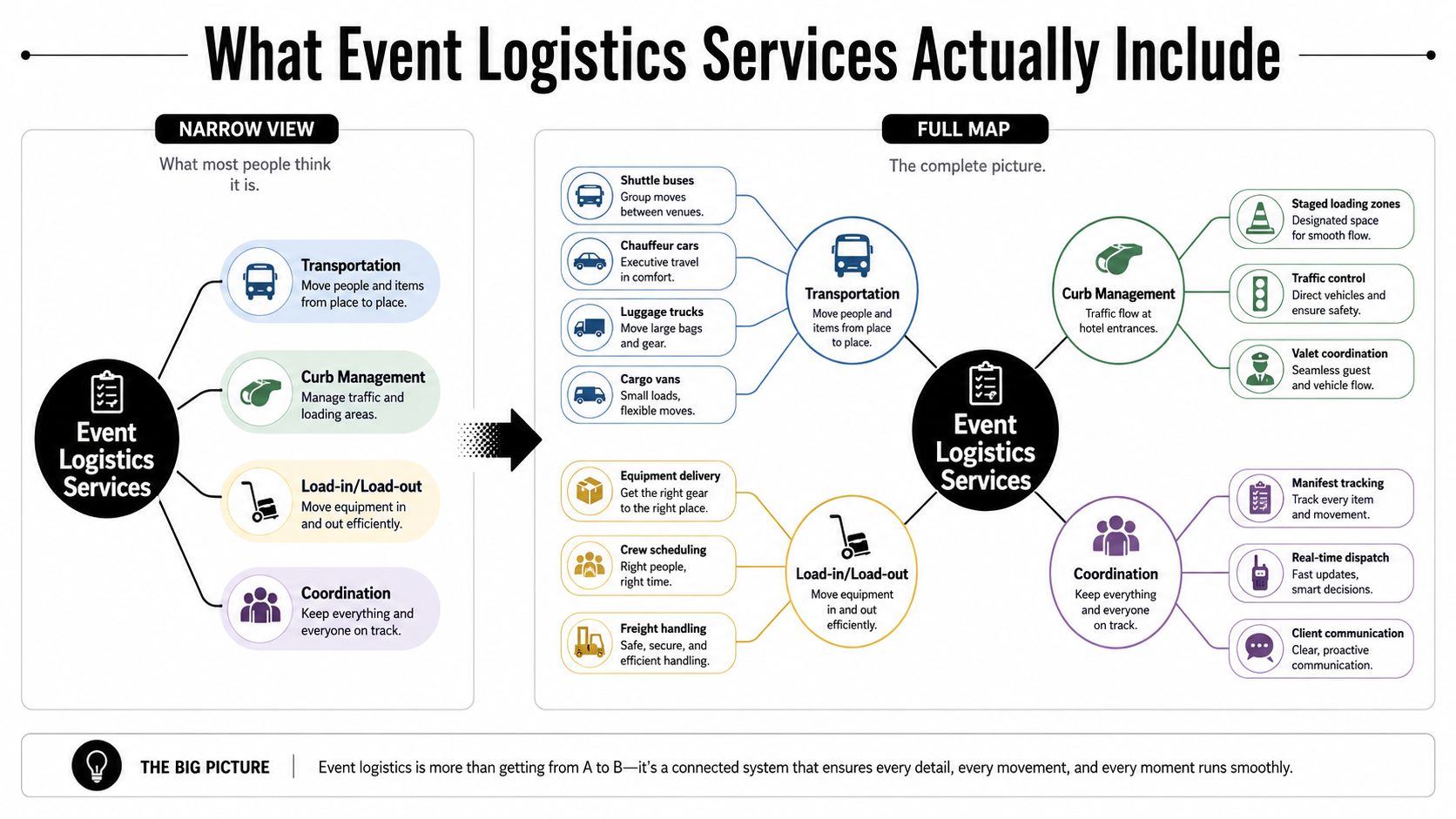
Most corporate buyers begin with a narrow definition: shuttle buses, luggage trucks, chauffeur-driven cars, and perhaps a few vans. Those assets matter, but they don't describe the work. A vehicle can be perfectly clean, correctly licensed, and sitting at the right hotel while the event still suffers because nobody coordinated the pickup zone or updated the passenger manifest.
Event logistics services are the integrated planning, coordination, and execution layer for movement across a venue-based timeline. That layer covers passenger transportation, crew and equipment staging, VIP routing, FBO handoffs, venue access, and live disruption response. It should connect the itinerary to the physical realities of docks, curbs, gates, restricted areas, traffic patterns, and program milestones.
The full operating layer
A mature program typically includes:
- Passenger movement: Shuttle buses, chauffeur cars, executive vans, luggage trucks, and cargo vans assigned by traveler type and movement window.
- Curb management: Staged loading zones, traffic control, valet coordination, hotel lobby procedures, and venue access instructions.
- Load-in and load-out: Equipment delivery, crew scheduling, freight handling, dock reservations, and return movement.
- Coordination: Manifest tracking, real-time dispatch, driver communications, client updates, and escalation ownership.
- Special handling: VIP routing, secure transport protocols, FBO access, customs-aware planning, and cross-border handoffs.
The distinction matters because event logistics isn't the same as freight. Freight providers focus on moving equipment, displays, or materials through a defined chain. Event logistics must align freight with passenger movement and programming. A trade show truck arriving on time is not enough if its delivery blocks the executive arrival lane.
It also isn't the same as a destination management company. A DMC may coordinate local venues, activities, and hospitality. A ground-transport operator may provide vehicles on demand. A successful event logistics partner must integrate those parties into one movement plan, with clear ownership for what happens when their schedules collide.
For a practical explanation of how transportation fits into the broader planning discipline, see this guide to logistics in event planning. The essential buying test is simple: can the provider show the workflow between booking, staging, dispatch, access control, passenger tracking, and exception management? If the proposal only lists vehicle classes and hourly rates, you're reviewing a car-service quote, not an event logistics solution.
The Five Pillars of a Premium Ground Operation
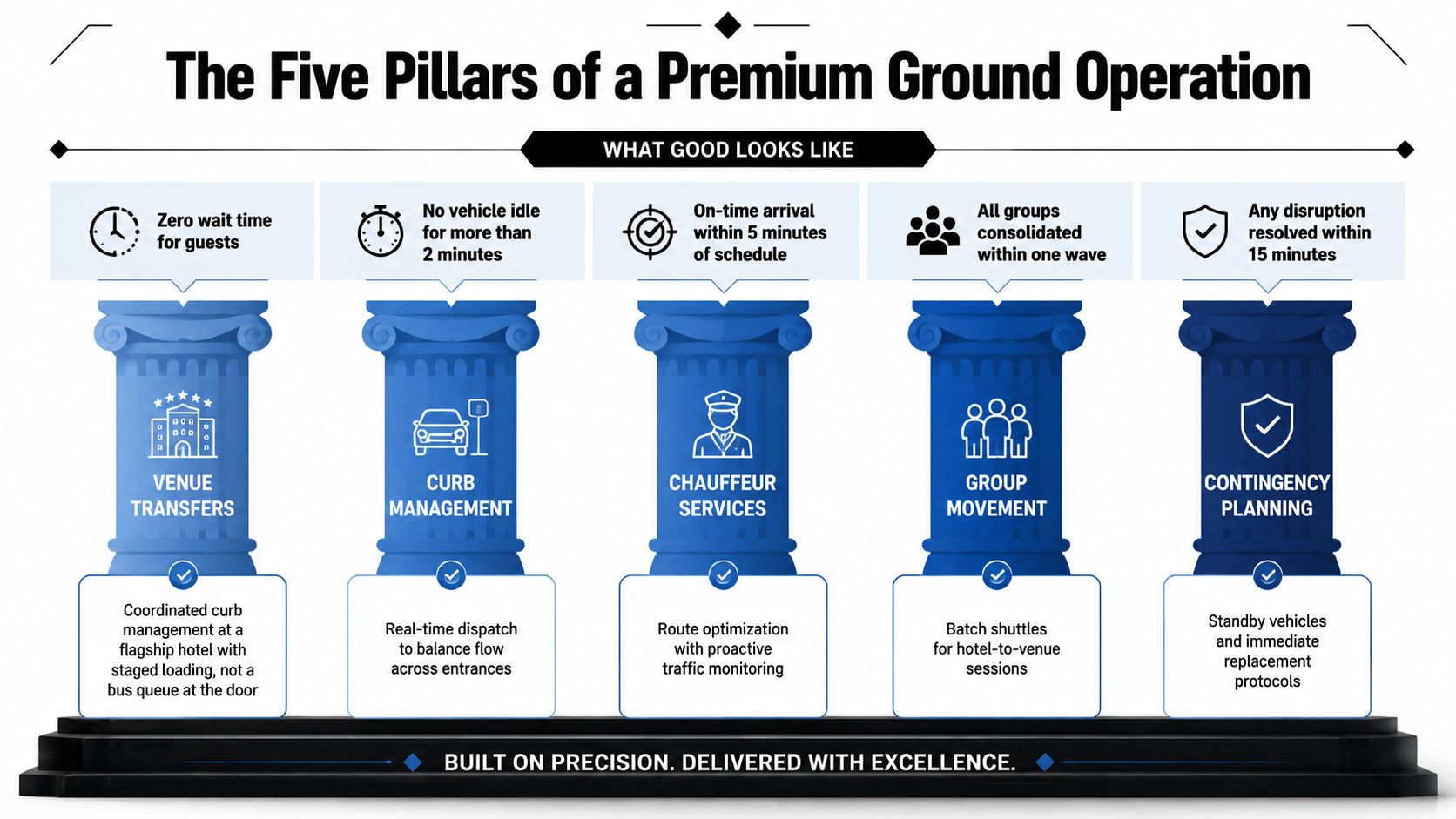
A premium operation has five connected pillars. They aren't five separate add-ons. Each one protects a different point where a roadshow can lose time, control, or privacy.
Venue transfers
A venue transfer starts before the vehicle leaves the hotel. The operator should know which entrance accepts executive arrivals, where vehicles stage, how long the curb remains available, and which vehicles move first when space is restricted.
At a flagship hotel, good execution means staging cars in an approved holding area and releasing them in sequence. It doesn't mean lining buses along the front door and asking guests to find the right one.
What good looks like: The venue, hotel, security lead, and dispatch team share the same curb plan. Drivers receive entrance-specific instructions, and one coordinator controls the release order.
Curb management
Curb space is an operational resource. If passenger cars, catering vehicles, production vans, and taxis all use the same access point, the operator needs a traffic pattern, not a hope that everyone will cooperate.
A dispatcher should balance flow across entrances and redirect arrivals when a zone becomes saturated. The venue team must know who can authorize a change. The client shouldn't discover the new pickup point through a confused text message from a driver.
Chauffeur services
Chauffeur service for executives requires more than a named vehicle. The driver needs the correct passenger profile, approved route, meeting point, security instructions, and backup plan. For VIP travel, privacy and discretion belong in the operating brief alongside timing and vehicle assignment.
Route planning should account for traffic restrictions, venue closures, aircraft timing, and the possibility that a principal leaves early. A chauffeur who can report a developing issue to dispatch is more valuable than one who only follows the original itinerary.
Group movement
Group transportation needs cohort control. The travel manager and security lead should be able to see which passengers belong together, who has boarded, which vehicle is assigned, and who owns the next communication.
A centralized manifest can support separate views for executives, staff, production, and security while preserving one operational record. Named contacts for each cohort eliminate the familiar failure in which every vendor calls the same senior assistant for routine updates.
Contingency planning
A contingency plan must specify actions, not just risks. It should identify reserve vehicles, alternate routes, alternate pickup zones, escalation contacts, and the conditions that trigger a change.
For an international arrival, the plan also needs customs-aware routing and a defined handoff between the FBO, ground operator, and receiving venue. For an event with a fixed keynote, reserve capacity should be positioned where it can be used quickly, rather than held at an impractical remote location.
The strongest event plan has one operations lead who owns the day. Five vendors with overlapping scopes create five places to wait for permission.
That lead should maintain a live board showing arrivals against program milestones, vehicle status, venue restrictions, and open incidents. The board can be digital, but the ownership must be human. A dashboard won't decide whether to hold a shuttle, move a reserve SUV, or reroute a principal while security changes the perimeter.
Planning Around Venue Surges Instead of Headcount
Headcount alone produces weak transport plans. Two events with the same attendance can generate entirely different movement patterns because venue layouts, schedules, hotel locations, session transitions, and access points control when and where demand concentrates.
Start with the venue. Map every ingress and egress point, identify staging areas, mark the loading dock, and document the walking route from each pickup zone to the actual room or gate. Separate arrivals from departures, VIP movements from general attendee flows, and scheduled waves from unscheduled exits.
Build the operating model
Use this sequence for every venue:
- Map the geometry: Record curb length, turning restrictions, security checkpoints, pedestrian crossings, dock access, and alternative entrances.
- Mark the surges: Identify session ends, hotel departures, meal transfers, aircraft arrivals, and program milestones that concentrate demand.
- Model the flow: Estimate passenger movement through each zone during each window. Then set the vehicle release pattern and headway.
- Stage the assets: Place reserve vehicles near zones likely to overload, particularly where a long hotel route slows recovery.
- Set triggers: Define when dispatch will compress headways, redeploy vehicles, open another pickup point, or activate the reserve plan.
The event shuttle dispatcher playbook recommends mapping sessions above 500 attendees, treating the 8 to 15 minutes after a session ends as a primary surge period, and using an 8-minute wait target during peak arrival windows. It also recommends reassessing redeployment when a queue exceeds 40 passengers and monitoring vehicle allocation at 15-minute intervals during the first 90 minutes of a major arrival burst.
These operating rules give the dispatch lead clear action points. A 300-person gala with two simultaneous ballroom transitions can create one sharp release. A conference with rolling breaks can create several smaller waves. Fleet size, headways, and staging positions must match the pattern.
Crowd research treats density and attendee volume as measurable risk inputs, including a point for every 500 attendees in one risk model, with adjustments for event-specific conditions, according to this technical report on crowd densities. Apply the principle rather than copying the formula. Capacity, local geometry, timing, and access restrictions belong in one operating picture.
For a group movement example, review this overview of group transportation services. The operating standard is early intervention. Move assets before the second surge arrives, while the team still has room to recover.
How to Vet a Premium Ground-Transport Partner
An RFP should test operating judgment, not invite vendors to decorate a rate sheet. Ask each candidate to explain what its team will do when a flight delay compresses a planned arrival window, the venue closes a curb, and several principals still need to reach the same program milestone.
Score the answer for sequence, authority, communications, and recovery. Marketing phrases such as “service” tell you nothing unless the vendor can name the dispatcher, the escalation route, the reserve assets, and the client update process.
Premium Ground-Transport Partner Vetting Matrix
| Vetting Criterion | What Good Looks Like | Common Weak Answer |
|---|---|---|
| Dedicated event operations manager | One named lead owns the master plan, venue coordination, and day-of decisions. | A shared account representative forwards requests to separate teams. |
| Live dispatch and driver communications | Dispatch sees vehicle status, communicates in both directions, and records changes. | Drivers receive static instructions and call a general office when something changes. |
| Affiliate depth in secondary cities | The provider can identify vetted local operators, vehicles, supervisors, and escalation contacts for every stop. | “We have coverage nationwide” without naming the operating structure. |
| FBO and customs coordination | The team understands aircraft arrival handoffs, restricted access, passenger processing, and customs-related timing. | Airport pickup is treated like a standard curbside reservation. |
| Contingency vehicle reserves | Reserve vehicles have defined locations, release authority, and replacement procedures. | The vendor will “do its best” to source capacity after a failure. |
| Post-event incident reporting | The client receives a clear record of delays, missed handoffs, substitutions, and corrective actions. | The vendor closes the invoice without reviewing operational exceptions. |
| Security and privacy procedures | Driver vetting, passenger confidentiality, route controls, and protect protocols are documented. | The proposal lists vehicle specifications but avoids process detail. |
Make the vendor answer scenarios
Give every bidder the same scenario set. Ask what happens if a principal's flight moves, a driver loses cellular coverage, a hotel changes its entrance, or a vehicle becomes unavailable during a departure wave. Require the response in operational order.
A serious provider will clarify who makes the decision, which stakeholders receive the update, what the passenger sees, and how the team confirms the recovery. It should also explain how it documents the incident afterward. For background on one element of driver due diligence, review these driver background check practices.
Disqualify answers that rely on unnamed “local partners,” vague promises of availability, or a single emergency phone number that rings into a general queue. For executive travel, procedure beats polish. The provider that can describe its failure response is usually safer than the provider with the most impressive fleet brochure.
Why Scale Alone Is Not the Right Selection Signal
A large fleet can help, but fleet size doesn't prove event readiness. A provider with hundreds of vehicles may still assign your roadshow to an overloaded dispatch desk, subcontract a secondary city without meaningful oversight, or lack the authority to move assets when your schedule changes.
For multi-city and cross-border programs, evaluate the network behind the logo. You need vetted affiliates in every secondary market, a concierge operation that understands principal preferences, and an accountable lead who can coordinate across time zones.
Where scale can work against you
- Distributed attention: Your event becomes one booking among many, so small exceptions wait for a supervisor who isn't watching your program.
- Unverified affiliates: A local operator may meet a basic reservation requirement but lack experience with FBO access, secure movements, or venue-specific staging.
- Volume-driven pricing pressure: A large contracted program can trigger capacity constraints and surge pricing in the markets where you most need control.
The right selection signal is absorptive capacity. Can the partner recognize a disruption, make a decision, redeploy assets, and communicate the change before the failure spreads? A smaller network with audited affiliates, clear operating standards, and one named operations lead may handle that work better than a larger company that treats every city as an interchangeable booking zone.
Don't ask only how many vehicles the provider owns. Ask how many vehicles it can control, where its supervisors are located, how it audits affiliates, and who answers when the primary route is no longer usable. That conversation reveals operational scale more accurately than a fleet count.
Pre-Event Readiness Checklist for Corporate Travel Teams
The final sign-off should be binary. Each item is either confirmed or open, and an open item has an owner and a deadline. Subjective confidence isn't a readiness standard.
Use this go/no-go list with the operations lead:
- Master manifest: Confirm every cohort, vehicle assignment, backup contact, and passenger update path.
- FBO details: Cross-check arrival slots, access instructions, customs requirements, and aircraft information.
- Chauffeur roster: Verify driver identity, language capability, security clearance requirements, and client preferences.
- Surge math: Rehearse headways against the venue's actual dock map and pickup geometry.
- Contingency routes: Test an alternate route and pickup zone for every venue.
- Communications coverage: Confirm cellular and radio coverage at each pickup and staging location.
- Weather triggers: Document the conditions that activate shelter, rerouting, vehicle repositioning, or schedule changes.
- VIP protection: Review secure movement protocols with the security lead and assigned drivers.
- Finance authorization: Clear gratuity, incidentals, replacement vehicles, and payment approval paths.
- Command contact: Connect the 24/7 operations contact to the venue security operations center and lead planner.
A passed item should have evidence, not a verbal assurance. That might be a signed venue map, a confirmed access email, a tested radio call, a driver briefing record, or a named person acknowledging responsibility. The event is cleared only when the checklist is complete and the command team knows what happens next.
For a corporate roadshow or VIP program, MLR Worldwide Service offers executive chauffeur services, airport and FBO support, corporate roadshow transportation, event and group logistics, VIP secure transport, and 24/7 coordination through a vetted global affiliate network. Visit the site to discuss your itinerary, venue constraints, and contingency requirements with a team that can plan the ground operation as one connected program.