
At 3 a.m., a principal reports crushing chest pain halfway between a Midtown hotel and Teterboro Airport. The chauffeur is close enough to reach either an FBO or a hospital, but not both quickly. The operations phone is ringing, the flight crew wants an answer, and nobody is certain who has authority to change the plan.
That's where most emergency response procedures are tested. Not in the binder, not during a scheduled briefing, but in the first sixty seconds when several organizations act at once and incomplete information moves faster than the facts. Executive transport requires more than a hazard checklist. It requires clear decision rights across the chauffeur, dispatcher, FBO, flight crew, security provider, and public safety agencies.
The procedures below focus on those seams. They don't replace clinical direction from emergency services, aviation rules, law enforcement instructions, or vehicle manufacturer guidance. They establish how an operations team recognizes an event, communicates it, transfers responsibility, protects privacy, and keeps the wider itinerary from becoming a second incident.
Getting Started
The first decision is ownership. Every shift needs one named decision-maker, even when several supervisors are available. That person may not make every field decision, but they own the operating picture, assign calls, authorize escalation under the playbook, and prevent two well-meaning people from sending conflicting instructions.
The chauffeur's job is to keep the client safe and report facts. The dispatcher's job is to coordinate the response. Those roles should be separated before an incident, because a chauffeur who is driving, assisting a client, and searching for a hospital shouldn't also be expected to manage an FBO gate, an airline coordinator, and a security vendor.
Practical rule: If a chauffeur must ask permission before taking a pre-authorized safety action, the procedure is too slow.
Build emergency response procedures around four operating principles:
- One decision-maker per shift: Publish the person's name, backup, and escalation authority at turnover.
- Parallel communication: Keep the chauffeur focused on the client and vehicle while dispatch contacts the FBO, airline operations, assistant, security desk, or law enforcement liaison.
- Failsafe defaults: If a contact cannot be reached, the next approved action should be obvious. The team shouldn't wait indefinitely for a preferred contact.
- Pre-authorized intervention: Define when the chauffeur may call 911, divert to a safe location, request emergency access, or activate a replacement vehicle without seeking approval.
The opening transmission should be factual and short: vehicle identifier, current location, incident type, client condition as observed, and immediate need. “Medical emergency, SUV 24, eastbound near the Cross Bronx Expressway, passenger conscious with severe chest pain, requesting 911 and a hospital decision” gives the dispatcher something actionable. “Something's wrong” does not.
The broader emergency management model supports this emphasis on defined command and coordinated communication. The Incident Command System emerged from California wildfire coordination failures in the early 1970s, and FIRESCOPE introduced the ICS concept as a field management framework by 1972. It later became a foundation for all-hazards coordination after wider federal adoption and integration into NIMS, as documented in this history of the Incident Command System.
Stop and Check
Test every procedure with one question:
What does the dispatcher do in the first sixty seconds?
If the answer depends on finding a manager, opening a long document, or identifying which partner owns the call, rewrite the procedure.
Risk Assessment for Executive Routes
A useful route risk assessment isn't a static list of everything that might go wrong. It's a daily decision tool that tells the chauffeur and dispatcher whether they should reroute, re-stage, add a contact, change the handoff, or move the principal away from a venue.
Start with the route layer. Transfers near Teterboro, Westchester County, or helicopter corridors can be affected by arterial congestion, airport access restrictions, weather, bridge closures, construction, or a blocked approach. A detour near Hudson Yards or the High Line may not merely add travel time. It can eliminate a discreet stopping point, force a vehicle into a crowd, or leave an SUV unable to turn around.
The client layer changes the response posture. A medical disclosure in the manifest, travel with minors, a security detail, mobility limitations, or a prior protective concern should influence staging and communications. Store only the information the response team needs, protect it through role-based access, and make sure the chauffeur can receive a concise operational brief without exposing unnecessary personal data.
Venue risks deserve equal attention. An FBO apron may be congested, a hotel may restrict vehicle staging to valet lanes, and a discreet side entrance may create a blind approach for the vehicle and the receiving team. The plan should identify the primary entrance, alternate entrance, emergency access point, nearest safe waiting location, and the person authorized to open each gate.
Assess the layers that move decisions
Vehicle and threat-environment reviews complete the picture. Consider tire failure at speed, smoke or fire, electric-vehicle battery incidents, protest activity, suspicious approaches, active-threat information, and weather that affects both road and air operations. Don't rank hazards only by how unusual they are. Rank them by whether they change what the team does today.
A simple route brief can assign a qualitative rating such as low, heightened, or restricted, then record the trigger behind it. “Heightened, bridge closure affecting alternate route” is more useful than a high score with no explanation. Update it at shift turnover and whenever the itinerary, vehicle, venue, or threat picture changes.
| Risk Layer | Example | Field Decision Triggered |
|---|---|---|
| Route | Construction blocks the planned hotel departure lane | Confirm an alternate pickup point and safe staging location |
| Client | Medical information requires faster access to emergency care | Brief the chauffeur and identify the nearest suitable receiving facility |
| Venue | FBO gate access depends on one manager | Add a backup gate contact and pre-clear emergency entry |
| Vehicle | Mechanical warning appears during transfer | Stop safely, notify dispatch, and activate replacement transport |
| Threat environment | Protest activity affects the planned approach | Reroute, delay departure, or move to a protected holding point |
For organizations managing several operators or complex movements, a review of secure transport companies can also help clarify which providers understand layered route, venue, and protective requirements rather than treating security as a separate add-on.
The best assessment is the one a chauffeur can use without interpretation. If a risk doesn't produce a field decision, remove it from the front-page brief and keep it in the background assessment.
Incident-Specific Response Flows
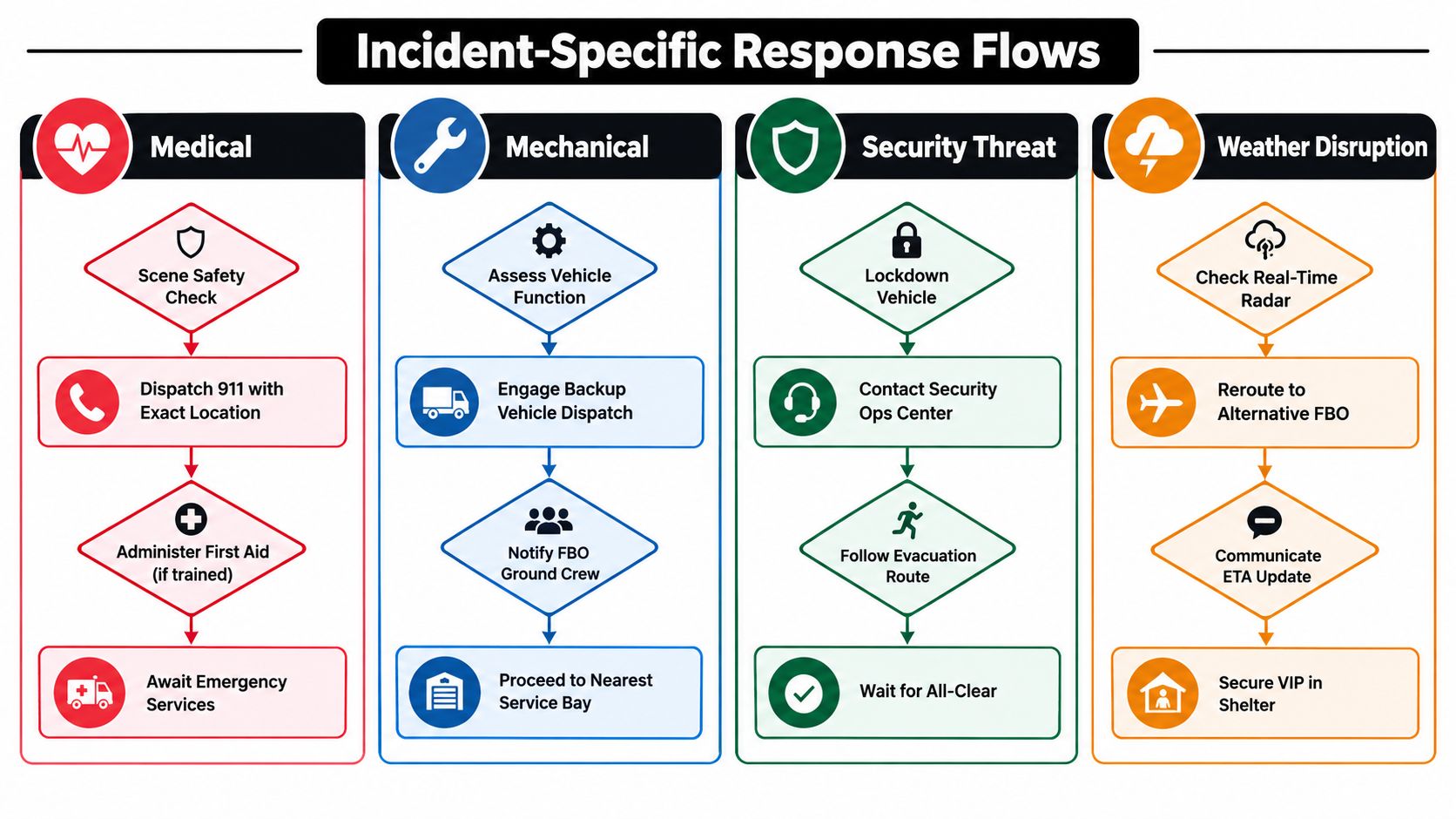
A response flow should tell people what to do first, who owns the next decision, and what information must cross the partner boundary. It shouldn't read like an encyclopedia. Under stress, the team needs short actions and precise handoff language.
Medical event
First action: The chauffeur states the vehicle's location and requests dispatch support in under fifteen seconds.
The chauffeur confirms scene safety, calls 911 with the exact location and access notes, and follows only trained first-aid instructions. Dispatch contacts the receiving FBO, the principal's assistant, and the airline or flight coordinator if the passenger is mid-itinerary. The decision between continuing to a hospital and meeting emergency responders belongs to emergency services and the facts on scene, not to an operations coordinator trying to protect a departure time.
The FBO needs a clear arrival message: “Medical response inbound, vehicle at the service entrance, escort needed from gate, privacy requested.” That avoids the weak handoff of “someone is sick in the car.”
For sudden cardiac arrest, the sequence is recognition, CPR, early AED deployment, and shock execution. A major review reports survival with immediate on-site AED use at 50% to 74%, while some public-access programs reported 74% to 100% survival for shockable rhythms. The same review notes that survival can drop by about 7% to 10% for every minute defibrillation is delayed, so AED location and collapse-to-shock time belong in operational planning, not just medical training. See the review of public-access defibrillation and survival.
Vehicle incident
First action: The chauffeur reports location, vehicle status, injuries, and traffic exposure.
Secure the scene when possible, move away from immediate danger if the vehicle can operate safely, and request emergency services for injuries or hazards. Dispatch opens the incident log, preserves relevant records, begins client notification through the approved channel, and activates the pre-authorized replacement vehicle arrangement. The chauffeur documents facts, not conclusions, including location, visible damage, involved parties, and time of each contact.
At the FBO, the receiving coordinator must know whether the principal is arriving in the original vehicle, a replacement vehicle, or with emergency services. A vague “vehicle issue” leaves the gate team guessing and can create a second delay.
Security threat
First action: The chauffeur states the threat, current location, client status, and immediate movement constraint on the approved secure channel.
The vehicle may need to lock down, leave the exposure area, or proceed to a predefined rally point, depending on the threat and instructions from security or law enforcement. Don't broadcast the principal's name or exact destination on an open frequency. Dispatch coordinates the protective detail, security operations center, FBO, and law enforcement liaison while the chauffeur keeps communications limited and usable.
Evacuation or weather disruption
First action: The chauffeur or FBO contact reports the affected access point and confirms whether the client is moving, sheltered, or unaccounted for.
Aircraft-related evacuation requires an FBO-specific egress plan, alternate ground transport lines, manifest reconciliation, and reunification instructions. Weather disruption requires a current route and airport status, an alternate FBO or ground plan, an updated ETA, and a protected shelter location. The airline should hear the same operational facts from the coordinator, not discover the incident through social media or an unrelated passenger.
The recurring failure is the handoff. State who has the client, where the client is, what has been done, what remains needed, and who owns the next decision.
Communications and Escalation Protocols
A call tree works only when every role knows its lane. The dispatcher should be the primary coordinator, not because the dispatcher has the best view of the scene, but because that person can maintain the cross-agency picture while the chauffeur remains occupied.
The first transmission should fit into one breath:
Vehicle ID, route segment, client code, incident type, exact location, immediate need.
For example: “SUV 24, hotel to Teterboro, client code Blue, medical event, southbound near the airport access road, emergency medical response and FBO gate escort needed.” The chauffeur then stays on one assigned channel. The dispatcher owns cross-channel traffic with the FBO, airline operations center, travel security desk, executive assistant, and law enforcement liaison.
Build the call tree around roles
The dispatcher's backup should be named at shift turnover. The chauffeur needs a direct dispatcher contact and a backup method. The FBO line needs both the normal operations contact and an emergency gate or security contact. Airline operations needs a coordinator who can confirm flight status, crew instructions, and passenger handling. The assistant should receive client-facing updates, while the security desk advises on threat posture and protected movement.
Use three severity levels, but define them by action rather than drama:
- Level 1: A contained disruption with no immediate threat to life or security. Dispatch coordinates the affected partner and records the resolution.
- Level 2: A developing event involving medical concern, injury, significant route exposure, or an uncertain security condition. The shift decision-maker joins the call and activates the relevant partner branch.
- Level 3: An immediate threat to life, active security danger, major evacuation, or multi-agency response. Dispatch escalates to emergency services and the designated senior operations lead while preserving a single operating picture.
Client identity should be released to law enforcement only through a pre-cleared script and when safety requires it: “I'm the transport coordinator for client code Blue. The individual is located at [specific location]. I'll provide identifying details through your authorized officer for safety and verification.” Privacy is important, but it can't obstruct emergency response.
Keep sensitive incident information out of informal channels. The same discipline used in data breach notification procedures applies here: limit disclosure, verify the recipient, document the communication, and avoid forwarding unconfirmed details.
Measure communication quality
Finland's Emergency Response Centre Agency provides a useful illustration of how emergency intake is measured at scale. In 2022, the agency recorded 2,920,020 emergency telephone calls, responded to 99% of calls in less than 30 seconds, answered 90% in less than 10 seconds, and reported an average response time of 3 seconds, according to its 2022 emergency call statistics presentation. Executive transport teams should apply the same logic qualitatively: track the speed and clarity of intake, triage, dispatch, and escalation, not just the final outcome.
Roles and Responsibilities Across Partners
The coordinator hears the chauffeur say, “Passenger has severe chest pain,” while an FBO manager asks whether to open a service gate and a flight crew wants to know whether a connecting passenger will board. The executive assistant wants reassurance, and a security vendor is asking whether the principal's location should be shared with airport police.
Nobody needs a longer meeting. They need ownership.
The chauffeur stabilizes the immediate situation, communicates observations, and documents what happened. The dispatcher coordinates the response, assigns calls, escalates according to severity, and briefs each partner with the same facts. The FBO manages airside access, medical staging, privacy, and local movement. The airline controls flight and crew coordination, including any manifest or passenger-handling decision within its authority.
A practical handoff
The chauffeur tells dispatch, “I'm at the FBO service entrance, passenger is with emergency responders, assistant is not on scene, flight crew has been notified.” Dispatch tells the FBO manager exactly where the vehicle is and who is escorting responders. The airline coordinator receives the operational impact, not an unverified diagnosis: passenger status, location, expected delay, and the person responsible for the next update.
At each transfer, use a closed-loop confirmation. The receiving person repeats the essential facts and states the next action. “FBO medical team has custody at the service entrance, dispatch will update the assistant, and airline operations will hold passenger handling pending the next status” is stronger than “They've got it.”
| Partner | Primary Role | Handoff Moment | Information Shared |
|---|---|---|---|
| Chauffeur | Protect the client, report facts, follow trained instructions | Client leaves the vehicle or emergency responders arrive | Location, observed condition, vehicle status, hazards |
| Dispatcher | Coordinate, escalate, log, and maintain the operating picture | Any partner assumes a response task | Incident type, priority, actions completed, next owner |
| FBO | Control access, staging, privacy, and airside movement | Vehicle reaches the agreed entrance or gate | Arrival point, escort need, client status, access restrictions |
| Airline operations | Manage flight, crew, and passenger coordination | Flight status or passenger handling changes | Operational impact, timing, approved passenger information |
| Security or law enforcement liaison | Advise on threat posture and public safety coordination | Threat escalates or law enforcement takes command | Verified threat facts, location, client identity when necessary |
A one-page RACI matrix should sit beside the quick-reference flow. Mark who is Responsible, Accountable, Consulted, and Informed for calling 911, approving a diversion, releasing identity, opening an FBO gate, arranging replacement transport, notifying the assistant, and closing the incident. Before assigning a driver, confirm the broader suitability and access requirements through documented driver background checks.
Training, Drills, and Real-World Readiness
An annual tabletop can prove that people understand the words in a plan. It doesn't prove they can use the right radio channel while driving, locate an AED, reach an FBO gate contact, or protect a client's identity during a confused handoff.
Staffing shortages across emergency management, EMS, fire, public health, and emergency communications make resilient coverage harder to maintain. A 2026 emergency-management trends report also identifies recurring concerns around preparedness capacity, while a Canadian emergency-response review found problems involving standardized training, role definition, information sharing, and rapid scaling. The practical implication is direct: your plan must work when the primary person is off duty, delayed, unreachable, or covering another movement.
Use short drills with real constraints
Run a surprise scenario for the dispatcher and chauffeur, then spend the remaining time identifying what broke. Use actual routes, real FBO contacts, current vehicle types, and realistic client privacy constraints where appropriate. The drill should test a decision, not reward theatrical performance.
A workable monthly format is:
- Scenario launch: Give the dispatcher and chauffeur one event with limited facts.
- Initial response: Require the first location report, call-tree activation, and immediate safety action.
- Partner handoff: Add an FBO, airline, security, or law enforcement complication.
- Debrief: Record the missing contact, unclear authority, delayed decision, or channel conflict.
- Correction owner: Assign one person to fix the procedure, contact list, training gap, or equipment issue.
Physical practice should include defensive driving refreshers, evacuation from the premium SUV used by the team, medical-kit and AED familiarization, and bleed-control equipment. Cognitive practice should cover radio brevity, identity verification, client privacy decisions, alternate FBO selection, and off-duty recall.
Set role-based expectations. Chauffeurs should drill regularly enough to retain movement and communication habits. Dispatchers need more frequent call-tree and scenario practice because they coordinate multiple channels. The FBO liaison should rehearse access, staging, and privacy arrangements with the actual facilities.
The DOE emergency-management briefing emphasizes testing situational awareness, command media, and common operating procedures across response venues. That's exactly where executive transport exercises should concentrate. Require sign-off that each participant can reach the call tree without searching through an outdated contact sheet.
Post-Incident Review and Continuous Improvement
A procedure is not mature because someone approved it. It is mature when the team can reconstruct what happened, explain each decision, identify where information stalled, and show who corrected the weakness.
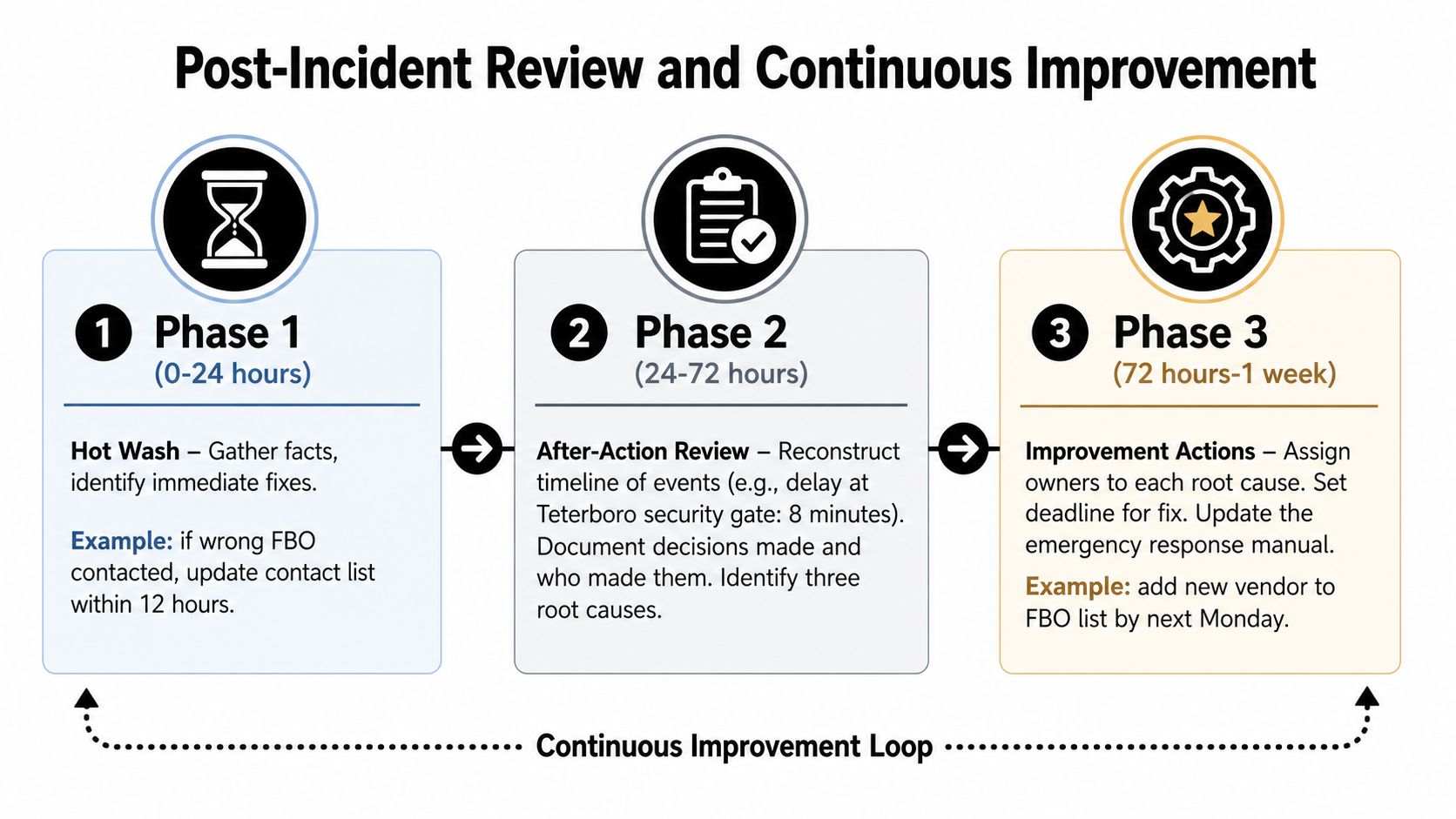
Start with a hot wash while facts remain available. Record the incident timeline, decision log, communications transcript, partner feedback, client impact, and every departure from the published flow. Keep the first review factual. An incomplete timeline quickly becomes a blame exercise, and blame rarely fixes a failed handoff.
Use a defined review cadence
Within 24 hours, run the hot wash and apply urgent corrections, such as replacing an incorrect FBO contact or fixing a gate instruction. Within 72 hours, reconstruct the sequence, mark decision points, and confirm who owned each action. During the following week, assign improvement owners, revise the manual, and schedule the drill that tests the change.
Review performance against operational indicators:
- Time to first decision: How quickly did someone choose the initial safe action?
- Communication clarity: Did the first report include location, incident type, client code, and immediate need?
- Channel discipline: Did the chauffeur stay on one channel while dispatch coordinated the others?
- Flow adherence: Where did the response depart from the published procedure, and was that deviation justified?
- Handoff integrity: Did the receiving partner confirm custody, location, next action, and update responsibility?
- Client impact: Did the response protect privacy, safety, mobility, and a clear client-facing update?
A quarterly trends review should remove steps that no longer match routes, staffing, vehicles, venues, or partner capabilities. It should also expose recurring defects, such as an FBO gate contact who repeatedly fails to answer, a radio channel that creates confusion, or a backup role that remains unfilled.
Build a ninety-day improvement arc
During the first phase, collect recent incidents and near-misses, verify every contact, and find procedures that depend on one person. During the next phase, run route-specific drills, test backup staffing, and validate the handoffs among the chauffeur, FBO, airline, security vendor, and airport police. The objective is a shared operating picture before pressure forces each partner to work from a different version of events.
During the final phase, publish controlled updates, brief every affected role, and confirm the revised flow in practice. A document change is incomplete until the people receiving the handoff can state who owns the next action and when the next update is due.
Revise immediately when:
- A procedure produces conflicting instructions.
- A partner hears about the incident through public channels before the coordinator calls.
- The chauffeur cannot reach dispatch or the approved backup.
- The FBO, airline, or security vendor disputes ownership of the next action.
- The client's identity is exposed unnecessarily.
- The route, venue, vehicle, staffing model, or access arrangement changes.
- A drill shows that the call tree, equipment, or rally point cannot be used.
The DOE emergency-management briefing highlights the need to test situational awareness, command media, and common operating procedures across response venues. Executive transport teams should apply that discipline locally. Keep one incident record, assign one owner to each corrective action, set one deadline, and run one drill that proves the change reached the chauffeur, dispatch desk, FBO, flight crew coordinator, security vendor, and airport police contact.