

Your aircraft has landed, but the day's most important meeting is still ahead. The executive team needs to clear immigration, collect luggage, locate the chauffeur, reach the hotel, reset after a long flight, and arrive prepared for a boardroom discussion. A small delay at any point can affect every appointment that follows.
International trips strain schedules, test security protocols, and challenge personal well-being. The best tips for international travel therefore go beyond packing and airfare. They cover documentation, ground transportation, connectivity, privacy, time zones, local regulations, and contingency planning.
Visa and passport checks belong at the start of the process. A U.S. State Department report cited an average global wait of about 144 days for a B1/B2 visitor visa interview in April 2024, with a median wait of 42 days. The same report said routine U.S. passport service took 6 to 8 weeks, while expedited service took 2 to 3 weeks. These timelines make early verification essential for executives managing fixed meetings, private aviation schedules, and multi-stop itineraries. The passport and visa backlog report provides the underlying planning context.
This guide turns that principle into an executive-grade operating plan, with actionable examples and transportation strategies informed by MLR Worldwide Service.
1. Pre-Arrange Ground Transportation Before Arrival
An international arrival should trigger a planned handoff, not a search for a taxi queue. Pre-arranged ground transportation gives the executive, travel manager, and receiving team a clear process from aircraft touchdown to hotel or meeting venue.
Send complete flight information before departure, including the flight number, aircraft type, terminal or FBO, estimated arrival time, luggage requirements, and destination address. Private aviation travelers should identify the precise FBO or operator terminal because airport signage and passenger flows differ substantially from commercial terminals. MLR Worldwide Service can coordinate arrivals at major FBOs, including NetJets and XO terminals, with vehicles positioned before the aircraft lands.
Share preferences during booking rather than improvising them at the curb. Temperature control, refreshments, privacy glass, luggage capacity, child seats, and preferred routes all affect the quality of the transfer.

Build a visible arrival handoff
Use a meet-and-greet process that includes the chauffeur's name, photograph, vehicle description, and meeting point. That gives the passenger a simple way to identify the correct driver without disclosing sensitive details publicly.
A roadshow team moving between cities needs the same discipline at every stop. MLR Worldwide Service has coordinated simultaneous transportation for executive teams across multiple destinations, while family offices may need unified arrangements connecting residences and hotels in New York, London, Dubai, and Tokyo.
Use live SMS or app updates, define the fastest and traffic-aware route in advance, and give the provider permission to adjust the route when conditions change. For a practical booking workflow, review this guide to booking airport transfers.
2. Leverage Global Affiliate Networks for Unified Service Standards
A global itinerary shouldn't feel like a series of unrelated vendors. The executive should receive the same level of communication, vehicle readiness, privacy, and service discipline in every city.
A vetted affiliate network gives the lead transportation provider local operating knowledge while preserving one central coordination process. This matters across EMEA, APAC, and the Americas, where licensing rules, airport procedures, traffic patterns, languages, and business customs vary.
Set standards before the itinerary begins
Ask the provider to document the service requirements for every destination. The brief should cover:
- Partner credentials: Confirm licensing, insurance, operating authority, and relevant safety procedures before assigning a trip.
- Driver information: Request driver profiles and background-screening details for high-security or high-profile travelers.
- Vehicle specifications: Match seating, luggage capacity, privacy features, accessibility equipment, and security requirements across cities.
- Escalation procedures: Identify the single concierge contact and define who handles delays, vehicle substitutions, and itinerary changes.
MLR Worldwide Service maintains a vetted global affiliate network serving major hubs such as New York, London, Dubai, and Tokyo. That structure supports a single point of contact even when local chauffeurs and vehicles change.
A corporate event can expose weaknesses quickly because attendees arrive at different terminals, hotels, and venues. Coordinating transportation for a large international group requires one operating picture, consistent passenger manifests, and an escalation path that doesn't depend on a traveler solving a local problem alone.
Review the provider's Go VIP worldwide service to understand how a unified international service model can support executive and high-value travel. Schedule formal partner reviews, update destination requirements, and keep the concierge team informed of changes in corporate security policy.
3. Understand and Navigate International Driving Regulations and Documentation
A vehicle that works legally in one city may create a compliance problem in another. Executives who plan to drive, rent vehicles, or arrange specialized transportation should verify licensing, insurance, emissions, toll, and access requirements before arrival.
London's Ultra Low Emission Zone, for example, affects which vehicles can enter designated areas. A compliant executive transfer therefore requires the provider to confirm vehicle eligibility before dispatch, not after the passenger reaches the city. Other European destinations may apply congestion controls, restricted access zones, or commercial vehicle rules that affect pickup points.
Put documentation under one owner
Assign a travel manager, security lead, or transportation concierge to own the verification process. That person should confirm:
- Driving authority: Obtain an International Driving Permit through AAA or the relevant issuing organization when the destination or rental company requires it.
- Insurance scope: Verify that existing coverage applies in every destination and arrange supplemental protection where necessary.
- Vehicle access: Check low-emission zones, congestion pricing, toll systems, and commercial access restrictions before the itinerary is finalized.
- Document copies: Store licenses, passports, permits, insurance records, and booking confirmations digitally and in physical form.
Foreign license holders may face additional requirements in European Union countries, while China generally doesn't permit foreign visitors to drive using a foreign license alone. In Dubai, the Salik toll system records charges through vehicle registration, so the transportation provider should manage account and vehicle compliance before the trip.
Compliance rule: If the local rule affects whether a vehicle can enter, the provider should verify it before booking is confirmed.
Don't assume a rental desk or chauffeur company will resolve every issue at the last minute. Use a transportation provider familiar with local regulations, and ask for written confirmation when access, emissions, or insurance requirements could affect the itinerary.
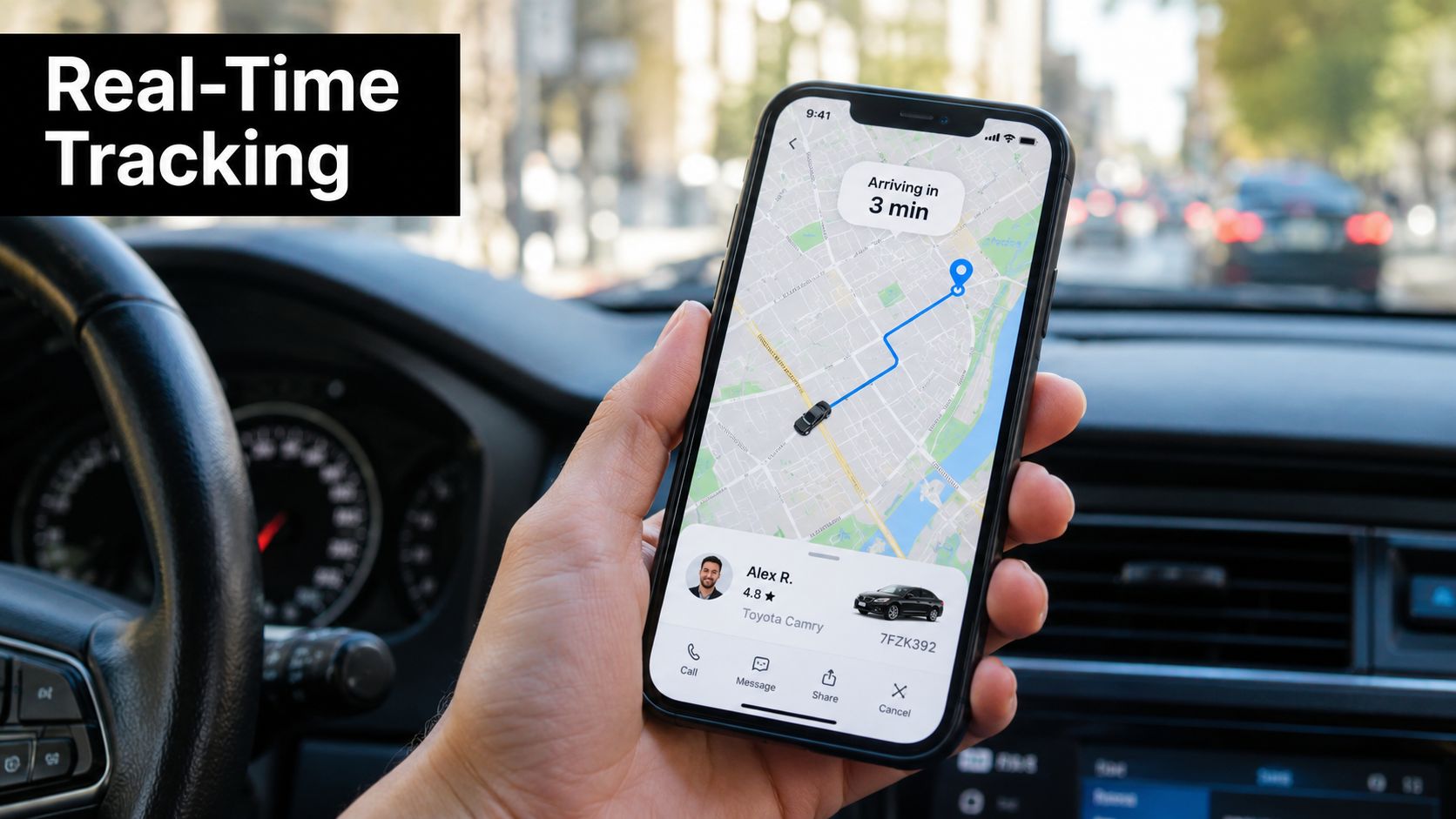
4. Coordinate Seamless Airport-to-Hotel Transfers with Real-Time Communication
The airport-to-hotel transfer is often the traveler's least resilient moment. The executive may be tired, unfamiliar with the terminal, unreachable on a roaming plan, and carrying sensitive equipment. A coordinated handoff removes unnecessary decisions.
Give the transportation provider the hotel's full address, concierge number, preferred entrance, check-in contact, and any restrictions on vehicle access. Share the same arrival brief with the hotel. If the traveler needs chilled water, a particular room temperature, preferred refreshments, or executive lounge access, both teams should know before the aircraft lands.
A Dubai arrival illustrates the workflow. The driver monitors the flight, adjusts the pickup plan, confirms the hotel's readiness, and receives the traveler's climate and refreshment preferences. That coordination keeps the passenger from becoming the messenger between airport staff, chauffeur, and hotel.
Create one communication chain
Enable notifications for flight status, chauffeur location, passenger instructions, and hotel readiness. The provider should have a clearly named contact who can authorize changes when luggage is delayed, the aircraft diverts, or a meeting moves.
For a roadshow, the process must support several arrivals at different terminals. Each passenger needs an individual pickup record, while the travel manager needs a unified dashboard or concierge channel showing who has landed, who is in transit, and who has reached the hotel.
Confirm baggage handling in advance. Decide whether the chauffeur meets the passenger inside, waits curbside, uses porter assistance, or transfers luggage directly to the hotel. When the driver arrives before the anticipated landing, vehicle placement and cabin preparation can happen without making the executive wait outside.
5. Maintain Flexible Scheduling for International Time Zone Transitions
A packed calendar can make an international itinerary look efficient while leaving no margin for human performance. Time-zone changes affect sleep, attention, appetite, meeting preparation, and driving requirements. Build recovery time into the plan before anyone books the first appointment.
For a New York to London journey, avoid scheduling a high-stakes meeting immediately after arrival. A six-hour recovery buffer can give the executive time to clear the airport, reach the hotel, shower, eat, review materials, and reset. The exact buffer should reflect the itinerary, but the principle is fixed. The first meeting shouldn't be the first test of physical endurance.
Schedule the driver as carefully as the executive
Transportation managers must account for legal rest rules, shift changes, and driver fatigue. EU rules commonly require an 11-hour minimum daily rest period, so a multi-city schedule needs properly timed handoffs rather than a single chauffeur being stretched across every segment.
A transatlantic program with continuous movements should use crew rotation and backup drivers. An Asian roadshow should stagger meetings around arrival, sleep, and acclimatization instead of assuming that the executive can operate on the departure city's clock.
Use calendar labels that show both local time and home-office time. Add a recovery block, meal window, preparation block, and departure buffer to the itinerary. Wellness support, including massage, sleep consultation, and meal timing, can also be coordinated when the schedule demands sustained performance.
Executive scheduling principle: Protect the first meaningful work block after arrival. A shorter, prepared meeting is more valuable than a longer meeting held while the team is exhausted.
Keep mobile alerts active for pickup changes and driver status, but don't turn every notification into an interruption. The travel manager should filter operational updates and escalate only decisions that require executive attention.
6. Secure Executive Privacy and Data Protection During Ground Transportation
The back seat is often treated as a private office. It isn't private by default. A confidential call, acquisition discussion, personnel conversation, or product update can be exposed through the driver, vehicle design, unsecured messaging, or an unexpected stop.
Start with personnel controls. Require background checks, reference verification, confidentiality agreements, and ongoing compliance training for chauffeurs, dispatchers, affiliate partners, and anyone with access to passenger details.
Specify the vehicle and communications standard
Ask for privacy glass, a partition or sound-control option, secure seating arrangements, and a clean-cabin policy. A vehicle used for confidential work should give the executive enough space to work without placing documents, screens, and conversations in public view.
Use encrypted communication for reservations, itinerary changes, passenger manifests, and security instructions. Keep sensitive documents out of ordinary text messages unless the provider's security process explicitly supports them. Establish a response protocol for media contact, unexpected visitors, route diversions, and requests for passenger information.
An M&A executive may need to speak with legal counsel during a transfer. The transportation plan should identify a discreet vehicle, a trained chauffeur, and a communications process that protects the call without distracting the driver. A pharmaceutical executive visiting research facilities across several countries may also require consistent confidentiality controls from every local transportation partner.
For privacy obligations affecting international data handling, review MLR Worldwide Service's GDPR compliance measures. Travel managers should audit access permissions, retention practices, and partner compliance as part of the broader security program.
7. Utilize Executive Summary Briefings for Destination Logistics and Cultural Context
A destination briefing should answer practical questions before the executive has to ask them. Include local traffic behavior, airport layout, business customs, dress expectations, communication preferences, venue access, dining protocols, and current operational restrictions.
Request the briefing several days before arrival. Give the provider the business objective, meeting tone, attendee profile, and preferred level of formality. A generic city guide won't help an executive decide whether a venue suits a sensitive negotiation or whether a transfer route supports a tight meeting sequence.
Make the briefing operational
In Dubai, the briefing may address Ramadan observance, restaurant availability, professional attire, and Salik toll coordination. In Tokyo, it may cover business-card etiquette, meal timing, neighborhood navigation, and alternatives to road travel. In Shanghai, the transportation team may need to monitor air quality, restaurant reservations, and access procedures at a VIP venue.
Ask the chauffeur for real-time context during the transfer, but don't make the driver responsible for unverified political, legal, or security advice. The provider should maintain a clear distinction between local operating insight and formal guidance from government, legal, or security advisers.
Use the briefing to shape the transport plan. If a meeting venue has a restricted entrance, identify the correct drop-off point. If the executive needs to greet local partners formally, prepare the vehicle arrival sequence and passenger timing. If road travel is unreliable, identify a practical alternative before the schedule is under pressure.
A useful briefing ends with decisions, not trivia. It should tell the executive what to wear, where to enter, whom to contact, how much flexibility to preserve, and which customs could affect the meeting.
8. Integrate Mobile Technology and Real-Time Tracking for Seamless Coordination
International travel requires visibility across flights, vehicles, terminals, hotels, and meeting venues. A mobile coordination system gives the travel manager a shared operating picture and lets the chauffeur respond quickly when the plan changes.
Enable notifications for flight status, vehicle location, pickup instructions, traffic conditions, and itinerary updates. Share trip details with the executive's assistant, security lead, hotel contact, and designated emergency contact, but apply access controls so each person sees only what they need.
Use alerts to trigger action
A flight delay should automatically prompt a review of the pickup time, driver duty period, hotel arrival, and meeting schedule. If a vehicle is moving toward the wrong terminal, the travel manager should see the issue before the executive reaches the curb.
The same approach works for a roadshow. A coordinator tracking several executives across multiple cities can confirm which vehicles are en route, which passengers have arrived, and where a route change affects the next appointment. An FBO coordinator can connect aircraft landing information with vehicle dispatch and hotel notification.
Download offline maps, backup contact details, and essential itinerary records before leaving reliable connectivity. An eSIM can help maintain data access across borders. GSMA Intelligence reported that 51% of eSIM users had used the service while traveling abroad for leisure or personal reasons in the prior 12 months, and 28% of travel eSIM users bought service from a global international roaming provider. GSMA's eSIM adoption reporting supports the case for treating connectivity as part of travel preparation.
Use a dual-SIM setup. Keep the primary number active for calls and SMS, then use the travel eSIM for data, messaging, maps, and coordination. Review the end-of-trip record for mileage, timing, expenses, and service issues before the next itinerary.
9. Plan Multi-Stop Itineraries with Strategic Vehicle and Driver Coordination
A multi-stop itinerary needs an operations plan, not a collection of individual reservations. Provide every destination, meeting time, hotel, venue address, passenger name, luggage requirement, local contact, and security instruction well before departure.
For a corporate roadshow, pre-position a vehicle and chauffeur in each city, confirm venue access, and assign a local backup. For an investment tour through London, Frankfurt, Dubai, and Hong Kong, one concierge should manage handoffs across time zones while local teams execute the details.
Design continuity into every leg
Keep the same chauffeur where practical, especially when the executive values familiarity and the route remains within legal duty limits. When continuity isn't possible, transfer a complete passenger brief to the next driver. Include pronunciation, preferred greetings, luggage handling, privacy expectations, route priorities, and communication preferences.
Build a short buffer between consecutive stops. A delay leaving a hotel can affect the vehicle arrival, venue security check, meeting start, and onward flight. The itinerary should show which commitments are fixed and which can move.
Use this planning sequence:
- Fourteen days before departure: Send the complete itinerary and identify every passenger, venue, contact, and special requirement.
- Before each city handoff: Confirm vehicle class, chauffeur assignment, access instructions, luggage capacity, and backup availability.
- Between legs: Hold a brief operations check-in to adjust timing, route choices, and passenger preferences.
- Before the final transfer: Reconcile the next day's departure time, airport or FBO details, and document requirements.
An executive traveling between New York, Los Angeles, and Toronto may benefit from the same professional standard across each city, even when different vehicles and drivers are necessary. The objective is a consistent experience with no silent gaps in responsibility.
10. Establish Emergency Protocols and Contingency Transportation Resources
A resilient travel plan assumes that something will change. Weather can delay a flight, a driver can become unavailable, traffic can close a primary route, and a security concern can make a hotel or venue unsuitable.
Request the emergency protocol before booking. It should list the 24/7 operations contact, passenger escalation process, backup vehicle policy, alternate drivers, medical and security contacts, and authority for approving itinerary changes.
Pre-approve the response
A driver illness during a London business meeting shouldn't force the executive to negotiate a replacement. The provider should have a backup chauffeur and vehicle ready to continue the schedule. If an international arrival is delayed for many hours, the travel manager should already know how the provider will arrange a nearby hotel, revised pickup, refreshed vehicle, and new meeting departure.
Route disruption requires the same preparation. In Dubai, a blocked road may require immediate rerouting to protect a critical meeting. The driver and operations team should know which route priorities matter, who can approve a change, and how the executive will receive the update.
For a security concern at a hotel, define the relocation process in advance. The provider should maintain alternatives for accommodation and transportation, preserve passenger privacy, and coordinate with the corporate security lead rather than improvising publicly.
- Contact readiness: Give the provider the executive's mobile number, assistant's number, security contact, and emergency contact.
- Resource coverage: Confirm backup drivers and vehicles in every destination, not only at the primary airport.
- Escalation clarity: Assign a decision-maker for medical, security, weather, traffic, and schedule incidents.
- Review cadence: Revisit the protocol regularly and update it when destinations, personnel, or security requirements change.
Contingency standard: A backup plan isn't complete until someone can activate it without asking the traveler to solve the problem.
10-Point Comparison: International Travel Transport & Logistics
An executive arriving for a same-day meeting cannot afford an unconfirmed pickup, an unfamiliar driver, or a poorly timed schedule. Compare each transport decision by execution difficulty, resource needs, business effect, and the situations where it delivers the most value.
| Item | Implementation Complexity 🔄 | Resource Requirements ⚡ | Expected Outcomes 📊 | Ideal Use Cases 💡 | Key Advantages ⭐ |
|---|---|---|---|---|---|
| Pre-Arrange Ground Transportation Before Arrival | Moderate, advance planning, flight sync | Moderate, confirmed vehicles, vetted chauffeurs, concierge tools | High reliability; predictable pickups and reduced arrival stress | Executive arrivals, single-leg VIP transfers | Predictability, vetted drivers, schedule protection |
| Use Global Affiliate Networks for Consistent Service Standards | High, partner vetting & governance | High, global partner management, compliance oversight | Consistent service quality across markets | Multinational roadshows, frequent cross-border exec travel | Unified standards, multilingual support, unified billing |
| Understand International Driving Regulations and Documentation | High, ongoing regulatory monitoring | Moderate, legal expertise, documentation systems | Legal compliance; fewer fines and operational interruptions | Cross-border vehicle use, country-specific vehicle requirements | Reduced liability, regulatory compliance, smoother operations |
| Coordinate Airport-to-Hotel Transfers with Real-Time Communication | Moderate, multi-party integration | Moderate, flight tracking, hotel liaison, mobile communications | Reduced wait times; prepared rooms and faster handoffs | Jet-lagged executives, same-day meeting arrivals | Room readiness, minimized delays, personalized welcomes |
| Maintain Flexible Scheduling for International Time Zone Transitions | High, dynamic scheduling and buffers | Moderate‑High, scheduling tools, backup drivers, wellness services | Improved executive performance and driver safety | Long-haul travel, multi-time-zone itineraries | Health-forward scheduling, regulatory rest compliance |
| Secure Executive Privacy and Data Protection During Ground Transportation | Moderate‑High, vetting and security protocols | High, background checks, encrypted communications, special vehicles | Strong confidentiality and reduced information risk | M&A, political visits, high-profile executives | Discretion, data protection, enhanced personal security |
| Use Executive Summary Briefings for Destination Logistics and Cultural Context | Low‑Moderate, research and briefing preparation | Low, local intelligence, concierge time, briefing documents | Better cultural preparedness and meeting outcomes | First-time destinations, culturally sensitive negotiations | Cultural competence, optimized routing, fewer missteps |
| Integrate Mobile Technology and Real-Time Tracking for Coordinated Service | Moderate, IT integration and training | Moderate, mobile platform, connectivity, user support | Increased visibility; faster adjustments to disruptions | Dynamic itineraries, multiple simultaneous arrivals | Real-time visibility, rapid response, expense tracking |
| Plan Multi-Stop Itineraries with Strategic Vehicle and Driver Coordination | High, complex logistics and contingencies | High, multiple vehicles and drivers, pre-positioning, backups | Smooth multi-city journeys; minimized gaps and delays | Corporate roadshows, multi-city investor tours | Continuity, contingency resources, time optimization |
| Establish Emergency Protocols and Contingency Transportation Resources | High, protocol development and drills | High, backup fleets, medical/security networks, 24/7 operations | Rapid incident response; maintained schedule integrity | High-risk travel, critical meetings, remote locations | Safety assurance, crisis mitigation, business continuity |
MLR Worldwide Service case studies show why transport planning must connect airport operations, vehicle assignments, driver communication, privacy controls, and executive schedules. A provider that manages only the ride misses the operational chain around it.
Use the table to identify where your itinerary needs stronger controls. Assign ownership for each handoff, confirm the required vehicles and communications, and require destination-specific briefings before the executive departs. A reliable international program protects meeting time, personal security, and decision-making capacity.
Your Next Steps to Flawless Executive Travel
Start with the decisions that can create the longest delay. Verify passport validity, visa eligibility, entry requirements, driving documents, and insurance before confirming a complex international schedule. Visa processing can add substantial uncertainty, and documentation replacements aren't immediate. Treat these checks as operational dependencies, not administrative details.
Next, create one master itinerary. Include flight or aircraft information, terminals and FBOs, hotel addresses, meeting times, vehicle requirements, passenger contacts, security instructions, and local time zones. Give the transportation provider enough detail to plan the entire journey instead of asking separate chauffeurs to interpret isolated reservations.
Ground transportation deserves the same preparation as aviation. Pre-arrange every airport transfer, identify the correct meeting point, confirm chauffeur details, and define the route priority. For private aviation, specify the FBO and aircraft information. For corporate roadshows, map each vehicle handoff, venue entrance, hotel arrival, and backup resource.
Build a communication architecture around the executive rather than placing the executive inside every operational conversation. A travel manager or concierge should monitor flight status, driver location, hotel readiness, traffic, and itinerary changes. The executive should receive clear decisions and timely instructions, while the operations team manages the moving parts.
Connectivity should be ready before departure. Install and test the travel eSIM, keep the primary number active for calls and SMS, download offline maps, and save essential contacts. This is especially important when the itinerary crosses several borders in a short period. GSMA Intelligence's adoption data shows that travelers are already using eSIMs abroad, making pre-trip connectivity a practical part of executive preparation rather than an experimental upgrade. The GSMA eSIM findings also report that 95% of first-time users said they would use an eSIM again, while adoption among multi-country travelers reached 26%. Use that evidence once, then make the operational decision.
Insurance belongs in the same planning conversation. Forecasts place the global travel insurance market at about USD 27.05 billion in 2025, rising to approximately USD 29.7 billion in 2026 and a projected USD 62.50 billion by 2032, with a forecast CAGR of 13.20%. A separate estimate projected growth from USD 27.05 billion in 2024 to USD 63.87 billion by 2030, at a 15.4% CAGR. These projections are reported in the travel insurance market analysis. The executive takeaway is simple. Review cancellation, medical, baggage, delay, evacuation, and business-trip conditions before departure, especially when the itinerary includes premium fares, deposits, remote destinations, or multiple connections.
Booking timing also needs an explicit policy. Current travel trend reporting says 85% of international travelers choose or would choose a destination for favorable exchange rates. Broader planning guidance places the common international cash-booking window at 2 to 8 months before departure, while points availability may improve when schedules are released and again near departure. Use the 2026 travel trend report from Mastercard as a planning input, not as a substitute for checking route-specific availability and meeting commitments.
Protect time after landing. European border processing under the Schengen Entry/Exit System has been reported to take up to 70% longer at some airports, with peak waits reaching 3 hours. The practical response is larger post-arrival buffers, fewer separate-ticket connections, and no high-stakes meeting scheduled immediately after a border crossing. Reporting on Schengen EES delays highlights why an early landing doesn't always produce an early hotel arrival.
Finally, formalize the emergency plan. Name the person who can authorize a vehicle substitution, hotel change, route diversion, driver replacement, or security relocation. Confirm 24/7 coverage and backup resources in every city. Run a pre-trip briefing with the executive assistant, security lead, transportation concierge, and local contacts so everyone knows what happens when the original plan fails.
MLR Worldwide Service can support this operating model through executive chauffeur transportation, airport and FBO transfers, corporate roadshows, VIP secure transport, event logistics, airline crew movements, and 24/7 concierge coordination. Its vetted affiliate network covers major business and leisure hubs, including New York, London, Dubai, and Tokyo, allowing travel teams to coordinate multi-city journeys through one transportation partner.
The best tips for international travel become valuable only when someone owns execution. Assign that ownership, document the standards, test the communication channels, protect recovery time, and require a contingency plan before the executive boards the aircraft.
MLR Worldwide Service coordinates executive chauffeur service, airport and FBO transfers, corporate roadshows, VIP secure transport, event logistics, and airline crew movements across major global hubs. Visit MLR Worldwide Service to arrange a discreet, fully coordinated transportation plan for your next international itinerary.