
A senior executive lands in Dubai after an overnight flight. The day starts with an airport pickup, moves into a hotel check-in that can't run late, then into investor meetings across the city, followed by a private dinner and a next-morning departure from a private terminal. On paper, it looks straightforward. In practice, one delayed arrival, one missed handoff, or one driver who doesn't understand the schedule can throw the entire visit off balance.
That's why experienced travel managers don't treat chauffeured transport as a visual upgrade. They treat it as schedule protection. In Dubai, that distinction matters more than many first-time buyers expect. The city is built for global business, aviation, hospitality, and events. Movements are frequent, routes change, venues are spread out, and timing is rarely forgiving.
A proper Chauffeur Service Dubai booking sits inside a broader ground operation. If you need a practical baseline for that broader category, ground transportation for executive travel is the right frame. The car is only one part of the deliverable. The primary product is controlled execution.
Navigating Dubai with Precision and Purpose
Most clients first ask about the vehicle. The better question is what the movement needs to achieve.
For a board member arriving for a single hotel transfer, a clean executive sedan and a trained chauffeur may be enough. For a CEO on a compressed roadshow, the requirement changes. The operator has to track the inbound flight, align airport meet-and-greet timing, stage the correct vehicle, brief the chauffeur on all stops, adjust the route as the day evolves, and maintain communication with the assistant or security detail without creating noise around the passenger.
What usually goes wrong
The common failure points in Dubai aren't glamorous. They're operational.
- Arrival friction: The traveler exits the terminal but the pickup point is unclear.
- Weak schedule control: The driver knows the first stop, but not the revised second and third stops.
- Poor communication: The assistant sends updates, yet nobody confirms receipt or execution.
- Static routing: The car follows the original route after traffic conditions have changed.
- Mismatched vehicle selection: A sedan turns up for a traveler with additional luggage or colleagues joining later.
Practical rule: If the provider talks mainly about leather interiors and bottled water, but not dispatch, communications, and backup planning, you're buying presentation rather than execution.
The strongest providers in Dubai work like an operations desk, not a showroom. They build the day around timing windows, access points, contingency options, and client handling standards. That's especially important when the itinerary includes airports, financial districts, hotels, event venues, and private residences in one sequence.
What good execution looks like
A well-run chauffeur assignment feels quiet because the work happens in advance. The chauffeur already knows whether the passenger prefers a direct hotel transfer or a short wait for a colleague. Dispatch already knows who receives updates. The vehicle is already matched to passenger count, luggage, and image requirements.
That's the standard corporate clients should expect from a serious Chauffeur Service Dubai provider. Comfort matters. Reliability matters more.
Understanding Dubai's Regulated Chauffeur Landscape
Dubai's professional chauffeur market works differently from loosely structured luxury transport in many cities. The key reason is regulation.
According to an industry overview of chauffeur hiring in Dubai, the Roads and Transport Authority (RTA) requires chauffeurs to hold special permits, pass background checks, complete professional training, and undergo medical tests. The same overview states that vehicles must be commercially registered, insured, and regularly inspected, which creates a more dependable operating environment than many unregulated point-to-point services. You can review those requirements in this Dubai chauffeur regulation overview.

Why corporate clients should care
For an executive assistant or travel manager, regulation isn't paperwork in the background. It's a filter that reduces avoidable risk.
A regulated chauffeur framework affects three things directly:
Driver suitability
A licensed chauffeur has gone through checks and formal requirements that support trust, especially when the client is a senior executive, family office principal, or public-facing VIP.Vehicle legitimacy
Commercial registration, insurance, and inspection standards help separate enterprise-grade transport from informal premium rides dressed up as chauffeur service.Service consistency
Regulation creates a baseline. It doesn't make every provider equal, but it makes the market more legible. That matters when you're booking for people who won't tolerate uncertainty.
The difference between licensed service and informal premium transport
Clients new to Dubai sometimes assume any black car with a suited driver qualifies as a professional chauffeur product. It doesn't.
A real Chauffeur Service Dubai operation usually has:
- Licensed chauffeurs with the documentation required for the role
- Commercially compliant vehicles rather than privately operated substitutes
- Structured dispatch that can support airport work, meetings, and schedule changes
- Booking channels that fit business use, including online reservations, app-based requests, or hotel concierge coordination, as noted in the same industry overview
The visible luxury is the least important part of the model. The real value is that the service runs inside a controlled framework.
What regulation does not guarantee
Buyers require judgment. RTA alignment sets a floor, not the ceiling. A compliant provider can still have weak communications, limited dispatch depth, or poor itinerary handling. Regulation tells you the operator belongs in the professional category. It does not tell you whether they can run a two-day investor roadshow without errors.
That second test comes down to operations, which is where provider vetting becomes decisive.
Core Chauffeur Services for Business and VIPs
The Dubai market supports many trip types, but one use case dominates the category. A 2025 market report valued the global chauffeur-services market at $46.8 billion, and airport transfers represented 34.2% of total revenue, making them the largest service type in that market, according to Dataintelo's chauffeur-services market report. For Dubai, that's the right place to start.
Airport and FBO transfers
Airport transfers look simple until they aren't. Commercial arrivals require precise flight monitoring, terminal awareness, pickup-point discipline, and clean handoff procedures. Private aviation adds another layer. FBO moves require close timing around tail changes, revised slot times, and direct coordination with aviation-side contacts.
For business travelers, this category matters because the first and last legs of the trip carry disproportionate risk. If a chauffeur arrives late, the passenger loses trust before the day even starts. If departure timing slips, the client may miss a check-in window, a slot, or a planned arrival at the next destination.
Well-run airport work includes:
- Live flight monitoring: The vehicle and chauffeur are timed to actual movement, not just scheduled arrival.
- Meet-and-greet discipline: The client shouldn't have to search for the car.
- Luggage planning: Vehicle choice must match passenger count and baggage reality.
- Clear contact chain: The traveler, assistant, or aviation desk knows exactly who to call.
Corporate roadshows and multi-stop days
Roadshows separate polished operators from serious ones. A roadshow isn't a collection of single transfers. It's one moving schedule.
The provider has to manage venue sequencing, buffer logic, waiting time, chauffeur positioning, and updated instructions from multiple stakeholders. If an investor lunch runs over, the entire afternoon needs to be recalculated. If one principal joins remotely and another appears in person, the seating and stop order may need to change on the fly.
In these assignments, the chauffeur is only one part of the system. Dispatch and operations carry the main load.
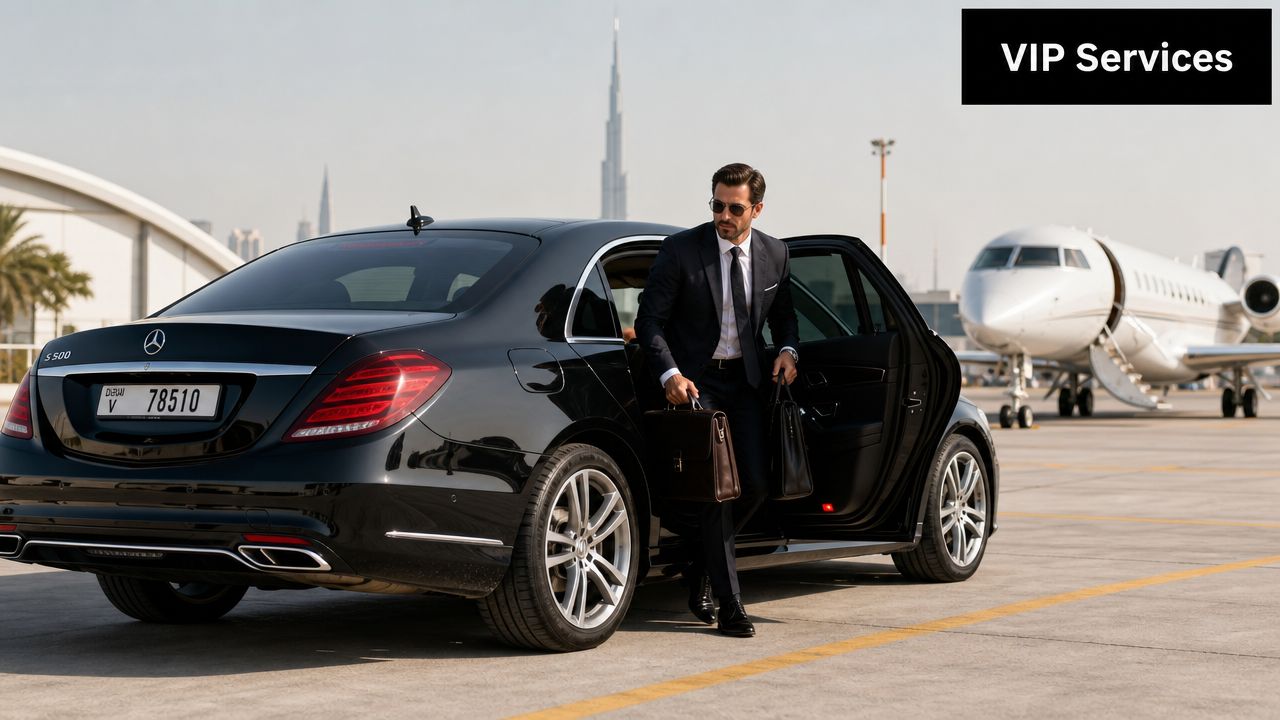
Here's a useful visual reference for how premium airport-facing transport is often presented in the market:
Secure transport and high-discretion movements
Some passengers need more than punctuality. They need low-profile execution.
That can include public-company executives before market-sensitive meetings, family office principals, legal teams, high-net-worth travelers, or guests attending a tightly managed event. In those cases, the operating standard changes. Driver briefing becomes tighter. Route details are shared selectively. Pickup locations are handled with more care. The provider may also need to coordinate with close protection, household staff, concierge teams, or event security.
For a VIP movement, discretion is not a courtesy feature. It's part of the operating brief.
Group and delegation transport
Dubai also generates steady demand for group transport tied to conferences, exhibitions, delegations, weddings, and executive teams traveling together. This work depends less on one premium sedan and more on fleet coordination. Timing windows, vehicle sequencing, manifests, and staging locations matter more than brand badge.
That's where many “luxury transport” sellers struggle. They can deliver one nice car. They can't always deliver synchronized movement across multiple vehicles and stakeholder groups.
Selecting the Right Fleet for Your Itinerary
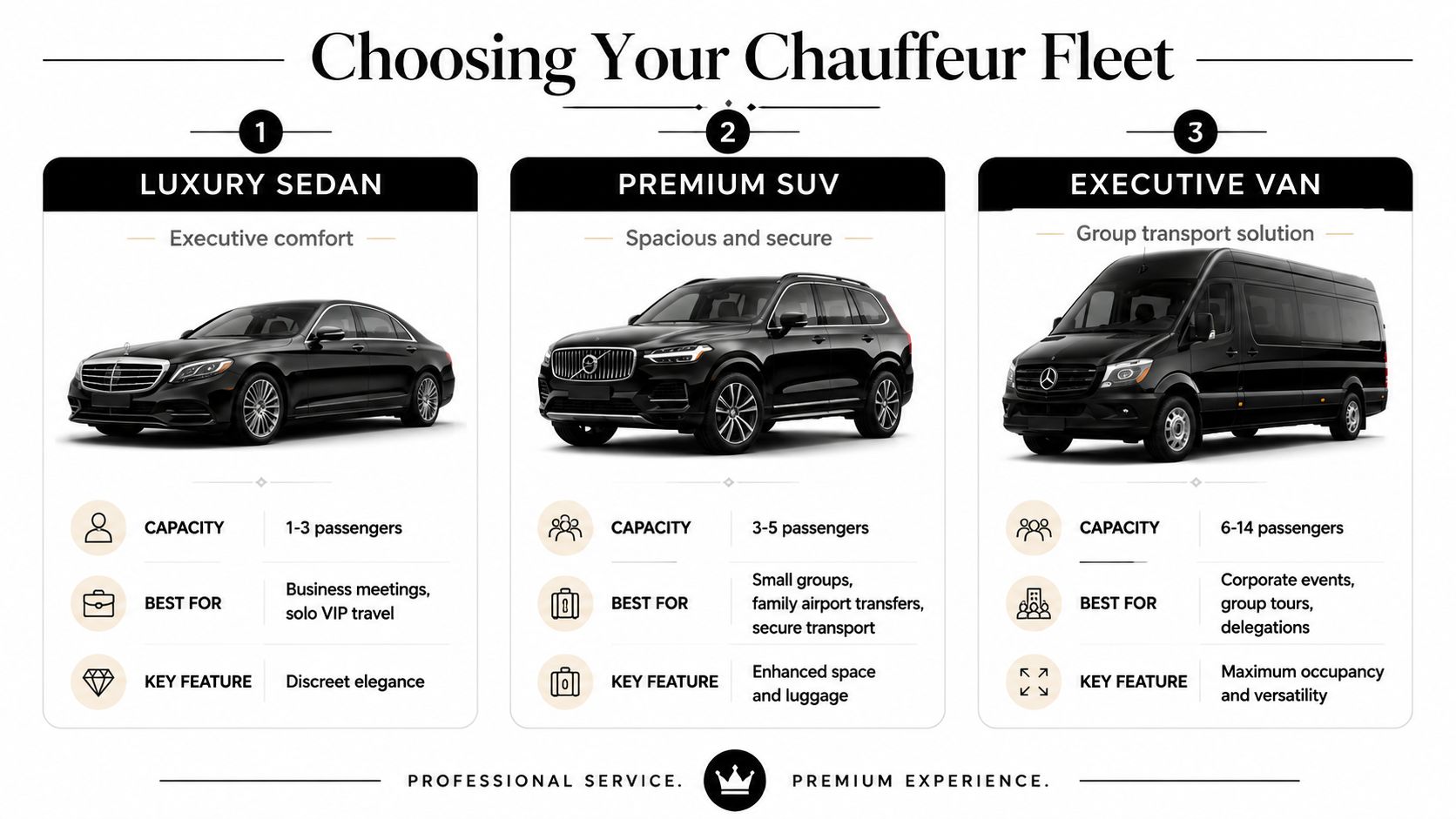
Fleet planning should start with mission fit, not preference. The right vehicle is the one that supports the passenger profile, luggage load, route length, and presentation requirement without creating friction.
The practical use of each vehicle class
A sedan works best when the assignment is centered on one principal, one assistant, or a small pair traveling between formal meetings. It presents well, moves efficiently, and keeps the profile understated.
An SUV is usually the better choice when the traveler has more luggage, wants a higher seating position, or expects additional passengers to join during the day. It also helps when the passenger values space as much as image.
An executive van changes the operation entirely. It keeps teams together, reduces split-arrival risk, and makes event or delegation movement far easier to control. For many corporate planners, that's more valuable than booking several separate sedans.
Quick comparison for booking decisions
| Vehicle type | Best fit | Operational advantage | Watch-outs |
|---|---|---|---|
| Luxury sedan | Solo executives, VIP couples, formal meetings | Discreet arrival, efficient for city use | Limited luggage and passenger flexibility |
| Premium SUV | Executives with baggage, small family office groups, security-conscious travel | More cabin space and storage | Can be unnecessary for tightly scheduled solo city work |
| Executive van | Small teams, delegations, event transport | Keeps the group on one schedule | Larger footprint may not suit every venue approach |
For clients comparing group options, luxury van rental for executive travel is often the most practical answer when coordination matters more than individual privacy.
A simple selection rule
Book the smallest vehicle that comfortably supports the brief. Not the smallest vehicle that might work.
That distinction matters. If there's any doubt about luggage, added passengers, presentation gear, or same-day changes, move up one class. Overspecifying by a level is usually manageable. Underspecifying creates visible problems in front of the client.
Vetting Providers and Coordinating Itineraries
A strong provider proves value before the car arrives. The key difference sits in the backend. Dispatch coverage, communication discipline, routing logic, and change management decide whether the day runs cleanly.
Top operators in Dubai combine GPS tracking with real-time traffic updates, allowing dispatchers and chauffeurs to reroute around delays and protect time-critical schedules, as described in this overview of key chauffeur service features in Dubai. That's why premium service should be evaluated as a time-management system, not a luxury purchase.
Questions that reveal operational maturity
When you vet a Chauffeur Service Dubai provider, skip generic sales language and ask operational questions.
- Who monitors live trips after dispatch? If nobody actively watches the movement, schedule recovery depends too heavily on the chauffeur alone.
- How are itinerary changes handled? You want a clear chain for receiving, confirming, and implementing revisions.
- What happens when a meeting overruns? The answer should include chauffeur holding procedure, dispatch monitoring, and revised routing.
- How do they manage multi-stop briefs? A provider should be able to explain stop sequencing and communication protocol in plain terms.
- What is the after-hours support model? Senior travelers rarely stay inside office-hours schedules.
A useful benchmark is whether the company can support the same traveler standard across markets, not just in one city. If that matters for your program, executive car service coordination across major business hubs is the level to compare against.
What good coordination looks like on the day
The passenger shouldn't be the project manager. The assistant shouldn't have to chase three people for one answer.
A capable operator usually does the following without prompting:
- Confirms all essential trip details in a usable format
- Assigns the correct vehicle to the actual brief
- Shares chauffeur and vehicle details at the right time
- Monitors the assignment while it's live
- Responds quickly when the schedule shifts
If your provider only reacts after the client reports a problem, the operation is already late.
Signs of a weak provider
Not every failure is dramatic. Some signs show up early.
- Vague confirmations: Details are acknowledged, but not restated accurately.
- No ownership of schedule changes: The team says “noted” but doesn't confirm implementation.
- Overreliance on the driver's phone: Serious operations use dispatch structure, not just direct texting.
- No practical contingencies: If a car issue, delay, or reassignment happens, there should be a backup path.
This is also the right place to mention one market option factually. MLR Worldwide Service operates with a 24/7 concierge model, managed airport transfers, roadshows, group logistics, and a vetted affiliate structure across major cities, which fits the kind of enterprise-level coordination many corporate clients require.
The MLR Worldwide Approach to Dubai Ground Transport
A Dubai assignment usually tests several things at once. Local compliance. Chauffeur quality. Vehicle standards. Dispatch responsiveness. The ability to keep the client insulated from operational noise. An enterprise-grade provider has to combine all of them.
That combination is what makes a managed service useful to multinational companies, private aviation desks, and executive assistants handling complex travelers. The client doesn't need a vendor that can only provide a car in Dubai. The client needs a provider that can deliver the same service logic in Dubai that they expect in Chicago, London, New York, or Tokyo.
What consistency actually means
Consistency isn't branding. It's repeatable execution.
For Dubai ground transport, that usually means:
- A vetted affiliate or operating network that can work within the city's professional transport framework
- Late-model executive vehicles chosen for mission fit rather than visual excess
- Discreet chauffeurs who understand client handling, timing, and professional presence
- A live operations team that manages revisions, delays, and handoffs in real time
That structure is especially relevant for organizations with recurring travel into Dubai. Once the movement profile is known, the provider can standardize preferences, communication pathways, and service notes across repeat trips.
Where this matters most
The value becomes obvious in assignments with multiple moving parts:
| Trip type | What the client sees | What the operator is managing behind the scenes |
|---|---|---|
| Executive airport arrival | Smooth pickup and direct transfer | Flight timing, curbside or terminal coordination, chauffeur staging |
| Investor roadshow | A calm day of meetings | Multi-stop routing, waiting logic, schedule shifts, venue sequencing |
| Private aviation support | Door-to-door continuity | FBO timing, revised departures, luggage handling, communication with flight-side stakeholders |
| Delegation movement | Group arrives together | Vehicle allocation, manifests, staggered departures, event timing |
A reliable provider makes the trip feel simple without pretending it is simple.
For buyers evaluating Dubai suppliers, that's the right lens. Don't ask who has the flashiest fleet photos. Ask who can absorb complexity without pushing it back onto your traveler or your team.
Frequently Asked Questions About Dubai Chauffeur Services
When is a chauffeur better than ride-hailing or taxis
For routine short city hops with flexible timing, on-demand options may be perfectly adequate. The stronger case for a chauffeur appears when the movement has consequences if it goes wrong.
Dubai International Airport handled about 92.3 million passengers in 2024, according to Blacklane's Dubai chauffeur service page. In that environment, airport pickups can become congested and unpredictable, especially during peak periods. A pre-booked chauffeur is usually more valuable for arrivals, departures, complex meeting days, VIP guest movements, and any itinerary where waiting uncertainty creates downstream problems.
How are Dubai chauffeur services typically booked
Most professional services offer bookings online, through apps, or via concierge channels, and common formats include hourly hire, daily disposal, and fixed-price airport transfers, as noted earlier in the discussion of Dubai's regulated market.
The right booking model depends on the shape of the day:
- Fixed transfer: Best for one clear origin-to-destination movement
- Hourly hire: Useful when stop order may change
- Daily booking: Better for full executive schedules with multiple unknowns
What should be included in the quote
Ask for a quote that makes the service structure clear. You want to know the vehicle category, service window, waiting assumptions, and whether the booking is point-to-point or as-directed.
If the trip involves airport work, include the arrival details and expected luggage profile at the quoting stage. If it's a roadshow, share the stop list and any timing priorities. Vague briefs usually lead to mismatched vehicles or unrealistic service assumptions.
How far in advance should you book
For standard business travel, earlier is better, especially if the booking needs a specific vehicle type, repeated daily coverage, or coordinated service for multiple travelers.
Advance planning matters even more during major events, exhibition periods, high-demand weeks, and private aviation peaks. Last-minute bookings can often be accommodated by serious providers, but your options narrow quickly if you need a particular fleet class or synchronized multi-vehicle support.
Should you tip chauffeurs in Dubai
Tipping practices vary by client and provider arrangement. Many corporate travelers tip for excellent service, while some company accounts prefer all service charges to stay inside formal billing.
The practical rule is simple. Check your travel policy first. If gratuity is not already handled contractually and the chauffeur has delivered strong service under a demanding brief, a tip is generally appreciated.
What details help the operator run the trip well
The best booking requests are specific without being long. Include:
- Passenger profile: Executive, VIP guest, family office principal, team movement
- Flight or venue details: Arrival timing, terminal, hotel, office tower, event access notes
- Luggage reality: Not just “some bags”
- Communication contact: Assistant, traveler, security, concierge, or flight desk
- Special handling notes: Meet-and-greet, privacy concerns, child seats, extra stop flexibility
That level of detail lets the provider build the trip properly before the wheels move.
If you need a managed solution for Dubai arrivals, executive schedules, FBO support, or multi-stop corporate transport, MLR Worldwide Service provides structured ground transportation with 24/7 operations support, vetted chauffeurs, and coordinated service across major global hubs.