
Your principal lands at O'Hare after a delayed international arrival. The phone powers on to a string of updates. A meeting has moved up. One attendee is coming from a different terminal. A checked bag is missing. The destination has changed from the Loop to a private office in the western suburbs. At that point, the vehicle matters less than the operating model behind it.
That is where most Chicago airport transfer planning breaks down. Too many bookings are treated like a simple car request, when they should be handled like a live travel movement with decision points, fallback options, and clear ownership. A standard taxi or rideshare can work for casual travel. It is a poor tool for executive movement where timing, discretion, and communication have to hold together under pressure.
For executive assistants and travel managers, airport transfer Chicago is not a commodity purchase. It is risk control. The right provider protects the traveler from missed handoffs, curbside confusion, and silence when the plan changes. The wrong provider adds one more variable to a day that already has too many.
The Stakes of Executive Travel in Chicago
A C-suite arrival into Chicago often looks simple on paper. Wheels down. Collect the passenger. Drive to the hotel or meeting. In practice, that trip can involve customs timing, terminal changes, road congestion, baggage irregularities, security protocols at the destination, and a traveler who needs to be on calls before the car leaves the airport.
That is why the question isn't, "Who has a black SUV available?" It is, "Who owns the trip from touchdown to final drop-off?"
What failure looks like
A poor transfer rarely fails in one dramatic moment. It fails through small misses that compound.
- The chauffeur is present, but not briefed. They know the name, but not the updated destination, the extra passenger, or the preference for a quiet ride.
- The dispatcher is reactive. Flight status is checked once, not monitored through the arrival cycle.
- The pickup plan is vague. The traveler gets told to "call when outside," which pushes coordination onto the person least available to manage it.
- No one is handling exceptions. If the itinerary changes, the booking line becomes a voicemail box instead of an operations desk.
Practical rule: If the passenger has to solve the transfer while standing at the curb, the service model has already failed.
Chicago amplifies those risks because the city handles every type of traveler at once. Corporate arrivals, convention traffic, international passengers, private aviation guests, and airline crews all move through the same metro area, often under tight time pressure. Premium service exists to absorb that complexity before it reaches the passenger.
What success actually means
For executive travel, success is quiet. The traveler exits the airport, finds the right person in the right place, enters a clean vehicle that matches the brief, and arrives with no administrative friction. The executive assistant receives the updates they need. The traveler receives only the communication they want. Nobody is improvising.
That level of consistency doesn't come from vehicle inventory alone. It comes from process discipline, dispatch coverage, and chauffeurs who understand that punctuality is only one part of a much larger job.
Navigating Chicago's Airport Landscape
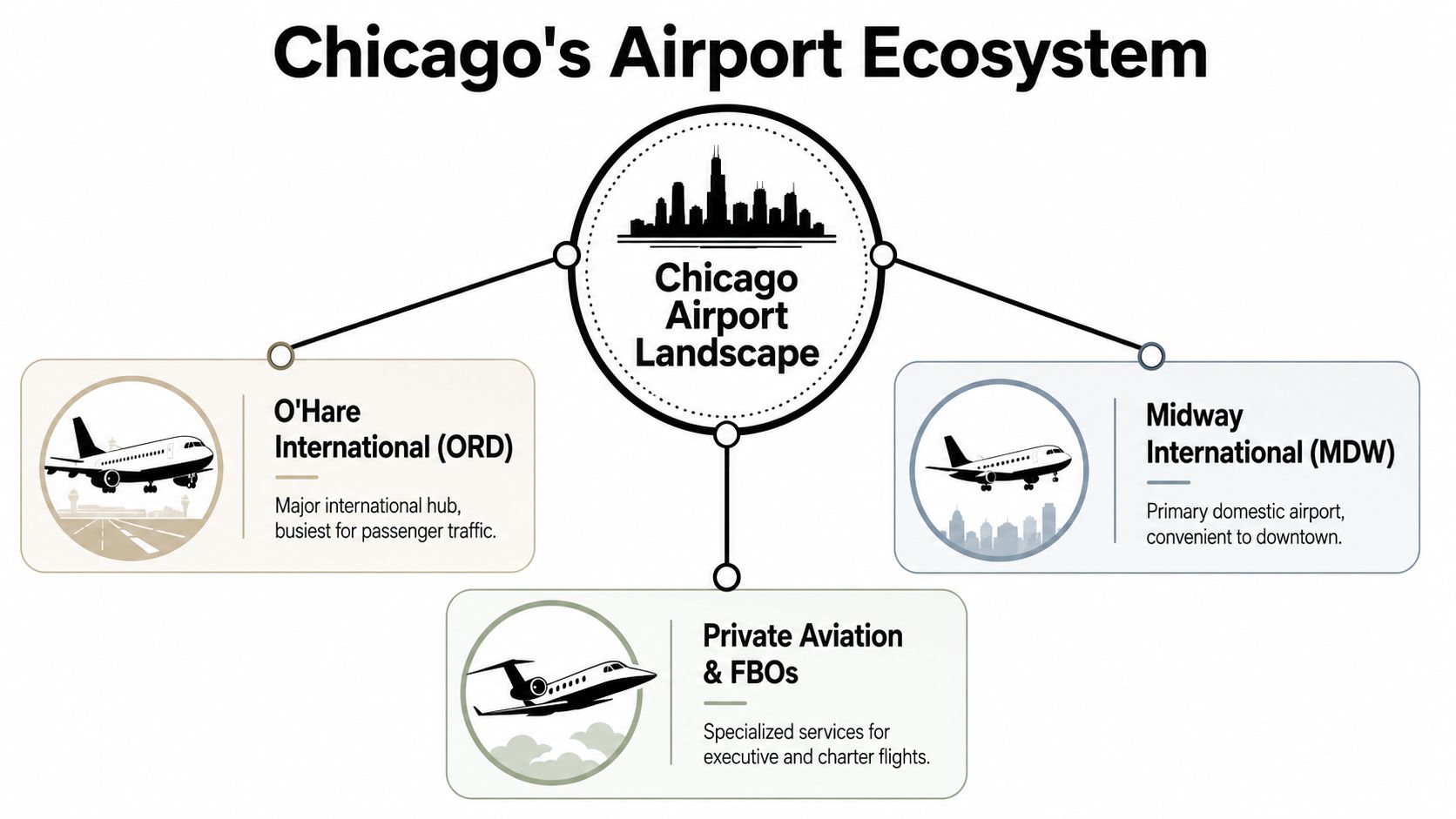
Chicago isn't one airport environment. It is a network, and each node behaves differently. If you're booking executive ground transportation without accounting for those differences, you're planning blind.
Chicago airport transfers are shaped by one of the country's largest air hubs. O'Hare handled more than 8.26 million passengers in July 2025 alone, averaging about 266,000 travelers per day, which explains why curb activity and ground demand can change quickly during peak periods, conventions, and international arrival banks, according to O'Hare passenger traffic reporting.
O'Hare requires a terminal-specific plan
O'Hare is not just busy. It is operationally layered. Domestic arrivals, international arrivals, airline-specific pickup norms, baggage timing, and roadway congestion all affect where and how you stage a pickup.
For ORD, the details that matter most are usually these:
| Factor | Why it changes the transfer |
|---|---|
| Arrival type | International arrivals often create more variable exit timing than domestic flights. |
| Terminal location | Pickup routing can change depending on where the passenger exits and whether a meet-and-greet is required. |
| Traveler profile | A senior executive, family office principal, or foreign delegation may need escort-level handling, not curb-only pickup. |
| Connection pressure | Some arrivals need immediate onward movement to meetings, heliports, rail links, or private terminals. |
At O'Hare, assumptions create delays. A serious provider confirms the exact operating plan and keeps adjusting it as the flight progresses.
Midway is simpler, but not casual
Midway usually gives planners a more straightforward transfer environment. It is often more convenient for domestic business travel and can support tighter downtown scheduling. That said, "easier" does not mean "hands-off."
Midway still demands clear pickup instructions, accurate luggage information, and a provider that can adjust when a same-day itinerary moves. Travel managers who treat MDW as informal often create preventable confusion because they assume less coordination is needed than the trip requires.
Private aviation runs on different protocols
FBO movements are a separate discipline. The passenger may never enter a commercial terminal. Timing can shift with aircraft readiness, ATC delays, customs handling, or principal preference. The pickup point may change with little notice, and discretion usually matters more than signage or high-visibility curb procedures.
That is why many planners separate commercial airport handling from executive aviation handling, even when the destination is the same. Providers that understand both can consolidate the work. If you're comparing options, a useful benchmark is whether the company also handles adjacent executive movement such as executive car service in Chicago, not just airport runs in isolation.
ORD, MDW, and FBOs may sit in one metro, but they should never be managed with one generic playbook.
What Defines a Premium Transfer Service
Most marketing in this category mistakes premium for leather seats and polished paint. That is surface-level quality. In executive ground transportation, premium service is the operating system behind the ride.
Chicago has trained travelers to expect around-the-clock connectivity. O'Hare is supported by infrastructure such as the CTA Blue Line, which runs 24 hours a day, 7 days a week, reinforcing the expectation that airport transfers should also be available at all hours and aligned tightly to flight schedules, as outlined by CTA airport service information. If public infrastructure is available all night, a premium private provider can't disappear after standard office hours.
The service layers that actually matter
When I evaluate a transfer partner, I don't start with the fleet page. I start with four operational questions.
Is there real 24/7 dispatch coverage?
Not an answering service. Not a form that gets reviewed later. An actual operations function that can make decisions while the trip is live.Does flight tracking trigger action, not just awareness?
Anyone can see that a flight is late. Premium service means the pickup plan, chauffeur timing, and communication sequence adjust without the passenger needing to intervene.Are chauffeurs briefed beyond the name sign?
A strong chauffeur knows the revised destination, passenger count, luggage profile, preferred route style, and whether conversation should be limited.Can the provider absorb itinerary drift?
Most executive trips change. The question is whether the operator treats that as normal work or as a disruption.
What premium isn't
A premium transfer is not:
- A luxury car with weak operations
- A low-price booking with add-on confusion
- A single-point contact who becomes unreachable after wheels down
- A generic meet-and-greet script applied to every traveler
The vehicle is the visible part of the service. The invisible part determines whether the trip holds together.
This is why the broader category of ground transportation services matters. Airport movement is only one leg of a larger executive itinerary. The providers worth keeping are the ones that understand the airport transfer as a controlled handoff within a full day of travel, not as an isolated booking.
The difference between luxury and operational confidence
Luxury is easy to photograph. Operational confidence is harder to market, but it is what executive assistants remember. They remember whether the chauffeur communicated clearly after a gate-side delay. They remember whether dispatch handled a destination change without friction. They remember whether the principal had to ask, "Where is my car?"
If you're sourcing for high-value travelers, ask for process answers, not aesthetic answers. The companies with mature operations will welcome that scrutiny.
Choosing the Right Vehicle for Your Mission
Fleet selection should start with the assignment, not the passenger's title. The right vehicle supports the purpose of the transfer. The wrong one creates friction, even if it looks impressive on arrival.
Match the vehicle to the working conditions
A solo executive arriving for meetings across the Loop usually needs a different setup than a principal traveling with security, presentation materials, or family members.
| Mission | Best-fit vehicle type | Why it works |
|---|---|---|
| Solo executive transfer | Executive sedan | Low-profile, efficient, comfortable for calls and focused travel. |
| Small group or extra luggage | Premium SUV | Better cargo flexibility, easier for airport baggage variability, strong curb presence. |
| Roadshow or team movement | Luxury van or Sprinter-type vehicle | Keeps a group together and supports materials, multiple bags, and in-transit coordination. |
| FBO principal with support staff | SUV or van depending on entourage | Gives room for assistants, security, or specialty luggage without splitting the movement. |
The hidden cost of underbooking
Travel managers often underbook for luggage because the manifest looks simple. Then the party arrives with garment bags, trade-show materials, instrument cases, or family luggage that was not disclosed. That pushes the team into a second vehicle request or a cramped ride that starts the day badly.
Use a stricter decision standard:
- Book the sedan when the traveler needs privacy, speed, and minimal baggage.
- Book the SUV when there is any uncertainty around luggage, companions, or winter travel conditions.
- Book the van when keeping the group unified matters more than individual aesthetics.
Presence matters, but function wins
There are trips where appearance carries weight. Investor meetings, board weekends, diplomatic arrivals, and family office travel can justify a more formal vehicle profile. Even then, the first filter should be operational fit.
A well-selected vehicle gives the traveler room to work, protects timing at the curb, and reduces the chance of last-minute equipment changes. That's what professional planning looks like. Not the most expensive option. The most suitable one.
The Anatomy of a Seamless Booking Process
A smooth transfer starts long before the chauffeur enters the airport queue. Good booking is data discipline. The planner supplies the right details early, and the operator turns those details into a controlled movement plan.
Step one is the brief, not the reservation
The first request should include more than date, time, and airport. A professional operator needs enough context to stage correctly.
Provide these essentials up front:
- Flight or tail information so operations can monitor the live arrival, not just the scheduled one.
- Passenger identity and role because a principal, assistant, family member, and security detail may each require different handling.
- Pickup style such as curbside, meet-and-greet, or FBO-side coordination.
- Destination logic including first stop, final stop, and whether changes are likely.
- Communication rules covering who receives texts, who receives email updates, and who has authority to change the trip.
Confirmation should answer operational questions
A real confirmation does more than acknowledge the booking. It should lock in responsibility.
Look for confirmation that covers:
| Booking element | What you want confirmed |
|---|---|
| Service date and airport | Exact arrival movement being monitored |
| Pickup protocol | Terminal, FBO, meet point, signage, or curb instructions |
| Vehicle class | Confirmed equipment, not a vague "similar vehicle" promise |
| Primary contacts | Passenger contact and planner contact |
| Change handling | Clear path for same-day adjustments |
Irregular operations separate strong providers from weak ones
Airport transfer Chicago is an operations test. Delays, missed connections, rebookings, and late-night changes are not edge cases. They are normal conditions in air travel. O'Hare's Travelers Aid presence across multiple terminals is a reminder that passengers often need real-time help when plans break down, as noted by Travelers Aid services at O'Hare.
When flights go off plan, the best transfer providers don't ask whether they should adapt. They ask which option protects the traveler best.
What works in those moments is simple:
- One operations contact owns the adjustment
- The chauffeur receives revised instructions quickly
- The traveler gets only the information they need
- The assistant gets status without chasing updates
What doesn't work is a rigid booking workflow that treats every change as a new order. Executive travel doesn't move that way, and neither should your airport provider.
Specialized Support for FBOs and Airline Crews
Private aviation and airline crew transport sit outside the standard airport-transfer playbook. They involve different access points, different timing logic, and different consequences when coordination slips.

FBO work depends on precision and discretion
An FBO transfer is rarely just "airport pickup." It may involve direct coordination with private terminal staff, tail-aware scheduling, security-sensitive passengers, and instructions that change within minutes of arrival. The chauffeur may need a very low-profile posture. The dispatcher may need to coordinate through an assistant, aviation desk, and destination contact simultaneously.
For these moves, the planning standard should include:
- Aircraft-aware timing rather than fixed commercial assumptions
- Named contact points at both the aviation side and the receiving side
- Discretion protocols for high-profile travelers
- Luggage and entourage planning before the vehicle is assigned
Airline crew moves require consistency at scale
Crew transportation is different again. The goal is repeatable reliability across shifts, hotels, and staggered schedules. One crew movement may be simple. A full operating pattern can include separate pickups, delayed arrivals, legal-rest timing, and route changes that must be handled without introducing confusion to the crew.
Providers that support this work need strong manifest control and a disciplined handoff process. If you're evaluating that niche, it helps to review how a company approaches airline crew transportation as its own service line rather than assuming crew work is identical to executive sedan service.
High-value airport transport is often less about driving and more about controlled handoffs between restricted environments.
Why this niche changes how you vet providers
A company can perform well on standard hotel transfers and still struggle with private terminals or crew logistics. Ask about communication protocols, exception handling, and who has authority to make real-time decisions. In these environments, speed matters, but clarity matters more.
Actionable Tips for Flawless Airport Transfers
If you manage executive arrivals regularly, the highest return comes from tightening the brief before the trip goes live. Most transfer failures are preventable at the booking stage.
Use this pre-departure checklist
- Confirm the live itinerary: Verify the exact flight or tail movement, pickup style, and destination sequence before travel day.
- Name both operational contacts: Give the provider the passenger's mobile details and your own. That avoids dead ends if one party is unreachable.
- State luggage realistically: Count oversize items, garment bags, presentation kits, and anything that changes vehicle fit.
- Define communication boundaries: Some travelers want direct texts from the chauffeur. Others want all updates filtered through an assistant.
- Flag access and assistance needs early: Accessible transport should never be treated as a last-minute note.
A critical gap in this market is practical planning for travelers with mobility needs. Much of the airport transfer conversation centers on luxury presentation, while planners often need concrete answers about wheelchair-accessible vehicles, boarding help, and door-to-door support, as discussed by Chicago handicap transportation guidance for ORD and MDW.
Small details that prevent large problems
Two habits improve outcomes more than typically expected.
First, brief the provider on the purpose of the ride, not just the route. "Board meeting on arrival," "family office principal with assistant," or "crew rest transfer" tells operations how tight the tolerance is and how the service should feel.
Second, define what should happen if the plan changes. Don't wait for the disruption to decide whether the chauffeur should hold, reroute, or return later.
The best bookings don't assume a perfect travel day. They include instructions for the imperfect one.
For airport transfer Chicago, that is the essential dividing line between a car order and a managed movement. One is transactional. The other protects time, reputation, and traveler focus.
MLR Worldwide Service supports executive airport transfers, FBO coordination, corporate roadshows, VIP transport, and crew movements with 24/7 operations oversight and a professionally managed fleet. If you need a Chicago transfer program built around communication discipline, schedule protection, and discreet execution, review MLR Worldwide Service as part of your sourcing process.