
You're already in the part of the day where the travel plan looks simple on paper and fragile in reality. The meeting moved, the flight time shifted, the client asked for an extra stop, and somebody still needs to make sure the right vehicle is at the right curb with the right person on board.
That's where executive transport stops being a nice-to-have and starts acting like operational infrastructure. A polished car is useless if the pickup is late, the route fails under pressure, or the handoff at the airport breaks down. In executive travel, the value is not the leather seat. It's the system that protects time, privacy, and decision-making when schedules get messy.
Beyond Luxury A New Standard for Executive Travel
A senior vice president lands after a delayed flight, the driver is waiting at the wrong terminal, and the backup contact doesn't answer. By the time the executive reaches the hotel, the prep call has started without them, the assistant is fielding apologies, and the rest of the day is built on avoidable friction. That's not a luxury problem. It's an operations failure.
Executive transport exists to prevent exactly that kind of breakdown. The best providers treat the trip like a controlled workflow, not a ride request. They protect focus, they absorb change, and they keep a leader moving without forcing the leader or assistant to solve ground logistics in real time.
Treat it like business infrastructure
The strongest comparison is not hospitality, it's support functions that keep the company running. Just as IT protects access and legal protects exposure, transport protects time and continuity. That mindset matters because executives rarely travel in a straight line anymore. They move between airports, boardrooms, private terminals, hotels, and event venues, often in one day.
The historical model for this level of mobility goes back to state-level executive movement. When Dwight D. Eisenhower became the first sitting U.S. president to use a helicopter in official transportation service on July 12, 1957, it marked an early turning point in how top leaders could move quickly and securely when timing mattered most (White House Historical Association). The point wasn't glamour, it was access and protection.
Practical rule: If a transport provider only talks about the vehicle, keep looking. A real executive solution manages the trip, the risk, and the handoff.
A good assistant should think the same way. You are not booking a car. You are buying continuity for the executive's day.
Decoding Executive Transport Service Types
Everyone assumes every premium ride is the same. That's a mistake. A simple airport transfer, a multi-stop roadshow, and a secure VIP movement solve different problems, and if you book the wrong one, the service will look polished while still failing the mission.
Airport and FBO transfers
These are the baseline. The job is to meet the traveler cleanly, get them to the vehicle without confusion, and deliver them to the destination without delay or awkward coordination. For private aviation, the FBO handoff is the true test, because the transfer has to align with aviation timing and terminal access, not just curbside convenience.
Use this service when the trip is point-to-point and the schedule is stable. It should feel invisible. The passenger should not need to think about where to stand, who is waiting, or how the vehicle will be staged.
Corporate roadshows and multi-stop movements
Roadshows are a different animal. One late meeting can compress the whole day, and one missed turn can put the next three appointments at risk. In such scenarios, dynamic scheduling, dispatch coordination, and live communication matter more than the badge on the grille.
The internal logic of a roadshow is simple. Every stop depends on the previous one. If the provider cannot handle changing timings, extra security screening, or last-minute agenda edits, it isn't a roadshow partner. It's a sedan service pretending to be one.
For a plain-language primer on ground movement categories, the overview at What Is Ground Transportation is useful as a reference point.
Event logistics and group movement
Large events expose weak operators fast. Attendees arrive at different times, VIPs need separate handling, and one missed shuttle can ripple across check-in, programming, and hospitality teams. Group transport is really about sequencing, not just capacity.
High-security VIP transport
This is the category where discretion and route control become part of the product. The provider should be able to plan movements with privacy in mind, coordinate handoffs carefully, and avoid unnecessary exposure around sensitive travelers or sensitive business meetings.
You want a provider that understands the difference between moving people and managing access.
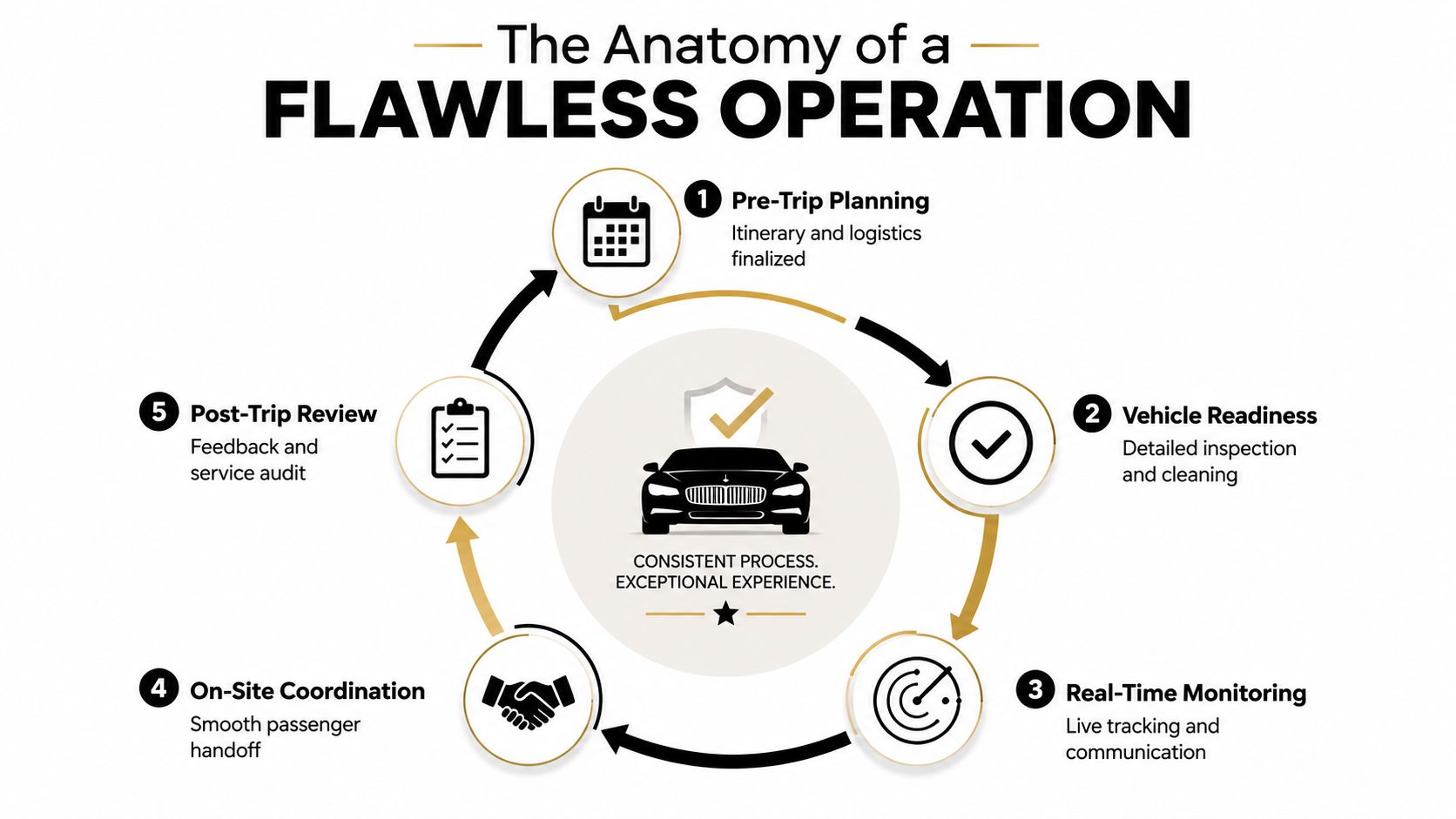
The Anatomy of a Flawless Operation
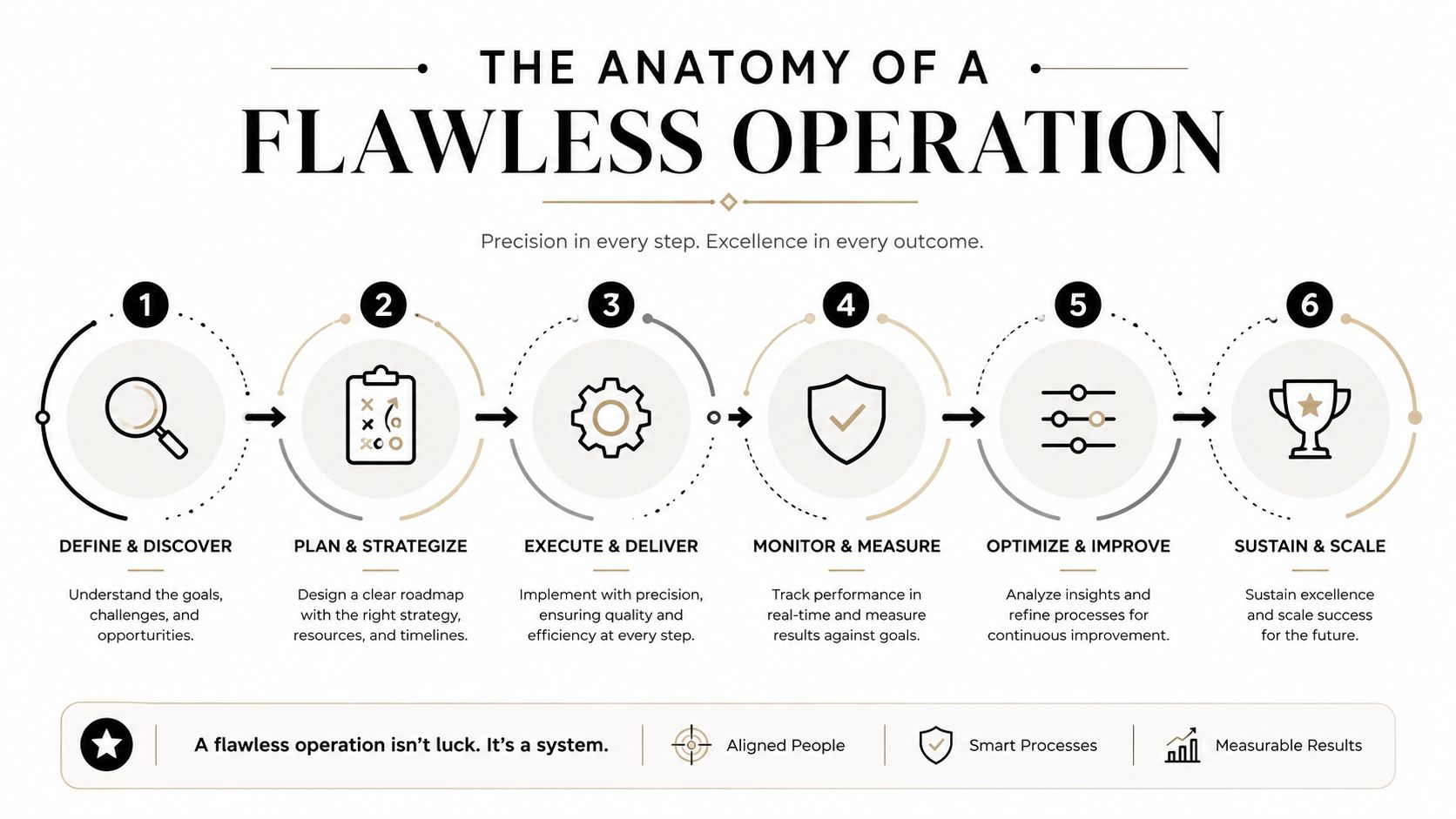
A flawless trip usually looks easy to the passenger because the hard work happened long before the door opened. The actual operation starts with dispatch, routing, confirmation, and exception planning, then continues until the traveler is safely handed off at the final stop.
The control room matters more than the curb
The White House Transportation Agency is a 24/7 transportation system staffed exclusively by Army noncommissioned officers, serving the First Family, White House staff, and official visitors in the Washington, D.C. area (U.S. Army). That structure is useful because it shows what elite mobility requires: continuous availability, strict protocol, and coordination across moving parts. The vehicle is only one part of the system.
A serious executive transport provider should mirror that logic. Dispatch needs to know who is moving, when they're moving, what changes are likely, and which handoffs are sensitive. If that information lives in one person's inbox, the operation is already weak.
Monitoring has to be active, not reactive
Flight status, terminal access, traffic patterns, and passenger timing all need active monitoring. Not because every trip goes wrong, but because high-value trips become expensive when the provider reacts too late. The assistant should expect updates before they have to ask.
If a provider waits for you to notice the problem, the provider has already failed.
That same mindset applies to contingencies. A serious operator builds the trip around recovery. If a flight slips, the ground plan should flex. If a meeting runs long, the handoff should absorb it. If the day turns into a multi-city scramble, the dispatch team should already have the next move ready.
Executive transport is built on recovery
Resilience separates premium from merely expensive. A good operation absorbs friction without making the traveler pay the emotional cost. That means clear communication, disciplined re-routing, and one point of contact who can make decisions fast.
The broader standard for presidential movement also shows the tension between speed and endurance. The Boeing VC-25A is reported with a cruise speed of about Mach 0.84, a maximum speed of Mach 0.92, and a range of 6,800 nmi, which reflects the balance between high-speed movement and long unrefueled reach for time-critical transport (VC-25). For corporate travel, the lesson is simpler. You need a system that can move fast without breaking when the day changes.
The Pillars of a Premier Fleet and Crew

The fleet should look restrained, not flashy. Clean lines, late-model vehicles, and predictable quality matter more than trying to impress someone with chrome. A top provider also keeps vehicle options broad enough to fit the trip, because a solo board member, a three-person deal team, and a family office transfer don't need the same setup.
What the vehicle must do
The vehicle has to be ready, clean, and suited to the mission. That sounds obvious, but obvious is where weak providers fail. If a sedan is too small for baggage, if an SUV arrives with unclear branding, or if a van doesn't match the group size, the transport plan starts bleeding credibility before anyone reaches the destination.
Diversity in the fleet is not a marketing line. It's how the operator prevents mismatches. The right vehicle should support the itinerary, the luggage, the privacy level, and the tone of the engagement.
What the chauffeur must do
A true executive chauffeur is not just someone who knows how to drive. The role includes defensive habits, local route familiarity, quiet professionalism, and the discipline to anticipate what the passenger needs before they have to ask. That can mean managing boarding calmly, adjusting for a last-minute stop, or understanding when silence is better than conversation.
The better chauffeur behaves like a mobile extension of the assistant team. They don't create extra work. They reduce it.
Maintenance is a risk issue, not a cosmetic issue
Vehicle upkeep is part of service reliability. A fleet that is not maintained tightly can turn into a chain of delays, substitutions, and embarrassment. The maintenance approach should be systematic and visible in service quality, not just hidden in a company promise.
A useful operational benchmark is the maintenance discipline described in fleet maintenance best practices, because it reinforces a simple truth. Clean vehicles are nice. Reliable vehicles are mandatory.
Practical rule: If the provider can't explain how it keeps vehicles road-ready, it's not managing a fleet. It's managing exposure.
The crew is the last mile of trust. If they're sharp, calm, and discreet, the whole service feels easier. If they're not, every other part of the system gets harder.
Security Privacy and Discretion as Standard
High-profile travelers don't just need a ride. They need protection from unnecessary visibility. That includes physical movement, conversation in the cabin, and the data trail created by the booking process itself.
The first layer is staff vetting and conduct. Anyone touching a VIP itinerary should understand confidentiality as a core duty, not a courtesy. The second layer is route and timing discipline. Sensitive movements should not be treated like casual errands, because public exposure, predictable patterns, and sloppy handoffs all create avoidable risk.
Privacy is operational, not theoretical
In practice, privacy means fewer surprises. It means the provider knows who should receive trip details, how those details are shared, and what happens when a traveler's plans change. It also means the chauffeur understands that the cabin is not a place for gossip, speculation, or casual disclosure.
The advisory around access barriers in transport research is relevant here too. Independent transport research says access barriers shape daily life across income and ability levels, and recommends pairing mobility services with community organizations, more diverse public engagement, and multimodal options such as ride-hailing and micro-transit (University of Minnesota Center for Transportation Studies). For executive transport, the lesson is that high-touch service should still be accessible, whether the traveler has mobility needs, language needs, or special handling requirements.
Security is broader than escorting someone to a car
A smart provider plans the route with intent. That may involve avoiding obvious choke points, controlling the pickup scene, or coordinating more carefully around airports, events, and public arrivals. The goal is simple, limit noise, reduce exposure, and keep the traveler moving.
The value of this approach is not paranoia. It's corporate responsibility. If an assistant books transport for a board member, a guest investor, or a high-net-worth principal, that booking carries reputational and operational risk. The provider should act accordingly.
The rest of the market often underplays disruption. Guidance for executive movements around events points to flexibility, real-time ETAs, centralized booking, and contingency planning, because the ultimate test is how the provider responds when the schedule shifts (Driven Worldwide). That's the standard to demand. Not “clean car, on time.” Better than that. Controlled movement under pressure.
How to Choose the Right Executive Transport Partner
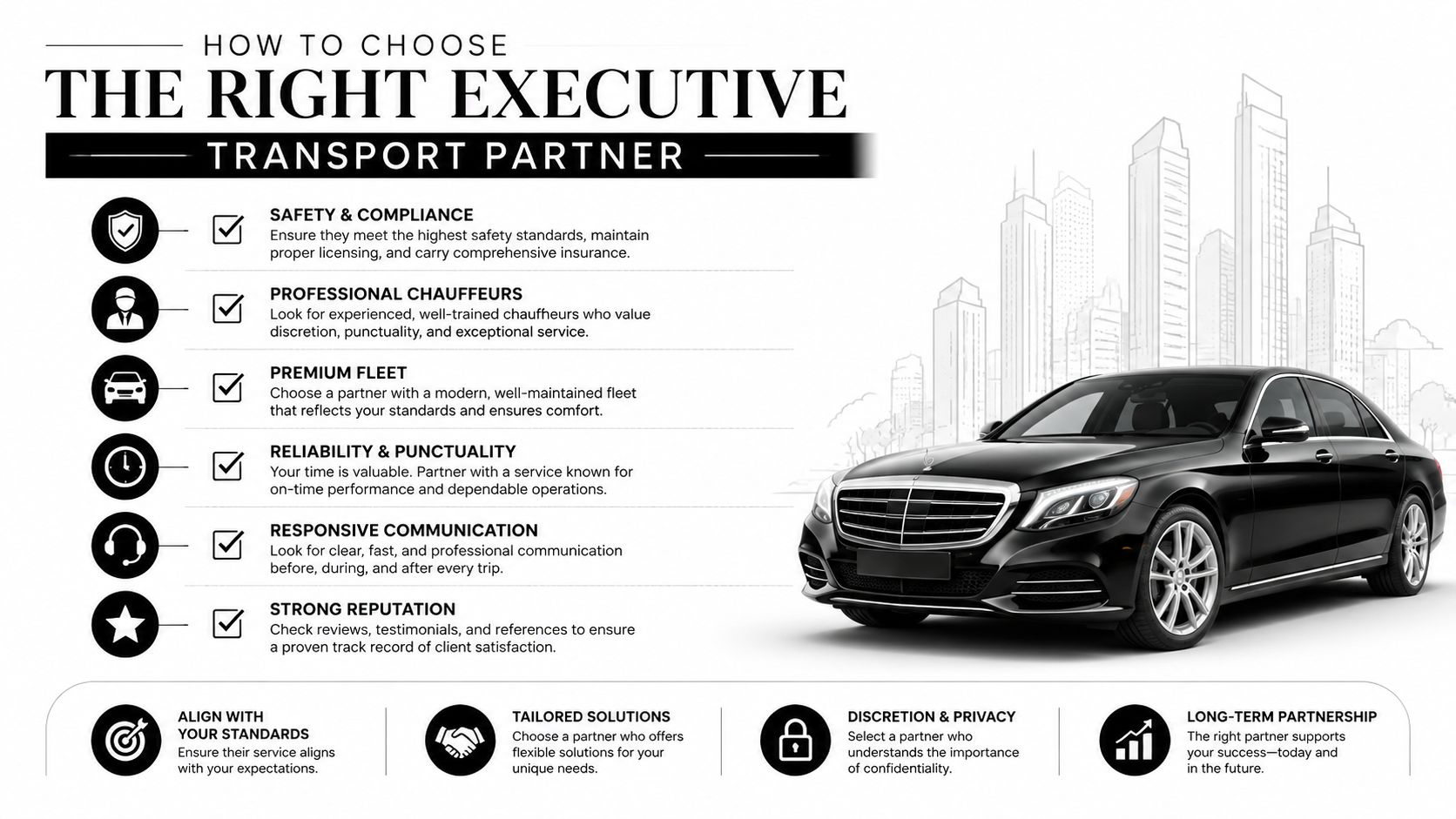
Pick the provider like you'd pick any other risk-sensitive vendor. Start with capability, then verify process, then check how they behave when the itinerary stops being neat.
Ask for the operating model, not the sales pitch
You need to know who answers after-hours calls, how dispatch handles a delayed arrival, and whether the same team can manage a simple transfer and a more complex roadshow. If the provider can't explain its workflow clearly, that tells you something important. Good operators can describe how they work without hiding behind buzzwords.
Verify coverage and continuity
A provider with an affiliate network should be able to keep standards consistent across cities. That matters when executives move between business hubs and expect the same level of professionalism everywhere. Don't ask whether they “serve globally.” Ask how they maintain consistency when the trip crosses borders or time zones.
Match the pricing structure to the mission
Hourly service works when timing is fluid and the executive may need the vehicle to wait. Point-to-point works better when the route is fixed and predictable. Retainer arrangements make sense for repeat travel or extended support where continuity matters more than one-off booking convenience.
Make inclusivity part of the checklist
Often, many teams miss the obvious. Ask how the provider supports travelers with mobility needs, language needs, or access concerns. The question is not polite filler. It's a real test of whether the service can handle human variation without friction.
Use the insurance and coverage overview at insurance coverage details as a reminder to verify protection before you rely on a provider for sensitive movements.
Decision rule: If a transport partner is hard to evaluate before the trip, it will be harder to trust during the trip.
A strong shortlist should include one provider that feels operationally boring in the best possible way. That usually means they've done the planning work well enough that you don't have to think about them twice.
Executive Transport Frequently Asked Questions
How does a professional service handle last-minute itinerary changes or flight delays?
It should respond without drama. A capable operator monitors timing, adjusts dispatch, and communicates the change before the traveler starts wondering where the car is. If the trip is worth doing well, the provider should be able to absorb a slip in one part of the itinerary without breaking the rest of the day.
The key question is whether the company has a live coordination process. If the answer is yes, last-minute changes become manageable. If the answer is vague, expect problems.
How far in advance should I book a multi-city roadshow versus a simple airport transfer?
A simple airport transfer can often be arranged quickly, but a multi-city roadshow needs more lead time because the schedule has to be built, checked, and protected against disruption. The more stops, the more people involved, and the more that can go wrong if the plan is rushed.
My rule is simple. Book the complex trip as early as you can, and never assume a “standard car booking” is enough for a schedule with moving parts. Complexity deserves planning time.
What is the standard protocol for tipping and gratuities?
Follow the provider's policy first, because that's the cleanest way to avoid confusion. In premium transport, gratuity norms can vary by market and service type, and the assistant should confirm what's already included before the trip starts.
If you're booking for executives, make the payment and gratuity process part of the prep checklist. That keeps the end of the trip as professional as the beginning.
What should I ask before I confirm a provider?
Ask who manages the trip, how they handle delays, what vehicle class will be provided, and whether they can support any access, language, or privacy needs. Then ask one more question: what happens if the schedule changes after the car is already en route. That answer will tell you whether you're dealing with a real operator or a polished dispatcher.
The best providers don't just promise punctuality. They build for disruption, because disruption is the normal condition of executive travel.
If you need a transport partner that treats mobility like a mission-critical function, MLR Worldwide Service is built around that standard. Their executive chauffeur, airport, roadshow, event, and VIP transport services are designed for the exact kind of resilience, discretion, and control discussed here. Visit them now and compare their approach against the way your team moves.