
Your board member's flight just diverted, the driver is already staged at the wrong airport, and your CFO wants confirmation before the next meeting starts. That's the true test of premium car service, not whether the cabin has bottled water or soft leather. If you're the person responsible for getting executives, crews, or VIPs from air to ground without embarrassment, you need an operator that behaves like a logistics partner, not a ride app with nicer photos.
What a Modern Executive Deserves on the Road
A chief of staff in Chicago can handle a late flight change if the provider can absorb it. The problem is that many firms sell comfort, then fail on the one thing that matters at 9 p.m. on a travel day, which is coordination. A good premium car service protects the schedule when a landing shifts, a meeting runs long, or the arrival airport changes at the last minute.
The commercial foundation for this market is not small. In the U.S. limousine and town car sector, IBISWorld estimates $11.6 billion in 2026 market size and 196,000 businesses operating in the industry, with the sector growing at a 9.7% CAGR from 2021 to 2026 (IBISWorld industry profile). That growth reflects one thing clearly, reserved luxury ground transport has moved from niche convenience to core business infrastructure.
Why the stakes are higher than comfort
Executives and their support teams don't judge a ride by seat stitching. They judge it by whether the vehicle is there, the chauffeur knows the route, and dispatch can adapt without drama. In that sense, premium car service sits inside the wider travel chain, alongside flight monitoring, hotel coordination, and meeting logistics.
If the operator cannot manage disruption, the whole itinerary becomes brittle. That's why the wrong choice costs more than a late pickup. It creates a cascade of phone calls, rebooking pressure, and a credibility problem for the person who made the reservation.
Practical rule: If a provider can't explain how it handles diversion, delay, and after-hours changes in plain language, it's not ready for executive travel.
The audience for this guide is the person who has to make the transportation decision and live with the consequences, a chief of staff, travel manager, FBO coordinator, executive assistant, or operations lead. The standard is simple. The car has to show up, the plan has to survive disruption, and the billing has to be predictable.
Defining Premium Car Service and How It Differs From Other Options
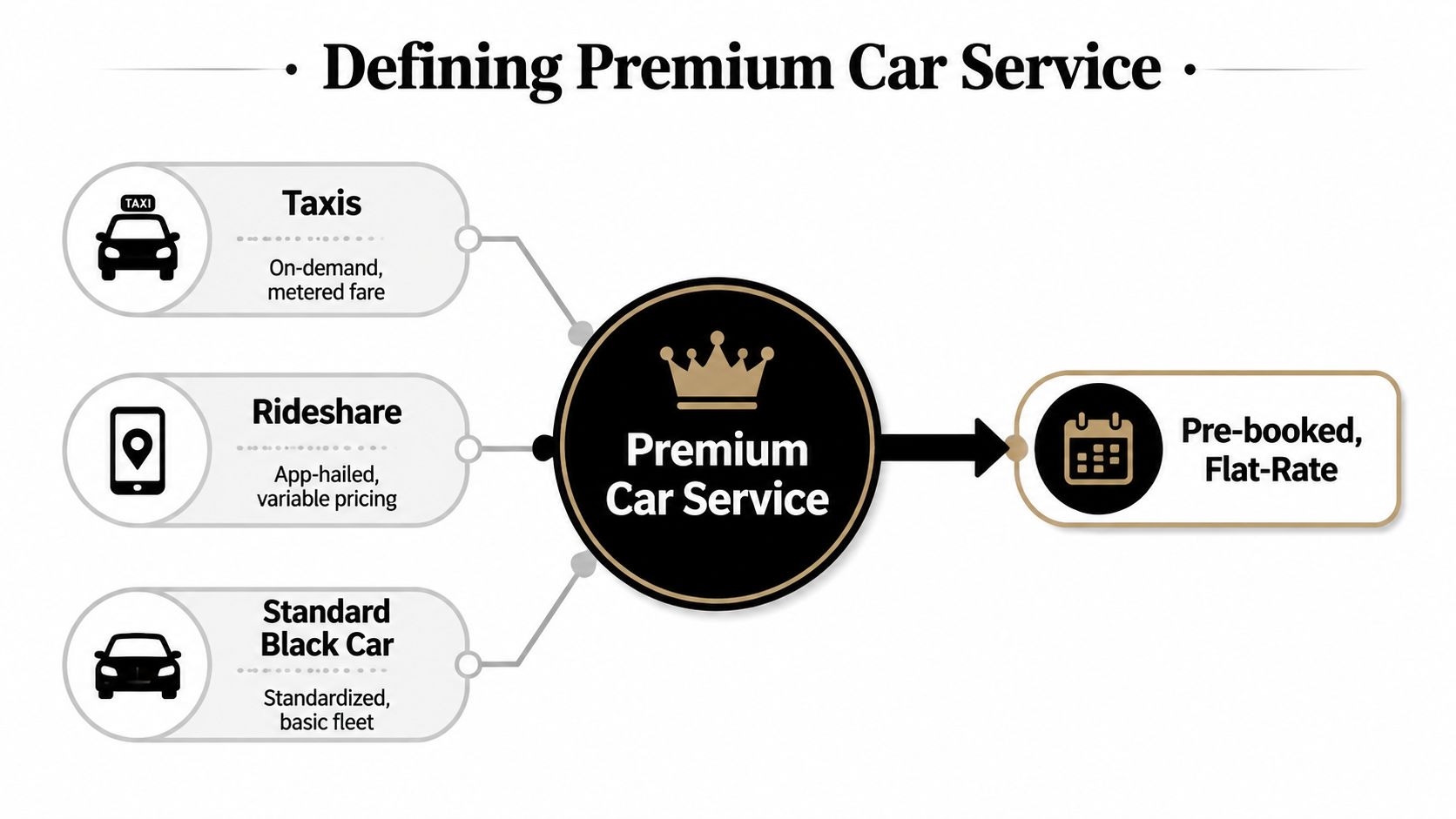
Premium car service is pre-booked, chauffeur-driven, and usually priced as a flat-rate or otherwise transparent journey rather than a spontaneous pickup. That sounds basic, but the operating model is what separates it from taxis, rideshare, and basic black-car coverage. You are not buying a seat in a moving vehicle. You are buying an itinerary that has been assigned, monitored, and protected in advance.
Chartered aviation versus a commercial seat illustrates the core difference. Both get you to the same city, but one is organized around your timing, your route, and your ground handling, while the other is organized around general availability. The same distinction applies on the road. Premium transport is built for planned movement, not improvisation.
The operational contract matters more than the vehicle
Taxis are on-demand and metered. Rideshare is app-hailed and price-variable. Standard black-car service often improves the presentation, but it can still behave like a basic transfer product if there is no real dispatch discipline behind it.
Premium service promises more than appearance. It promises a guaranteed class of vehicle, a vetted chauffeur, advance reservation, transparent pricing, and consistent standards across cities. That consistency matters when a traveler moves from one market to another and expects the same level of execution everywhere.
What the buyer is actually purchasing
The core value is control. A premium operator should let you reserve in advance, confirm the vehicle class, set pickup parameters, and know who is driving. For FBO coordinators and corporate travel teams, that control is the difference between a smooth transfer and a scramble at the curb.
A standard on-demand option can be fine for casual movement. It is not the right tool for board travel, client hosting, or any itinerary where the arrival window matters. In those cases, the service must behave like a scheduled asset, not a best-effort suggestion.
If the trip is tied to a meeting, a flight, or a formal event, don't buy mobility, buy certainty.
Premium service also changes how the traveler experiences pricing. Flat-rate or clearly structured quotes remove the friction of meter anxiety and surge volatility. That is why executives and their assistants keep returning to it for trips where predictability is worth more than convenience.
Core Pillars That Separate Operators From Each Other
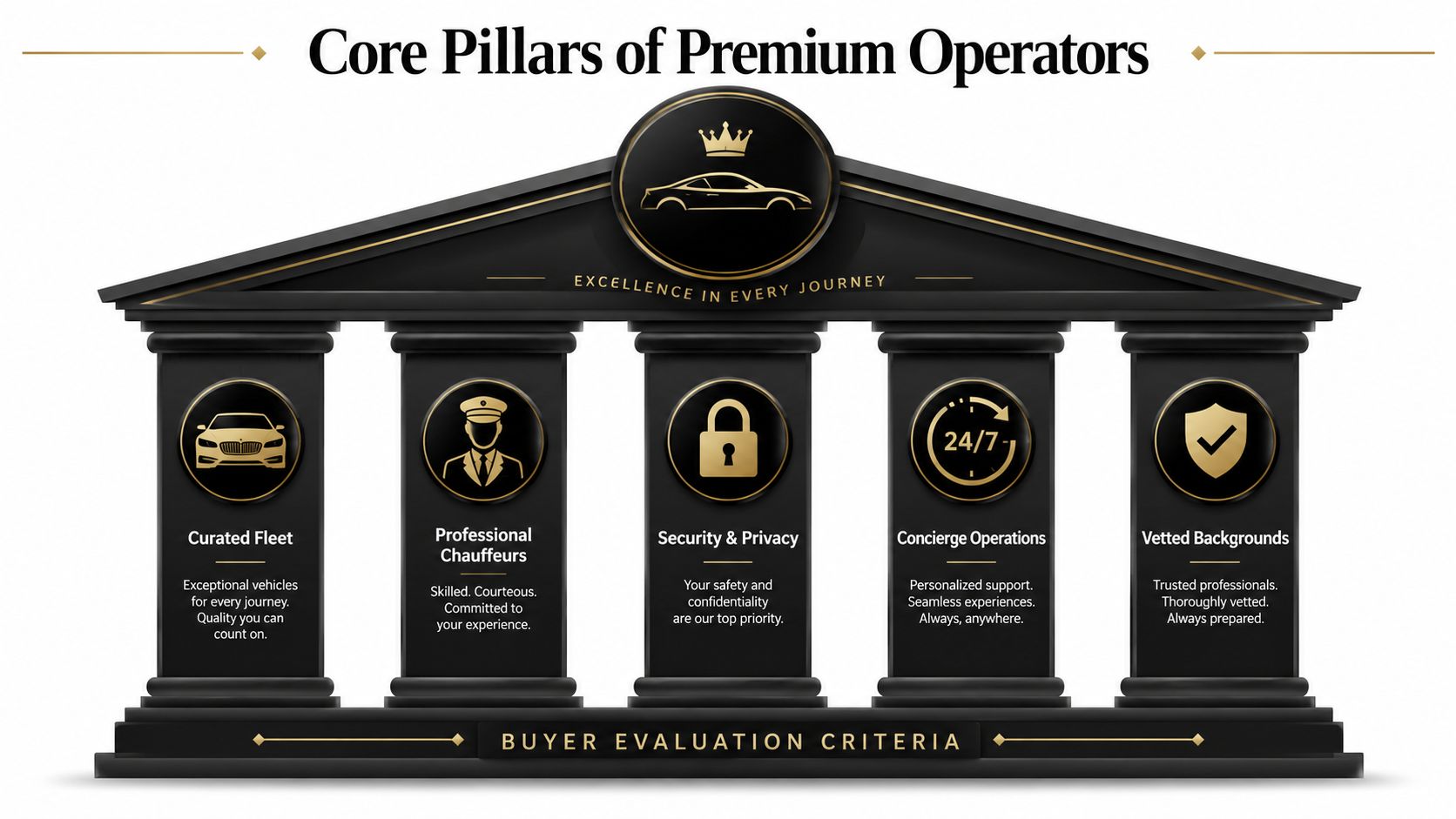
The difference between average and excellent is not the logo on the door. It's whether the provider can repeat the same standard in a storm, after midnight, and in a city its own office doesn't physically sit in. Premium buyers should evaluate five pillars, the fleet, the chauffeurs, security and privacy, concierge coverage, and affiliate reach.
J.D. Power's 2024 U.S. Customer Service Index found the premium segment at 886, up 8 points year over year, versus an industry average dealer service score of 868 (J.D. Power coverage). That gap matters here because premium customers are clearly trained to expect more than a polite greeting. They expect reliability, responsiveness, and disciplined execution.
Fleet quality is more than a model year
A curated fleet should mean clean interiors, late-model vehicles, backup units, and real configuration options. For executive travel, that includes sedans, premium SUVs, luxury vans, and specialty vehicles when the itinerary requires it. It also means the operator can support practical needs, not just prestige.
Fleet quality also reveals whether the company manages exceptions well. If a client needs child seats, a backup vehicle, or a mobility-friendly option, the provider has to answer quickly and without improvisation. The point is not luxury for its own sake. The point is fit for purpose.
Chauffeurs and dispatch are where service becomes real
A professional chauffeur is not a driver with a nicer title. They should understand timing, route discretion, client privacy, and how to work around changes without turning the ride into a conversation. The best teams are trained to anticipate, not react.
Security and privacy matter for the same reason. A premium client may not want names repeated, itineraries discussed, or pickup details exposed. The operator should treat discretion as part of the service, not as an upsell.
Concierge coverage and affiliates are the hidden differentiator
A 24/7 concierge desk is not a marketing line. It is the difference between a missed connection and a solved problem when a flight lands early or a meeting runs over. Good operators also maintain vetted affiliate networks, so the service standard survives when the trip crosses borders or time zones.
In that category, MLR Worldwide Service is a relevant option because it combines executive chauffeur service, airport transfers, FBO support, corporate roadshows, event logistics, VIP secure transport, and airline crew movements with 24/7 coordination and a vetted global affiliate network. That combination matters because it reflects the operating model buyers need, not just a polished storefront.
Premium Car Service Compared to Black Car and Rideshare
The right choice depends on the itinerary, not the ego of the traveler. A junior analyst heading to dinner does not need the same transport logic as a CFO moving between investor meetings and a late flight. For corporate buyers, the question is whether the service can support the schedule, absorb changes, and keep the billing clear.
| Criterion | Premium Car Service | Standard Black Car | Rideshare |
|---|---|---|---|
| Booking model | Pre-booked with itinerary control | Usually pre-arranged, but less standardized | App-hailed, immediate request model |
| Pricing | Transparent, often flat-rate | Often fixed or hourly, varies by operator | Variable pricing, can change with demand |
| Chauffeur vetting | Strong vetting and service training expected | Mixed, depends on provider | Platform screening, less personalized |
| After-hours support | 24/7 coordination is expected | May be limited | App support, often not tailored to complex changes |
| Best use case | Roadshows, FBO transfers, VIP travel, recurring executive movement | Point-to-point airport runs and simpler business travel | Casual local trips with low operational risk |
For a basic definition of black car service, this overview is useful: what black car service means in practical terms. The distinction that matters is that standard black-car can still be a single-trip product, while premium service is built as a managed transport layer.
Match the tier to the itinerary
Use rideshare for low-stakes movement where flexibility matters more than precision. Use standard black-car for a straightforward airport run or a simple point-to-point transfer with little risk of change.
Choose premium car service when the trip is multi-stop, timed to an arrival, or linked to a formal business event. That includes roadshows, FBO coordination, recurring executive travel, and any movement where a missed pickup creates a bigger problem than a higher quote.
Where Premium Car Service Earns Its Keep in the Real World
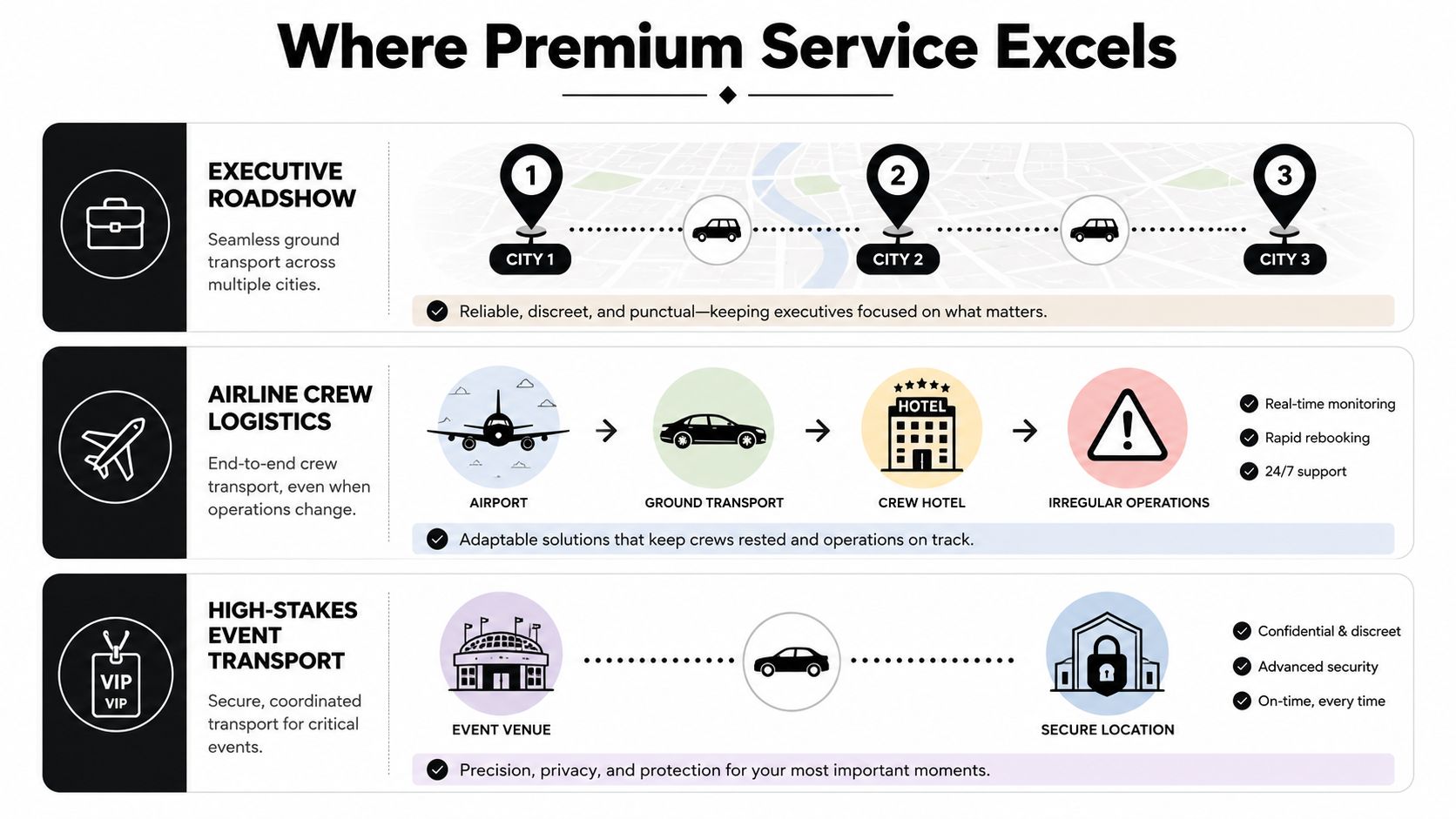
An executive roadshow across three U.S. cities in 48 hours is a coordination problem first and a driving job second. The operator has to stage vehicles in the right cities, confirm pickup windows against meeting changes, and keep the assistant informed without flooding them with updates. If one leg slips, the rest of the chain has to be adjusted without losing the next appointment.
An airline crew movement during irregular operations is even less forgiving. Crews often need a transfer from an FBO to a hotel, then back again on a modified schedule, and the provider has to respect both timing and fatigue. The service wins when dispatch stays in sync with the revised arrival, the affiliate in the next city is already briefed, and the crew doesn't have to negotiate logistics while working.
A conference with staged VIP arrivals is different again. The challenge is not speed, it's sequencing. The best operator coordinates arrival waves, keeps the vehicles separated by purpose, and prevents the lobby from becoming a bottleneck.
The point is not that every trip needs ceremony. The point is that premium transport earns its premium when the itinerary is fragile. At that moment, the chauffeur is only one part of the system, and the dispatch desk, the affiliate network, and the booking logic matter just as much.
An additional look at airport-ground coordination is available here: luxury airport car service in a broader travel chain.
Booking Checklist and Pricing Considerations
Start with fleet and backup plans. Ask what vehicle classes are available, whether the provider keeps spare units ready, and how it handles a last-minute change from sedan to SUV or van. If the answer is vague, the operator is probably not built for executive work.
Then ask about chauffeur vetting and training. You want to know who screens the drivers, how privacy is handled, and whether the chauffeurs are briefed for business travel rather than casual point-to-point rides. Background checks matter, but so does the ability to behave professionally when the client is under pressure.
Buyer rule: If the provider can't explain cancellation, wait-time, and last-minute change billing in one call, don't sign the agreement.
Pricing needs the same scrutiny. Flat-rate pricing is usually easier to defend for executive travel because it protects against surprises and makes internal approval cleaner. Hourly minimums can make sense for roadshows or meetings with uncertain duration, but they should be paired with clear billing rules for overtime, extra stops, and route changes.
For a practical vehicle and package reference, this overview of car service packages helps frame how providers bundle sedans, SUVs, and group movement. The important question is not which package sounds premium, it's whether the package matches the itinerary.
Questions to ask before you approve the vendor
- What is the fleet's backup process? You need to know whether the company can swap vehicles without disrupting the pickup.
- How are affiliate operators vetted in other cities? A global claim is meaningless if the local partner doesn't meet the same standard.
- What is included in the quoted price? Clarify tolls, wait time, parking, meet-and-greet, and gratuity before the first ride.
- How are after-hours changes handled? A real premium desk should answer this without sending you through three departments.
- What triggers a higher price? Vehicle class, city pair, late-night pickup, specialty requirements, and multi-stop routing should all be explained upfront.
The direct lesson is simple. The best quote is the one you can explain internally, defend during the trip, and reconcile after the invoice arrives. If the provider can't do that, the service is not premium, it's just expensive.
Connecting Air and Ground Without Losing a Minute
Premium ground transport works best when it behaves like the missing link between aircraft, hotel, and meeting room. That means flight tracking, clear pickup rules, and a dispatch team that knows whether the traveler wants curbside pickup or an inside-terminal meet-and-greet. It also means the provider understands FBO routines, hotel timing, and the next stop on the schedule.
The value of a vetted affiliate network becomes obvious here. A traveler can move through cities like London, Dubai, and Tokyo with a single operating standard if the underlying partners are disciplined and the process is repeatable. The contrarian truth is that white-glove service fails when it becomes too bespoke. The stronger model is standardized, transparent, and easy to execute under pressure.
That is why premium operators should be judged as part of the door-to-door logistics chain, not as an isolated car ride. A late aircraft, a changed gate, or a meeting that runs over should trigger a coordinated response, not a chain of apologies. The ground provider should already know what to do.
Questions Executive Travelers Ask Before They Book
If a flight is diverted at 2 a.m., the provider should have a live person who can reassign the pickup and confirm the new plan quickly. If the only option is an email form, the service isn't built for executive travel.
For international coverage, verify who fulfills the ride in the destination city and how that affiliate is vetted. For wait time, ask for the rule in plain English, because meetings run long and no one wants billing surprises afterward.
If the movement involves a group or an event, ask how the operator scales beyond one sedan. The right partner can coordinate multiple vehicles without losing arrival order or client privacy.
Premium car service is worth paying for when the itinerary is fragile, the traveler matters, and the consequences of a missed handoff are real. If that's your world, your next step is a discovery call with a provider that can prove its dispatch discipline, affiliate standards, and 24/7 coverage before you sign anything.
MLR Worldwide Service supports executives, FBO coordinators, corporate travel teams, and crew logistics with scheduled chauffeur service, airport transfers, roadshows, secure transport, and around-the-clock coordination. If you need a provider that treats premium car service as a logistics chain, not a vanity product, visit MLR Worldwide Service and request a quote for your next itinerary.