
Your operations inbox probably has the same message in it right now. One client wants a black-car arrival at an FBO, another wants a route plan that avoids delays, and someone in finance wants proof that the travel program is doing more than talking about sustainability. That pressure is exactly where carbon footprint reduction stops being a slogan and becomes an operating discipline.
For executive ground transport, the hard part isn't choosing between service and sustainability. The hard part is building a program that protects punctuality, discretion, and comfort while still lowering emissions in ways you can measure, defend, and improve. The good news is that the toolkit is already real, from smarter routing and cleaner fleets to tighter affiliate standards and better reporting.
Beyond the Buzzword Why Sustainability Matters in Executive Travel
A chauffeur is already on the clock when a sustainability decision is made. If the vehicle arrives late, the handoff feels disorganized, or the car does not match the client's standard, the environmental intent fades fast. Executive travel runs on trust, and any carbon reduction plan has to protect that first.
The broader context still matters. Humanity's carbon footprint has risen sharply over time, and global energy-related CO2 emissions remain high, so carbon reduction is no longer just a policy topic, it is an operating question. At the same time, lower-carbon technologies are already preventing meaningful emissions, which shows that practical action is possible without waiting for the perfect market condition.

That matters to private aviation teams, executive assistants, and FBO coordinators. Ground transport is the last leg of a premium journey, yet it often shapes the client's view of the entire trip. When vehicle selection, dispatch logic, and supplier standards are aligned, sustainability becomes part of service delivery instead of a separate reporting exercise.
Practical rule: If a sustainability change creates visible friction for the traveler, fix the operating design before you roll it out.
For teams comparing their transportation model to broader travel-management practices, a useful starting point is this overview of corporate travel management. The question is not how to make travel feel less premium. It is how to remove waste without weakening the experience.
Establishing Your Emissions Baseline
A credible emissions program starts with trip data that reflects what moved on the road. For executive transport, that means separating owned fleet activity from affiliate and vendor activity, then converting each trip into the same emissions metric. The aim is not a perfect model on day one. It is a reliable one that can support operational decisions, service planning, and ESG reporting.
Start with activity data, not assumptions
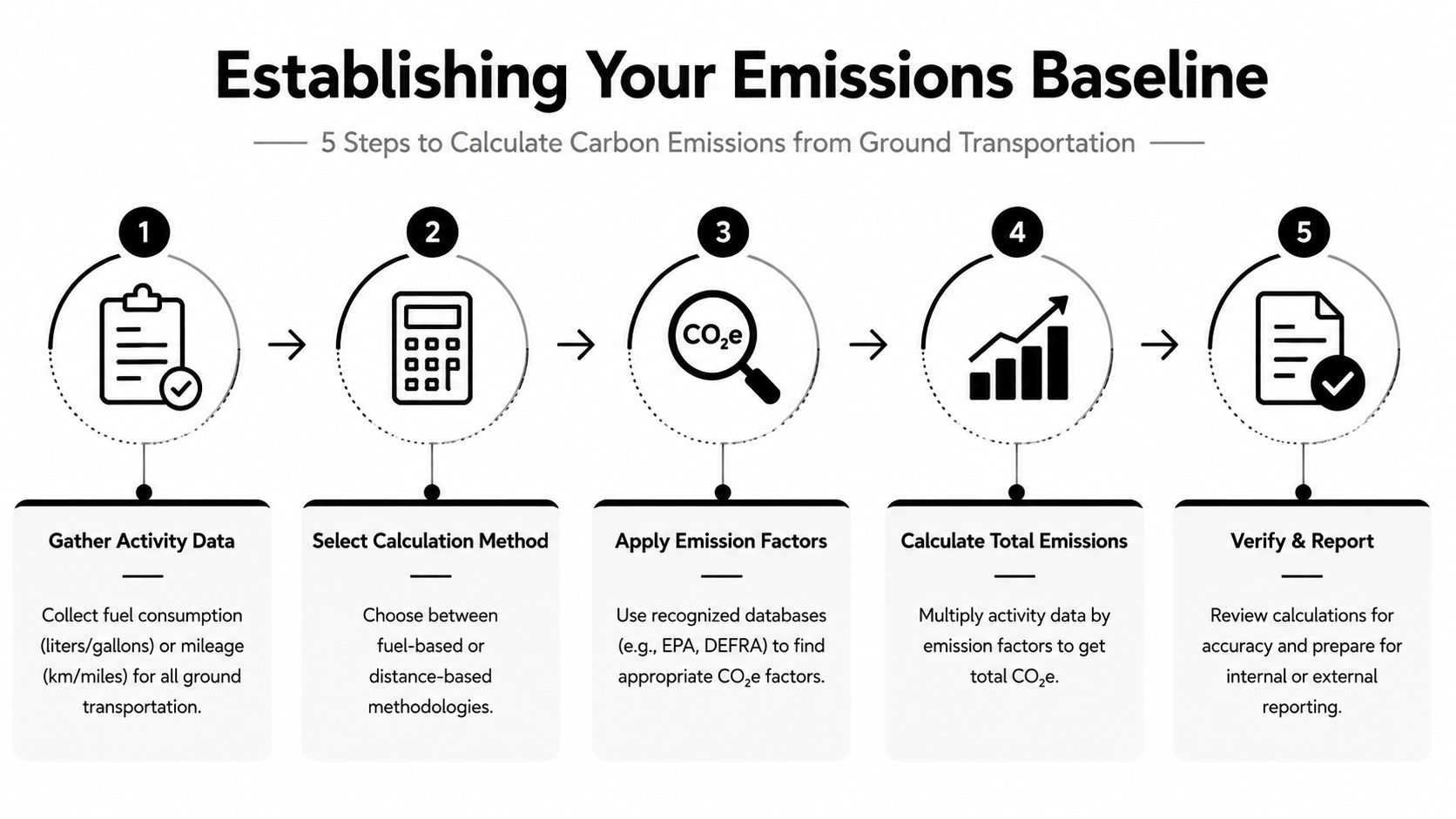
The first job is to gather fuel consumption, mileage, vehicle type, and trip volume for every channel you control. If you manage a dedicated fleet, that data usually sits in the cleanest category because usage can be traced directly. If your program depends heavily on affiliates, request the same inputs across markets, even when reporting formats differ.
The measurement workflow is direct. Define the operational boundary, collect activity data, choose a recognized emission factor, calculate CO2e, then review the result for gaps or anomalies. A baseline built this way gives you something an operations team can use, rather than a spreadsheet that looks complete but cannot support action.
Why data quality matters more than perfect software
A carbon-footprint workflow needs dependable activity data from the start. In the TNO study summary, calculator-based interventions worked better when they included intensive guidance, frequent contact, clear goal-setting, and progress reinforcement. That pattern fits emissions reporting as well. Software helps organize the work, but it cannot correct weak trip records or inconsistent vendor inputs. For teams building a practical program, sustainable travel practices for premium operations begin with disciplined data collection, not a prettier dashboard.
Don't treat the baseline as a branding exercise. Treat it like a dispatch log that has to survive scrutiny from finance, operations, and ESG teams.
For executive transport, I'd split the baseline into three buckets. Owned fleet, where fuel and mileage are under direct control. Affiliate trips, where consistency and documentation matter most. Client-specific exceptions, such as unusual routing or last-minute itinerary changes, where operational context explains outliers. That structure makes the data more useful for reduction planning and for reporting to stakeholders who expect service quality and accountability at the same time.
Use the Baseline to Identify High-Impact Areas
Once the numbers are mapped, the reduction work becomes sharper. Some programs discover that a small number of route patterns create most of the waste. Others find that certain vehicle classes are used for trips where a smaller or lower-emission model would still meet the brief. The job is to turn a broad sustainability target into a set of decisions a dispatcher, fleet manager, or affiliate lead can act on without disrupting the traveler experience.
If the data is incomplete, start there before you chase anything else. You cannot manage what you have not defined, and you cannot defend a reduction claim if the baseline rests on guesswork.
Implementing High-Impact Operational Efficiencies
The fastest wins usually come from how trips are planned, what vehicles are assigned, and how drivers behave in traffic. That matters in premium transport because executive clients notice smoothness, not just arrival time. A good efficiency program should feel invisible to the traveler and obvious to the operations team.
Vehicle selection should match the job, not the habit
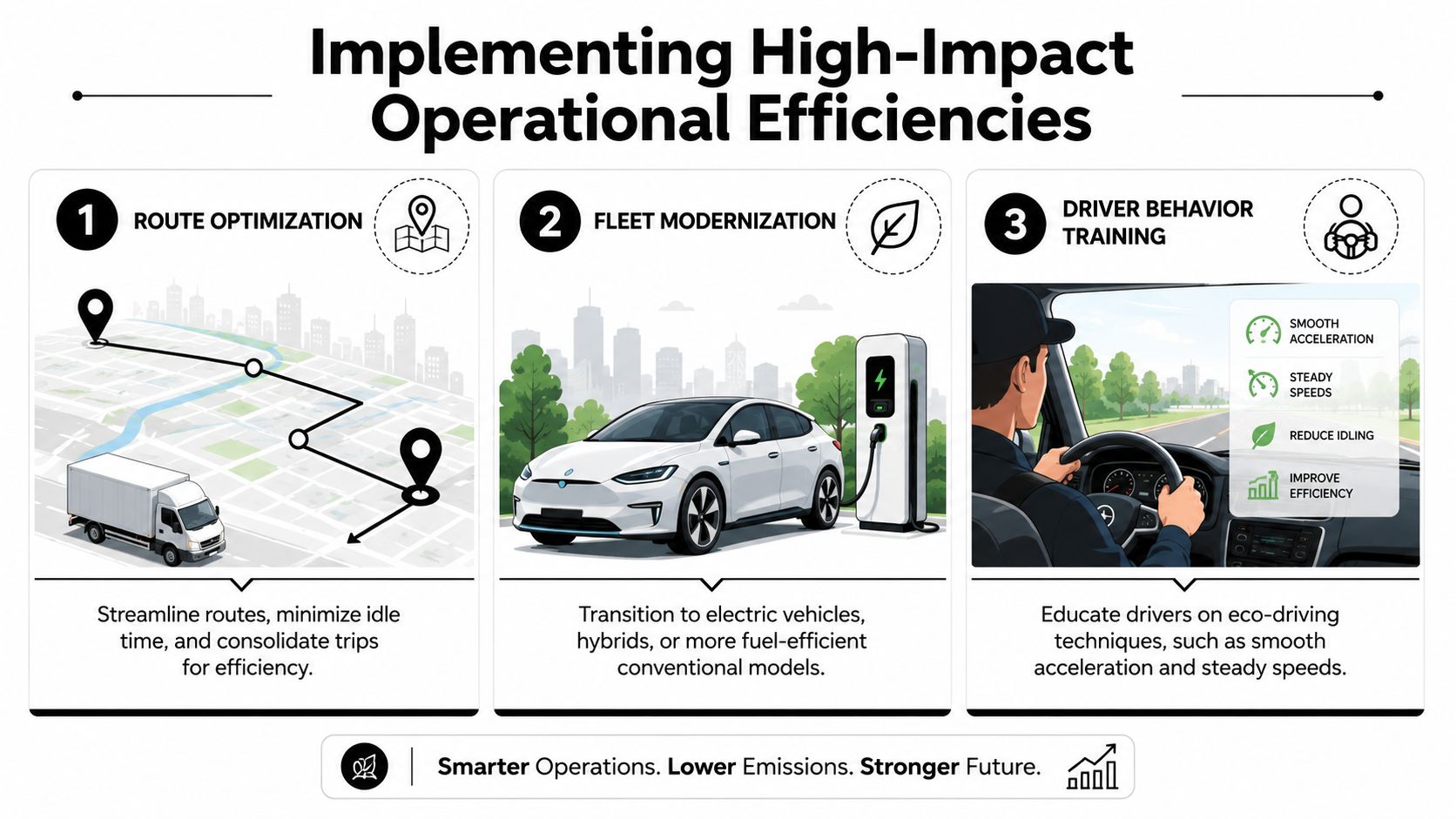
The first question isn't whether to buy EVs, hybrids, or conventional models. It's whether the vehicle assigned to each trip is fit for the route profile, charging reality, client expectations, and local infrastructure. An EV makes sense when the trip pattern is predictable and charging can be planned without risking the schedule. A hybrid can be the better bridge where range, climate, or utilization patterns still create uncertainty.
That's especially important for executive and private aviation clients, who expect consistency. If you introduce a cleaner vehicle but can't guarantee availability, cabin comfort, or baggage capacity, the service standard slips. A measured rollout works better than a symbolic one, because the most credible sustainability programs are the ones dispatch teams can run every day without improvisation.
Route optimization cuts waste before the car even moves
Route planning is one of the quietest emission levers because it reduces unnecessary mileage, congestion exposure, and avoidable idling. In practical terms, that means consolidating stops, sequencing pickups intelligently, and using traffic-aware planning rather than defaulting to the shortest map path. In airport and FBO work, the routing decision should also reflect curb access, terminal constraints, and timing windows, not just distance.
The IPCC notes that prioritizing car-free mobility and electric mobility can save about 2 tCO2-eq per person per year (IPCC AR6 WG3 Chapter 5). For high-travel users, that reinforces a simple point. The biggest gains often come from mode choice and trip design, not from small cosmetic changes.
Driver behavior still matters
Smooth acceleration, steady speeds, and less idling sound basic because they are basic. They also matter because premium service depends on calm, controlled driving anyway. Driver training works best when it's tied to live feedback, not just an annual presentation that disappears by Monday.
A chauffeur who understands the route plan and the client profile can protect both fuel use and service quality at the same time.
That link is why operations leaders should treat behavior as a managed system. Clear dispatch notes, sensible arrival buffers, and realistic routing all support lower-emission driving without asking the chauffeur to improvise under pressure. The result is cleaner execution, fewer wasted miles, and a better traveler experience.
For a broader view of how service design and sustainability connect in this sector, it helps to compare these practices with sustainable travel practices. A key takeaway is that efficiency doesn't have to look spare. In the right program, it looks polished.
Setting Sustainability Standards Across Your Global Network
A premium ground transport program is only as clean as the suppliers behind it. That reality matters in executive travel, because much of a company's footprint sits in upstream activity such as suppliers, logistics, product use, and disposal, as noted earlier. The car at the curb is only one part of the picture. The affiliate operating it matters just as much.
Build a Green Preferred Partner standard
A global network needs one shared vetting framework. Without it, sustainability claims drift from market to market, and the client experience becomes uneven. The standard should cover fleet mix, driver training, data transparency, and the ability to deliver the same service discipline your core operation promises.
Onboarding should ask for operating proof, not statements of intent. That means evidence that the partner can report vehicle types, trip activity, and emissions-related data in a format your team can use. It also means confirming that the operations team can handle last-minute changes with the same precision you expect from any high-touch executive movement. This is why we prioritize partners who invest in a modern fleet of eco-friendly vehicles.
Tie sustainability to contract language and reviews
A standard that is not written into supplier agreements usually fades. Contract terms should spell out what the affiliate must report, how often they report it, and what happens if they cannot maintain service or data quality. Performance reviews should weigh both travel quality and sustainability execution, because a partner that meets one but not the other is only partially fit for a premium program.
The broader context makes that harder to ignore. Cleaner vehicle choices already have a real place in the market, so partner fleets that can adopt lower-emission options deserve priority when service quality stays steady. That creates a practical selection rule. Choose affiliates who can show operational readiness for lower-emission vehicles and who can still deliver the standard your clients notice.
Make consistency the client promise
Executives rarely want a sustainability lecture. They want the same polished arrival in every city, with as little friction as possible. A global standard lets you say, truthfully, that the service experience stays consistent while the operating footprint gets tighter over time.
Affiliate management also becomes a brand issue. If one market is transparent, another is vague, and a third cannot report at all, the program loses credibility quickly. A disciplined network closes that gap before it reaches the client.
Communicating Value and Reporting Progress to Stakeholders
Sustainability reporting only works when a busy stakeholder can read it fast and act on it. Boards, travel buyers, and executive assistants do not want a dense technical memo. They want a clear view of what changed, what that means for the program, and whether performance is heading in the right direction.
The report should focus on decisions and outcomes, not activity counts. Show how many trips were routed through lower-emission options where service needs allowed, where the largest savings came from route consolidation, and which markets are improving data quality. If the main result takes more than one sentence to explain, the report is trying to do too much.
Translate operations into client value
The strongest sustainability reports connect environmental action to service quality. Lower mileage usually means less wasted time. Better supplier standards usually mean fewer surprises. Cleaner fleet choices, when managed well, signal that the program is current and aligned with the client's own ESG posture.
That framing matters because premium transport buyers judge risk, reputation, and reliability together. A clear report shows that sustainability is not a separate expense line. It is part of how the service protects the client's brand and operational standards.
Report only what you can defend
Precision matters. The safest metrics are the ones your baseline can support, such as CO2e by trip category, fleet mix by vehicle type, affiliate compliance with reporting requirements, and the share of journeys handled by preferred partners. Avoid claims that sound impressive but rest on loose assumptions.
The TNO study summary also reinforces a basic reporting discipline, because sustained behavior change depends on reinforcement rather than a single exposure. The same principle applies to stakeholder updates. If you report progress regularly and keep the format consistent, decision-makers are more likely to trust the trend.
Transparent reporting is not about proving perfection. It is about showing that the program is measurable, managed, and improving.
A Credible Approach to Neutralization and Offsetting
Offsets have a place, but only after the direct work is done. Too many programs start with a credit purchase because it feels easier than changing fleet, routing, or supplier behavior. That shortcut creates credibility risk, especially in a sector where clients expect disciplined execution.
Reduce first, then address the residuals
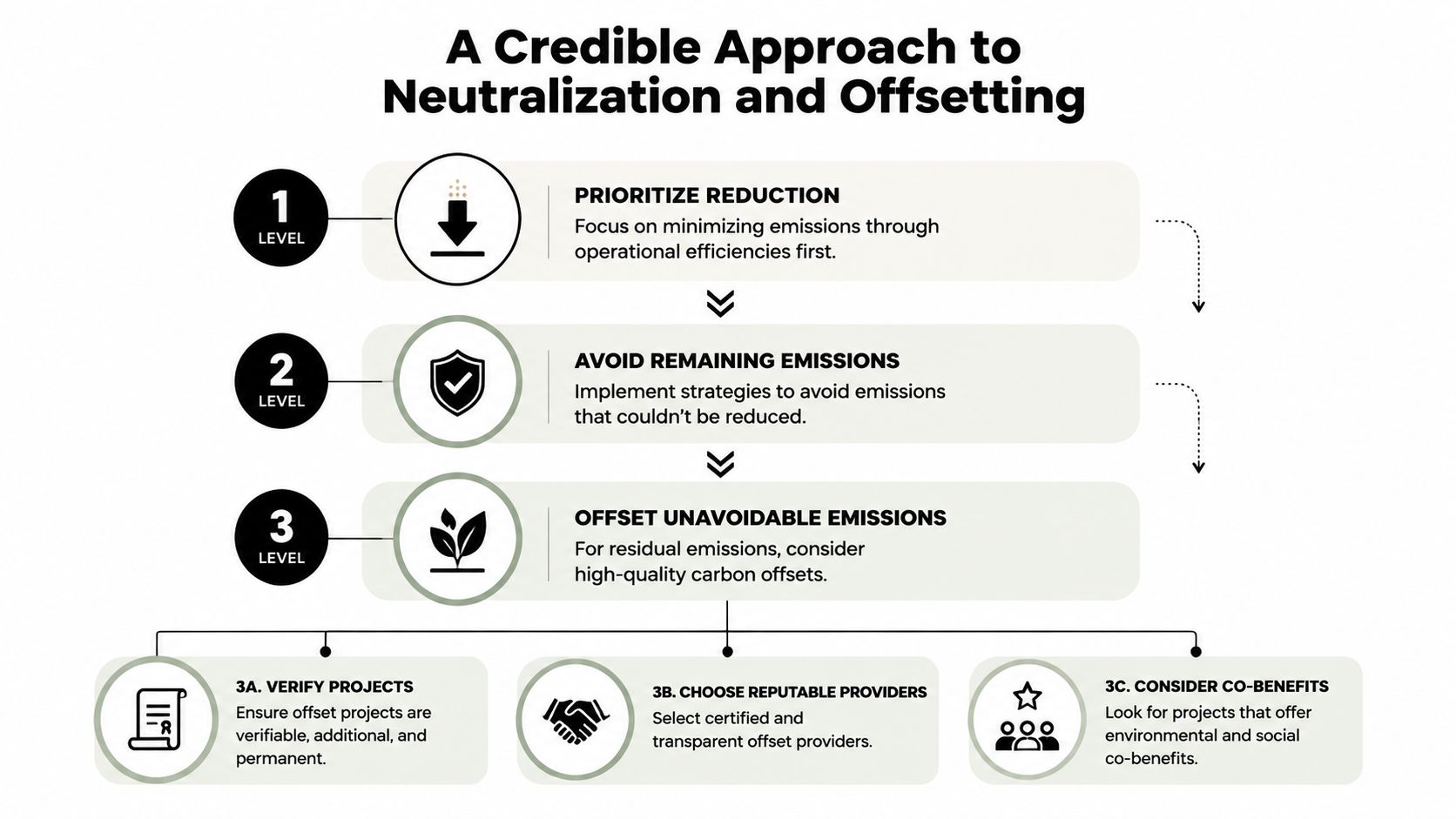
The hierarchy is simple. First, reduce what you can through cleaner vehicles, smarter dispatch, and better supplier choices. Second, avoid emissions you don't need to create in the first place. Only then should you look at neutralizing what remains.
That order matters because the offset market still has serious quality problems. A 2024 Nature Communications meta-analysis found that less than 16% of issued carbon credits in the investigated sample represented real emission reductions (Nature Communications meta-analysis). The same study found especially weak outcomes in several project types, which is a reminder that generic credit buying is not a substitute for direct action.
Vet the project, not just the certificate
If a program uses offsets, the project has to be verifiable, additional, and durable. The provider should be transparent about methodology, monitoring, and third-party validation. A vague claim of “carbon neutral” without detail is a warning sign, not a finish line.
The best fit for residual emissions is a portfolio built for scrutiny. That means asking what the project changes on the ground, how permanence is handled, and whether the claim survives if a client or auditor asks for documentation. If the answer is fuzzy, the credit isn't strong enough for a premium travel brand.
Keep the message honest
A defensible neutralization strategy says, clearly, that the organization reduced first and only used offsets for the remainder it couldn't eliminate. That wording may sound less dramatic than a blanket neutrality claim, but it's far more credible. In executive transport, credibility is the authentic luxury signal.
If you're building a sustainable ground transport program and want service quality to stay as high as your ESG standards, MLR Worldwide Service can help you design a premium operation around reliable routing, vetted affiliates, and executive-ready execution. Visit MLR Worldwide Service to explore how a disciplined chauffeur program can support your carbon footprint reduction goals without compromising the traveler experience.