
Your executive lands late. The terminal is crowded, baggage is slow, the rideshare pickup zone has moved again, and the driver assigned in the app still isn't at the curb. Meanwhile, your traveler has a board dinner in less than an hour, a confidential call to take, and no patience for airport guesswork.
That isn't a transportation problem. It's an operations failure.
Corporate travel managers often treat airport moves as a commodity purchase. That's the mistake. For a senior executive, investor, board member, legal team, or VIP client, the airport arrival is a controlled handoff between two risk environments. If that handoff is sloppy, you lose time, visibility, privacy, and credibility in one shot.
A proper airport transfer service isn't just a car booking. It's a managed service built around schedule protection, duty of care, and time certainty.
Beyond the Curb A New Standard for Arrivals
The failure point is rarely the flight. It is the first ten minutes after arrival.
Your traveler lands, clears the gate area, and enters a messy handoff with too many variables and no clear owner. Pickup rules change by terminal. Traffic officers redirect vehicles. Baggage delays break timing. A driver who knows the city may still know nothing about that airport's current commercial vehicle procedures. For a corporate travel manager, that is not a minor inconvenience. It is exposure.
A managed arrival removes that exposure before the passenger reaches the curb. The itinerary is set in advance. Flight progress is monitored. Pickup instructions match the terminal and the airport's operating rules. The chauffeur has the traveler details, destination, and escalation contacts. If plans shift, operations adjusts the movement instead of pushing the problem onto the passenger. If you need a broader framework for this category, review this explanation of what ground transportation includes in a managed travel program.
That is the standard corporate teams should use.
Price-only booking ignores the true cost of failure. A missed lender meeting, a delayed legal filing, an exposed VIP, or an executive stranded in a public pickup zone costs more than the fare difference between an app ride and a properly managed service. The service succeeds when the traveler moves from aircraft to destination with time certainty, privacy, and continuous visibility.
Operational truth: A smooth arrival is built before wheels-down.
What corporate teams should stop accepting
Too many corporate travel programs still allow avoidable weakness at arrival:
- Reactive booking: Ground transport is arranged after landing, when options are limited and the traveler is already absorbing delay.
- Unclear ownership: No dispatcher, coordinator, or service desk is accountable for execution when conditions change.
- Commodity procurement: The decision is based on ride price instead of schedule risk, privacy requirements, and duty of care.
- Weak arrival control: Pickup points are vague, terminal procedures are not validated, and there is no escalation path for disruptions.
That standard may pass for casual travel. It fails executive travel.
Defining the Modern Airport Transfer Service
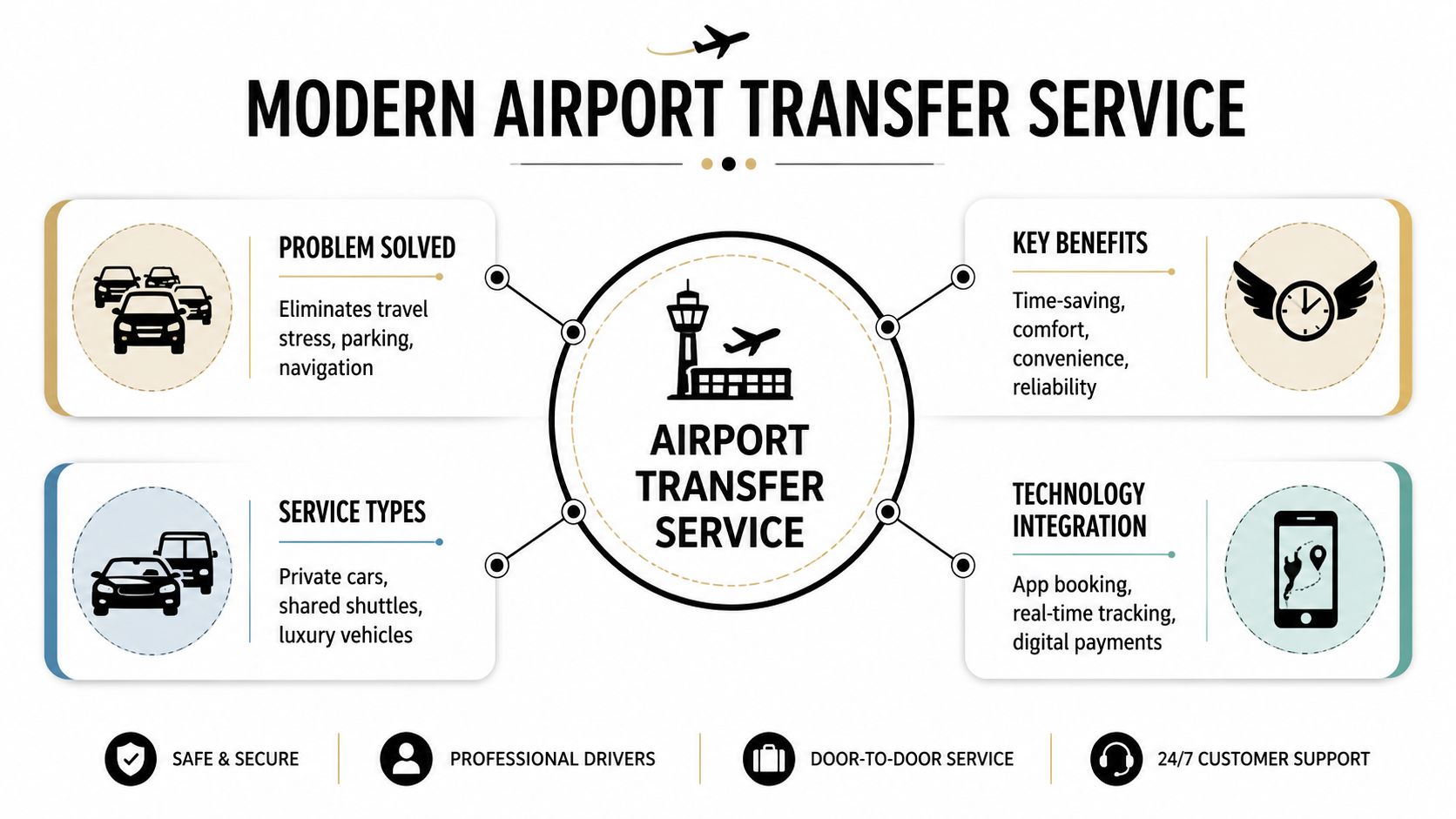
A modern airport transfer service is a managed logistical service for moving a traveler between the airport and a destination with prearranged controls around timing, routing, vehicle assignment, and traveler handling.
A ride is a vehicle request. A managed service is an operational plan.
That's the cleanest way to understand the distinction. If you book ad hoc transport, you're buying availability in the moment. If you book an airport transfer service, you're buying planning, accountability, and execution before the traveler reaches the curb.
What makes it a service instead of a ride
The core elements are straightforward:
- Pre-booked itinerary: The trip is scheduled in advance against a known flight and destination.
- Fixed-price structure: The traveler and booking party know the commercial terms before arrival.
- Assigned vehicle class: Sedan, SUV, van, or specialist vehicle is matched to the traveler profile and luggage load.
- Named service responsibility: A provider, dispatcher, or operations desk owns execution.
Corporate buyers should think of it the same way they think about managed air, hotel, or security support. The value isn't the commodity itself. The value is control.
Ground transportation planning for corporate itineraries matters for exactly this reason. Airport movement sits inside a broader chain of obligations, meetings, and handoffs. If one link is unmanaged, the whole day becomes fragile.
The service architecture that matters for business travel
Corporate airport transfers are commonly segmented into private vehicles, shared shuttles, and executive chauffeur services. Dedicated private transfers provide direct routing, clearer control over baggage, waiting-time allowances, and duty-of-care requirements. They're materially better suited to SLA-driven travel because the vehicle, driver, and price are confirmed before arrival, as outlined in Navan's airport transfer overview.
That last point is the one most buyers underestimate. Confirmation before arrival changes the entire risk profile. It reduces uncertainty at the exact moment when the traveler is least able to troubleshoot.
My recommendation
Use this rule. If the passenger's schedule, profile, or role makes delay costly, book a managed private transfer. Don't hand the problem to the traveler at the curb.
Shared and ad hoc options still have a place. They just don't belong in movements where confidentiality, punctuality, or executive readiness matters.
Exploring the Types of Airport Transfers
Not every airport transfer service should be sold or bought the same way. Travel managers who lump every trip into one category usually overspend in the wrong places and underprotect the movements that matter.
The right question isn't “What's the cheapest ride from the airport?” The right question is “What level of control does this traveler need on this movement?”
Shared shuttle
Shared shuttles exist for one reason. Cost spreading.
They can work for large event blocks, non-urgent staff movements, or predictable hotel routes where timing flexibility is acceptable. They are not a strong fit for executives, legal principals, investor relations teams, or anyone traveling with strict appointment windows.
The problem is structural. Shared service trades certainty for efficiency. More passengers mean more stops, less routing control, and weaker schedule protection.
Private car service
This is the baseline for serious corporate travel.
A private car service gives the traveler a dedicated vehicle on a prearranged route. That creates tighter control over luggage handling, pickup timing, and arrival sequence. For airport-to-hotel, airport-to-office, and airport-to-residence moves, this is usually the right default if the traveler's day matters.
Private service is also easier to manage operationally. One passenger, one itinerary, one accountable vendor.
If your traveler has to be somewhere at a specific time, stop treating the airport exit like a casual consumer transaction.
Executive chauffeur service
Executive chauffeur service takes the private model and adds a higher standard of driver presentation, discretion, airport handling, and traveler support.
This is the category for board members, C-suite leaders, VIP guests, confidential visitors, and situations where the arrival experience reflects directly on your company. It's also the right fit when the passenger needs a quiet cabin, professional meet-and-greet handling, or a low-profile transfer.
This isn't about vanity. It's about reliability, representation, and reduced friction for high-value travelers.
Specialist movements
Two categories deserve separate treatment because they're operationally different.
First, FBO and private aviation support. These movements often require precise air-to-ground coordination, tarmac-adjacent procedures depending on facility rules, and drivers who understand private terminal workflow.
Second, airline crew and structured group movements. These require dispatch discipline, repeatable SOPs, and tighter manifest control than consumer airport transport. The operating logic is more like crew logistics than passenger rides.
Comparison of Airport Transfer Service Types
| Service Type | Best For | Privacy Level | Cost Model | Typical Vehicle |
|---|---|---|---|---|
| Shared Shuttle | Non-urgent staff travel, event blocks, hotel loops | Low | Per passenger or shared booking | Shuttle van or minibus |
| Private Car Service | Business travelers with fixed schedules | Medium to high | Pre-booked point-to-point rate | Executive sedan or SUV |
| Executive Chauffeur Service | C-suite, VIPs, client pickups, confidential travel | High | Pre-booked premium service rate | Luxury sedan, premium SUV |
| FBO or Specialist Transfer | Private aviation, crew movements, secure or complex handoffs | High | Custom operational booking | Sedan, SUV, van, specialty vehicle |
Matching service to traveler
Use traveler profile, not corporate habit.
- Choose shared when price discipline matters more than schedule precision.
- Choose private car when the passenger has meetings, luggage, and no room for ad hoc delays.
- Choose chauffeur service when visibility, discretion, and executive readiness are part of the assignment.
- Choose specialist support when the airport environment itself is unusual, controlled, or operationally sensitive.
Most travel teams don't need one airport transport product. They need a selection model.
Decoding Service Features for Executive Travel
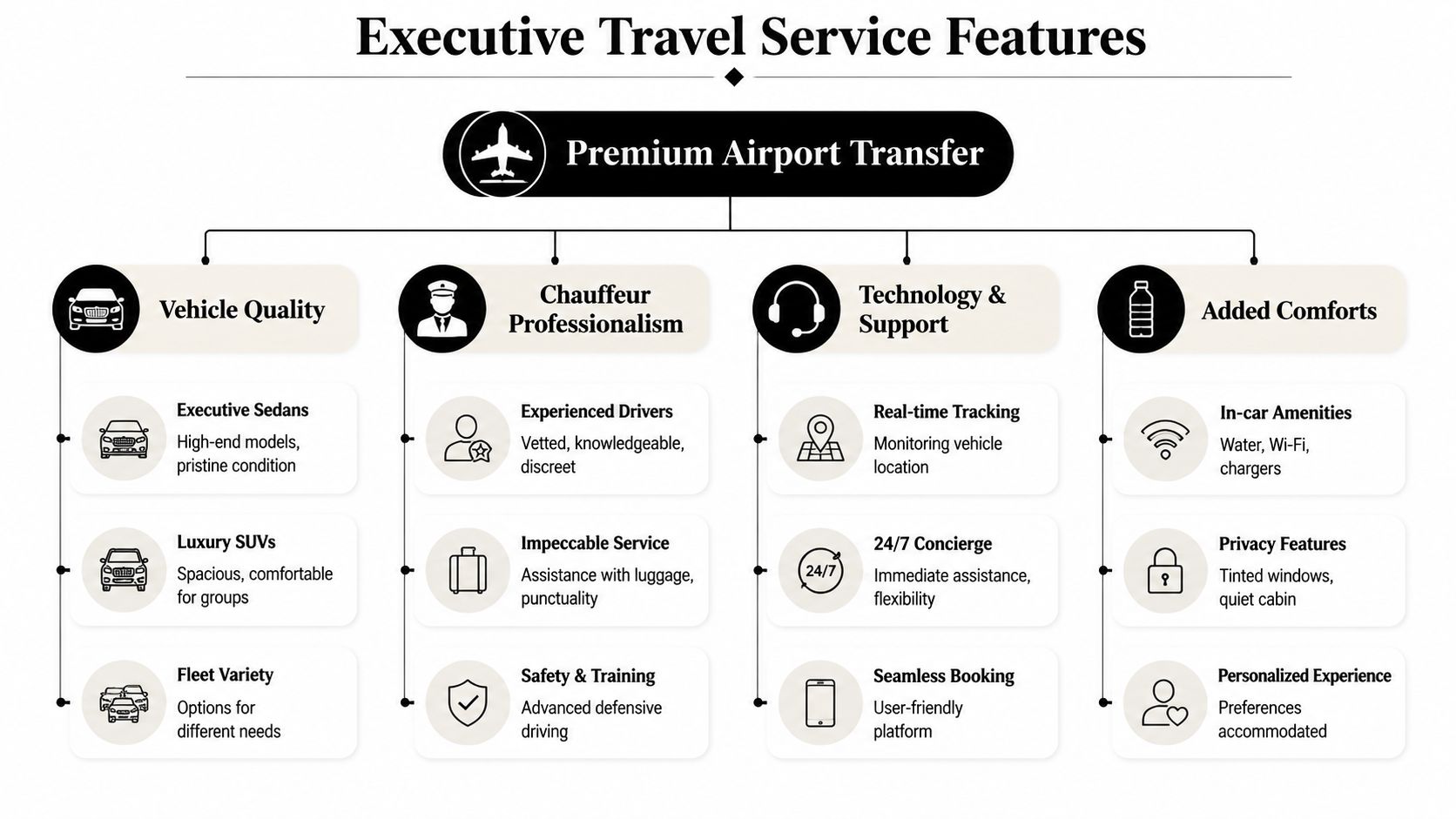
A premium airport transfer service isn't defined by leather seats or bottled water. Those are amenities. They're not the core product.
The actual product is controlled execution under variable conditions.
Flight tracking is non-negotiable
Airport transfer operations work best when flight data is treated as a live control input. Systems that sync bookings with airline schedules can automatically recalibrate pickup windows for delays and terminal changes, dynamically replanning dispatch to improve punctuality, as described in FATbit's guide to airport transfer app operations.
That's the difference between a car waiting because someone guessed, and a car waiting because the operation is actively managed.
For executive travel, live flight synchronization should be standard. If a provider can't explain how they handle early arrivals, delays, and terminal changes, they aren't selling a managed service.
Meet and greet changes the risk profile
Meet and greet isn't ceremonial. It reduces traveler friction at the most chaotic point of the trip.
A competent meet-and-greet process does four things well:
- Identifies the traveler quickly
- Eliminates confusion around pickup location
- Speeds the handoff from terminal to vehicle
- Protects the traveler from wandering through public pickup chaos
That matters more for first-time visitors, late-night arrivals, language barriers, high-profile passengers, and anyone arriving under time pressure.
Chauffeur quality is part of duty of care
The driver is not just a driver in executive travel. The chauffeur is the frontline operator in a controlled movement.
Look for providers that can explain:
- How chauffeurs are vetted
- What service training they receive
- How they handle discretion and client confidentiality
- What happens when the original assigned chauffeur becomes unavailable
If the answer is vague, reject the provider.
For buyers comparing options in the premium end of the market, luxury airport car service standards are useful because they force the conversation beyond vehicle photos and into service mechanics.
My rule for executive travel: Buy the operations model first. Buy the vehicle second.
Vehicle standards still matter
The vehicle doesn't create the service, but it does protect the traveler's readiness.
Poor vehicle matching causes avoidable failures. Too little luggage space, difficult ingress for older passengers, weak rear-cabin privacy, or poor maintenance discipline all show up at the wrong moment. Match vehicle class to purpose, not image.
For example, an executive sedan may be ideal for one traveler with light luggage and a tight city transfer. A premium SUV may be the smarter choice for winter conditions, multiple bags, or a two-person executive movement.
How to Choose Your Airport Transfer Partner
A traveler lands at 11:40 p.m. in a secondary market after two delays, with a board meeting at 8:00 a.m. and no room for drift. That handoff is not a ride request. It is an operating event with exposure attached.

Choose the provider that treats airport transfers as managed ground logistics. Generic car services sell vehicle access. A real transfer partner controls the handoff, monitors the movement, and fixes problems before the traveler feels them. That distinction matters most for executives, VIP guests, legal teams, and anyone moving on a fixed timetable.
Questions that expose weak providers
Start with control, accountability, and response time.
Ask these questions:
- Who owns the trip in real time? You want a live operations team with authority to intervene.
- How are flight disruptions handled? Look for active monitoring, reassignment procedures, and traveler communication standards.
- What is your pickup protocol for low-profile or no-contact arrivals? Sensitive travelers need a defined method, not improvisation.
- How do you manage affiliate cities? Coverage only matters if service rules, reporting, and escalation are standardized.
- What happens after hours? Late-night cancellations, missed connections, and baggage delays are routine. Support has to be available when the airport fails.
Weak providers answer with app features, vague availability, and generic promises. Strong providers describe the exact workflow.
Evaluate for consistency across markets
Corporate travel managers do not need broad coverage on paper. They need the same operating standard in every city where risk exists.
Check for consistency in:
- Dispatch control and escalation
- Arrival and meet-and-greet procedure
- Communication timing and format
- Service recovery when a chauffeur or vehicle changes
- Post-trip reporting and billing accuracy
This is part of the corporate travel manager's role in controlling airport handoffs and traveler risk. If the provider cannot show a repeatable process across markets, you are not buying a managed service. You are buying uncertainty at scale.
Don't ignore privacy and billing discipline
Data handling is an operations issue. Passenger names, itineraries, hotel details, and meeting locations should not pass through loose texting chains or unmanaged subcontractors.
Billing discipline matters for the same reason. Centralized invoicing, clear trip references, and rate transparency reduce reconciliation time and expose service failures quickly. If your team has to chase receipts, verify wait time manually, or rebuild movement history after every airport run, the provider is shifting administrative risk back onto your staff.
A Travel Manager Checklist for Seamless Logistics
Travel managers don't need another generic booking tip sheet. They need a repeatable control list that works under pressure.
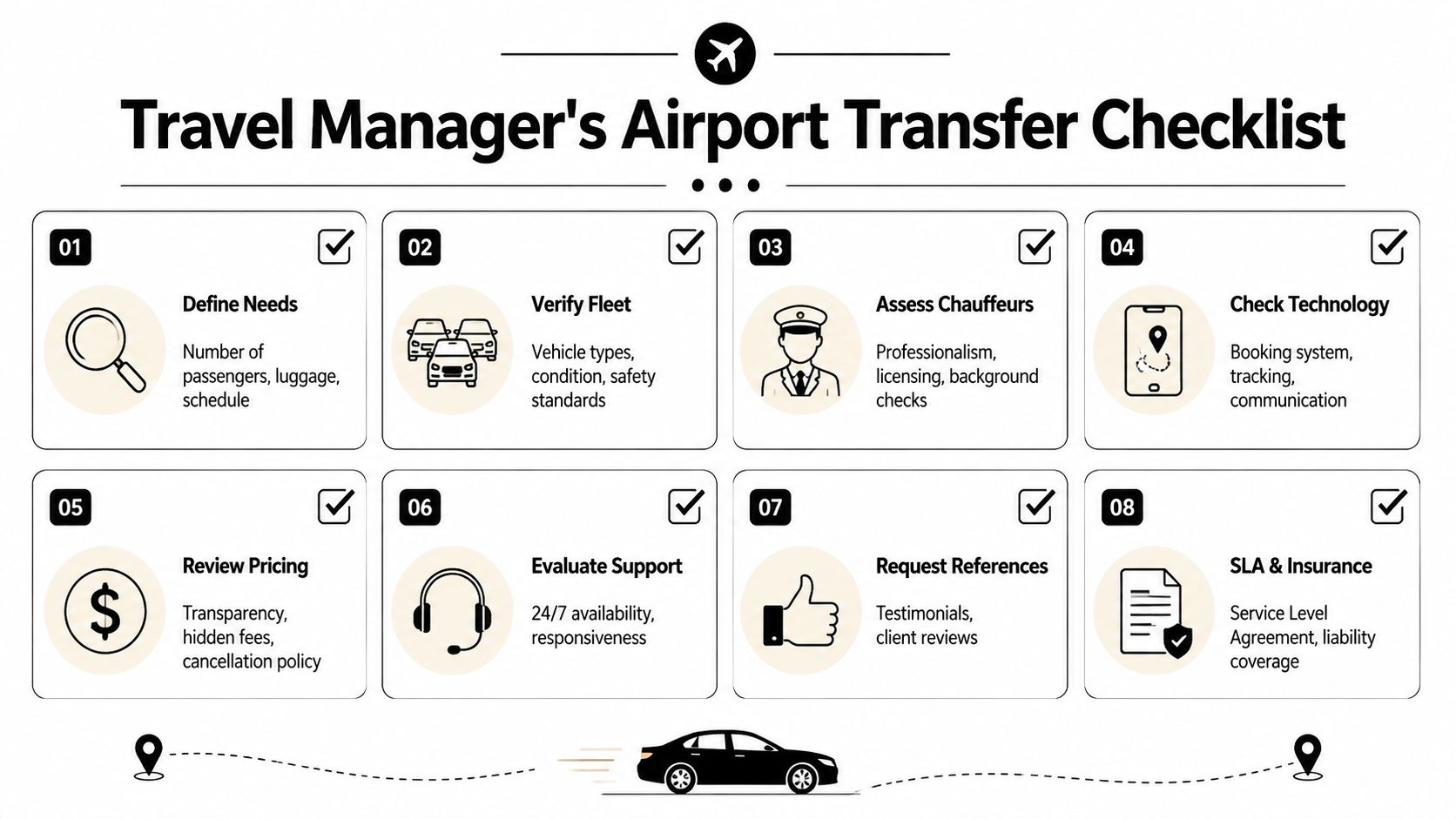
Use this checklist before every executive airport movement.
Before you book
- Confirm the traveler profile: Executive, VIP guest, group, legal, finance, or general staff. Service level should follow exposure.
- Collect the full air itinerary: Flight number, arrival airport, terminal details if known, and final destination.
- Assess physical requirements: Luggage count, oversized items, child seat needs, accessibility needs, or medical equipment.
- Decide the handoff style: Curb pickup, meet and greet, or FBO coordination.
This is also where your role becomes operational, not administrative. If your team owns traveler experience, then the scope of a corporate travel manager's responsibilities absolutely includes controlling the airport handoff.
At booking
A prearranged chauffeur with meet-and-greet may add 15 minutes to the process, while still offering a low wait time of 10 to 15 minutes after baggage claim, according to AGT's airport meet-and-greet guidance. For business travelers, that's often the better trade because it avoids the time lost navigating congested pickup zones.
Include these instructions in every booking:
- Passenger mobile number and assistant contact
- Exact destination and any stop sequence
- Pickup signage name if meet and greet is required
- Language or communication notes
- Waiting-time expectations
- Billing code or cost center
After booking
Use a simple confirmation protocol.
- Send the traveler the pickup instructions
- Confirm who they contact on arrival
- Verify any schedule changes the day before travel
- Keep the provider updated if the itinerary shifts
Good airport transfers don't depend on traveler improvisation. They depend on clean instructions, early coordination, and one owner of the movement.
Day-of-travel control points
Don't wait for a problem to discover the process.
Check:
- Has the flight been monitored?
- Has the chauffeur been assigned?
- Does the traveler have the correct contact details?
- Is there a backup communication path if the traveler's phone fails?
If a provider can't support those basics consistently, replace them.
Frequently Asked Questions for Executive Support Staff
How should we handle last-minute flight changes or cancellations
Use a provider with live operations support and update the booking as soon as the itinerary changes. Don't assume the app or system will catch every revision instantly. For high-value travelers, your team should confirm that the new flight, terminal, and arrival timing are acknowledged by a human operations contact.
What's different about transfers from a private airport or FBO
FBO transfers require tighter coordination with the private terminal environment. Confirm the exact facility, aircraft timing, passenger handling rules, and approved pickup procedure. Don't book these like standard commercial arrivals.
How do we judge service quality across a global affiliate network
Ask for the quality-control method, not the city list. You want to know who vets affiliates, how service standards are enforced, and what escalation path exists when a local operator misses the mark. Coverage without control is just outsourced inconsistency.
What should we do for a traveler with mobility or medical needs
Treat this as a door-to-door assistance question, not a simple vehicle request. Accessible airport transfer is often underserved. A professional service can and should coordinate assistance from the curb to check-in and from baggage claim to the vehicle, as noted by Angel Flight West's guidance on ground transportation for medical travel. Clarify the need at booking, including wheelchair support, extra boarding time, escort handling, and equipment requirements.
When should we choose chauffeur meet and greet instead of a standard pickup
Choose it when the traveler is senior, unfamiliar with the airport, arriving late, carrying significant luggage, traveling internationally, or expected somewhere immediately. In those cases, the added control is worth more than the minor extra process time.
If your travelers can't afford confusion at the curb, build airport movements as managed operations, not casual rides. MLR Worldwide Service supports executive airport transfers, FBO handoffs, VIP chauffeur service, crew movements, and global coordination for travel teams that need punctuality, discretion, and a clear chain of responsibility.