
A chief of staff is tracking a landing time that keeps slipping by minutes. An executive assistant has added an unscheduled stop. The client wants a quiet route, not the most obvious one. Traffic is building between the airport, the hotel, and a board meeting that can't start late. In executive transport, that isn't a difficult day. It's a normal one.
Real time route optimization shifts from being a logistics buzzword to becoming part of the service itself. A consumer navigation app can suggest a path from point A to point B. That's useful, but it isn't enough when the traveler is stepping off a private flight, moving through a compressed schedule, and expecting every handoff to feel effortless.
At the executive level, the route is only one piece of the decision. Operations teams also have to weigh pickup timing, aircraft movement, chauffeur positioning, local congestion, service windows at each stop, vehicle readiness, and how itinerary changes affect the rest of the day. The best systems do more than react after a delay appears. They help the team stay ahead of it.
Beyond the Map The New Standard in Punctuality
A roadshow exposes weak operations fast. One executive arrives on a morning flight, heads to a breakfast meeting, moves to two investor sessions, changes venues late in the afternoon, then needs a precise airport return with no wasted motion. On paper, that can look manageable. In practice, every segment is vulnerable to disruption.
A static route plan fails because the day never stays static. Flight timing shifts. Building access takes longer than expected. A downtown corridor locks up because of an event. A principal decides to extend one meeting and shorten another. If dispatch only planned the morning once and hoped the rest would hold, the service is already behind.
A premium trip is managed, not merely driven
In executive transportation, punctuality isn't about taking the shortest route on a map. It's about preserving the client's schedule when conditions change underneath it. That requires a system that keeps evaluating the trip as a live operation, not as a finished plan.
Three differences separate premium routing from ordinary navigation:
- Timing has to be protected across the full itinerary. A chauffeur can't optimize one leg in isolation if that choice creates risk for the next stop.
- Context matters as much as distance. A route that's technically faster may be the wrong choice if curb access is poor, security is tighter, or passenger comfort suffers.
- Reassignment needs to stay invisible to the client. When schedules shift, the operations team should absorb the complexity without creating friction for the traveler.
The client shouldn't feel the optimization. They should feel that everything simply ran on time.
That's the new standard. Not a car arriving eventually. Not a driver following directions well. A coordinated operation that protects the traveler's time, privacy, and confidence from first pickup through final drop-off.
Why this matters more at the top end of the market
For parcel delivery, a delay is often an inconvenience. For executive travel, a delay can mean a missed board presentation, a missed slot at an FBO, or a visible failure in front of stakeholders. The cost isn't just operational. It's reputational.
That's why serious operators treat routing as a live control discipline. The map still matters. It just isn't the whole job anymore.
Understanding Real Time Route Optimization
A static GPS route works like a printed itinerary. It tells the driver what looked best at one moment, based on the information available then. If conditions change, the route often changes late, inconsistently, or not at all. That's fine for casual travel. It's weak for managed transport.
Real time route optimization works more like ground-side air traffic control. Instead of trusting a single plan, the system keeps checking what's happening now and recalculates based on current conditions. The objective isn't merely the shortest path. It's the most reliable path given live traffic, stop timing, service constraints, and downstream commitments.
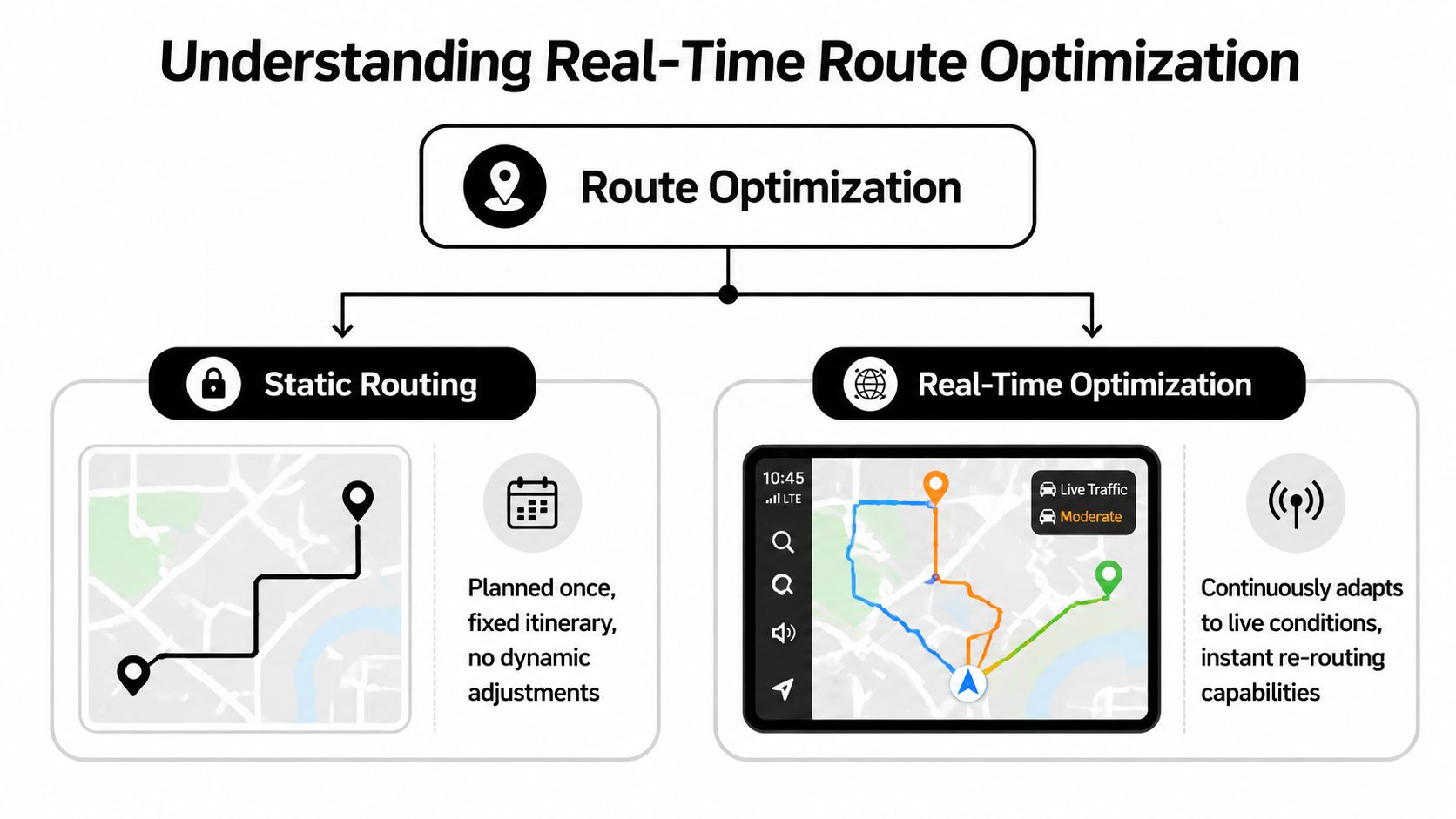
Static routing versus dynamic control
The difference becomes clear when you compare how each model behaves under pressure.
| Approach | How it works | What breaks |
|---|---|---|
| Static routing | Plans once, then largely follows the original itinerary | Delays compound when traffic, access, or schedule changes occur |
| Real time optimization | Continuously updates route and timing decisions using live inputs | Requires strong systems integration and disciplined dispatch oversight |
The technology matters because manual dispatch can only process so much information at once. According to FleetRabbit's analysis of AI route optimization versus traditional methods, AI algorithms reduce route planning time by 75-85% compared to manual dispatching and improve ETA accuracy by 23-40% over traditional static methods. For an operations team, that means decisions that used to take hours of sequencing and adjustment can be handled in minutes or seconds.
What the system is actually optimizing
A common mistake is to assume optimization means “pick the fastest road.” In practice, the system is balancing several goals at the same time:
- Time reliability: Not just expected arrival, but confidence in that arrival.
- Operational efficiency: Positioning the right vehicle and chauffeur without creating unnecessary deadhead movement.
- Predictability: Giving dispatch, assistants, and travelers an ETA that holds up under changing conditions.
- Service quality: Avoiding choices that create awkward pickups, poor passenger experience, or preventable stress.
Practical rule: If your routing tool only tells the driver where to turn, you don't have real time route optimization. You have navigation.
That distinction matters. Navigation supports the driver. Optimization supports the entire operation.
The High-Stakes Advantage in Executive Travel
Standard route optimization was built around moving goods at scale. Executive transport moves people whose time is unusually expensive, highly scheduled, and often inflexible. The same software logic doesn't always transfer cleanly.
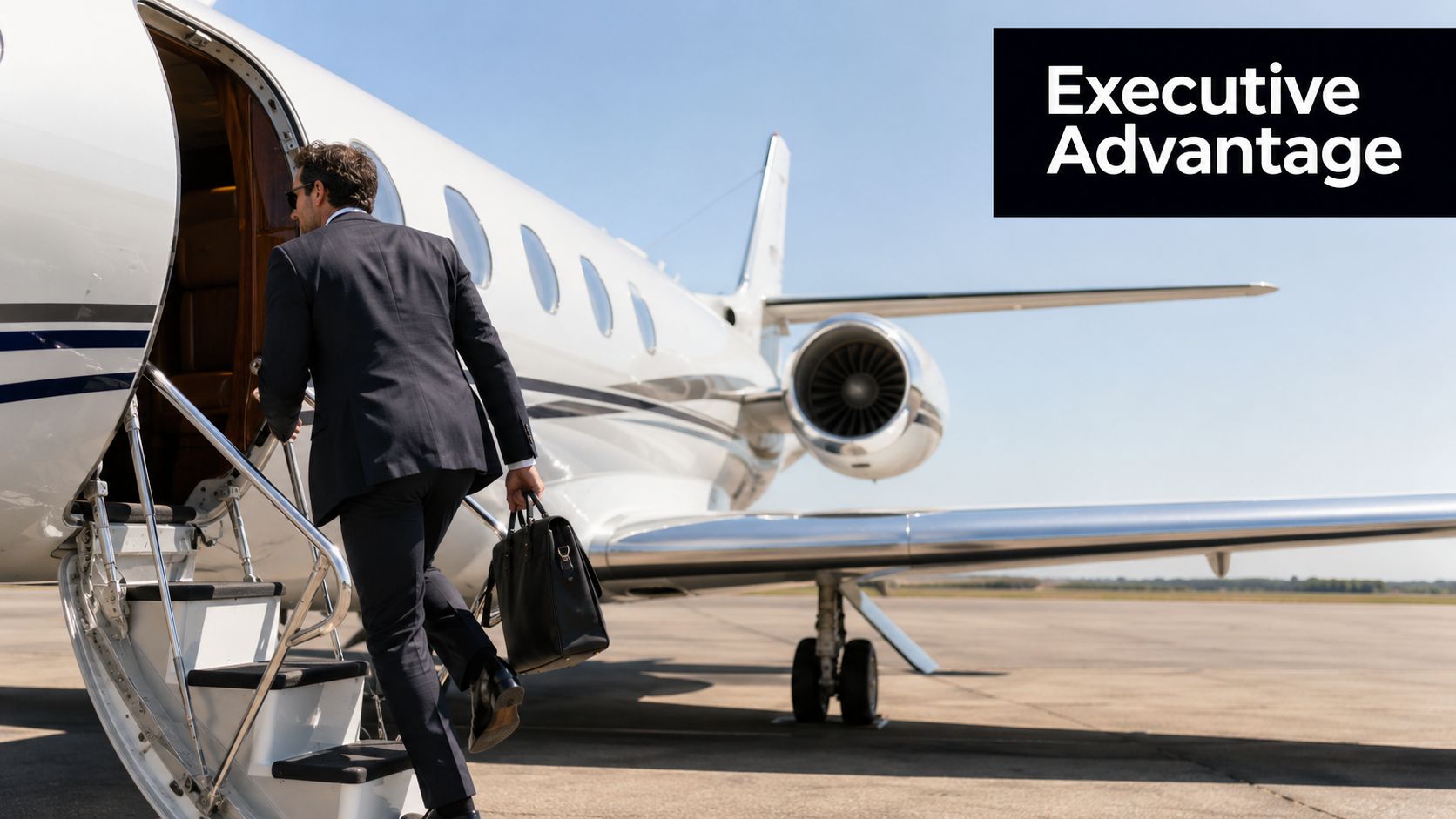
A parcel can wait on a porch. A senior executive cannot wait at the curb while dispatch decides whether the aircraft landed early, whether the original pickup point is still viable, or whether the next meeting should trigger a chauffeur reposition. In this segment, reliability is the product.
Why generic logistics logic falls short
Executive travel introduces variables that many delivery-focused systems don't treat as primary.
- Flight-linked timing: The route has to align with live aviation movement, not just scheduled arrival times.
- Pre-assigned service: Chauffeurs are often assigned well before pickup, which creates a different planning problem than “send the nearest available unit.”
- Discretion requirements: Some clients request quiet arrival patterns, lower-profile access points, or route choices that reduce visibility.
- Schedule sensitivity: One small delay can damage an entire chain of appointments.
That last point is the one buyers feel most sharply. A late restaurant reservation is frustrating. A late arrival to a confidential deal meeting can affect the day's outcome.
According to Carto's discussion of last-mile transportation route optimization, most content misses the gap between predictive demand forecasting and real-time re-optimization in high-value passenger logistics, where riders are pre-assigned hours in advance despite changing traffic. That nuance is central in VIP ground transportation.
Predictive assignment changes the operating model
The best executive operations teams don't wait for the trip to begin before making smart positioning decisions. They anticipate where pressure will appear and position assets accordingly. That's especially important around airports, FBOs, major hotels, event venues, and financial districts where timing windows can tighten quickly.
This is worth seeing in motion:
A VIP service model usually needs both of these capabilities working together:
- Predictive assignment before the pickup so the right chauffeur and vehicle are already in the right zone.
- Real-time re-optimization during the trip so the schedule stays intact when conditions shift.
The failure point in executive transport usually isn't the drive itself. It's the handoff between what was planned earlier and what reality looks like now.
That's why basic ride-hailing logic often disappoints premium clients. It reacts. Executive transport has to anticipate.
The Data Driving Flawless Execution
Good routing decisions come from good data. In executive transport, that means the system can't rely on one feed, one map layer, or one dispatch screen. It has to combine multiple live inputs and interpret them in context.
The core data layers are usually straightforward to name, but difficult to orchestrate well. Vehicle telemetry tells the team where each car is and whether it's moving as expected. Commercial traffic feeds show congestion, closures, and route degradation. Aviation data helps airport and FBO teams align pickups to actual movement. Booking and itinerary systems add the client's true service requirements, not just an address pair.
The inputs that matter most
Each data source answers a different operational question.
| Data layer | What it tells the team | Why it matters |
|---|---|---|
| Vehicle telematics | Current position, movement, and status | Confirms whether execution matches plan |
| Traffic and road feeds | Congestion, closures, disruptions | Prevents avoidable delays and poor route choices |
| Flight information | Updated arrival and departure movement | Keeps airport pickups aligned to reality |
| Client itinerary data | Stops, service windows, preferences | Protects the experience, not just the trip time |
| Weather and local events | External conditions affecting movement | Helps dispatch anticipate friction before it hits |
No single input is enough on its own. Traffic data might show a delay, but without itinerary context the system can't judge whether that delay threatens a meeting, an aircraft connection, or a timed venue arrival. Flight data might show an early arrival, but without chauffeur status the platform can't tell whether the pickup remains viable.
Why synthesis matters more than raw information
The operational advantage comes from combining these signals quickly enough to act on them. Nuvizz's analysis of real-time route planning notes that dynamic planning can cut fuel waste and avoid missed connections by up to 25% by adapting to live conditions instead of following static routes.
For executive travel, the “missed connections” idea is broader than a transfer window. It includes the handoff between runway and curb, curb and meeting, hotel and event, or venue and return flight. Every successful transfer depends on timing confidence.
Consider what a strong platform should be able to do in seconds:
- Detect route risk early: A slowdown ahead matters more when a client has a hard arrival window.
- Recommend a better approach: Sometimes the best answer isn't a full reroute. It's a different access point or altered staging plan.
- Update dispatch and chauffeur together: A recommendation is useless if the team and driver aren't working from the same live picture.
Better executive transport doesn't come from more alerts. It comes from fewer surprises.
That's the difference between data collection and operational control.
Integrating Technology for a Seamless Service
An optimal trip doesn't run on one platform alone. It runs on the quality of connection between booking, dispatch, telematics, navigation, and external data feeds. If those systems operate in silos, the team spends its day reconciling conflicting information instead of serving the traveler.
The strongest service environments build a single operating picture. The booking record defines who is traveling, when, where, and under what constraints. Dispatch software turns that into an assignment plan. Telematics validates execution in the field. External traffic, weather, and aviation feeds keep the plan current. The optimization engine sits in the middle and keeps those inputs aligned.
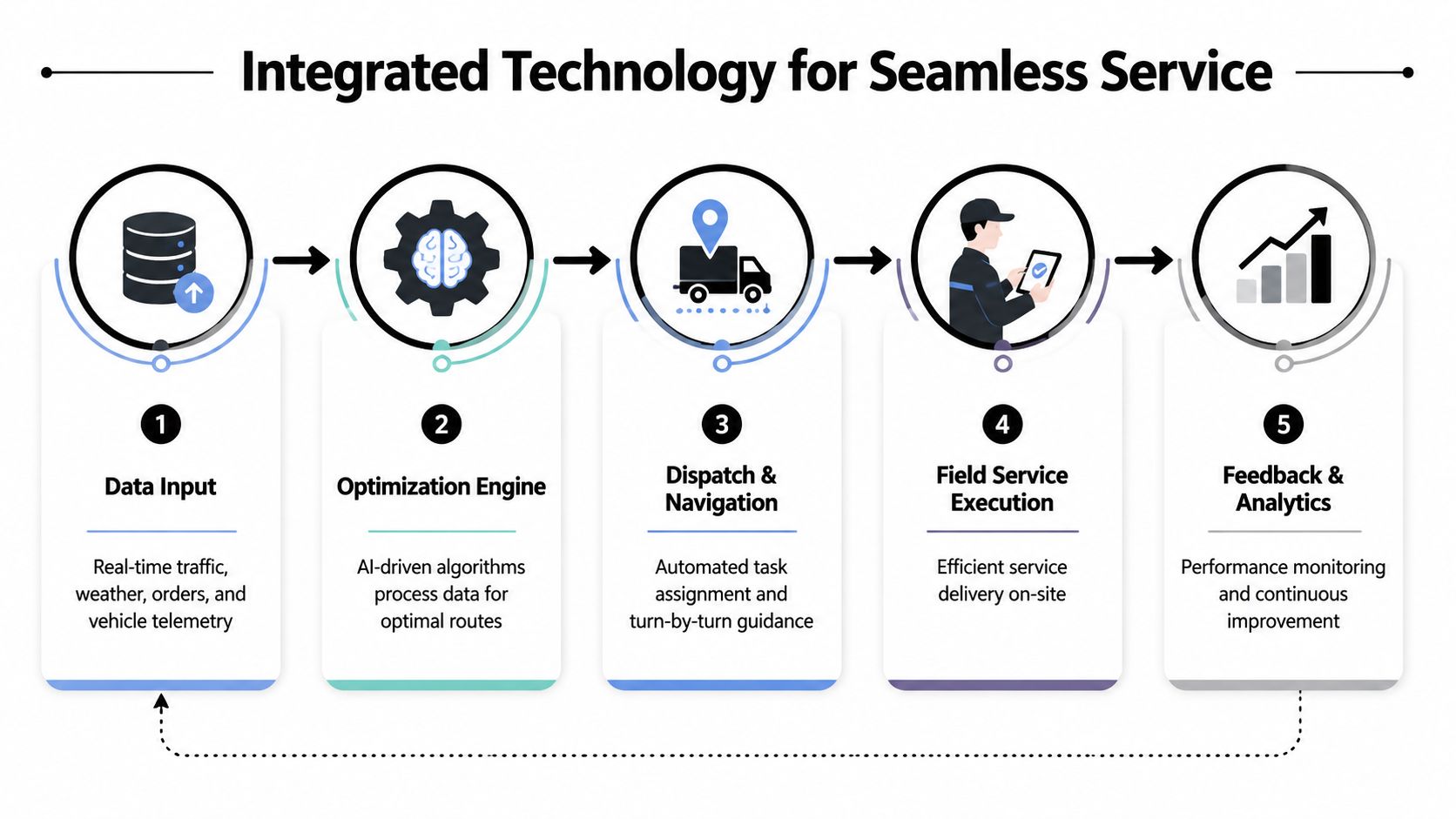
What integration looks like in practice
A well-integrated operating model usually includes:
- Booking to dispatch continuity: Trip details shouldn't be re-entered manually from one system into another.
- Telematics in every vehicle: Dispatch needs a live operational view, not periodic check-ins.
- External feed connectivity: Airport transfers and complex city work both depend on current outside data.
- Shared visibility: Chauffeurs, dispatchers, and client-facing teams need aligned information when plans change.
Here, many providers underperform. They may have a routing tool, a dispatch platform, and flight tracking on separate screens, but they haven't connected them into one decision flow. The result is slower response, duplicate work, and inconsistent communication.
Integration determines whether optimization is usable
Yellow's overview of real-time route optimization with AI emphasizes that AI-driven platforms consider vehicle capacity, driver schedules, and delivery time windows to maximize fleet utilization and support stronger on-time performance. In executive transport, the same logic applies, but with a tighter service expectation and far less tolerance for improvisation.
Organizations evaluating broader travel and relocation support often run into the same operational question: can one partner coordinate multiple moving parts without losing control at the handoff? That's why a well-built service stack matters just as much in global mobility services as it does in VIP transfers.
A client experiences this as ease. The operations team experiences it as disciplined system design.
Measuring What Matters KPIs and ROI
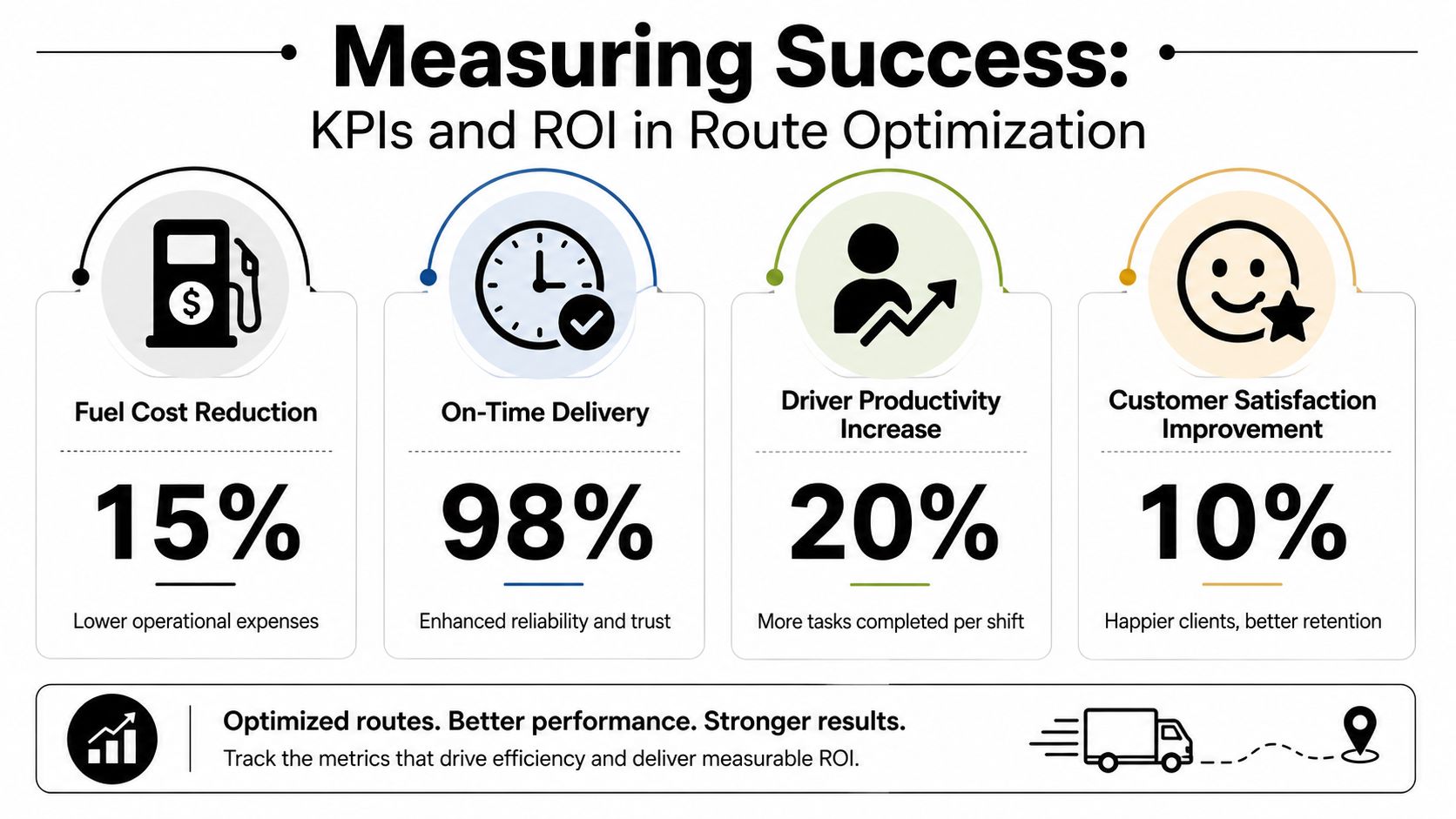
A routing platform is only valuable if it improves the metrics that clients and operators care about. In executive transport, that starts with punctuality, but it doesn't end there. The better question is whether the system protects service quality while improving operational performance.
The first KPI is usually on-time performance. This tracks whether the vehicle reaches pickup and destination within the promised service window. In executive travel, it's the clearest test of whether the operation is preserving the client's schedule rather than reacting to it.
The KPIs that deserve board-level attention
A useful scorecard includes several measures working together:
| KPI | What it measures | Why it matters |
|---|---|---|
| On-time performance | Success against committed pickup and arrival windows | Directly shapes client trust |
| ETA accuracy | How closely predicted arrival matches actual arrival | Determines whether clients and assistants can plan with confidence |
| Asset utilization | How effectively vehicles and chauffeurs are deployed | Helps operators absorb demand without service erosion |
| Fuel performance | Whether routing reduces wasteful drive time and idling | Affects margin and sustainability goals |
| Deadhead control | Non-revenue movement between assignments | Exposes inefficiencies hidden behind headline punctuality |
The financial case strengthens when those metrics improve together rather than in isolation. A provider can hit punctuality by over-buffering every trip, but that often hurts fleet efficiency. The better systems raise reliability without turning the schedule into excess slack.
Intellias' review of real-time route optimization reports that implementing dynamic route optimization results in a 10–20% reduction in fuel consumption and a 15–25% increase in on-time delivery accuracy within the first quarter. For executive operations, those gains matter because they improve both service consistency and operating economics.
ROI is bigger than cost savings
The obvious return is lower waste. Less idling, fewer poor route choices, and tighter fleet deployment all help. But premium transport has another layer of return that matters just as much: client retention.
A late trip gets remembered longer than a flawless one. A consistently flawless operation wins the next booking without having to argue for it.
That's why buyer evaluation should go beyond vehicle quality and coverage maps. Teams comparing ground transportation companies should look closely at how each provider measures punctuality, ETA reliability, and exception handling. Those numbers reveal whether the operation is engineered or improvised.
Choosing a Partner in Precision Travel
By the time a client is in the back seat, most of the important work should already be done. The vehicle should be correctly assigned. The chauffeur should be positioned. The route should reflect live conditions. The operation should be ready for the next change before the client needs to ask.
That's the standard real time route optimization supports in executive travel. Not merely route calculation, but coordinated control across airport pickups, roadshows, discreet transfers, and compressed schedules. In this market, small delays aren't small. They ripple outward into missed windows, rushed arrivals, and visible friction.
What to look for before you trust a provider
When evaluating a transportation partner, ask questions that go past the fleet list.
- How do they handle live disruptions? A strong answer should include operational process, not just “the driver uses GPS.”
- Can they coordinate across complex itineraries? Multi-stop work exposes whether routing, dispatch, and client communication are actually connected.
- Do they understand premium service constraints? Executive travel often includes privacy concerns, airport nuances, and nonstandard timing pressures.
- Are they built for managed transport or casual transport? Those are different businesses with different control requirements.
The provider choice is really a systems choice. You aren't only selecting a chauffeur and vehicle. You're selecting the quality of the dispatch discipline, the integration of the technology stack, and the maturity of the operation behind the trip.
That's also why buyers who are still defining their needs should start with the fundamentals of what ground transportation includes. Once the service stakes are clear, the difference between basic routing and executive-grade optimization becomes obvious.
If your travelers can't afford missed connections, visible delays, or disjointed handoffs, work with MLR Worldwide Service. Their team delivers executive ground transportation with the operational discipline, discretion, and real-time coordination that high-value travel demands.