

Your executive lands at MIA after a delay. The calendar has already shifted twice, a client dinner may run long, and the first car decision of the trip now carries real risk. If the pickup fails, the problem is not inconvenience. It is a missed handoff, a late arrival, and an executive forced to solve transportation instead of preparing for the meeting.
That is why experienced assistants treat executive ground transportation planning as a control function, especially during Miami's event-heavy months when airport volume, hotel congestion, and venue access can change by the hour.
An executive car service in Miami should reduce exposure at every step. The right provider tracks the flight, monitors terminal changes, confirms the meet point, manages wait time correctly, and gives the assistant a live contact who can fix problems fast. Those details matter far more than a luxury badge on the booking screen.
Miami adds pressure because demand spikes hard during conferences, art fairs, major sporting weekends, and peak corporate travel windows. In a crowded market, vague cancellation rules, unclear airport wait-time charges, and weak dispatch support turn a routine reservation into an avoidable failure. Book the service that can explain its policy in plain English before the trip starts. If the company cannot tell you exactly when wait time begins, what counts as a late cancel, and how they handle flight delays at MIA, keep looking.
Managing Miami's High-Stakes Corporate Travel Scene

Your executive lands at MIA 20 minutes early, the hotel is staging arrivals for a major conference, and the first meeting in Brickell cannot move. If the pickup fails here, the day starts with recovery mode instead of preparation.
Miami exposes weak booking decisions fast. Airport congestion changes by the hour, major events tighten vehicle availability across the city, and a simple terminal pickup can turn messy if the service has no clear meet procedure, no active dispatch, and no answer on wait-time rules. Smart assistants treat executive ground transportation planning as schedule protection.
Where executive bookings fail
The common mistake is booking by vehicle label instead of operating standard. "Black SUV" tells you almost nothing about execution. You need to know who is monitoring the flight, where the chauffeur will stand, how the assistant will be contacted, what happens if baggage is delayed, and when charges start if the traveler stops to take a call before exiting.
That is the part many providers gloss over. During Miami's busiest corporate and event periods, weak policy language creates real exposure. If the company cannot explain its airport wait-time policy, grace period, late-cancel cutoff, and flight-delay procedure in plain English, do not book it.
Rideshare is a convenience tool. Executive service is a control system.
If the traveler has to troubleshoot the pickup, the booking failed before the car arrived.
Why Miami creates more risk than it appears to
As noted earlier, demand for corporate transportation in Miami is heavy, and that pressure shows up in the places assistants feel first: airport curbs, hotel entrances, convention corridors, and last-minute availability. The risk is not limited to delay. It includes billing disputes, missed meet points, and drivers who are technically assigned but operationally unsupported.
Book with a risk screen, not a luxury screen:
- Reserve critical transfers early: airport arrivals, investor meetings, site visits, and event-night dinners should be locked in before surge demand tightens the market.
- Choose inside-terminal pickup for high-value travelers: curbside works only when the traveler can self-direct and tolerate confusion. Senior executives, clients, and first-time visitors should be met and escorted.
- Get the policy in writing before approval: confirm wait time, cancellation windows, flight-tracking procedure, overtime billing, and after-hours dispatch contact before the trip is finalized.
Ask one question before you confirm any reservation: what are the failure points, and who owns each one? That question separates a polished ride from a service that can protect the day.
Beyond the Black Car What Defines Executive Service
A lot of providers use “black car” as a catch-all label. That's sloppy. Executive service has a narrower meaning and a higher standard.
The industry recognizes four dominant service models: chauffeur service, point-to-point, hourly hire, and charter, and the inside-terminal meet and greet is a major differentiator from curbside pickup, according to this guide to executive car travel service models in Miami. If you're booking for an executive, you need to know which model matches the assignment.
The service model must fit the day
Use the wrong model and you create friction before the wheels move.
- Point-to-point: Best for a clean transfer from one location to another, such as MIA to a hotel or office. This works when the schedule is fixed and the route is straightforward.
- Hourly hire: Best for uncertain agendas, multiple meetings, or same-day schedule changes. If the executive may add stops, run late, or move between neighborhoods, hourly is the safer call.
- Chauffeur service: This is the managed experience. The chauffeur handles route adjustments, luggage, timing, and presentation with more polish than a simple transfer booking.
- Charter: Use this for multi-day programs, event blocks, or broader group movement where the vehicle is effectively dedicated to the client's schedule.
For a simple airport arrival, point-to-point may be enough. For a CEO doing back-to-back meetings across Brickell, Coral Gables, and Miami Beach, hourly is usually the smarter booking.
Non-negotiable signs of real executive service
Don't get distracted by photos of glossy vehicles. Ask whether the provider behaves like a logistics operator.
A legitimate executive car service in Miami should include:
- Fixed pre-arranged pricing: You should know the rate structure before the trip starts.
- A defined meet-and-greet process: The chauffeur meets the traveler inside the terminal when that level of service is required.
- Professional chauffeurs, not app-based availability: The person behind the wheel should be vetted, presentable, and trained for executive-facing work.
- Operational control: Someone should be monitoring changes and coordinating the trip, not leaving everything to the traveler.
If you need a sharper distinction between a premium ride and a managed service, this explanation of what black car service actually means is the right baseline.
Booking executive transportation is closer to arranging private aviation support than hailing a car. The vehicle matters, but the process matters more.
That's the standard you should enforce. If a provider can't explain the service model, the airport handoff, and the change-management process clearly, move on.
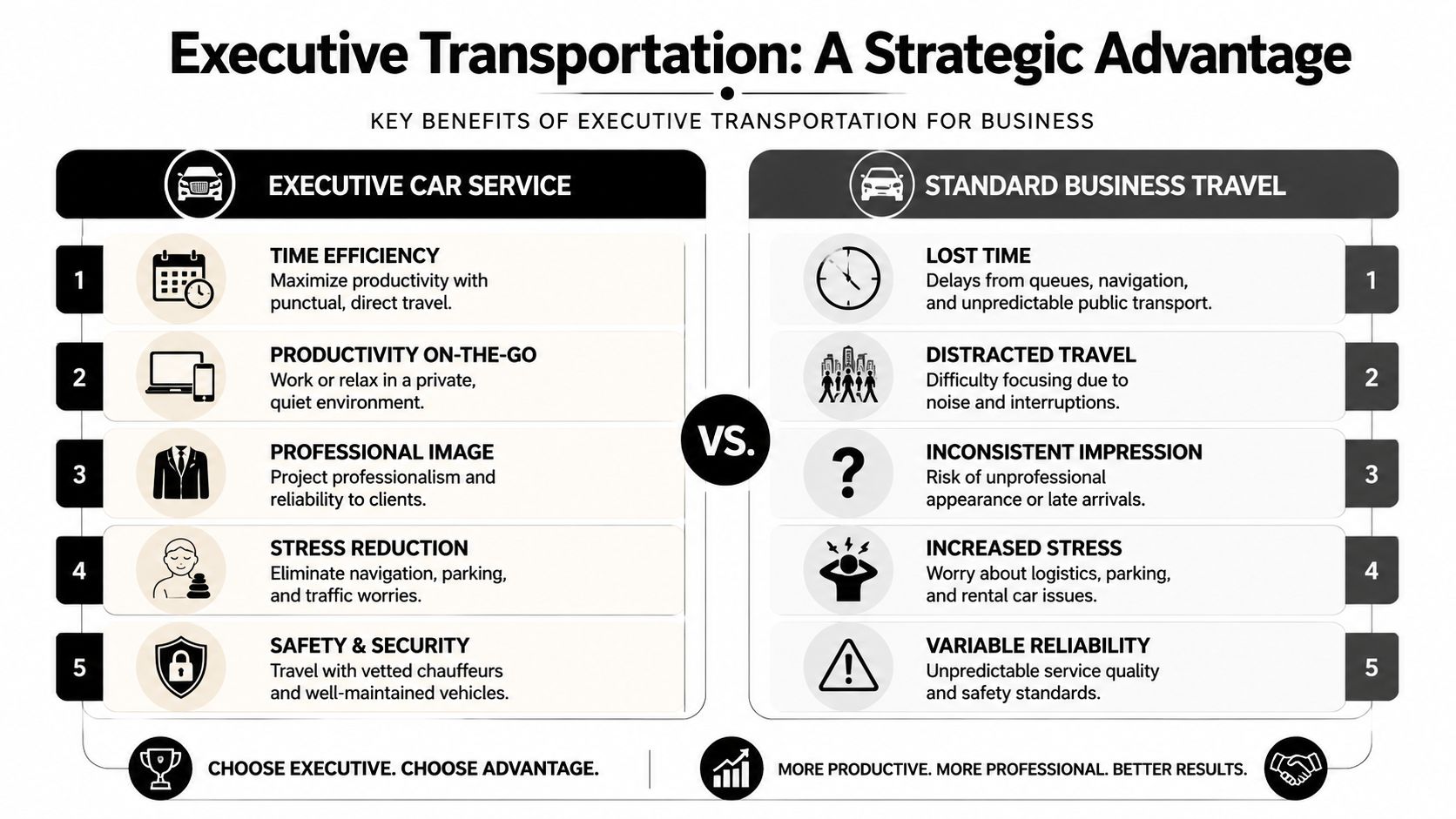
Key Benefits of Executive Transportation for Business
A CEO lands at MIA during Art Basel week, heads straight to a sponsor dinner in Miami Beach, and the flight arrives 42 minutes late. That is where weak transportation planning gets exposed. The primary benefit of executive car service is control over a day that can go sideways fast.
For business travel in Miami, executive transportation protects three things that get expensive very quickly. Time, confidentiality, and schedule integrity. Those are operational safeguards, not comfort upgrades.
Corporate demand reflects that reality. The business end-user segment accounts for about 41.5% of total revenue in the global chauffeur services market, according to IBISWorld's analysis of the limousine and chauffeur services industry. Companies keep booking these services because missed handoffs, unclear pickup procedures, and poorly managed delays cost more than the ride.
What executives actually gain
The first benefit is protected working time. In a properly managed vehicle, the traveler can prepare for a board meeting, review numbers, send approvals, or take a confidential call without dealing with routing, curb chaos, or driver confusion.
The second benefit is predictable execution. Miami is not a forgiving market during major conferences, finance events, F1 weekend, or holiday surge periods. Roads back up. Airports get messy. Hotel fronts become crowded staging zones. Executive service reduces failure points because the trip is planned, monitored, and adjusted as conditions change.
The third benefit is policy clarity, which many assistants overlook until there is a problem. During high-stakes event periods, wait-time rules, grace periods, airport meet-and-greet procedures, and cancellation cutoffs matter as much as the vehicle. If those terms are vague, the invoice will be unpredictable and the handoff will be messy. A serious provider explains those rules before the trip is confirmed.
The value shows up in risk reduction
Executives do not need transportation that merely looks polished. They need transportation that holds together under pressure.
A managed executive booking lowers the odds of four common failures:
- Missed airport pickups caused by poor flight tracking or weak dispatch follow-through
- Billing disputes tied to unclear wait-time, stop-time, or late-change policies
- Exposure of sensitive conversations in vehicles that are inconsistent in privacy and professional standards
- Reputational damage when a senior traveler arrives late, disoriented, or handling logistics personally
That last point matters. A client does not see your booking notes or your vendor spreadsheet. They see whether the principal arrives composed and on time.
Practical rule: If the traveler has a fixed commitment, sensitive discussions, or no tolerance for pickup confusion, book managed executive service and confirm the wait-time and cancellation terms in writing.
Executive service vs. rideshare vs. taxi
| Feature | Executive Car Service | Premium Rideshare (e.g., Uber Black) | Taxi |
|---|---|---|---|
| Pricing model | Pre-arranged structure with defined service terms | App-based, variable by demand | Metered or fixed in limited cases |
| Airport arrival experience | Meet-and-greet available, coordinated pickup plan | Usually curbside self-coordination | Curbside queue |
| Driver standard for executive-facing trips | Professional chauffeur expectation | Inconsistent | Inconsistent |
| Vehicle consistency | Booked by class and service standard | Varies by driver and availability | Varies |
| Change handling | Dispatcher can manage updates and timing shifts | Limited by app workflow | Limited |
| Privacy for sensitive calls | Better fit for confidential business travel | Mixed | Mixed |
| Support during disruption | Active operational support when the company is properly staffed | App support | Minimal |
When it's worth paying for
Book executive car service in Miami when the transportation failure would cost more than the fare.
That usually includes:
- Client-facing arrivals where the first five minutes set the tone
- Multi-stop itineraries with changing timing, venue access issues, or executive protection concerns
- Senior travelers such as board members, investors, C-suite leaders, and family office principals
- Airport pickups during delay-prone periods when wait-time rules and dispatch quality directly affect the outcome
- Event-season travel when congestion, venue restrictions, and cancellation terms need to be managed upfront
If the traveler is fully self-directed and the trip has no real downside, use a simpler option. If the calendar is high-value, book transportation the same way you would book any other mission-critical vendor. Define the service, confirm the policies, and remove avoidable risk before the wheels move.
Evaluating Fleet Quality and Chauffeur Professionalism
At 5:10 p.m. during Art Basel week, your principal lands early, the convention district is gridlocked, and the hotel has changed the pickup entrance because of event security. That is when weak operators get exposed. Fleet quality and chauffeur professionalism are not image points in Miami. They are risk controls.
Start with vehicle standards. You are not buying a generic black SUV. You are buying consistency under pressure. The provider should confirm the exact service class being assigned, keep vehicles clean and current, and match the vehicle to the trip. A solo airport pickup, a two-executive investor meeting, and a four-stop roadshow need different setups for luggage, call privacy, and working space.
What to inspect in the fleet
A credible operator offers defined categories such as executive sedan, premium SUV, and luxury van for small groups. In Miami, common options include the Cadillac Escalade, Lincoln Navigator, and Sprinter van. Those names matter less than maintenance discipline, interior condition, and vehicle age standards.
Ask for specifics, not marketing language. You need to know:
- What vehicle class is guaranteed in writing?
- What is your replacement standard if that vehicle becomes unavailable?
- How often are vehicles inspected, serviced, and detailed?
- Can you send current photos of the actual class, interior included?
- Do you have enough fleet depth to cover event-week surges without substituting down?
That last question matters more in Miami than many new assistants realize. During high-volume convention periods and major nightlife or sports events, weaker companies overbook, pull in affiliate cars with uneven standards, or swap vehicles at the last minute. If the operator cannot explain its backup plan clearly, keep looking.
The chauffeur should lower risk
A strong chauffeur does four things well. Arrives on time. Communicates clearly. Protects the traveler's attention. Handles changes without creating more work for you.
Polish matters, but judgment matters more. The chauffeur should know airport flow, private aviation procedures if relevant, hotel access patterns, venue restrictions, and where Miami traffic breaks down during event season. They should also know when to stay quiet. Senior executives do not need small talk. They need a calm car, direct updates, and zero friction.
Use this checklist:
- Professional presentation: business attire or uniform, composed demeanor, clean vehicle setup
- Operational discipline: confirms pickup details, monitors timing, follows instructions exactly
- Discretion: protects confidential calls and does not overshare, pry, or improvise socially
- Local judgment: adjusts routes and pickup positioning based on real conditions, not default GPS alone
- Service recovery skill: stays calm if a terminal changes, a meeting runs long, or security reroutes access
The chauffeur is the operating standard the traveler actually experiences.
Questions assistants should ask before booking
Do not ask broad questions such as whether the company provides great service. Ask questions that expose process quality.
- Are chauffeurs employees or affiliates for this trip?
- What training do chauffeurs receive for executive, airport, and event-week assignments?
- What is your procedure if the flight lands early, the client is delayed in customs, or the venue changes the pickup point?
- How do you document wait-time, and when does extra billing begin?
- Who has authority after hours to approve changes and dispatch a replacement vehicle?
Question four is where many bookings go wrong. A provider can look polished and still create invoice disputes later if wait-time rules are vague, airport grace periods are unclear, or the dispatcher does not document traveler contact attempts properly. During Miami's busiest weeks, those details decide whether the service feels controlled or chaotic.
If the company answers with generalities, skip them. Precision here is a preview of performance later.
Understanding Executive Car Service Pricing in Miami
An assistant books a low airport rate for an executive arriving during Art Basel week. The flight is late, bags take time, the pickup point changes, and the final invoice jumps because the original quote hid wait-time and airport procedure charges. That is how routine transportation turns into a service failure.
Control the booking by sorting every quote into three pricing structures: airport transfer, hourly service, and group vehicle service. If a provider cannot state which structure applies and what triggers extra charges, do not book them.
Miami executive pricing usually falls into predictable bands, as noted earlier in the market reports cited above. Sedans sit at the lower end, SUVs cost more, and Sprinter vans move into a different pricing tier because they often carry minimum-hour requirements, venue access complications, and higher standby risk. The exact number matters less than the quote format. A clean quote should tell you whether the rate is point-to-point or hourly, what vehicle class is guaranteed, and when billing starts if the traveler is delayed.
What the price should include
Base rate alone is meaningless. You need the full operating terms in writing.
For airport work, ask whether the quote includes:
- Flight tracking
- Airport wait time or a stated grace period
- Meet-and-greet procedure, if requested
- Parking, tolls, and airport fees
- Gratuity
- Bottled water, WiFi, or other onboard amenities if promised
- After-hours or event-week surcharges
If any of those items are left vague, expect an invoice dispute later. Miami's busiest weeks expose every weak policy. A provider may advertise a polished airport transfer price and still bill extra because the chauffeur waited at baggage claim longer than expected, the traveler requested curbside instead, or dispatch treated a terminal change as a new stop.
Hourly vs. transfer pricing
Choose transfer pricing for a simple movement. One arrival, one destination, no planned stop, no reason for the chauffeur to remain on standby.
Choose hourly service when the executive's schedule can shift. It costs more upfront, but it reduces operational risk when meetings run long, security changes access points, or the traveler decides to add a second stop. That is often the better decision during conference weeks, investor meetings, and multi-stop site visits.
Group vehicles need the closest review. They usually come with stricter minimums, tighter cancellation terms, and less flexibility once the vehicle is dispatched. If you are booking a Sprinter or larger format during a high-demand week, confirm the minimum hours, overtime increment, luggage assumptions, and the exact cutoff for cancellation without penalty.
The primary pricing issue is not the rate. It is policy clarity.
Ask these questions before you approve the trip:
- How many minutes of airport or FBO wait time are included?
- When does extra billing begin, and in what increments?
- What counts as a cancellation versus a delay or flight change?
- Do event-week dates carry different minimums or stricter terms?
- If the traveler changes pickup location after landing, how is that billed?
Those answers protect the budget and the traveler experience at the same time. A provider with disciplined pricing will answer quickly and in writing. A provider that stays vague is warning you that operations and invoicing are not under control.
Cheap transportation only stays cheap if the itinerary goes perfectly. Executive itineraries in Miami rarely do.
Choosing Your Miami Executive Car Service Partner
Most booking mistakes happen before the first ride. The assistant asks for a rate, confirms the vehicle type, and assumes the rest will work itself out. It won't. Provider selection should be a risk review.
Miami gets especially unforgiving during high-demand periods. The most overlooked issue isn't surge pricing. It's policy drift. During peak events, providers may tighten wait-time rules, change cancellation terms, or enforce stricter minimums.
The vetting checklist that matters
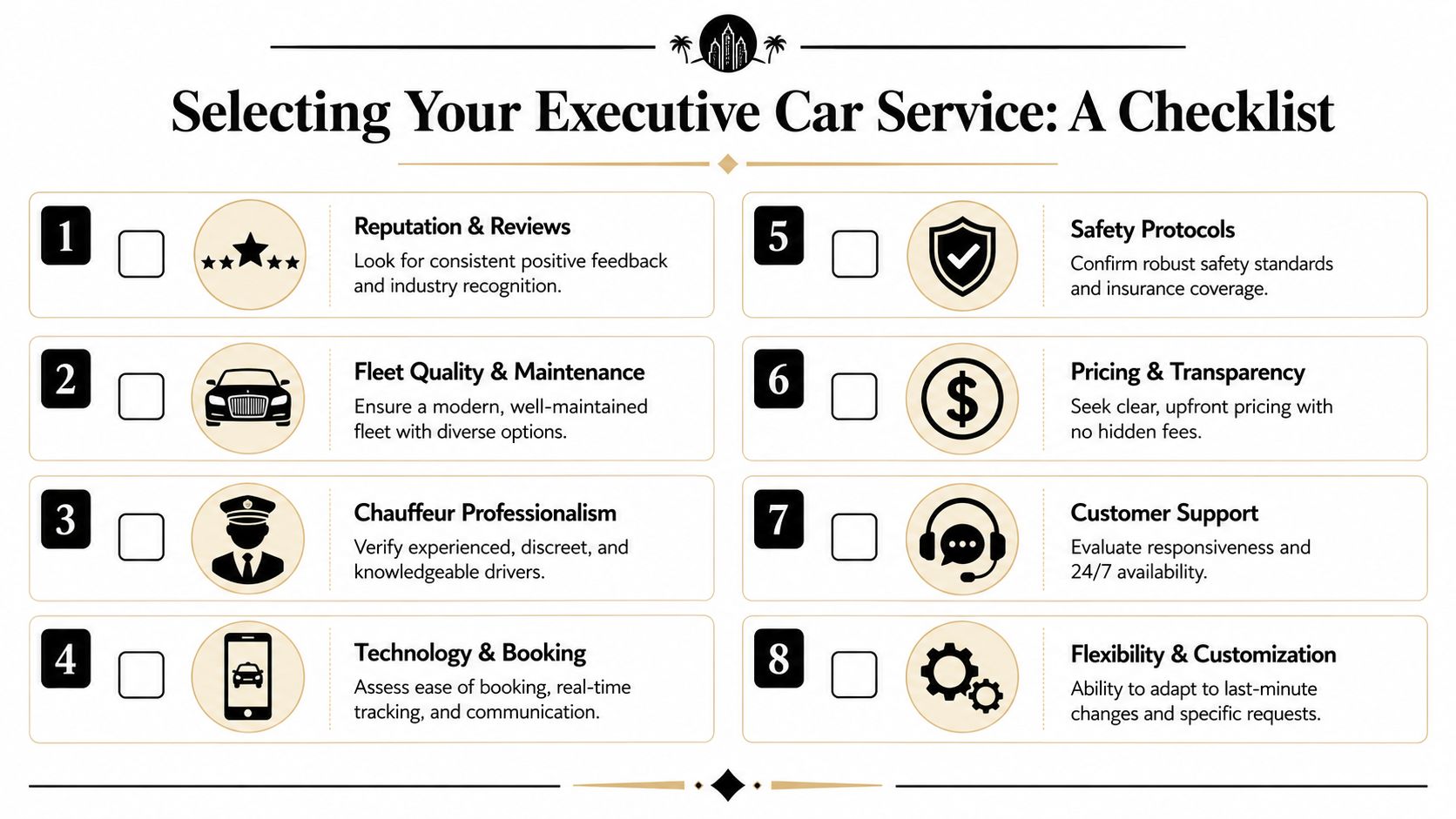
Use this short checklist before you approve any vendor:
- Live operations support: Confirm there's real dispatch coverage, not just app notifications or voicemail.
- Clear vehicle commitment: Ask what class is guaranteed and what happens if that class becomes unavailable.
- Airport procedure clarity: Confirm exactly how the chauffeur will meet the traveler and how updates are sent.
- Written pricing terms: Ask for what's included, not just the base quote.
- Change-management process: Find out who can modify the trip in real time.
- Repeat-service capability: If this executive travels often, ask how the provider handles profile notes and chauffeur preferences.
The questions competitors avoid
During major Miami event windows, this is the conversation you need to force. A verified Miami source notes that during periods like Art Basel, Ultra, and the Grand Prix, it's critical to clarify a provider's complimentary wait time at MIA, such as 60 minutes, versus any stricter minimums or no-show penalties, as detailed in this Miami event transportation policy guide.
Ask these questions exactly:
- How much complimentary wait time applies at MIA on my travel date?
- Does that wait time change during major events?
- When does a no-show fee begin?
- If the flight is delayed, do you extend the wait automatically or convert the trip into billable standby?
- Are there stricter minimum-hour requirements during event periods?
- If the traveler exits late because of customs, baggage, or security, what happens to the booking?
These aren't edge cases in Miami. They're standard stress points.
Don't ask whether the provider “works events.” Ask how their wait-time and no-show rules change when the city is under pressure.
Red flags that should end the conversation
Walk away if you hear any of the following:
- “We'll sort it out on the day.”
- “It depends” with no written policy.
- No distinction between curbside and meet-and-greet process.
- No named operations contact for live trip issues.
- No clear answer on delay handling at the airport.
The best executive car service in Miami is rarely the one with the flashiest website. It's the one that gives you exact operating answers before you need them.
The MLR Booking Process From Request to Arrival
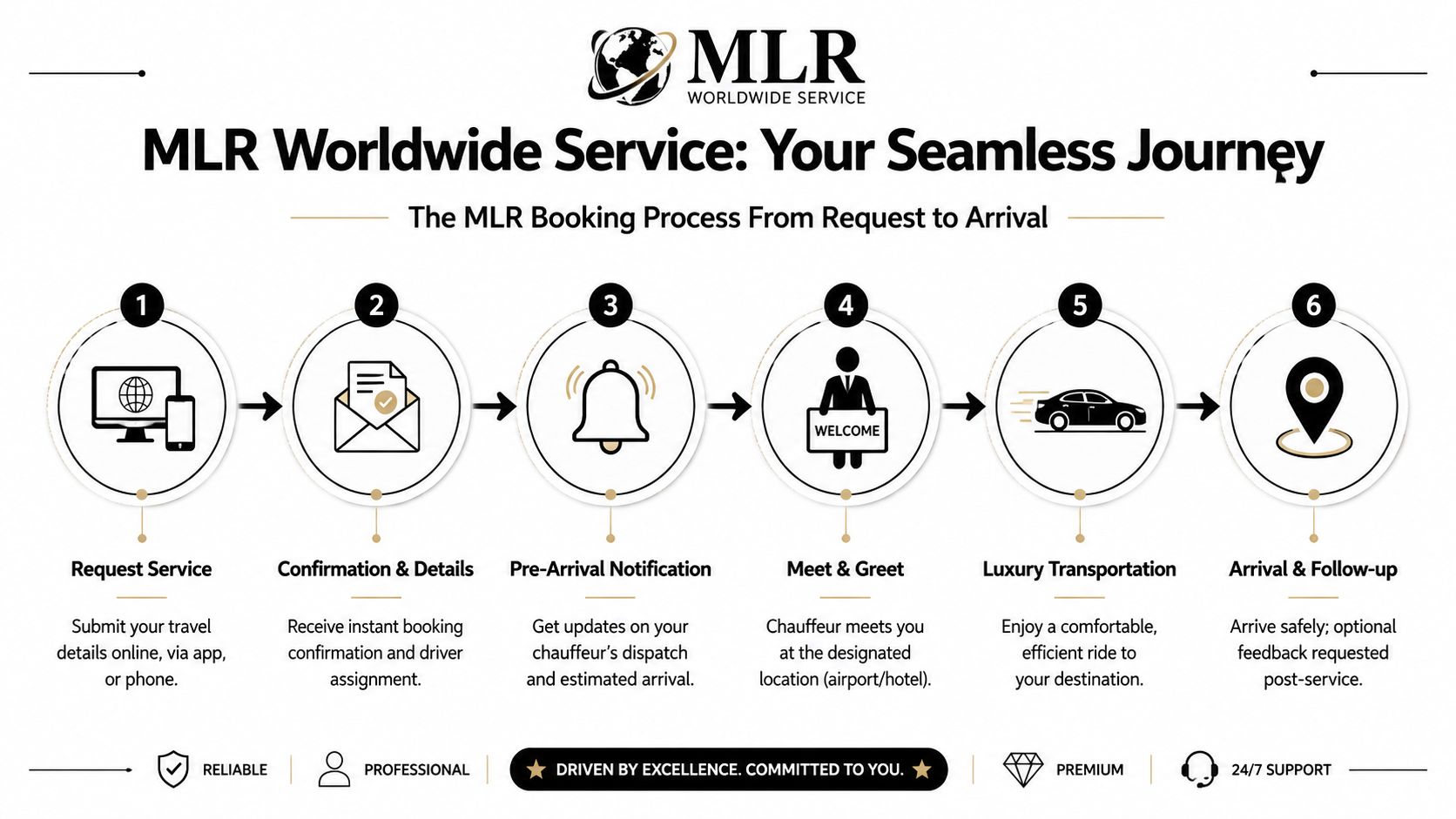
A strong booking process should feel boring. That's a compliment. The traveler submits details, receives confirmation, gets updates, meets the chauffeur without confusion, and arrives without needing to troubleshoot anything.
That's the standard assistants should demand from any premium provider. It starts with precise intake. The service needs the flight, terminal, arrival timing, destination, passenger count, luggage count, and whether the booking is a simple transfer or part of a larger itinerary.
What a clean process looks like
The ideal workflow is straightforward:
- Request submission: the assistant sends the itinerary through phone, email, or booking portal.
- Confirmation: the service confirms the trip details, pricing structure, and vehicle class.
- Pre-arrival coordination: operations tracks the flight and adjusts timing if needed.
- Meet-and-greet execution: the chauffeur meets the traveler at the agreed location with clear identification.
- Ride management: route and timing are handled without burdening the passenger.
- Completion and follow-up: the assistant gets closure, and any recurring preferences are stored for next time.
For travel planners managing repeat bookings, portal access matters because it cuts email clutter and preserves consistency. For example, MLR supports account-based coordination through its global travel agent login portal, which is the kind of operational tool that makes repeat executive travel easier to manage.
What separates a polished provider from an average one
The difference is what happens when the itinerary shifts.
A polished operation tracks flights, adapts to delays, handles last-minute changes, and gives the assistant one accountable point of contact. An average provider confirms the trip and disappears until pickup time. Those are not the same service level.
If you're booking executive car service in Miami for someone important, demand the first model. Anything less pushes too much risk back onto the traveler and the assistant.
If you need a provider that treats executive transportation like a managed logistics function, not just a ride, MLR Worldwide Service is built for that standard. Their team supports executive transfers, airport and FBO coordination, roadshows, VIP movements, and complex multi-stop itineraries with late-model vehicles, discreet chauffeurs, and 24/7 concierge oversight. For executive assistants and travel managers who can't afford pickup confusion, schedule drift, or weak communication, that's the right place to start.