

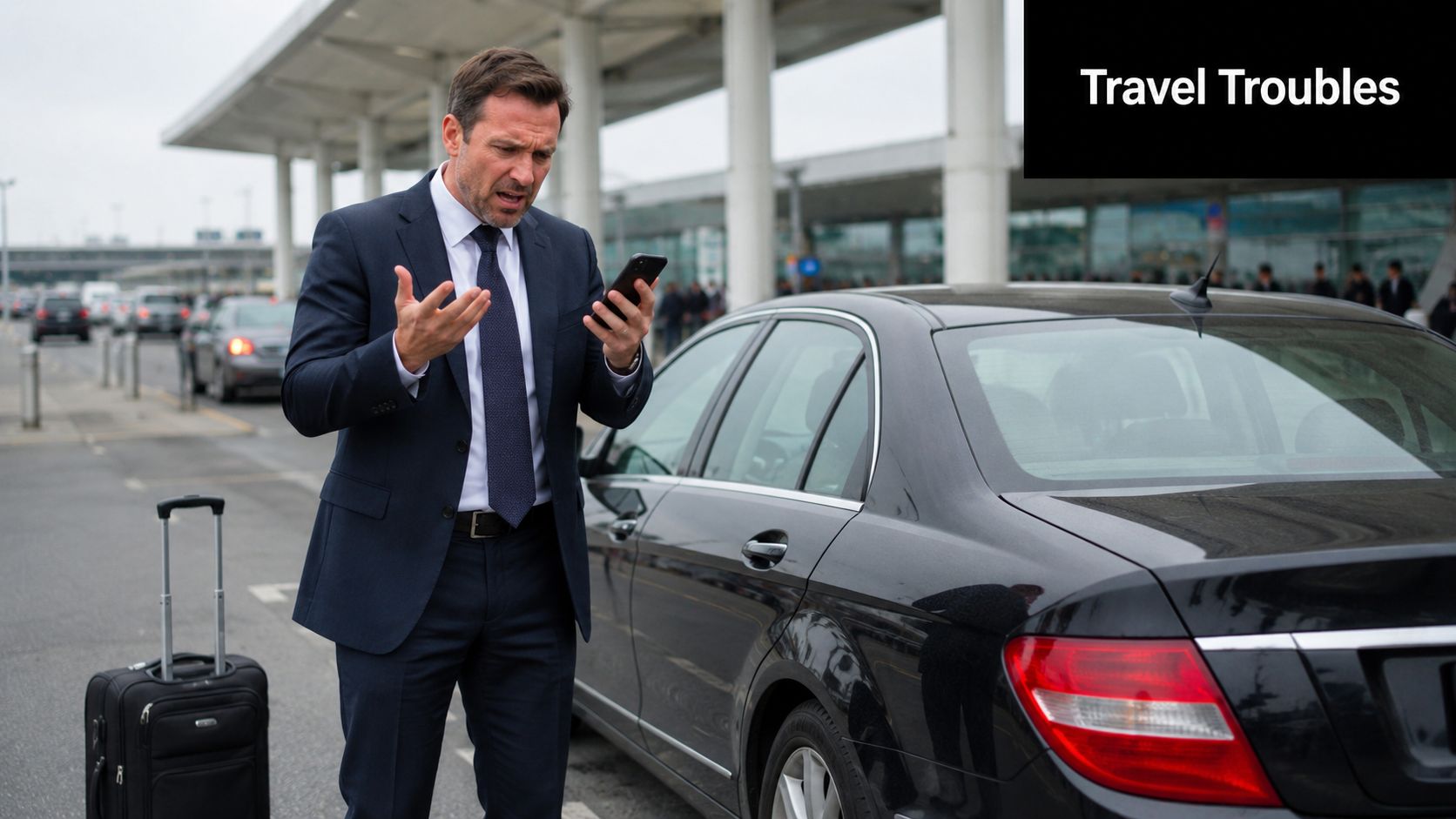
A chief of staff confirms the itinerary. The aircraft lands on time. The hotel is briefed. The meeting window is tight, but manageable. Then the ground transport fails in a way that shouldn't happen in a so-called premium service.
The chauffeur is late to the FBO because dispatch didn't adjust for an earlier wheels-down time. The wrong vehicle arrives for the passenger count. The driver asks the principal where to go, even though the route was provided hours earlier. A border crossing, venue security gate, or last-minute terminal change turns a controlled day into a scramble. Nobody on the provider side owns the problem quickly enough, so the executive absorbs it in wasted time, visible frustration, and lost focus.
That's the gap between a nice car and a serious operation.
In executive transport, what is white glove service isn't about bottled water, leather seats, or someone opening a door. It's about removing friction from high-stakes movement. Most content treats white-glove service as a physical delivery concept, but that misses where the standard matters most for many executives: people logistics, not package logistics. One widely cited industry angle notes that 78% of luxury travel clients cite unanticipated delays as their top pain point in discussions around white-glove service and premium logistics, while many guides still ignore itinerary adaptation and cross-border vetting in executive transport as discussed by ShipBob.
If you're arranging movement for a board member, investor, principal, or family office client, the useful question isn't “Do they offer luxury vehicles?” It's whether they understand what ground transportation includes in practice, especially when the day stops behaving as planned.
Introduction Beyond the Black Car
A lot of providers sell “executive transportation” as if the vehicle is the product. It isn't. The vehicle is one component in a larger operating system that has to protect time, privacy, and momentum.
That matters most when the trip has no slack. A CEO doing a same-day roadshow across multiple offices doesn't need stylish transportation. They need an operations team that already knows where congestion builds, who can get airside timing updates, how to sequence pickups without exposing the principal to idle curb time, and when to move from Plan A to Plan B without asking the client to make tactical decisions from the back seat.
Where premium often falls short
A standard black car provider can look polished on the surface and still fail operationally. Common problems include:
- Reactive dispatch: They wait for delays to happen, then start solving.
- Thin communication: The booker gets a confirmation, but no meaningful updates once conditions change.
- Weak handoffs: Sales, dispatch, affiliate partners, and chauffeurs don't share the same details.
- Driver-first thinking: The service follows the vehicle schedule instead of the client schedule.
White glove service starts before pickup. If the team only becomes active when the passenger calls, the standard has already been missed.
What the term should mean here
In transport, white glove service is an operating discipline. It's the quiet work that makes the movement feel easy even when the itinerary is difficult.
That includes pre-trip review, route logic, chauffeur briefing, secure data handling, live monitoring, and judgment under pressure. The best providers don't ask, “Can we complete the transfer?” They ask, “How do we protect the client from avoidable friction at every point of contact?”
Defining White Glove Service in Transportation
The phrase came from an older service standard in which staff wore white gloves to signal cleanliness, precision, and professional care. Over time, that visual cue became shorthand for a broader idea: intentional, error-resistant service. That historical origin is well summarized in Berkshire Receptionists' explanation of white glove service.
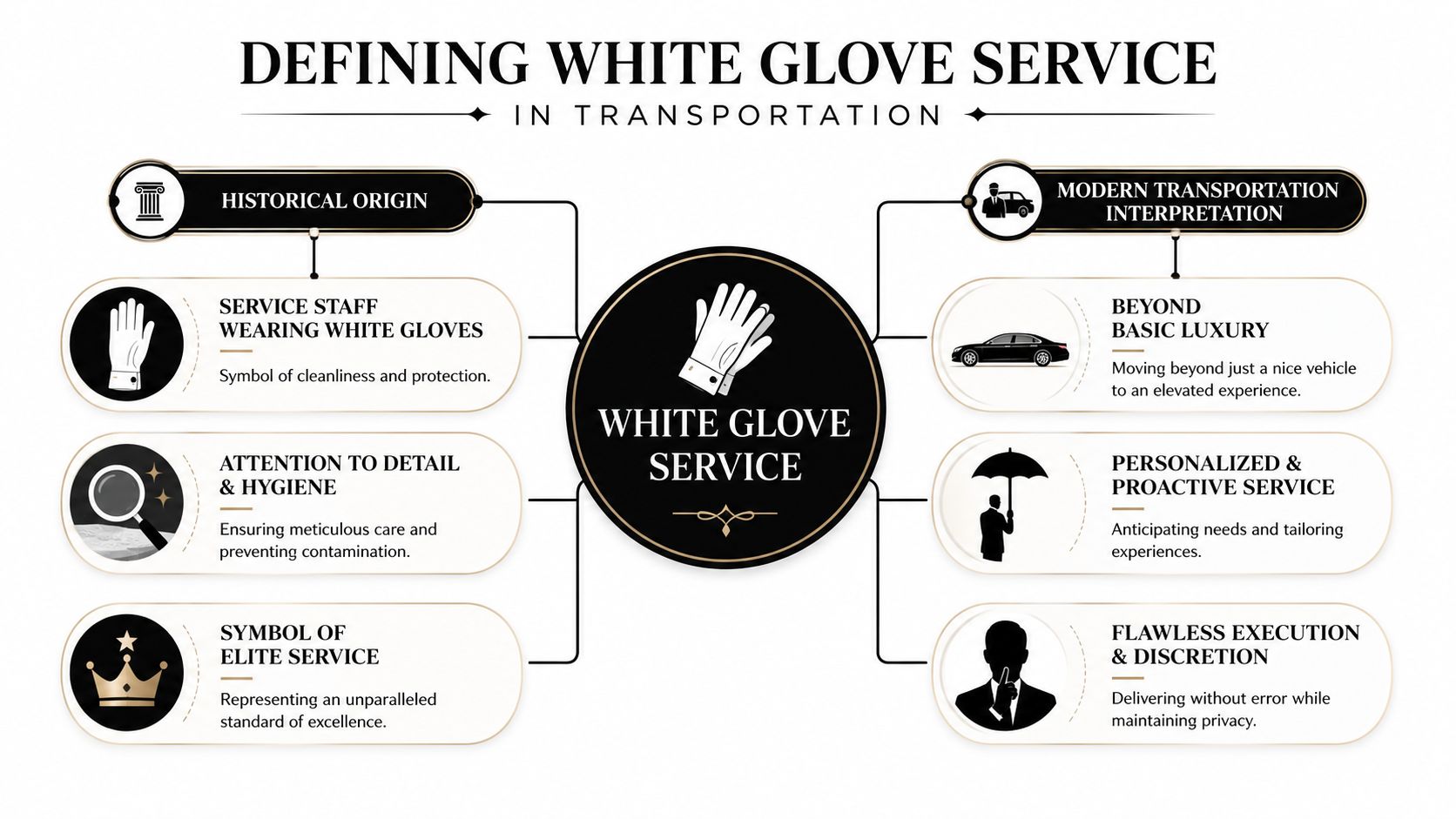
In logistics, the term usually points to careful handling, room-of-choice placement, setup, testing, and debris removal. In executive transport, the equivalent isn't assembly. It's orchestration. The client isn't buying movement from one address to another. They're buying a day that stays intact.
A practical definition
White glove service in executive transport is the deliberate removal of uncertainty through planning, discretion, and proactive control.
That's why the phrase can't be reduced to amenities. Wi-Fi, refreshments, and a polished fleet can support the experience, but they don't define it. A provider can offer every visible luxury touch and still run a fragile operation underneath.
The strongest test is simple: does the service depend on the client noticing problems early and helping solve them, or does the provider absorb complexity before it reaches the passenger?
What separates it from ordinary VIP service
Many companies market “VIP” service as upgraded hospitality. That usually means a better car class, a meet-and-greet, and maybe a more polished driver. White glove goes further.
It requires the provider to understand context. If the traveler is coming off a transatlantic arrival into a board meeting, the chauffeur doesn't fill the cabin with conversation. If the principal is traveling with family, the service has to manage pace, luggage flow, privacy, and pickup positioning differently. If the move involves an FBO, diplomatic venue, or protected residence, access protocol matters as much as punctuality.
A useful way to think about it is this:
- Good service responds correctly when asked.
- White glove service anticipates what will matter before anyone has to ask.
Standard vs Premium vs White Glove A Comparison
The U.S. white glove services market is projected to grow from $8.78 billion in 2023 to $20.25 billion in 2030, at a projected 12.7% CAGR, according to Fortune Business Insights on the U.S. white glove services market. That growth tracks with what many travel managers already know from experience. There's a real difference between transport that looks premium and transport that can protect an executive schedule.
If you're comparing options, start with operating capability, not branding. A useful reference point is the distinction between white glove transport and standard black car service models.
Service Level Comparison
| Feature | Standard Service (e.g., Ride-Share) | Premium Service (e.g., Typical Black Car) | White Glove Service (e.g., MLR Worldwide) |
|---|---|---|---|
| Booking model | App-based or basic reservation | Reservation with dispatcher support | Managed booking with itinerary review and operational oversight |
| Driver assignment | Often dynamic and last-minute | Scheduled in advance | Assigned with briefing, route context, and service notes |
| Communication | Mostly automated | Basic confirmations and pickup messages | Live coordination for booker, passenger, and support team as needed |
| Flight and itinerary monitoring | Limited | Sometimes available | Actively monitored with adjustments before the client has to ask |
| Chauffeur role | Driver focused on trip completion | Professional presentation, variable execution | Chauffeur trained for timing, discretion, protocol, and situational judgment |
| Personalization | Minimal | Preference handling may be informal | Client preferences documented and applied consistently |
| Problem response | Passenger usually solves issues in real time | Dispatcher intervenes after disruption becomes visible | Operations team acts early with contingency plans already prepared |
| Multi-stop complexity | Weak | Moderate | Built for roadshows, FBOs, events, and changing schedules |
| Privacy posture | Consumer-grade | Better, but inconsistent | Confidential handling, limited disclosure, need-to-know coordination |
| Affiliate consistency across cities | Unpredictable | Varies by network | Requires centralized standards, vetting, and quality control |
What the table tells you
The jump from standard to premium is mostly about comfort and presentation. The jump from premium to white glove is about risk control.
That distinction matters because executive transport failures usually don't begin as dramatic failures. They start as small misses: an unclear manifest, a driver who hasn't been fully briefed, a delayed status update, an affiliate who operates to local habit instead of client standard. Those are manageable on a leisure transfer. They're expensive on an investor day, legal roadshow, or principal movement tied to security timing.
Decision rule: If the client's day has material consequences when transport slips, you're not buying a ride. You're buying operational resilience.
The Pillars of White Glove Operational Excellence
A white glove standard only holds if the provider can repeat it under pressure. In practice, that comes down to disciplined operations. The concept is often described through precision, consistency, and context, which is a useful framework drawn from expert commentary on white glove service standards.
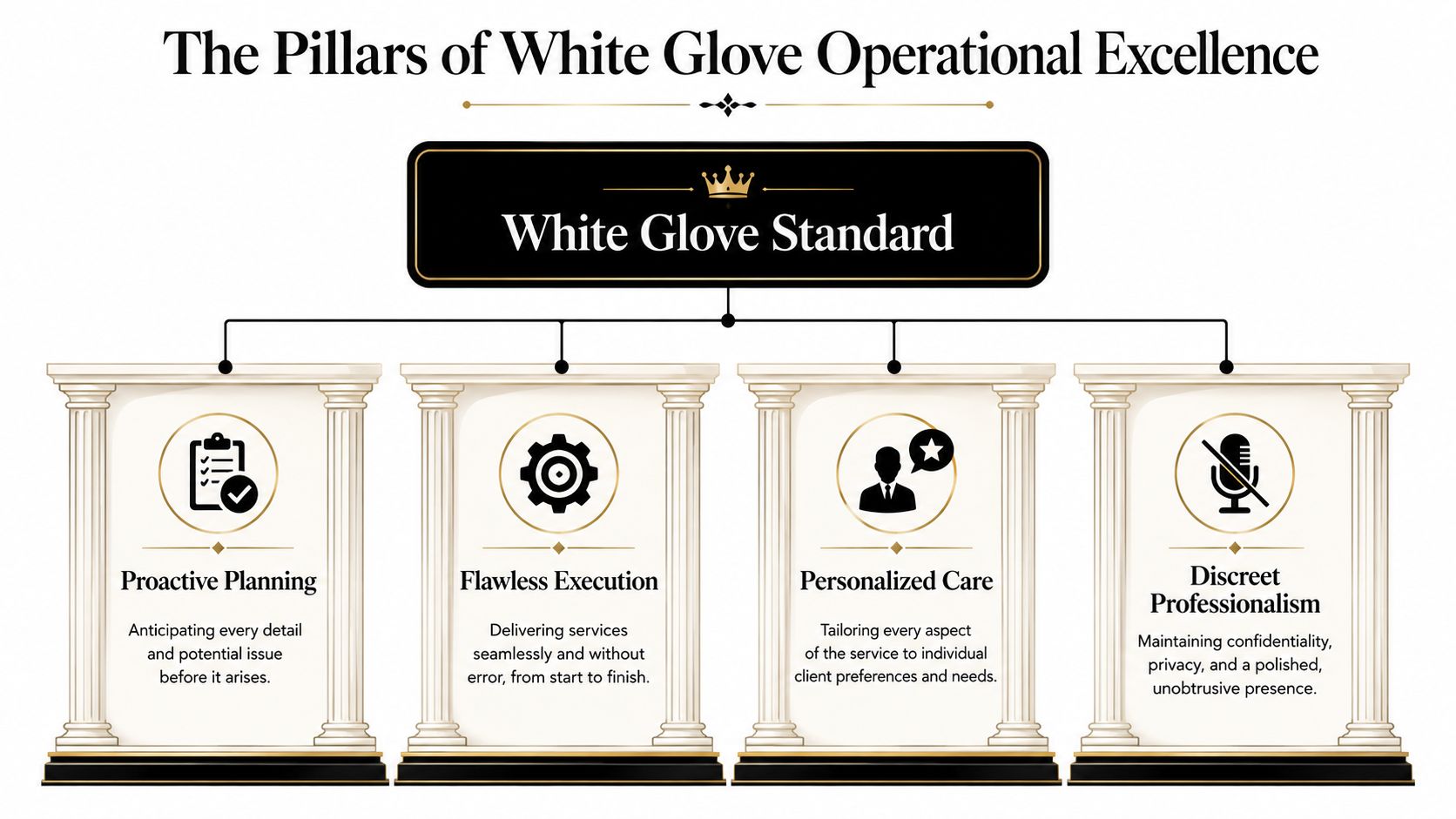
Proactive planning
Strong providers don't just receive an itinerary. They interrogate it.
They check airport or FBO details, likely curb conditions, venue access limitations, baggage assumptions, passenger count changes, and route sensitivities. For high-stakes trips, they also map failure points in advance. If arrival timing moves, if weather compresses road capacity, if the principal exits from a different terminal, the team should already know what changes operationally.
Many services break at this stage. They confirm the original booking cleanly but haven't built a process for dynamic adaptation.
Flawless execution
Execution is where planning becomes visible. The chauffeur arrives positioned correctly, briefed correctly, and aligned with the client's pace.
That sounds basic, but it requires detail discipline:
- Manifest accuracy: Names, pickup points, contact pathways, and schedule changes have to match across dispatch and chauffeur records.
- Vehicle readiness: The correct class, luggage fit, cleanliness, and maintenance standard must be confirmed before release.
- Timing discipline: Early is managed professionally. Late isn't normalized.
A polished greeting matters. But in executive transport, the deeper mark of quality is that the client never has to manage the provider.
Personalized care
Real personalization isn't performative familiarity. It's remembered operational preference.
Some clients want silence. Some want route updates. Some need a specific side of vehicle approach at venues, minimal branding, or tightly managed luggage handling. Family office and principal travel often include preference patterns that aren't glamorous but matter every time, such as child seating requirements, security coordination style, or a consistent communication chain through an assistant rather than directly with the traveler.
When teams log and apply those details consistently, service feels calm. When they rely on memory or improvisation, consistency disappears.
Discreet professionalism
In executive movement, privacy isn't a luxury add-on. It's a control standard.
Chauffeurs and dispatch teams should handle names, residences, movement patterns, and special requests on a need-to-know basis. They also need the judgment to stay unobtrusive. The best chauffeur in a high-profile environment knows when not to speak, when not to turn around, and when not to ask a question that should have been answered in briefing.
The client should feel supported, not observed.
White Glove Service in Action Real World Scenarios
White glove standards become easiest to understand when something changes midstream. That's when the gap between transportation and operational support becomes obvious.
Multi-city corporate roadshow
A CFO has meetings across several offices in one day, followed by an airport departure. The route on paper looks simple. In reality, meeting lengths drift, building exits vary, and one stop adds a security queue that wasn't in the original estimate.
A standard provider follows the first schedule until someone calls to revise it. A white glove team tracks the drift as it develops, updates sequencing, briefs the chauffeur on the next pickup posture, and keeps the assistant informed without flooding them with unnecessary messages. The vehicle isn't just available. The whole chain stays synchronized.
Family arrival through an FBO
A principal arrives with family, staff, and a large luggage load through private aviation. The challenge isn't “airport pickup.” It's controlled movement from aircraft side timing to ground departure with privacy intact.
That means the operation has to think about staging, baggage allocation, who rides with whom, how requests are routed, and how to keep the family from standing exposed while details are sorted out. A weak provider sees one booking with extra bags. A white glove provider sees multiple moving parts that need choreography.
Flight diversion and same-day recovery
A commercial arrival diverts late in the day. The executive still has a dinner, a hotel check-in, and an early departure the next morning.
Operations either earn their fee or reveal their limits. Good white glove response means rerouting the chauffeur, reassessing drive time, updating the hotel if needed, and preserving the next leg before the traveler is forced into a chain of rescue calls. The client should receive a concise update and a working plan, not a stream of apologies.
In executive transport, crisis management is rarely dramatic. It's usually a sequence of small decisions made quickly and correctly.
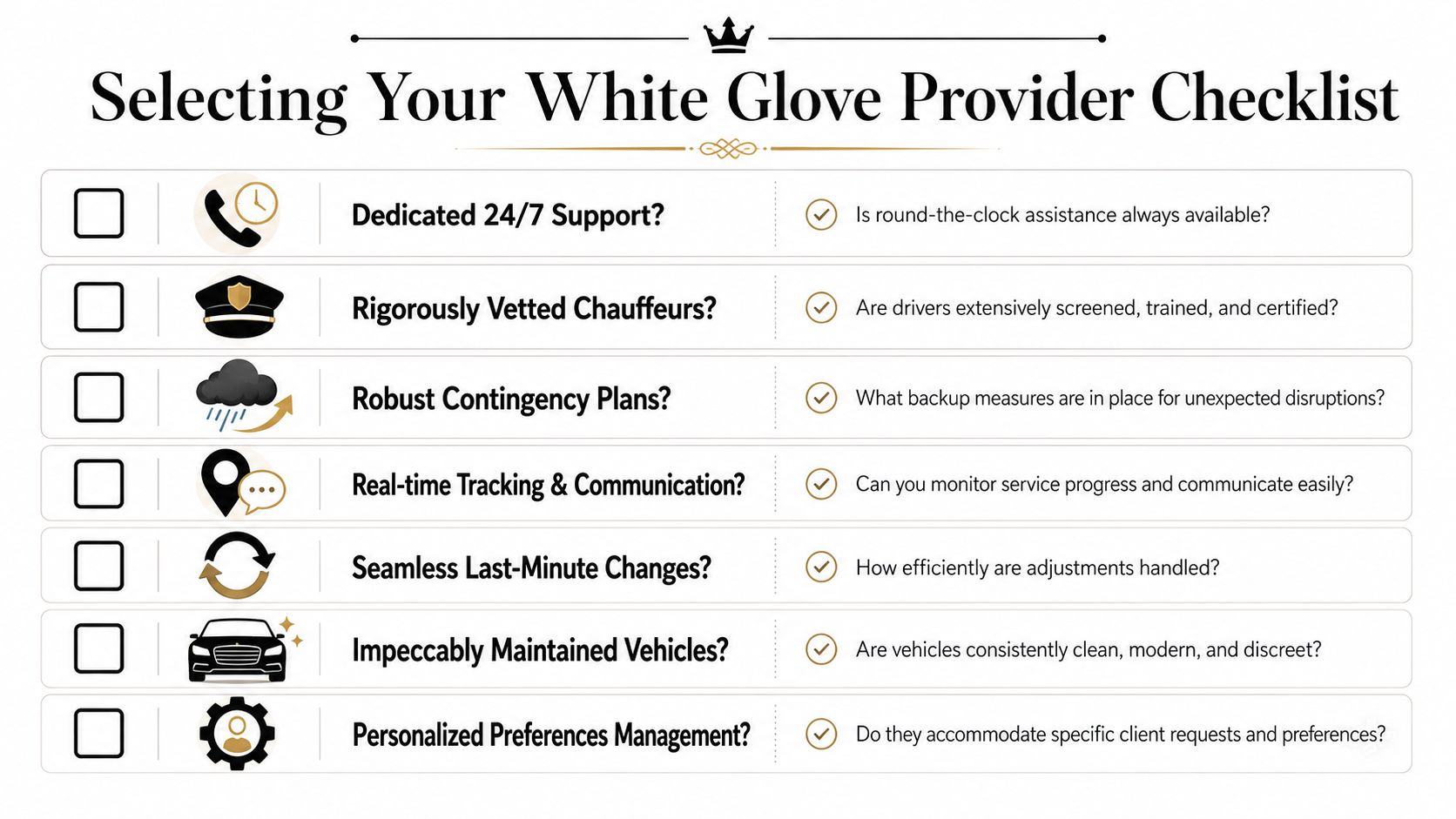
A Checklist for Selecting Your White Glove Provider
Marketing language won't tell you much. Every transport company claims professionalism, reliability, and luxury. The useful test is whether they can explain their operating method without resorting to slogans.
The strongest white glove models in logistics use advanced validation steps, including testing and reverse-process controls, to make sure service quality holds under demanding conditions. That same principle, adapted to travel, means pre-trip checks, verification, and contingency planning have to be built into the operating model, not added only when a problem appears. That principle is discussed well in AeroDoc's tiered view of white glove delivery complexity.
Questions worth asking
Use questions that force specifics:
- Who owns the trip after booking? Ask whether a live operations team monitors service or whether the reservation passes to dispatch and then to the chauffeur.
- How do you handle schedule changes? Listen for process, not reassurance. You want to hear how updates are received, confirmed, relayed, and documented.
- What standards do you apply to affiliate partners? If the provider operates globally, ask how they vet local operators and maintain consistency across cities.
- How are chauffeurs briefed? A serious provider should have a repeatable method for client notes, pickup protocol, route context, and special handling.
- What happens when a flight diverts, an FBO changes, or a venue access point closes? Their answer tells you whether they've lived through real disruption.
- How do you protect client privacy? Ask who sees itinerary details, how communication is limited, and how sensitive requests are handled.
One useful signal
If you're evaluating partners for recurring executive travel, look at providers that operate with a dedicated concierge or 24/7 control model, such as corporate chauffeur service programs designed for managed executive movement. The point isn't the label. It's whether there's real infrastructure behind the reservation.
A capable provider should be able to explain their service plainly. If they can't describe how they prevent avoidable friction, they probably mostly react to it.
Frequently Asked Questions for Travel Managers
Is white glove service only for the C-suite
No. It's most justified where the cost of disruption is high.
That often includes senior executives, board members, principal family travel, investor relations teams, legal teams on tight schedules, speakers, and clients arriving for sensitive meetings. The right threshold isn't job title. It's how much risk sits inside the itinerary.
How do you justify the higher cost
Frame it around exposure, not comfort.
A lower-rate option may be acceptable when timing is flexible and consequences are minor. It's a poor fit when a missed pickup, bad handoff, or weak communication chain can affect meetings, security posture, or client impression. White glove transport is easier to justify when procurement treats it as schedule protection and service continuity rather than a luxury line item.
What's the biggest mistake buyers make
They buy the vehicle class instead of the operating model.
A polished sedan and a suited chauffeur can create the impression of quality. But the real question is whether the provider can maintain standards when the itinerary changes, the client has layered needs, or service crosses city and affiliate boundaries.
Procurement note: Ask how they work on a bad day, not how they present on a good one.
How do providers maintain consistency globally
Consistency comes from standards, documentation, and oversight.
In a global network, local execution can vary unless the central provider sets clear requirements for chauffeur presentation, vehicle condition, communication, privacy handling, and escalation. The booking process should also preserve client preferences so they aren't rebuilt from scratch in every market.
Does white glove mean visible formality
Not necessarily. In fact, the highest standard is often quiet.
Some clients want traditional ceremonial touches. Others want the service to be nearly invisible. Good providers can read the context and adjust. The objective is not to perform luxury. It's to make the experience feel controlled, calm, and exact.
What is white glove service in one sentence
In executive transport, white glove service is the disciplined management of people, timing, privacy, and change so the traveler can stay focused on the purpose of the trip instead of the mechanics around it.
If your team needs ground transportation that supports executive schedules, private aviation movements, roadshows, and sensitive itineraries, MLR Worldwide Service provides managed chauffeur service with 24/7 operations support, vetted global coordination, and a white-glove approach built around punctuality, discretion, and real-time trip control.