
Your CEO's wheels are down early. The FBO updates the release time. One rider has garment bags that cannot be folded, another needs to work during the transfer, and the first five minutes of service will shape how the entire trip is judged. At that point, a standard van reservation is no longer the right standard.
Houston gives planners plenty of choices, and that abundance creates its own risk. A listing can show availability, premium trim, and a clean set of photos, yet still fall short where executive transportation succeeds or fails. The question is whether the operator can deliver the vehicle, driver protocol, timing discipline, luggage handling, and approved custom features your program requires.
Most generic guides fail at this point. They sort by seat count and daily rate, which is fine for a casual rental and weak for board travel, roadshows, private aviation pickups, or high-visibility event movements.
Experienced planners screen the service before they approve the van. They verify whether a so-called custom interior was professionally built or added after the fact. They ask how dispatch handles flight changes, who communicates with the driver, what backup plan exists for a mechanical issue, and what exactly the contract covers if the schedule moves by an hour. In Houston, that level of vetting matters because airport, FBO, hotel, and venue coordination can break down quickly if the operator is only set up for standard consumer rentals.
The goal is not to book the flashiest vehicle. The goal is to secure a transport setup that protects timing, privacy, safety, and client confidence under real operating pressure.
Beyond the Headcount Defining Your Executive Transport Needs
At 6:40 a.m., an assistant texts, “Need a van in Houston tomorrow for eight people.” That request sounds straightforward until the manifest includes a CEO, two board members, three roll-aboards, one security lead, and a hard stop at a private terminal. Seat count stops being the main planning variable very quickly.
A finance team running meetings downtown, a family office arrival through an FBO, and a sponsor group heading to NRG Center can all fit inside a similar vehicle. They do not need the same transport plan. The difference is usually operational: boarding pace, privacy, luggage separation, curb access, chauffeur protocol, and how the service performs once the itinerary starts shifting.
Start with mission, not seats
The first useful question is simple. What has to happen inside the vehicle, and what has to happen around it?
If passengers need to work en route, confirm the cabin supports laptop use, device charging, stable connectivity, low cabin noise, and easy entry in business attire. If the assignment is a discreet transfer, focus on privacy glass, driver discretion, luggage placement, and whether the pickup can happen without crowding the client. If the van supports an event, the pressure point is often staging discipline, release timing, and whether dispatch can keep up with production changes.
For planners comparing service levels, this guide to luxury van rental options for executive transportation is a useful reference point, but the ultimate decision still comes down to fit for purpose.
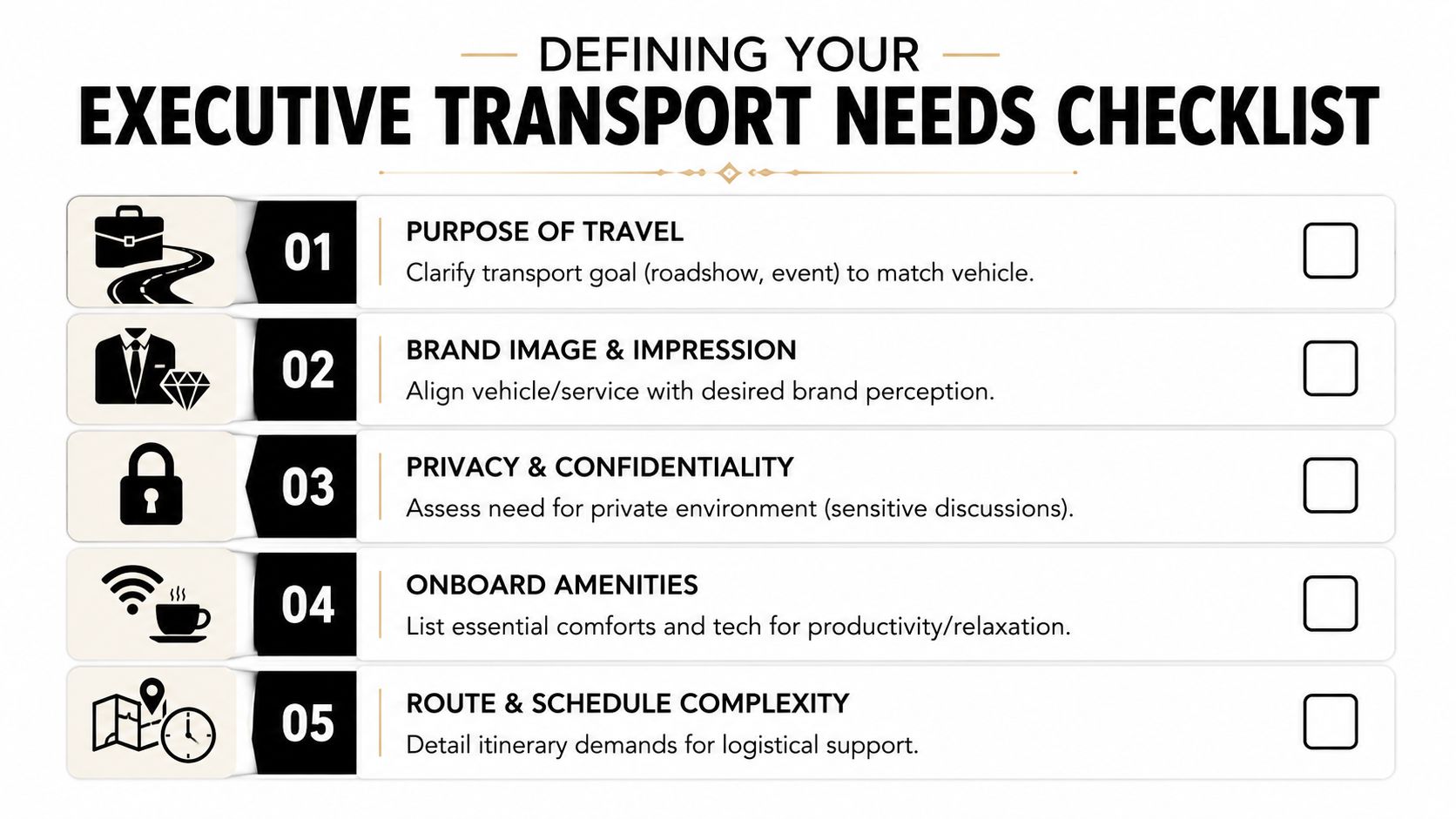
I use a five-part screen before I approve any custom van program in Houston:
- Trip purpose: board transfer, roadshow, airport arrival, FBO movement, event support, family office movement, or crew transport
- Passenger profile: executives, clients, VIP family members, security personnel, or a mixed group with different service expectations
- Privacy requirement: open conversation, confidential calls, sensitive documents, or no special sensitivity
- Cabin function: workspace, quiet transfer, luggage-heavy movement, hospitality-driven arrival, or all-day standby
- Itinerary pressure: one pickup, multiple stops, live schedule changes, venue holds, or rolling standby with uncertain release times
Friction is usually the real failure point
Senior travelers rarely describe a trip as failed because the van had the wrong badge. They remember slow boarding, poor cooling, cluttered luggage placement, a driver who called the principal directly, or an interior that looked customized online and felt improvised at the curb.
That is why intake quality matters.
A planner who defines only passenger count often gets a vehicle. A planner who defines exposure, handling requirements, and service protocol gets a transport solution that holds up under pressure. In Houston, that distinction matters because the city routinely combines long transfer windows, weather swings, event congestion, airport complexity, and tight executive calendars.
Build the request the way an operator can execute it
Internal teams should send more than “need a van.” A usable request includes the details that affect dispatch, equipment choice, and risk control:
- Who is riding: board members, clients, executives, family office principals, staff, security, or a mixed party
- What they are carrying: roll-aboards, garment bags, presentation kits, product samples, medical items, or event materials
- What must be protected: privacy, arrival appearance, schedule precision, quiet cabin conditions, or direct coordination through one point of contact
- How service should run: one-way transfer, meet-and-greet, standby by the hour, multi-stop managed itinerary, or dedicated chauffeur coverage
- What would damage the assignment first: late arrival, visible confusion at pickup, weak climate control, poor luggage management, or no backup if plans change
Those answers prevent two common mistakes. One is paying for cosmetic luxury without getting the service controls necessary for the trip. The other is booking a basic vehicle for a high-visibility movement and forcing the driver and passengers to absorb the gap in real time.
For executive transport, “custom” should describe a setup that supports the assignment, not just an upgraded cabin.
Decoding Houston's Custom Van Options and Service Tiers
At 6:10 p.m., a principal steps out of a Galleria meeting expecting a quiet ride to a private dinner. The van on site technically fits the party, but the rear cabin is warm, luggage is stacked beside the second row, and the interior “upgrade” turns out to be cosmetic trim over basic fleet seating. That is how planners learn the hard way that custom and executive-grade are not the same purchase.
“Custom” covers a wide range in Houston. Sometimes it means better leather, accent lighting, and a cleaner exterior presentation. Sometimes it means a true executive conversion with privacy glass, conference-style seating, rear climate control, charging access, and a layout built for people who need to work or arrive client-ready. It can also mean aftermarket work of uneven quality. The photos may sell the vehicle. The build quality decides whether it performs under pressure.
What separates executive-grade from dressed-up fleet stock
The useful distinction is operational, not cosmetic. A transport-grade van moves people. An executive-grade van supports schedule control, privacy, comfort, and presentation standards during live assignments.
In Houston, that difference shows up fast. Long drive times, heat, rain, airport waits, and venue congestion expose weak cabin cooling, poor ingress, marginal luggage planning, and thin service coordination. A van that looks good for a static photo can fail in the first pickup window.
Use this comparison during review:
| Service factor | Standard passenger van | Executive custom van |
|---|---|---|
| Cabin purpose | Basic group transfer | Transfer, calls, quiet work, hosted travel |
| Seating and finish | Durable fleet interior | Higher-grade seating, cleaner presentation, quieter cabin |
| Luggage handling | Shared cabin space is common | Better separation between passengers and bags |
| Privacy | Limited | More protection for conversations and sightlines |
| Service expectation | Pickup and drop-off | Tighter timing, higher protocol, stronger communication |
Vehicle category alone does not confirm quality. A Sprinter, Transit, or other high-roof van can be configured well or poorly. The review should focus on how the exact unit is built, how it is maintained, and whether the operator can describe where that vehicle fits best.
Features that matter because the assignment does
For executive use, rear climate control is a functional requirement in Houston. Front AC is rarely enough once the cabin fills, especially after curbside waits, hotel loading, or tarmac exposure. If the provider cannot explain how the rear cabin cools under summer conditions, keep asking.
Power access matters for a different reason. Senior passengers may not care about a long feature list, but they notice quickly when laptops, phones, and presentation devices cannot stay charged. The same goes for Wi-Fi. It should be described as available, vehicle-specific, and reliable enough for actual use, not listed as a marketing extra that may or may not be active on the day of service.
Layout also deserves more scrutiny than planners usually give it. Captain's chairs, aisle space, entry step height, and door operation affect boarding speed and rider comfort. For elderly VIPs, investors in formalwear, or guests carrying presentation materials, those details matter more than LED lighting or glossy trim packages.
For broader fleet guidance on premium van categories, this luxury van rental overview helps compare what different service tiers usually include.
Questions that expose weak customization claims
Ask direct questions and listen for direct answers:
- Was the conversion factory-produced or completed by an aftermarket upfitter? Aftermarket work is not automatically a problem, but reputable operators should be able to name the builder and describe the installation standard.
- What maintenance records support the custom equipment? TVs, charging ports, partition controls, powered seating, and upgraded lighting all need inspection and upkeep.
- How does this specific van handle luggage for this passenger count? “It should fit” is not a serious answer for executive work.
- What is the backup plan if this exact vehicle goes out of service? The substitute standard should be equal or better, not “same capacity.”
- Who usually rides in this unit? Experienced operators can tell you whether the van is best for airport transfers, roadshows, family office movements, artist handling, or board travel.
A credible provider will answer in operating terms. A weak one will fall back on luxury adjectives and brochure language.
The main job in this section is not picking the nicest-looking van. It is confirming that the customization is legitimate, the service tier matches the assignment, and the operator can support the vehicle at the standard your passengers will expect.
The Executive Planner's Booking Timeline and Contract Checklist
At 9:40 p.m., the itinerary looks settled. At 10:15 p.m., the client office adds two principals, one security lead, and a request for charging access during the transfer. The booking that looked fine an hour earlier can fail quickly if the contract only guarantees "a similar vehicle" and says nothing about how the van was built, who can approve changes, or what happens if the assigned unit goes out of service.
That is why experienced planners separate price shopping from risk control. Published rates help with budgeting. The essential task is confirming that the operator can deliver the exact service standard your passengers were promised.
Book in phases, with approval points
Strong bookings are built in three reviews, not one rushed confirmation.
Vehicle fit review
Confirm passenger count, luggage reality, cabin layout, climate performance, charging needs, and whether the stated customization actually supports the trip.Operational fit review
Define chauffeur standard, wait-time policy, manifest handling, arrival procedure, dispatch access, and who has authority to approve reroutes or extra stops.Contract fit review
Check substitution language, customization disclosures, billing triggers, insurance terms, and how service failures are documented and corrected.
The third review usually determines whether a premium booking stays under control on trip day.
The contract language that protects executive service
Executive transport contracts fail in predictable places. The wording is often broad where it should be specific. "Custom van" may refer to anything from a properly documented upfit to cosmetic add-ons with little disclosure behind them.
Ask for the details in writing before deposit and again before final confirmation. If the van includes upgraded seating, partitions, lighting, media systems, or added power components, the provider should be able to explain who installed them, how they are maintained, and what unit replaces them if that exact vehicle is pulled from service. A polished sales answer is not enough. For executive work, documentation matters more than adjectives.
Use this checklist before signing:
- Customization disclosure: Identify whether seating, electronics, lighting, partitions, and power systems are OEM, upfitter-installed, or later aftermarket additions.
- Substitution terms: Require advance notice and equivalent-class replacement language tied to layout and service level, not just passenger capacity.
- Insurance clarity: Get a plain-language explanation of coverage structure, claim handling, and any exclusions that affect executive ground transport.
- Service window definition: Confirm how standby, grace periods, delays, and itinerary changes are billed.
- Authority chain: State who may authorize route changes, added stops, or schedule extensions.
- Presentation standards: If the trip is client-facing, put cleanliness, driver attire, and vehicle presentation requirements in writing.
- Failure protocol: Define what happens if the assigned vehicle is late, disabled, or replaced with a lower-spec unit.
For planners benchmarking what should be specified in advance, this luxury Sprinter van rental with driver guide is a practical reference point.
Red flags that deserve a second look
Some operators expose weak controls before the first wheel turns.
| Red flag | Why it matters |
|---|---|
| Heavy focus on lighting, screens, or aesthetics with little detail on build origin | The customization may be more marketing than documented equipment |
| No clear answer on who installed custom components | Safety, maintenance, and liability become harder to verify |
| Broad substitution language | A downgrade can still satisfy the contract on paper |
| Sparse service terms | Dispatch problems and billing disputes shift to your team |
| No defined airport versus FBO procedure | The operator may not be set up for executive or aviation-grade handoffs |
One more discipline point matters here. Hold the reservation with a clear approval trail. Verbal assurances made during quoting should appear in the final confirmation and service order. If they do not, treat that gap as a warning, not an administrative oversight.
Booking discipline: If the vendor cannot explain the van build, substitution standard, and day-of-service process in plain English, do not hand them a high-visibility movement.
Mastering Houston Logistics Airport FBO and Venue Coordination
A flight can land on time and the movement can still fail.
That usually happens in the handoff. An executive party clears the terminal, the chauffeur is waiting at the wrong door, one bag is still missing, and the venue contact assumes the arrival is 20 minutes later than planned. In Houston, those small misses stack up quickly because airport footprints are large, drive times swing with traffic, and many premium venues limit where a van can wait.

Commercial airport pickups need clean handoffs
At George Bush Intercontinental Airport and William P. Hobby Airport, the quality check is simple. Can the operator take control of the pickup without pulling the passenger into dispatch work?
A capable provider confirms the airline, terminal, arrival status, baggage count, lead traveler, and the exact communication chain before wheels down. The service order should also state the meet point, hold procedure, and what happens if one traveler diverts while the rest of the party continues. If those details are being sorted out by text after landing, the plan was incomplete.
For airport-focused planners, this Gateway Travel Centre resource for connection flow and transfer planning is a useful companion.
FBO transport requires a different protocol
FBO work needs a tighter standard than a commercial curb pickup. Access rules, release procedures, and privacy expectations are different, and a provider that handles hotel transfers well can still struggle on private aviation movements.
Confirm the exact FBO, the approved point of contact, the arrival tail or flight reference if your aviation team uses one, and who has authority to release passengers and bags to the vehicle. Ask how the chauffeur identifies the party without creating an awkward public exchange. For some principals, low-profile positioning matters more than presentation. For others, vehicle placement is part of the arrival standard. The operator should not be guessing between those two service styles.
Cabin readiness also matters more than many planners expect. Houston heat exposes weak rear climate control fast, especially during ramp-side waits, luggage loading, or extended boarding with the engine idling under restrictions. A custom van may look right in photos and still perform poorly if the cooling setup cannot hold the rear cabin at a comfortable temperature.
Venue work tests whether dispatch and on-site coordination are actually disciplined
Downtown towers, the Galleria, NRG Center, hotels, and private event venues all run on different curb rules. The risk is rarely the drive itself. The problem is bad staging, unclear release timing, or a vehicle arriving at the right property but the wrong entrance.
I recommend building a one-page venue movement sheet and sending it to both dispatch and the chauffeur. Include:
- Exact curb, valet lane, dock, or private entrance
- On-site contact and mobile number
- Allowed staging window
- Passenger release time and latest acceptable departure time
- Identification method for the traveling party
- Luggage count and overflow plan
- Security, credential, or escort requirements
One missed field can create a visible delay.
The best Houston plans treat airport, FBO, and venue segments as separate operating environments with different risks, approval chains, and timing rules. That is how planners verify that a custom van service is more than a polished vehicle with a dispatcher behind it.
Sample Itineraries From Roadshows to Special Events
The easiest way to test a transport plan is to run it like a live day.
Corporate roadshow across Houston
A leadership team arrives in the morning, starts with an airport pickup, then moves through a sequence of meetings between the Energy Corridor and Downtown, a schedule where an executive van earns its keep as a controlled buffer between appointments.
The working version of the itinerary keeps the same chauffeur and vehicle through the day, protects a clean cabin between stops, and uses the van as a reset space for calls, notes, and presentation review. Luggage stays secured and out of the passenger area. Boarding stays fast because seating and bag flow were planned before pickup.

A weak version of this day usually shows the same pattern. The group books a large van for capacity, then discovers the interior is better suited to moving people than supporting executives. Calls become awkward, bags shift around, and the vehicle feels more like a shuttle than a mobile base.
VIP event movement near NRG Center
An evening gala, sporting event, or private function creates different pressure. Now timing, curb presence, and exit strategy matter as much as the ride itself.
A sound plan stages the vehicle well before guest release, confirms the exact pickup lane or private access point, and sets a communication protocol that doesn't force VIP passengers to coordinate their own retrieval. The chauffeur remains reachable, but the operational contact handles changes. That keeps the principal out of the logistics loop.
For planners, these event movements also reveal whether the provider understands custom van rental Houston at the executive level. The van should support a composed arrival, secure storage, and a clean departure without the chaos that often comes with busy venue curbs.
FAQs for Houston Executive Transportation Planners
How do quality providers handle last-minute itinerary changes?
This is one of the first questions experienced planners ask, and for good reason. A frequently raised issue in Houston executive transport is how custom van rentals manage last-minute changes for multi-city corporate roadshows or FBO transfers without penalizing the client, especially since 68% of corporate travel managers prioritize vendors with real-time itinerary adjustment capabilities (corporate travel preference for real-time itinerary flexibility).
The practical answer is that you should settle the process before the trip. Ask who can approve changes, how the driver receives updates, and whether the service model supports rolling adjustments or requires a new dispatch event for every stop change. The best operators centralize those updates through operations rather than turning the chauffeur into the planner.
What should I ask about customization legitimacy?
Ask direct, unglamorous questions. Who installed the seating, electronics, and power components? Was the work done as part of a recognized upfit or as later aftermarket modification? Can the provider describe the build confidently without falling back on lifestyle language?
You don't need a technical lecture. You need enough clarity to know the vehicle wasn't made impressive at the expense of safety or serviceability.
Is a larger van always better for executive groups?
No. Extra seats can create the wrong cabin if the trip is about comfort, discussion, or client presentation. Many executive groups do better in a vehicle with fewer but better-positioned seats, cleaner luggage handling, and easier boarding.
For visible client-facing trips, wasted space is less damaging than a crowded luxury claim that doesn't hold up once everyone sits down.
How should I manage multi-vehicle coordination?
Use one control point. Assign one planner or dispatcher to own release timing, passenger assignment, and venue communication. Split control creates missed handoffs and duplicate calls.
A simple manifest helps:
- Passenger grouping by priority or function
- Named lead contact for each vehicle
- Separate bag and equipment notes
- Fallback loading order if one vehicle is delayed
That's enough structure to avoid confusion without overengineering the day.
What matters most for airport and FBO pickups?
Accuracy and discretion.
For commercial airports, confirm terminal, baggage assumptions, and primary contact. For FBOs, confirm the exact facility, release process, and whether the passenger wants a low-profile or presentation-forward pickup. Those details sound small until one of them is wrong.
Should I prioritize vehicle amenities or operating process?
For senior travelers, process usually wins. A polished van with weak coordination still creates a poor experience. A well-run movement plan in a properly equipped executive vehicle feels calm, which is what most principals remember.
The strongest custom van rental Houston bookings get both right. They match the cabin to the mission, and they insist on operational clarity before wheels ever move.
If you need executive-level ground transportation with discreet chauffeurs, FBO coordination, roadshow support, and luxury van service planned to the last detail, MLR Worldwide Service is built for that standard. Their team supports complex itineraries, VIP travelers, and time-sensitive Houston movements with the kind of operational control that keeps principals focused on their day, not their ride.