
Your travel desk has the itinerary locked. The aircraft slot is confirmed. The meeting location is known. What usually remains vague is the highest-risk segment of the entire movement: the drive between secure points, often with a person, item, or set of documents that can't be replaced if something goes wrong.
That's where many buyers make a basic mistake. They assume an armored car service is a heavier vehicle with dark glass and a professional driver. In practice, executive transport under high risk is a different discipline. It combines route planning, discreet movement, vehicle selection, trained personnel, contract clarity, and insurance terms that match the asset being moved.
The public picture of this industry still leans toward bank routes and ATM replenishment. That view misses what corporate leaders, family offices, private aviation teams, and event managers often need most: secure, low-profile transport for executives and non-cash valuables where discretion matters as much as protection.
Understanding Modern Armored Car Services
The phrase “armored car service” often brings to mind a box truck outside a bank. That's only one slice of the market.
Public coverage still overwhelmingly frames armored transport as cash-in-transit for financial institutions, while giving very little attention to the emerging niche of secure transport for high-net-worth individuals and corporate executives traveling with portable high-value assets, as noted in IBISWorld's U.S. armored transportation industry coverage. For a corporate client, that distinction matters because the service model, vehicle profile, and operational behavior are not the same.
Cash movement and executive movement are different jobs
A traditional CIT operation is built around repeatable routes, custody controls, timing windows, and visible deterrence. The vehicle is part of the message. It signals hard target, trained crew, controlled transfer.
Executive-focused secure transport usually requires the opposite posture.
The client may need:
- Low-profile arrival that doesn't advertise wealth, deal activity, or family status
- Flexible routing because schedules shift, venues change, and exposure points emerge in real time
- Passenger-centered security where comfort, privacy, and continuity of meetings matter
- Mixed cargo protection for laptops, legal files, prototypes, jewelry cases, hard drives, or other portable valuables
A standard armored carrier may be excellent at moving sealed value bags and still be the wrong choice for moving a CEO from an FBO to a hotel while preserving discretion.
Practical rule: Buy the service model that matches the exposure, not the one that sounds toughest on paper.
Where executive clients usually get it wrong
The first mistake is focusing only on armor. The second is assuming all armored fleets are suitable for VIP movement. They aren't.
A visibly fortified vehicle can create problems in certain environments. It may draw attention at an upscale hotel, outside a board meeting, or during an investor roadshow. In those settings, low-profile SUVs or sedans with protective upgrades often make more operational sense than overtly commercial armored platforms.
The third mistake is treating secure transport as an isolated booking. It should sit inside the wider ground movement plan, especially when aviation, hotel access, and event timing are involved. If your team is still thinking in separate bookings instead of a coordinated movement plan, this overview of what ground transportation includes in practice is a useful starting point.
What modern buyers should ask for
A proper executive-grade armored car service should be scoped around purpose, not category label. Ask the provider what they're configured to do.
A useful first-pass framework looks like this:
| Service need | What matters most |
|---|---|
| Executive movement | discretion, route control, chauffeur judgment, secure communications |
| Non-cash valuables | chain of custody, declared value process, handling protocol, insurance wording |
| Event or gala transport | timed arrivals, curbside exposure management, close coordination with venue security |
| Airport and FBO transfer | tarmac-side timing, baggage handling discipline, no-delay contingency planning |
The right provider doesn't just confirm pickup and drop-off. They define who or what is being protected, where exposure points sit, and how they'll reduce those points without making the movement feel theatrical.
Decoding Armored Vehicle Specifications and Safety
When a provider says a vehicle is armored, the only useful follow-up is: armored against what?
That question changes the procurement conversation immediately. Protection should match the threat profile, not marketing language.
What “armored” actually includes
For valuables transport, armored vehicles are typically built on van or truck chassis with bullet-resistant glass, armor plating, and reinforced shells designed to withstand bullets from most handguns and rifles, according to the overview of valuables armored vehicles). The same source notes that personnel in armed roles must complete a minimum of 8 hours of pre-assignment training and a basic course of at least 32 hours.
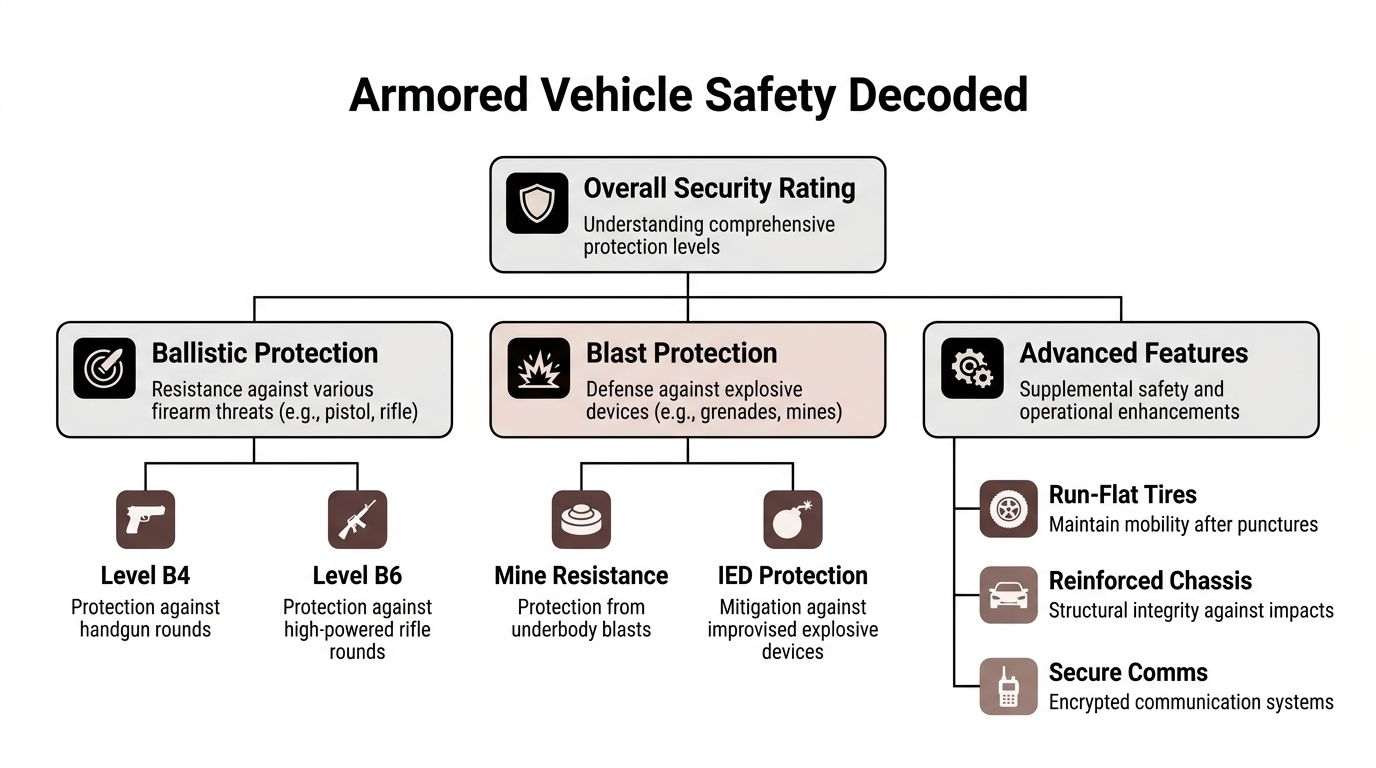
Those basics matter, but they don't tell you whether the vehicle is suitable for your mission. For executive movement, the smarter way to assess a vehicle is to view it as a system, not just a shell.
Protection is more than steel and glass
A protected vehicle that can absorb attack but can't keep moving is only half-prepared. In real operations, mobility often matters as much as resistance.
Look for these practical components:
- Run-flat tires: They help the vehicle clear the danger area after puncture or ballistic damage.
- Reinforced suspension and brakes: Added armor changes weight, stopping distance, and handling.
- Door and hinge reinforcement: These are stress points under impact and repeated use.
- Secure communications: The driver and support team need dependable contact with operations.
- Power management and redundancy: Electronics, locks, and communications shouldn't fail under load.
A common procurement error is to ask for the highest protection level available without considering what it does to ride quality, acceleration, visibility, and curbside discretion. More armor can reduce maneuverability. In some urban settings, that trade-off can work against the mission.
The best protected vehicle is the one that can leave quickly, blend in appropriately, and stay reliable for the full movement.
Match the vehicle to the route
A board transfer between a private terminal and a central business district doesn't present the same profile as a late-night movement with irregular stops, media visibility, or public-event congestion.
Use a simple decision lens:
- Threat type: opportunistic theft, targeted attack, protest activity, surveillance concern
- Environment: dense city core, suburban route, event venue, cross-border movement
- Exposure duration: curbside loading, hotel approach, traffic choke points, repeated stops
- Passenger requirement: discreet executive image, family comfort, room for support personnel, baggage load
If a provider can only describe the armor and not the operational trade-offs, they're selling hardware, not a security solution.
Key Use Cases for Secure Executive Transport
The demand picture tells you where the market's center of gravity still sits, but it also points to adjacent needs. In the United States, the armored car services segment grew 6.8% annually over the past three years and reached $4.3 billion in revenue by 2024, driven by banking, retail, and secure transport demand that also includes items such as jewelry and pharmaceuticals, according to Kentley Insights' industry report.
That matters because executive buyers often sit just outside those standard categories. Their use cases are real, recurring, and usually underplanned until the week of travel.
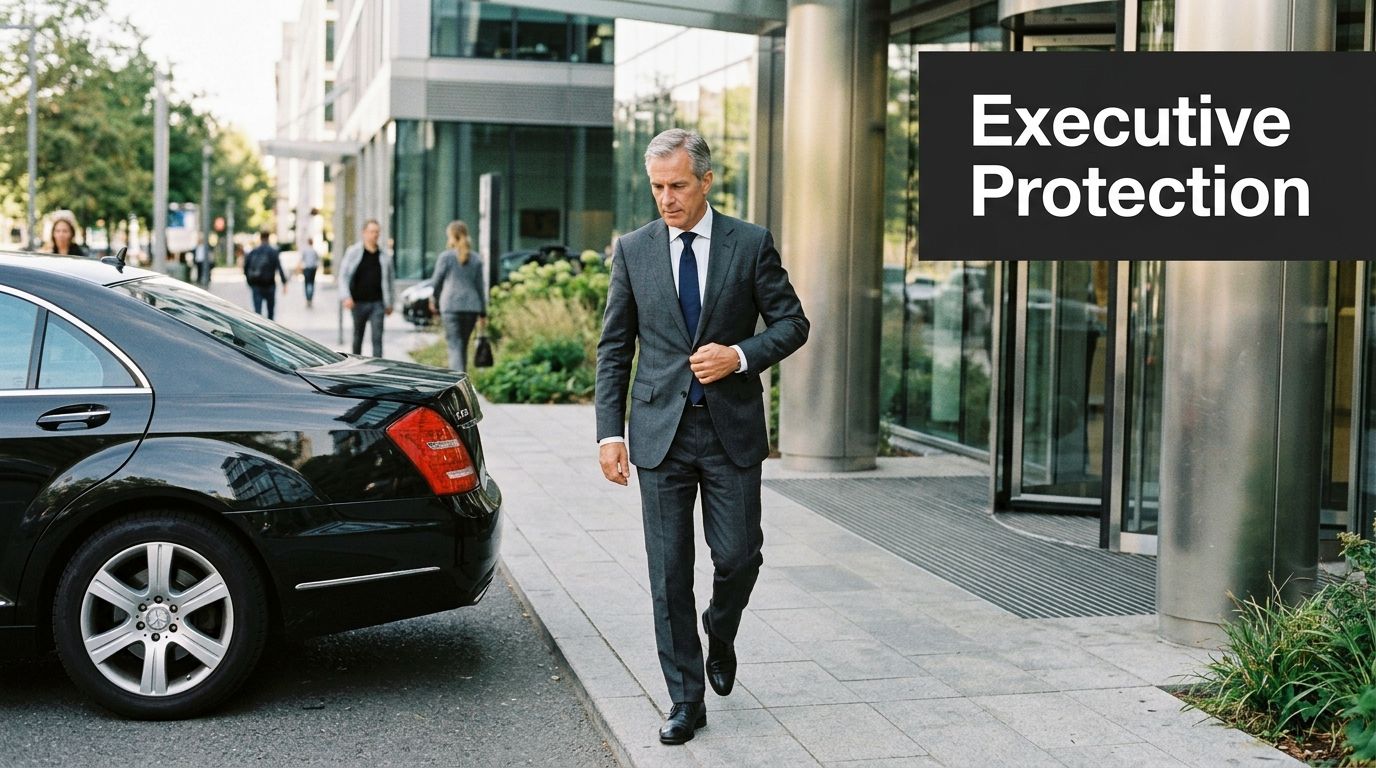
The chief executive with a visible schedule
A CEO lands after a public earnings event. The route to the meeting site is obvious. Protest activity is possible, local media may be present, and there's a narrow arrival window.
A standard premium sedan with a good chauffeur may handle comfort, but not high disruption risk. A proper armored car service in this scenario adds route alternatives, curbside timing discipline, controlled loading, and a vehicle that can absorb more than routine road risk without turning the arrival into a spectacle.
The outcome isn't dramatic. That's the point. The principal arrives on time, enters through the correct access point, and keeps the schedule intact.
The deal team carrying sensitive material
A legal team and transaction lead need to move between offices with signed originals, encrypted storage devices, and board materials that should never be left in a trunk at valet or in an unsecured car outside a restaurant.
Buyers often overestimate generic courier solutions and underestimate transport exposure. The value may not be sentimental or jewelry-grade. It may be strategic. Loss, theft, or tampering could disrupt a transaction even if the physical items look ordinary.
A secure movement plan solves for custody, access control inside the vehicle, and no-unsupervised-stop rules.
The family office moving portable valuables
The setting may be an auction, a private sale, a gala, or a temporary relocation between residences. The assets might be jewelry, watches, art components, or collectibles. The challenge is that the client wants both protection and discretion.
An overt commercial cash truck may be secure but socially conspicuous. A lightly planned luxury vehicle may be discreet but procedurally weak. The right answer often sits in the middle: protected transport, controlled handling, a tight manifest process, and a team briefed on who may touch what.
Security failures in this category rarely begin with an attack. They begin with assumptions, such as “the driver knows,” “the venue is secure,” or “we'll decide on the route later.”
The executive event arrival
A principal is scheduled to appear at a conference, shareholder event, or high-profile dinner where arrival timing is public and the curbside zone is chaotic. There are cameras, staff, guests, competing vehicles, and too many people authorized by nobody.
In this service, efficient operations matter more than visible force. The provider should know the venue approach, staging area, fallback entrance, holding pattern, and who has authority to change the plan. The vehicle itself is only one layer. The primary asset is disciplined execution in a compressed timeline.
Navigating Pricing Insurance and Liability
Pricing for an armored car service becomes distorted when buyers compare quotes before they compare scope. The lower quote often assumes less exposure, fewer controls, weaker insurance, or simpler vehicle requirements. On paper, the services look similar. In operation, they aren't.
What actually moves the price
Several variables shape cost, even when providers describe the service using similar terms.
Some are obvious:
- Vehicle profile: a low-profile armored SUV and a commercial valuables vehicle serve different missions
- Personnel model: solo chauffeur, dual crew, armed detail, or coordination with existing executive protection
- Route complexity: airport transfer is one thing, multi-stop city movement with changing access points is another
- Timing risk: late-night operations, event departure surges, and standby windows increase complexity
Others are less visible but often more important:
- Pre-mission planning
- Contingency route development
- Secure staging time
- Handling requirements for non-cash items
- Documentation and custody procedures
If you're comparing proposals, review how the provider defines inclusions. This breakdown of insurance coverage details clients should verify is useful because many quote gaps come from assumptions about what is and isn't covered.
The liability problem with non-cash valuables
Many experienced buyers are still surprised. Existing guidance on fiduciary responsibility often leans on older definitions tied to the face value of money, which leaves clients unclear about treatment for non-cash assets such as crypto hardware wallets or rare collectibles, as discussed in the U.S. Department of Justice archive on armored car industry liability issues.
That creates a practical problem. A provider may say they transport valuables. That doesn't automatically mean your specific item is covered the way you assume.
Questions that need written answers
Don't settle for verbal reassurance. For non-cash assets, ask for written confirmation on these points:
- Declared value: Is the item listed by specific declared value, or grouped under a generic valuables category?
- Coverage trigger: Does coverage apply during loading, in transit, temporary staging, and unloading?
- Exclusions: Are digital assets, collectibles, prototypes, one-of-a-kind items, or fine art carved out?
- Liability basis: Is reimbursement tied to contractual limits, appraised value, replacement cost, or a narrower definition?
- Client obligations: Must you pre-declare, package in a certain way, or use an approved inventory process?
A sentence like “fully insured” is not enough. It may refer only to the vehicle operation, not the actual asset.
Client-side discipline: If the item would create a board-level problem if lost, insist that the contract identify it clearly and state how liability will be handled.
What works and what doesn't
What works is a contract package that separates three issues cleanly: vehicle liability, passenger protection, and cargo or asset coverage. That lets legal, risk, and security teams review the service without guessing which policy addresses which exposure.
What doesn't work is bundling everything under a generic transport agreement and assuming expensive property automatically receives specialist treatment. For jewelry, rare collectibles, unique documents, or sensitive storage devices, specialized insurance may still be necessary even when the transport itself is secure.
One more operational point matters. If the asset is unusual, say so early. Providers can only plan around exposures they know exist.
How to Evaluate and Select an Armored Service Provider
A polished website proves almost nothing in this category. You need operational evidence.
The provider should be able to explain how they hire, train, equip, insure, and manage missions under pressure. If answers stay vague, move on.
Start with the essentials
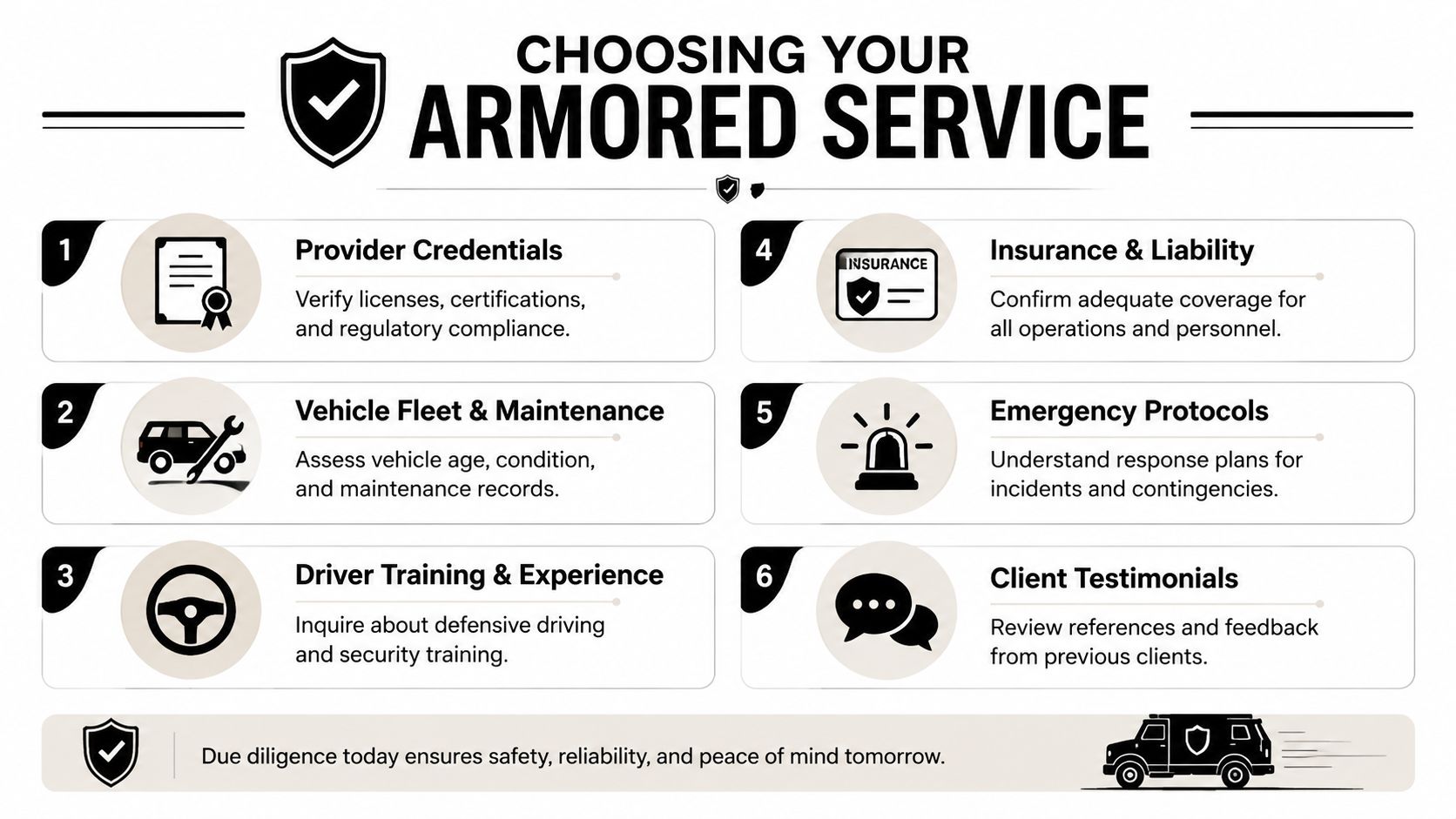
A practical due diligence process starts with documents, not branding. Professional standards require armored transport providers to carry full insurance for potential damage, theft, or loss during transit, which clients must verify as an essential risk control, according to Armormax's transport guidance.
Ask for proof, not promises.
Here's a strong starting checklist:
- Licensing and legal authority: Confirm the provider is authorized for the jurisdictions involved.
- Insurance certificates: Review active coverage documents and verify limits and applicable operations.
- Vehicle documentation: Ask how vehicles are maintained, inspected, and assigned to missions.
- Personnel screening: Verify background checks, role-specific training, and experience profile.
- Operations support: Confirm there is live coordination support, not just a dispatcher taking bookings.
If you need a broader shortlist before formal due diligence, this overview of secure transport companies serving executive and VIP clients can help frame what serious providers should look like.
Interview the provider like a risk vendor
Don't ask, “Are you secure?” Ask questions that force operational clarity.
For example:
| Area | Ask this |
|---|---|
| Personnel | Who drives the mission, and what security or defensive driving background do they have? |
| Fleet | Which vehicle would you assign to this route, and why that vehicle rather than another? |
| Contingencies | What happens if the primary route closes or the venue access point changes? |
| Communications | Who monitors the movement in real time, and how do they communicate with the team? |
| Incident handling | What is your procedure for breakdown, surveillance concern, or attempted interference? |
Notice what this does. It shifts the discussion from amenities to competence.
A reliable provider answers directly. A weak one falls back on phrases like “our team is highly experienced” without describing how that experience shows up during a real movement.
Before going deeper, it helps to see how the category presents itself publicly. This short video gives a useful visual reference point.
Red flags buyers should take seriously
Some warning signs are subtle:
- Vehicle-first sales pitch: They talk about plating and glass but not routes, exposure points, or custody.
- No contract specificity: They won't define who or what is covered.
- No operations layer: There's no sign of a real monitoring or coordination function.
- Generic references only: They can't produce relevant examples of executive or high-value movement work.
- Overconfidence: They promise that “nothing will happen.” Serious operators talk about preparation, not invulnerability.
A strong provider sounds measured. They don't dramatize risk, and they don't dismiss it.
The Logistics of a Secure Transportation Operation
The difference between a premium ride and a secure operation is everything that happens before the vehicle reaches the curb.
Good secure transport feels calm because the complexity has already been handled. Threat review, route work, access planning, driver briefing, timing buffers, and backup decisions are all settled before the client steps in.
Planning starts before wheels move
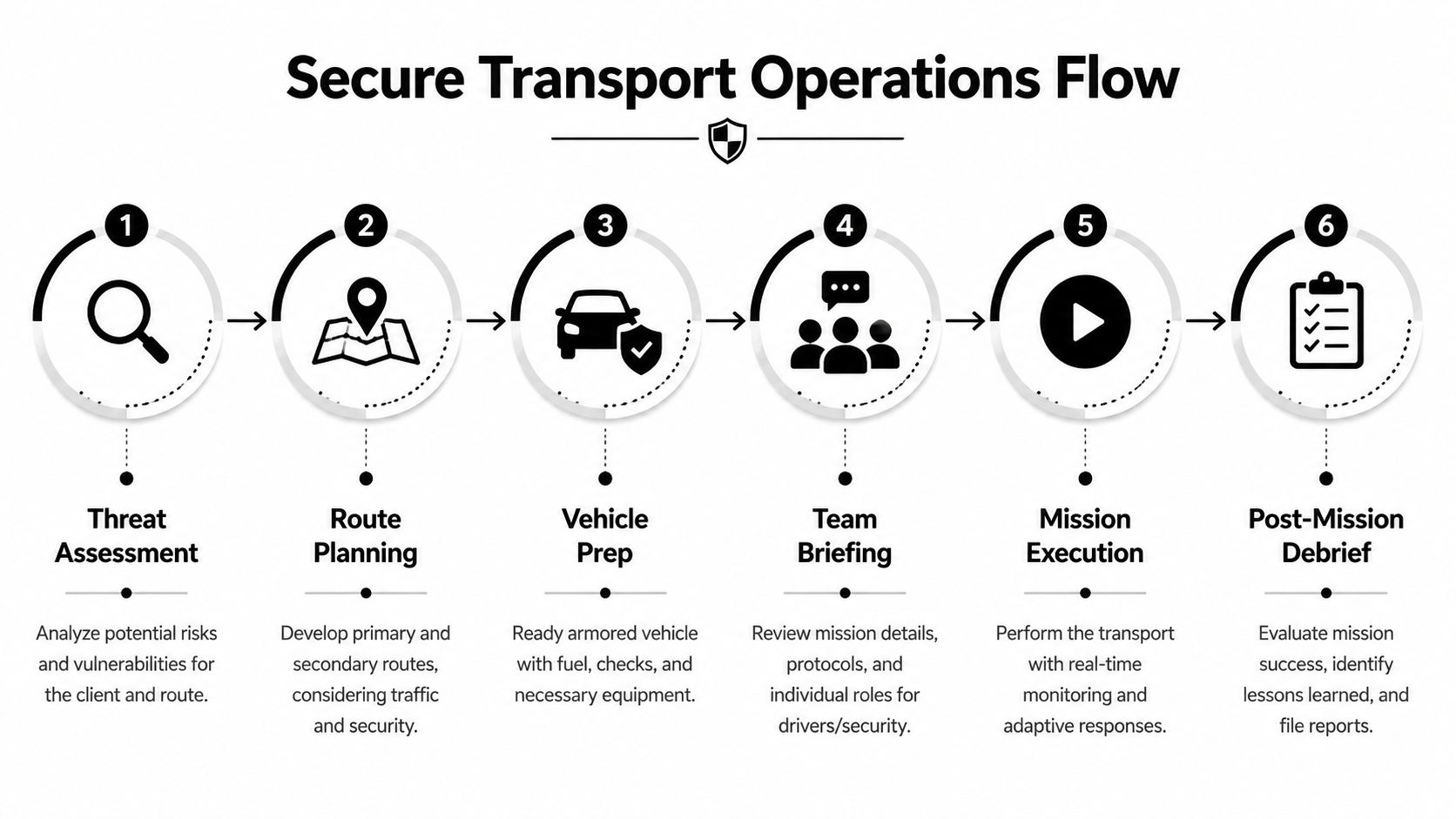
The strongest operations teams treat transport as a managed sequence.
A sound workflow usually includes:
- Threat review: Who is moving, what is being carried, and where are the pressure points?
- Route design: Primary and alternate routes, timing windows, choke points, and arrival procedures.
- Vehicle preparation: Mechanical readiness, fuel, cleanliness, communications, and any mission-specific equipment.
- Briefing: Driver, security personnel, coordinator, and client-facing staff align on the plan.
- Execution: The team monitors progress and adapts without improvising blindly.
- Debrief: Any issue, even a minor one, gets recorded and used to improve the next mission.
Seamless operations are usually quiet operations
In executive travel, the client shouldn't feel process friction. They shouldn't be hearing internal confusion at pickup, waiting while the team debates the entrance, or learning mid-route that nobody confirmed the loading zone.
The best movements are disciplined but unobtrusive. The vehicle arrives where it should. The chauffeur knows the name, the route, the backup route, and who has authority to modify the plan. The operations team tracks the movement without repeatedly calling the client.
This matters even more when multiple stakeholders are involved. Family office staff, aviation coordinators, hotel security, event producers, and executive assistants often each hold one part of the schedule. The transport provider has to turn that fragmented information into one coherent movement.
Where secure operations usually break down
Failures usually happen at handoffs.
Common weak points include:
- Airport to ground transition where timing slips and curbside exposure increases
- Venue arrivals where public access and service traffic mix together
- Asset handling when too many people touch the same case, bag, or container
- Schedule changes that trigger ad hoc routing without proper review
The fix isn't more drama. It's better control. Clear authority, confirmed contacts, pre-cleared access points, and a team that knows the mission profile before departure.
An armored car service earns its value long before any emergency response would be needed. It reduces the chance that the principal, the asset, or the schedule ever reaches a vulnerable point in the first place.
When executive travel, high-value assets, and tight schedules need to move without friction, MLR Worldwide Service provides discreet, professionally coordinated ground transportation built for demanding itineraries. For corporate leaders, family offices, aviation teams, and event planners who need secure movement handled with precision, MLR offers the kind of operational control, responsiveness, and discretion that high-risk travel requires.