
You know the scene if you work airline ops or flight department logistics. The crew clears the aircraft, the local time is ugly, the hotel is technically close, and the transfer sits in a gray zone between “handled” and “still waiting.” By the time everyone reaches a bed, the duty period is over on paper, but the fatigue risk has already been built on the ground.
That's the part most crews feel first and most programs measure last. Crew fatigue management isn't just about the leg in the air, because sleep loss, workload, and timing start stacking long before takeoff and keep stacking after landing. The strongest programs treat fatigue as a system problem, then build controls around scheduling, rest, transport, and recovery instead of asking people to be tougher.
Why Crew Fatigue Has Become a Board-Level Safety Issue
A long-haul rotation can look clean on paper and still be ugly in practice. The crew is displaced across time zones, the report time shifts earlier than expected, hotel check-in drags on, and the last mile from airport to bed eats into the only sleep window that matters. That is why fatigue stopped being treated as a personal discipline problem and became an organizational safety issue.
ICAO's cabin crew fatigue management framework defines fatigue as a physiological state driven by sleep loss, extended wakefulness, circadian phase, or workload that can impair alertness and safety-related performance. That definition mattered because it moved the conversation away from individual resilience and toward systemic risk control. Analysts summarized in Fatigue risk management for cabin crew found that 84% of 9,180 cabin crew reported being fatigued while on duty, 71% said their safety-related performance was affected, and 52% reported nodding off while working on a flight, all cited in ICAO's cabin crew fatigue management materials: ICAO cabin crew fatigue management.
The operational lesson is simple. If a schedule regularly produces fatigue, the schedule, the rest plan, and the handoffs around it are the problem. The crew is the last point where the risk shows up, not the place where it starts.
Practical rule: If the crew member's hardest hour is after the aircraft door closes, fatigue controls are already too late.
Regulators and safety teams now expect ownership to sit across dispatch, crew planning, hotel coordination, aviation ground services, and line management. Flight time limits still matter, but they cover only one layer of the risk. Modern crew fatigue management asks who protected sleep opportunity, who removed friction from the ground leg, and who checked whether the actual rest time matched the planned rest time.
The Science of Fatigue You Can Use
In operations, fatigue breaks into three drivers: sleep pressure, circadian rhythm, and workload. Each one shows up differently on a roster, and each one needs a different control.
Sleep pressure is the buildup of time awake and missed sleep. The longer someone stays awake, the more the body pushes back. Circadian rhythm is the body's timing system, and some hours are harder than others, especially when a crew member is awake during the window of circadian low, 0200 to 0600, which IATA flags as a key causal variable in event analysis: IATA fatigue management guide for airline operators.
Acute fatigue and sleep debt are not the same thing
A crew member who had one bad night is dealing with acute fatigue. A crew member who has been short on sleep for several days is carrying sleep debt, and the operational response is different. The first may improve with one protected rest opportunity, while the second usually calls for schedule design, not just a good hotel.
Workload matters because fatigue is not only about sleep quantity. Heavy service demands, irregular duty periods, disrupted routines, and poor recovery windows all raise the load on attention and decision-making. ICAO's definition and the cabin crew research linked earlier support that broader view of risk, which is why one “reasonable” rest plan can still fail if the ground leg burns too much wake time.
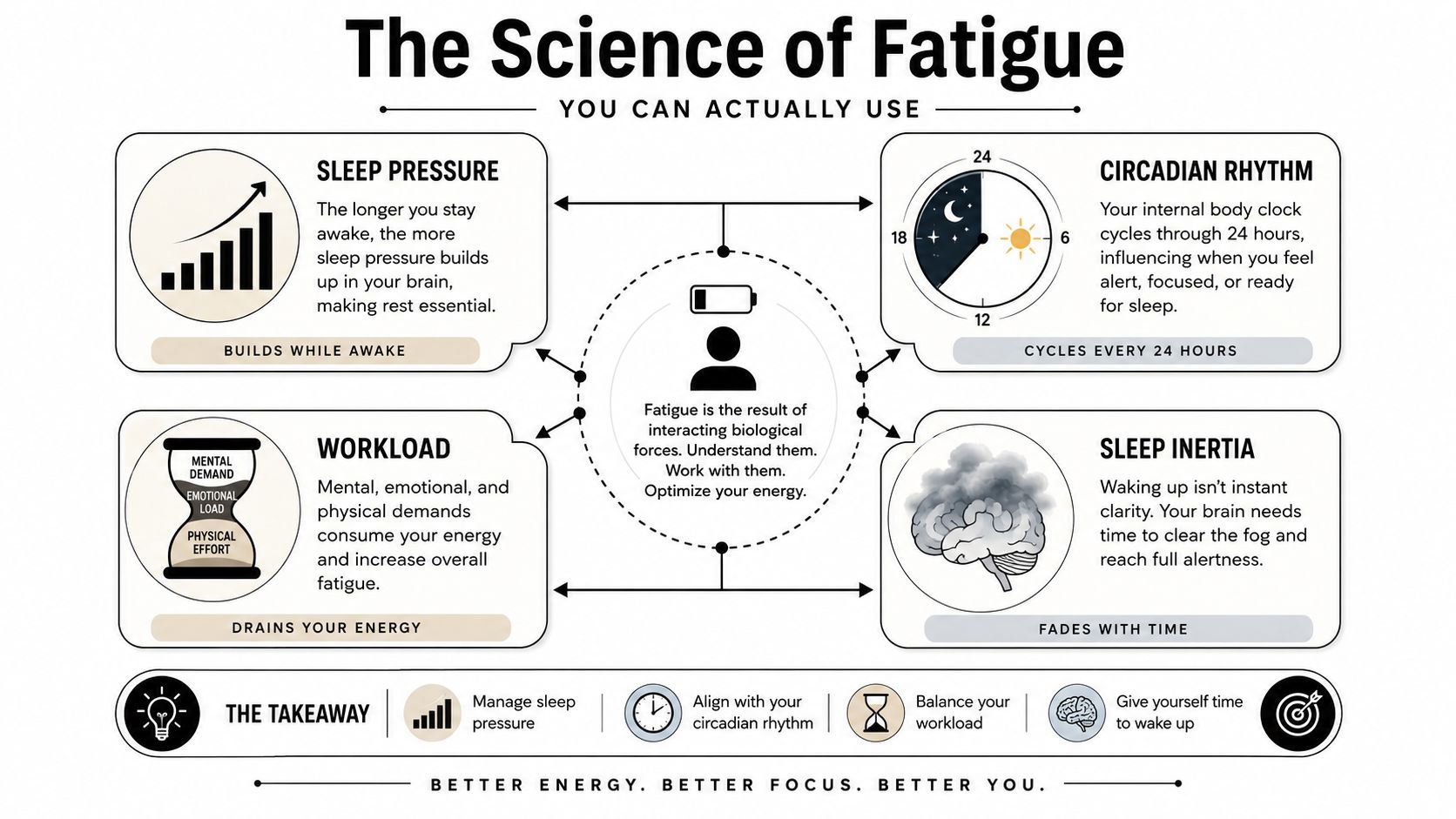
A schedule review gets clearer when you look at those drivers together. Early report times, late finishes, back-to-back crossings, and long hotel-to-airport transfers all push in the same direction. A stable roster with decent sleep opportunity can still fail if the hotel arrival is late and the wake-up call comes too soon.
Fatigue control starts when someone asks how much real sleep the crew can still get, not how long the duty looks on paper.
Prescriptive Limits Versus FRMS in Practice
Operators usually live inside two rule sets at once. The first is prescriptive limits, meaning fixed rules for flight time, duty time, and rest. The second is a Fatigue Risk Management System, or FRMS, which looks at actual risk using data instead of relying only on hard limits.
Prescriptive rules are still useful because they create a floor. They're easy to audit, easy to explain, and hard to misread. They also leave gaps when the operation is unusual, which is exactly where fatigue risk often becomes more complicated, such as ultra-long-range flying, compressed turnarounds, and mixed corporate schedules with ground travel layered on top.
FRMS fills that gap by asking whether the schedule is safe in context. IATA says fatigue can be assessed with actigraphy and sleep diaries for sleep history, PVT performance for reaction-time degradation, and validated subjective scales like the Samn-Perelli checklist and the Karolinska Sleepiness Scale: IATA fatigue management guide for airline operators. That matters because one roster can look compliant and still produce poor alertness if the sleep history and circadian timing are off.
The strongest programs don't choose one model and ignore the other. They layer FRMS on top of prescriptive limits, then use the data to spot the places where rules are legal but not smart. That's the mindset regulators want to see in practice, because compliance alone doesn't prove the crew is rested enough to perform.
The trade-off is administrative effort versus operational fidelity. A small operation can start with prescriptive rules and a lightweight risk review. A larger airline or a corporate department with complex routing usually needs FRMS tools to catch risk that basic limits never see.
The Core Components of an Effective FRMS
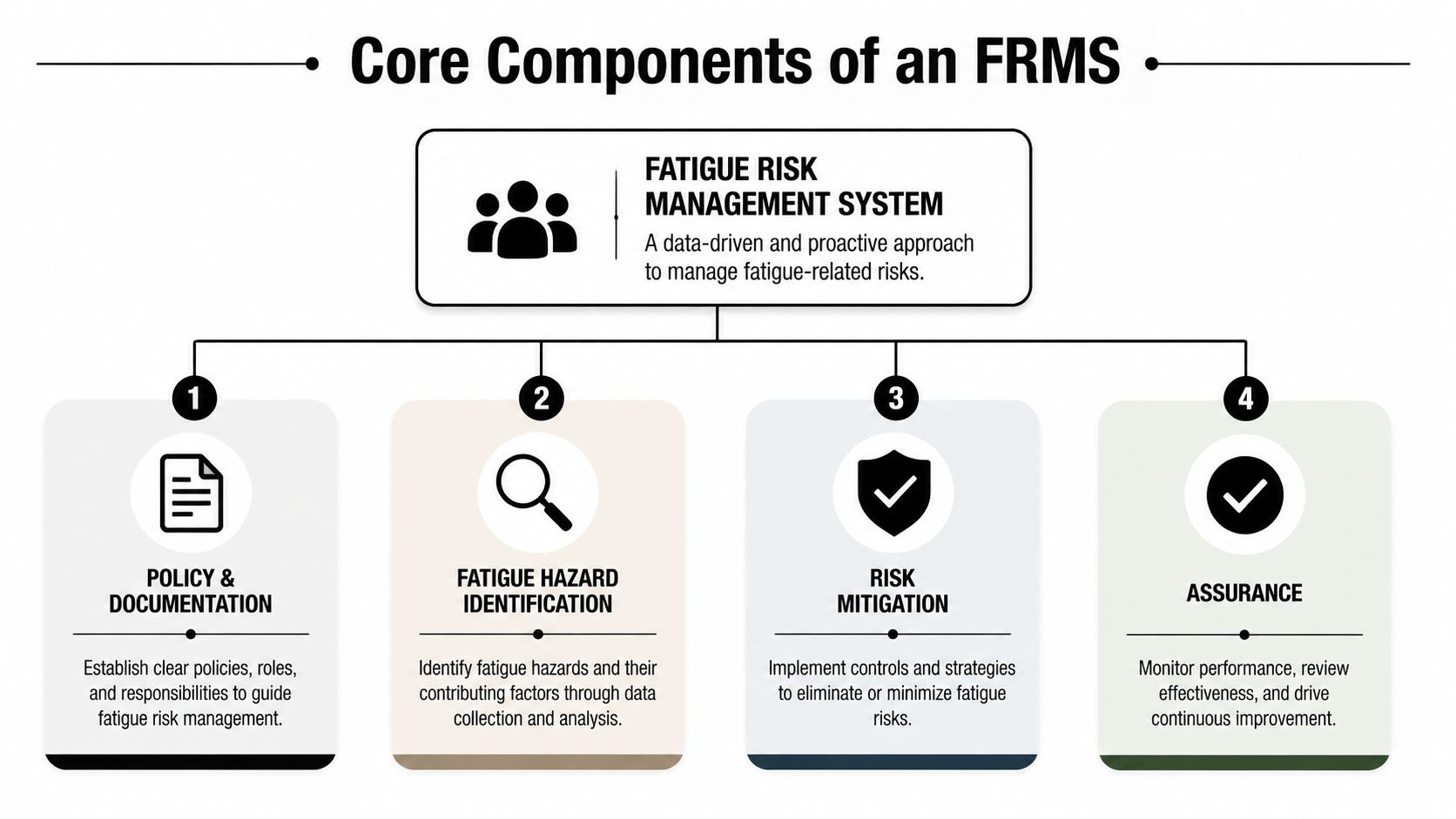
A strong FRMS rests on four parts that have to work together in daily operations, policy, hazard identification, mitigation, and assurance. Policy sets the rules for fatigue decisions, hazard identification finds where risk is showing up, mitigation changes the schedule or the support plan, and assurance checks whether those changes reduced exposure.
The practical test is simple. A small operation does not need a large safety department to get started, but it does need disciplined records and a repeatable review habit. A one-page policy that crews and dispatch can use is more useful than a vague paragraph buried in a manual, and a plain roster risk sheet will do more than hoping someone notices a pattern.
What each component needs in practice
Policy and documentation should name who owns fatigue decisions, what gets reported, and when a crew member can escalate a concern. Hazard identification should draw from rosters, incident notes, fatigue reports, and, where available, objective sleep and alertness tools. Mitigation should change something real, such as rest time, duty sequencing, hotel timing, or secure transfer coordination, because that is where long-haul fatigue risk often grows before the crew reaches the aircraft door. Assurance should show whether the changes reduced risk or only produced cleaner paperwork. For operators that need a practical reference point, the workflow used in crew logistics planning is a useful reminder that ground support decisions belong inside the fatigue program, not outside it.
| FRMS Component | Key Artifacts | Primary Data Sources | Maturity Indicator |
|---|---|---|---|
| Policy and Documentation | Fatigue policy, reporting pathway, role assignments | Manual, SOPs, training records | People can explain who owns fatigue decisions without searching for it |
| Fatigue Hazard Identification | Risk scoring sheet, event log, trend review | Rosters, fatigue reports, sleep data, incident notes | Repeating high-risk patterns are visible before they become incidents |
| Risk Mitigation | Schedule changes, rest protections, transport controls | Duty patterns, layover plans, hotel timing, crew feedback | Mitigations change the actual exposure, not just the language |
| Assurance | Quarterly review, corrective action log, follow-up memo | Trend data, audit findings, crew feedback, monitoring results | The program can show whether actions worked over time |
Keep the program close to the operation
The most common failure I see is a program that asks for reporting but never closes the loop. Crew members stop filing fatigue reports if nothing changes, which makes the data look cleaner than the operation really is. ICAO's framework and the cabin crew literature both point to underreporting as a real issue, so assurance has to include feedback, not just compliance checks.
If the crew thinks fatigue reports vanish into a file, the reporting system isn't a control. It is a form.
Rostering, Training, and Monitoring That Move Real Numbers
The roster is the first place to cut fatigue risk because it sets the limits for everything that follows. Research from ultra-long-range operations found that each additional hour of in-flight sleep reduced top-of-descent fatigue ratings by 0.24 points and sleepiness by 0.38 points, while each 10-point increase in overnight workload ratings increased both fatigue and sleepiness by 0.24 points: Frontiers study on ultra-long-range operations. That is not abstract science. It is a direct reminder that sleep opportunity and workload show up in the cabin.
Roster design should protect sleep, not just satisfy minimum rest
A schedule can meet the rule and still be poor fatigue management if the timing works against sleep. The practical rule from the research is to protect sleep before long duty sequences, preserve at least two local nights before ultra-long-range departures, and build layovers that allow two full nights of sleep for recovery, as noted in the earlier section on practical mitigation. That is how minimum rest becomes usable recovery time.
Training has to cover more than “get more sleep.” Crew members need to recognize circadian low points, report fatigue early, and understand what happens when sleep debt builds over several days. Schedulers need the same training, because they are the people deciding whether a turn is merely efficient or sustainable.
The monitoring cadence should stay simple enough to survive busy weeks. Review roster patterns regularly, check fatigue reports against actual duty sequences, and sample subjective alertness at the highest-risk points, especially top-of-descent and post-landing, where the ultra-long-range study found fatigue was highest. That gives you a practical early warning without waiting for an incident.
- Roster review: Flag repeated early reports, late finishes, and short recovery windows before publication.
- Crew training: Teach fatigue escalation, circadian timing, and how to use the report process.
- Supervisor monitoring: Compare fatigue reports with real duty patterns and late-night ground movements.
- Operational adjustment: Change the schedule or support plan when a pattern keeps reappearing.
For flight departments, logistics discipline matters as much as the roster itself. A movement plan can look tidy on the dispatch sheet and still leave the crew awake too long once hotels, transfers, and aircraft readiness are all counted together. The practical side of that coordination belongs with the same people who manage trip execution, not as an afterthought, and global crew logistics support is where many teams start to treat the ground leg as part of fatigue risk.
Ground Transport and Hotel Logistics as Fatigue Controls
The interval between aircraft door and hotel pillow is part of the fatigue picture, whether the schedule acknowledges it or not. If the transfer is slow, the pickup is uncertain, or the hotel check-in turns into a scramble, the crew spends more time awake and less time recovering. That's why ground transport and hotel coordination should sit inside FRMS thinking, not outside it.
In a corporate long-haul movement, the crew usually loses sleep opportunity in small pieces rather than one dramatic block. A late ramp call, a delayed chauffeur arrival, a congested airport exit, and an unprepared hotel desk can each add friction. None of those feels huge on its own, but together they push the rest window into the danger zone.
The best ground plans reduce decision-making for the crew. Secure transfers, confirmed pickups, and direct hotel routing remove uncertainty at the moment the crew is least able to absorb it. That matters because fatigue management is partly about lowering cognitive load when alertness is already dropping.
MLR Worldwide Service's chauffeur network fits that logic because it absorbs coordination that would otherwise sit on the crew or the local handler. When transport is timed well, the crew gets back to recovery faster and with less stress, which is exactly what a fatigue control should do. The same principle applies to late-night arrivals, irregular operations, and multi-stop schedules where the hotel is only one step in a longer chain, as shown in crew transport services.
Good logistics don't just feel smoother. They protect the next duty period by protecting the sleep window before it.
A lot of programs underperform. They put effort into legal duty limits and then let transport, check-in, and ground handoffs burn the recovery time those limits were supposed to protect. If the hotel plan can't reliably deliver sleep, it isn't a fatigue mitigation, it's just a reservation.
A 90-Day Implementation Roadmap for Operators
A workable fatigue program doesn't need a full redesign on day one. It needs a clear first pass, a place to record risk, and a short feedback loop. That's enough to move from informal judgment to a repeatable process.
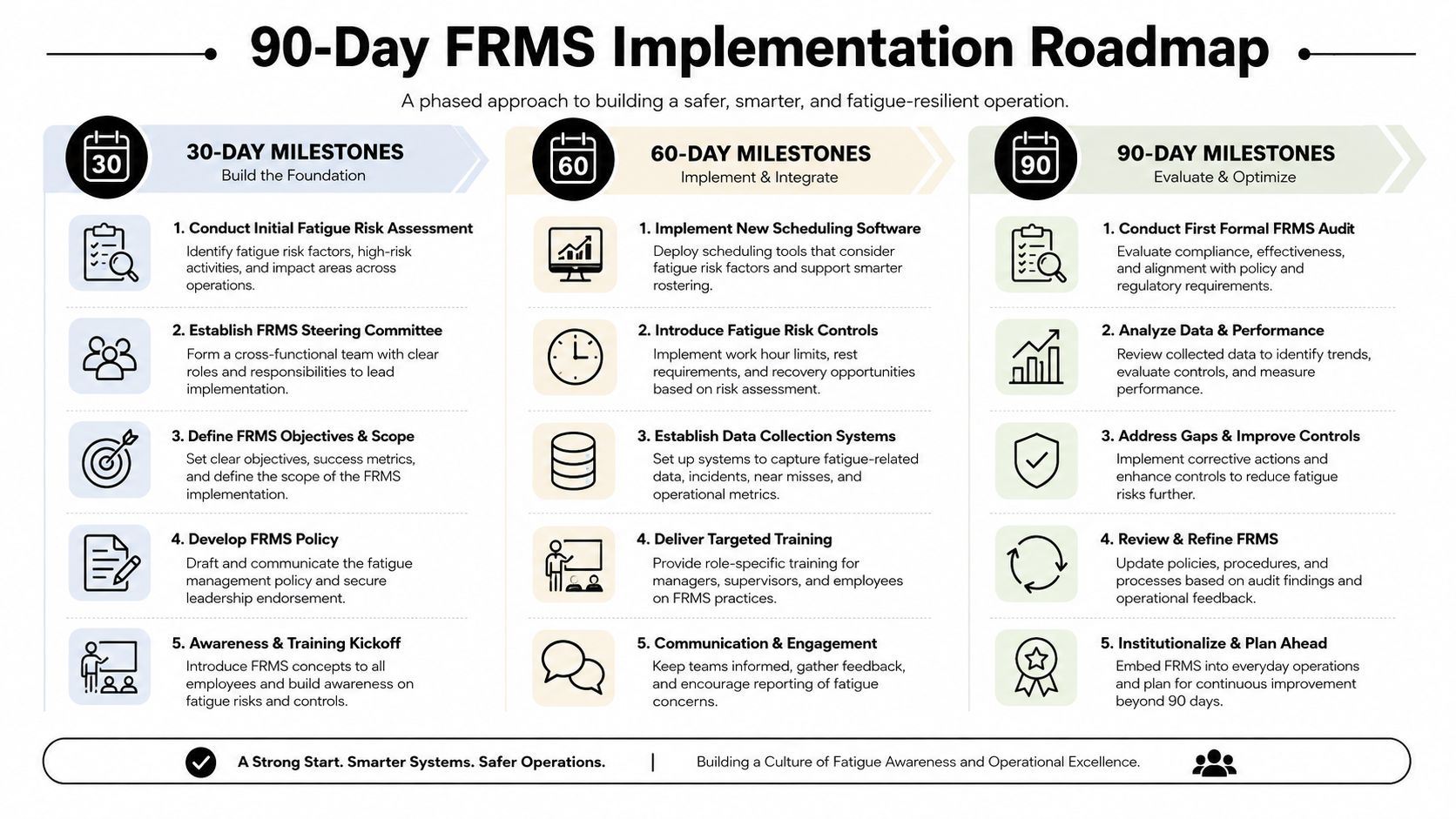
Days 1 to 30
Start with a one-page fatigue policy that names the owner, the reporting path, and the trigger points for escalation. Build a roster review checklist that flags early starts, late finishes, short turns, and disrupted layovers. Then map the current ground transport and hotel process so you can see where wake time is being lost.
Days 31 to 60
Train dispatch, crew planning, and line managers on the basics of sleep pressure, circadian timing, and what good reporting looks like. Add a simple fatigue log, even if it starts as a spreadsheet, and review it against actual duty sequences. Tighten one or two recurring weak spots first, such as transfers that routinely arrive too late for proper rest.
Days 61 to 90
Run the first formal review of the program. Compare the mitigations you put in place with the reports, roster patterns, and crew feedback you've collected. Then update the policy, the checklist, and the supplier brief so the program reflects what happened instead of what you hoped would happen.
A small FAQ usually comes up at this stage. Does FRMS replace prescriptive limits? No, it sits alongside them. Can you start small without slowing compliance? Yes, if you begin with the roster, the report path, and the ground leg, then build from there. What should change first? The highest-risk pattern you can see today, not the most complicated one.
The point of the first 90 days isn't perfection. It's proving that fatigue risk can be identified, reduced, and reviewed with the same discipline as any other safety control.
If your operation needs crew movements, airport transfers, hotel coordination, or secure ground support that helps protect sleep opportunity instead of burning it, MLR Worldwide Service can help you build that into the trip plan. Visit MLR Worldwide Service to coordinate ground logistics that support safer, smoother crew recovery and line-ready departures.