
You can lose a day on a service failure without anyone calling it a failure. The car shows up late, the FBO desk says they're “looking into it,” the flight crew is already moving, and the booking email still looks polite. That's the trap in executive ground transport. People mistake familiarity for control, then absorb the damage as if a missed pickup were just bad luck.
A proper service level agreement stops that pattern. It turns a promise into a measured commitment, then ties the missed commitment to a remedy, which is exactly why modern SLA practice matters whenever the service has real consequences. In digital services, the standard has long been written as uptime, response time, and recovery time, because vague “best effort” language doesn't protect anybody when the clock is running IBM's overview of service level agreements. Ground transport deserves the same discipline, especially when the failure is a missed connection, not a server alert.
When a Missed Pickup Becomes a Missed Connection
The most expensive failures in chauffeur and FBO work don't announce themselves. A driver is four minutes late to the curb, the aircraft is closing, and the dispatcher is on hold while the client is already deciding whether this vendor can be trusted again. The invoice still arrives on time. The apology usually does too. Neither one gets the day back.
That's why relationship management is a weak substitute for a written agreement. A vendor who “always takes care of you” can still leave you with no escalation path, no credit, and no agreed method for proving what happened. In enterprise IT, nobody accepts that level of ambiguity. If a provider misses a target, the contract usually says how performance is measured and what remedy applies. Ground transport buyers should expect the same seriousness.
Practical rule: if the service failure can ruin a flight connection, it belongs in writing before the first booking.
The true cost isn't only the lost ride. It's the wasted hours spent chasing people, the reputational damage when the guest is left standing, and the influence you surrender when the provider controls the story. A good provider won't mind precision, because precision protects both sides. A vague provider will tell you that no one needs “all that legal language,” which is exactly why you need it.
If you've ever had to explain a missed departure to a principal, a flight department, or an event client, you already know the issue isn't friendliness. It's contract design. Without measured commitments, every failure gets negotiated after the fact, and after-the-fact is where clients usually lose.
What a Service Level Agreement Really Is
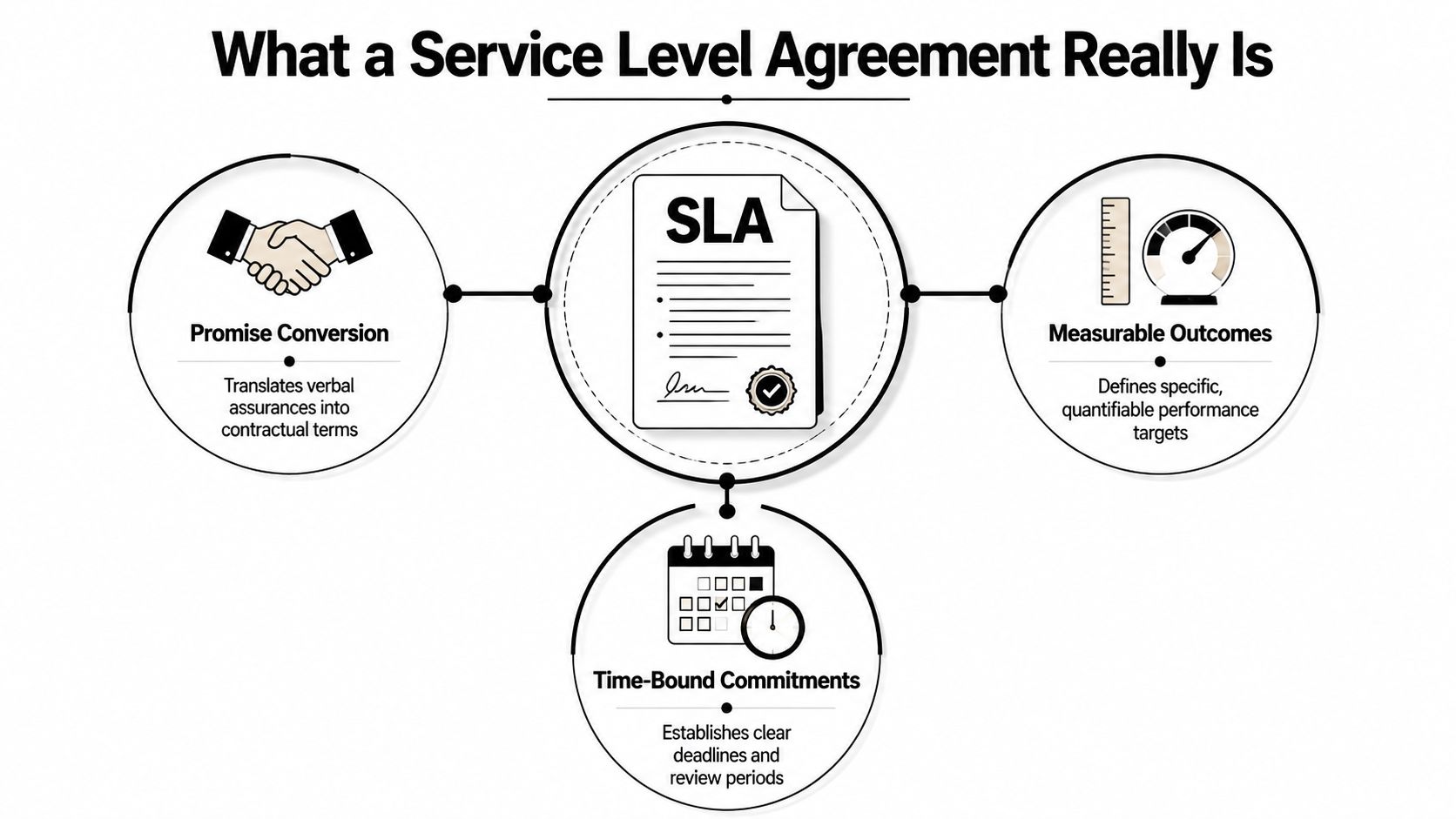
A service level agreement is the document that turns a vendor's promise into a measured, time-bound, and remedied obligation. In formal terms, it is a contract between a provider and a customer that states the expected level of service, how performance will be measured, and what happens if the provider misses the target IBM. For executive transport, that means the agreement has to describe service quality in language a dispatcher, a travel manager, and a lawyer can all read the same way.
A missed pickup is not a theory problem. It is a client standing on a curb, a flight moving without them, and a vendor trying to explain why “we usually do better” is not a remedy.
Promise, metric, remedy
The structure is simple, and it should stay simple. The promise says what the provider is supposed to do. The metric says how you measure whether they did it. The remedy says what happens when they do not. If any one of those three is missing, the document looks serious but behaves like a brochure.
That is where the digital vocabulary helps. In reliability work, an SLI is the indicator, an SLO is the target, and the SLA is the contractual promise with consequences incident.io's SLO, SLA, SLI guide. In a ground transport contract, the indicator might be curb arrival against aircraft movement, the target might be a defined arrival window, and the SLA is the clause that gives the client a credit or another remedy if the provider misses it.
Operators often treat an SLA as a general standard of service. That is a mistake. A brochure can promise professionalism. An SLA forces the vendor to define who measures performance, when they measure it, and what evidence settles the dispute. For cross-border or regulated work, that precision matters even more because service agreements often fall short on security and compliance details research on cloud SLA gaps.
For a useful comparison to international chauffeur operations, see this guide to international ground transportation. The point is not that transport should copy IT jargon for style. The point is that buyers need the same contractual discipline that digital teams already use to keep service failures from turning into endless arguments.
Anatomy of an SLA Worth Signing
A decent SLA does more than state a target. It closes loopholes. It defines where the service starts, where it ends, and what evidence decides whether the provider met the commitment. If a draft doesn't do that, it's a sales document dressed as a contract.
The clauses that actually matter
Scope of services comes first because scope creep kills accountability. If the agreement covers chauffeur service, airport transfer support, and dispatch coordination, spell that out. If it excludes meet-and-greet, waiting time beyond a threshold, or baggage assistance, say so plainly. Ambiguity here is where disputes hide.
Defined metrics come next. In transport, those metrics should not be vague words like “prompt” or “timely.” They should be measurable events tied to a source of truth. A target without a measurement method is just a preference.
Measurement windows and exclusions matter because every provider wants an escape hatch. Some exclusions are legitimate, like client-side delays or events the provider can't control. The problem is not exclusions themselves. The problem is silent exclusions that appear only after a failure.
Reporting cadence keeps the agreement alive. Monthly scorecards, named owners, and scheduled reviews force both sides to look at the same facts before the relationship drifts. Governance is not bureaucracy. It's how you keep a contract from turning into a post-incident argument.
A contract that never gets reviewed is usually a contract that stopped protecting the client months ago.
Escalation paths, remedy schedules, and termination triggers are the last line of defense. If a provider misses the same commitment repeatedly, the buyer needs a clean path to cure, credits, and, if needed, exit. That's not hostility. That's power.
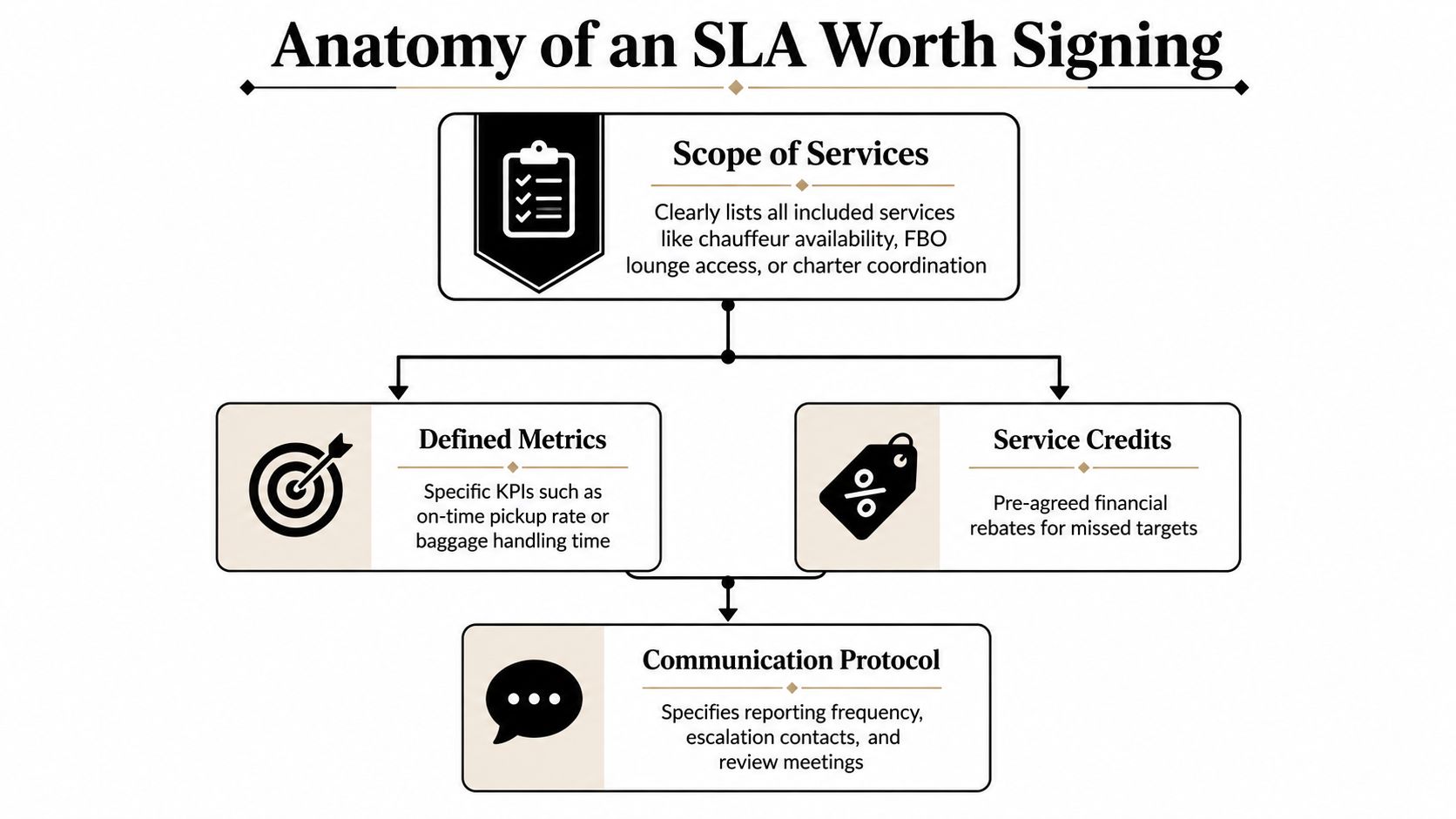
A strong draft reads like a checklist with consequences. If you can't point to the scope, the metric, the reporting method, and the remedy in one pass, the agreement isn't ready to sign.
KPIs That Matter for Chauffeur and FBO Service
The wrong KPI makes a bad contract look healthy. That happens all the time when buyers import digital service language without adapting it to the ground. Uptime works in cloud services because the asset is a system. In chauffeur and FBO work, the asset is trust at the curb, which means the metric has to follow the trip, not the reservation screen.
Measure the event that matters
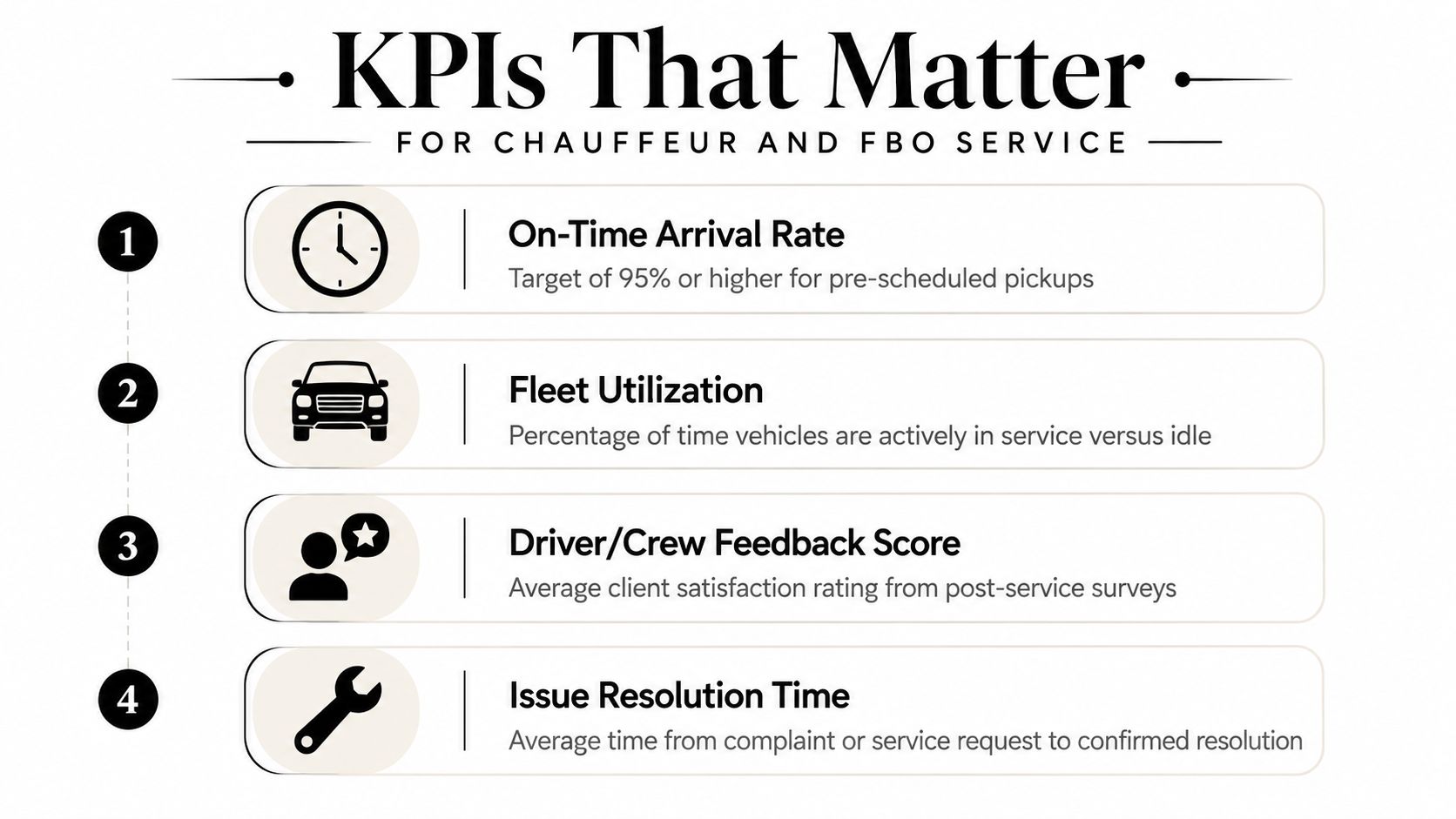
The first metric I'd enforce is on-time arrival against flight timing or the agreed pickup event, not just booking time. A car that arrives exactly on the reservation clock but misses the actual aircraft movement is still a failure. That matters most in private aviation, where the schedule can shift under the provider. The provider should be measured against the operational reality, not a static calendar entry.
The second metric is confirmation-to-dispatch lead time. If a request lands in the system, how long does it take before a driver is assigned and the client gets a meaningful confirmation? That is the transport version of response time, and it closes the silent gap where everyone assumes someone else is handling the booking.
The third is issue resolution time. A quick acknowledgment is not the same thing as a recovered trip. That distinction is standard in SLA design for support and infrastructure, where response time and resolution time are separate commitments AWS's SLA guidance. Ground transport buyers should insist on the same separation.
Other useful KPIs are more operational than glamorous. Vehicle cleanliness checks, chauffeur appearance compliance, lost-and-found recovery, and communication response windows all belong in a serious agreement. If the provider can't define them, they probably can't manage them.
The clauses that matter
Be selective. A vendor brief that tracks too many metrics becomes noise. Pick the few measures that map directly to client pain, then make each one auditable. One KPI can cover arrival performance, another can cover communication response, and a third can cover incident recovery.
Best practice: tie each KPI to one named owner on the provider side and one named owner on the client side.
If you're building a working draft for transport operations, start with the service history you already have and then sharpen the thresholds around the moments that matter most. For a broader vendor framework, this overview of ground transportation companies is a useful companion. The contract should make it impossible for a provider to claim success while the client is still stranded.
Sample Clauses You Can Adapt Today
Most vendor drafts are soft on purpose. They use friendly language because friendly language is easier to approve. Don't confuse that with protection. A clause that says “best efforts” gives you reassurance, not a stronger negotiating position.
A weak clause and a usable one
Weak version. “Provider will make reasonable efforts to ensure timely pickups and client satisfaction.”
That clause is useless when the car is late and the flight is leaving. It doesn't define timely, doesn't define pickup, and doesn't say what happens when the effort fails. If the provider sends a car, parks it five minutes away, and calls that a success, the clause won't help you.
Usable version. “For scheduled chauffeur pickups tied to a specific flight or event time, Provider will deliver the vehicle to the designated curb or meeting point by the agreed operational pickup time. Compliance will be measured by GPS-stamped arrival logs and, where applicable, FBO or manifest cross-checks. Missed compliance will result in a service credit applied to the affected account, unless the delay was caused by a documented client-side change or a defined exclusion.”
That language does three things. It sets the event. It defines the measurement method. It gives the remedy. It also makes the dispute about facts instead of opinions.
Remedies, exclusions, and reporting
For remedies, future credits are usually cleaner than cash refunds because they're easier to administer and they keep the relationship operational. For exclusions, keep them honest. Force majeure belongs there. So do runway holds, client-side delays, and last-minute itinerary changes that the client caused. What doesn't belong there is vague “operational constraints” that let the provider escape every hard case.
The measurement method should be explicit. If the provider wants to use arrival logs, flight tracking, or dispatch timestamps, the agreement needs to say which record controls when the records conflict. Reporting should be monthly, with named contacts on both sides and a short dispute window before the billing cycle closes.
If a clause can't survive one ugly day of operations, it won't survive a year of real-world use.
For buyers who want a cleaner vendor framework, preferred vendor agreements are often the place where these terms should live first. Get the language right there, then reuse it across programs instead of rewriting your protections from scratch every quarter.
Negotiating and Enforcing the Agreement
Buyers waste too much time haggling over headline percentages and not enough time on the parts that decide outcomes. The number on top of the page matters less than how the provider measures performance, what gets excluded, and what happens after the miss. That's where your power lives.
Push hardest on measurement, exclusions, and remedies
Measurement is the first battleground because it controls the story. If the provider defines the measurement window, the evidence source, or the denominator, they can make a bad month look acceptable. Don't let that slide. Decide whose records control, what the observation window is, and how disputes get resolved before anyone signs.
Exclusions are the second battleground. A fair contract excludes things the provider can't control. A weak contract excludes everything inconvenient. Your job is to narrow the carve-outs until they're honest. If the provider wants broad escape language, push it back to specific events with specific proof.
Remedies are the third battleground. A single flat credit for every failure doesn't tell the provider what matters. Tiered credits do. Repeated failures should trigger stronger remedies, not the same small apology in spreadsheet form. That's the only way the contract teaches behavior.
Enforce it before the relationship drifts
Governance keeps a good SLA from rotting. Monthly reviews and quarterly business reviews should be mandatory, not optional. If the provider misses the target, the review isn't a ceremony. It's the place where cure periods, corrective action, and if necessary termination get discussed while the facts are still fresh.
Enforcement only works if the buyer is willing to use it. If you never ask for the credit, never document the breach, and never escalate repeat failures, the agreement becomes decorative. The cleanest procurement posture is simple. Accept reasonable exclusions, insist on precise measurement, and hold the provider to real remedies when they miss.
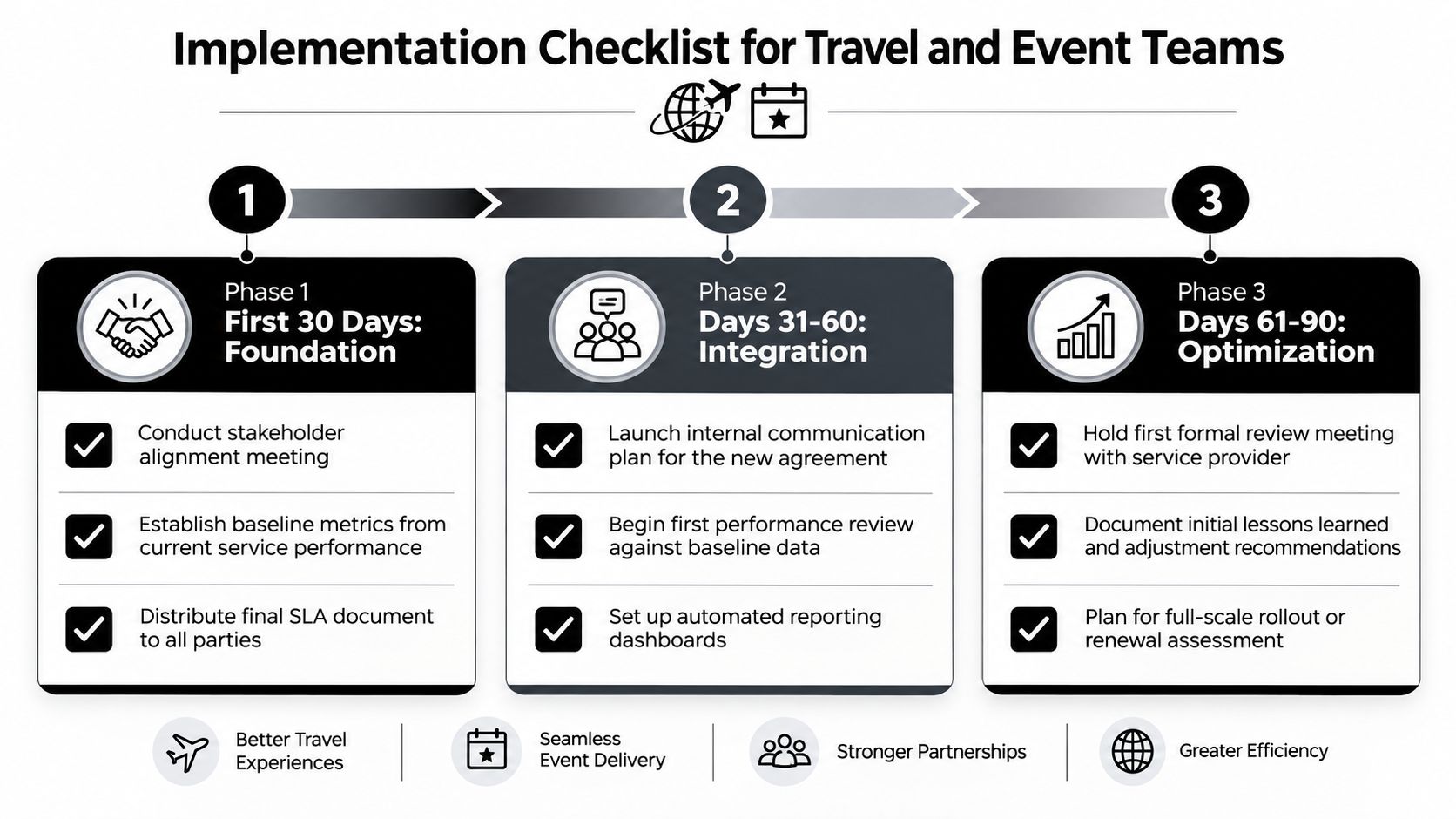
Implementation Checklist for Travel and Event Teams
A signed SLA doesn't fix anything by itself. The first 90 days after signature decide whether the agreement becomes an operating tool or another PDF in the archive. Execution is where most agreements fail, not in the drafting.
First 30 days
Start with stakeholder alignment. The travel manager, event lead, executive assistant, security contact, and provider operations team should all know who owns what. Lock the baseline metrics from prior service performance so future discussions have a reference point. Then circulate the final document to everyone who can trigger or block a booking.
Days 31 to 60
This is the integration phase. Brief chauffeurs, dispatchers, and account managers on the actual thresholds, not just the headline promises. Validate the communication tree so escalations don't die in a group chat. Set up the reporting rhythm, and make sure the provider's dashboard matches the numbers your team is using internally.
Days 61 to 90
The first formal review should happen here, not later. Compare performance against the baseline, document the misses, and decide whether the threshold needs a narrow adjustment or whether the provider needs a sharper corrective action plan. If the contract crosses regions or handles sensitive traveler data, bring security and privacy checks into the review so the service doesn't create a compliance problem.
The best SLA is the one your operations team can actually use at 6 a.m. on a bad travel day.
If the review process doesn't end with an action list, it wasn't a review. It was a meeting. Keep the meeting notes, tie them to the contract, and make renewal depend on performance, not goodwill.
Bringing It All Together
A premium transport promise means nothing until it becomes written, measured, and remedied. That's the entire test. If the provider can't show how the service is defined, how it's tracked, and what happens when it fails, you're buying confidence, not control.
The missed pickup from the opening would look very different under a mature SLA. The risk would've been visible earlier, the escalation path would've been defined, and the client would've had a credit or another remedy instead of a vague apology. The remaining challenge is whether the agreement captures only contract compliance or also the lived experience of the traveler. In executive transport, both matter.
If you need a ground transport partner that treats punctuality, discretion, and recovery as operating standards instead of marketing language, visit MLR Worldwide Service. Their executive chauffeur, airport transfer, FBO support, and crew movement programs are built for clients who can't afford sloppy communication or missed connections.