

Your CEO lands at 7:10, has a board meeting at 8:30, and needs to reach two offices before an evening client dinner. The itinerary looks simple in the travel portal. Operationally, it requires flight monitoring, a vehicle positioned at the right terminal, a chauffeur who understands executive protocol, a route that can absorb traffic disruption, and an operations team ready to change the plan without making the passenger manage it.
That's the difference between a chauffeured car service and a vehicle ordered for a single trip. The value isn't the leather interior. It's the controlled handoff between air travel, ground movement, meetings, security requirements, billing, and contingency response. For procurement teams, that distinction matters because reliable ground transportation protects executive time, reduces coordination risk, and creates a clearer service record.
What Chauffeured Car Service Actually Means
A senior executive flying through three cities rarely experiences the complexity behind a smooth itinerary. The passenger sees a name sign, a clean sedan, and a direct trip to the hotel. The provider has already matched flight details to pickup logic, assigned a vetted chauffeur, confirmed vehicle availability, reviewed the route, and established a communication path for delays or changes.
That operating model is why chauffeured transport belongs in corporate mobility planning, not only in luxury spending discussions. Industry forecasts place the global chauffeur car market at USD 54.2 billion in 2023, with a projection of USD 188.9 billion by 2033, representing a 13.3% compound annual growth rate over that period, according to the global chauffeur car market forecast. The same source places the broader executive ground transportation market at USD 87.4 billion in 2026, including a USD 28.3 billion U.S. market, with corporate travel representing 47% of that segment.
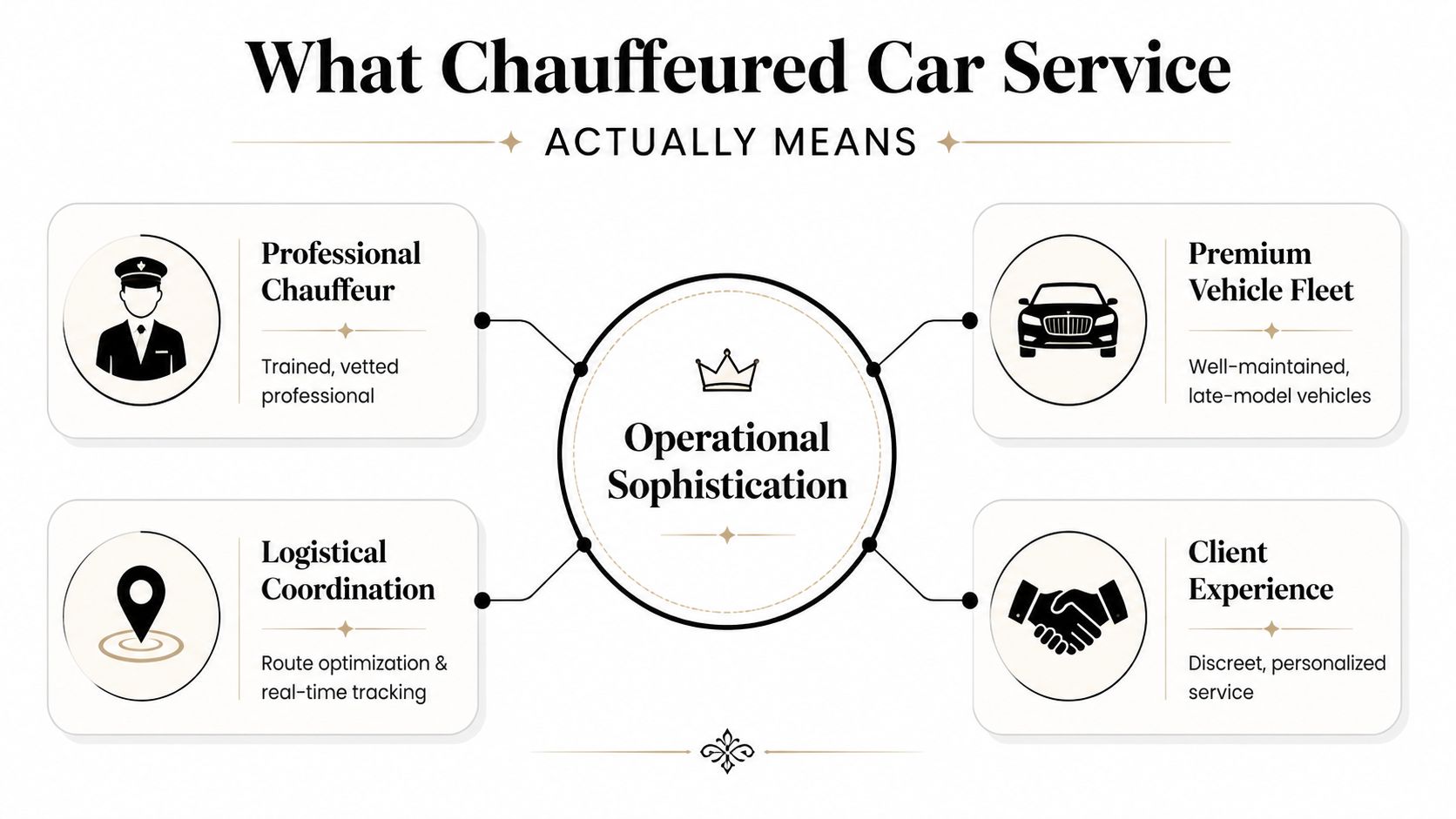
The four operating components
A proper program combines four elements:
- Professional chauffeurs: The driver is trained for punctuality, discretion, luggage assistance, communication, and executive etiquette. A rideshare platform may provide a driver. A managed service assigns responsibility for the passenger experience.
- Controlled fleet standards: Late-model sedans, SUVs, vans, and specialty vehicles should be clean, inspected, and consistent across assignments. Fleet presentation affects comfort, but vehicle condition also supports safety and service continuity.
- Live logistical coordination: Dispatch teams monitor flight changes, traffic conditions, terminal instructions, passenger communications, and vehicle status. They should be able to adjust the plan without forcing the traveler to solve the problem.
- Service-level accountability: Corporate buyers need confirmations, escalation contacts, billing records, and performance reporting. Without those controls, a premium ride remains an expensive one-off purchase.
Historically, the industry competed on comfort as well as mobility. Carey's history identifies its 1939 introduction of air-conditioned vehicles as a milestone described as a first for a chauffeured transportation company, showing how amenities and passenger comfort have long shaped the category. Buyer satisfaction has also been measured formally, including a 3.83 out of 5 average in one Business Travel News report and a later average of 4.09, up from 3.80, with all 10 service categories improving, as summarized in the Carey company history.
For a practical distinction between related categories, review this explanation of what ground transportation includes. The key point is simple: a chauffeur is only one visible part of a broader operating system.
Five Service Types Every Travel Manager Should Know
A provider that handles an airport transfer well may still be a poor choice for a roadshow, FBO movement, or crew rotation. Travel managers should buy against the operational requirement, not the vehicle description.
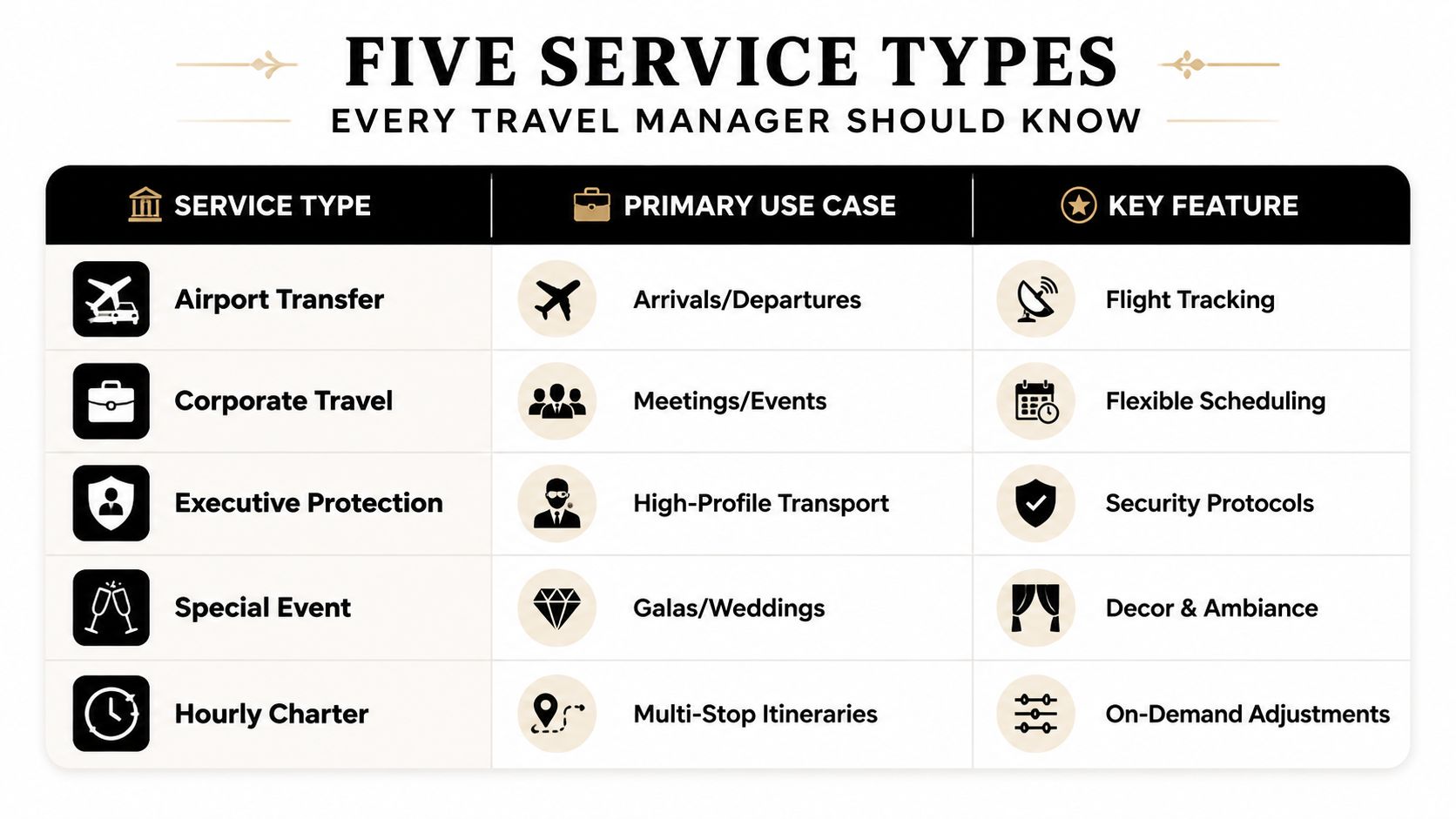
Airport transfers
Airport work depends on flight tracking, terminal knowledge, baggage assumptions, passenger communication, and a defined waiting policy. Ask whether the provider tracks the flight automatically, who contacts the passenger after landing, and how the team handles a gate or terminal change.
A fixed pickup buffer is a weak operating rule. At Washington, D.C. airports, one major chauffeured operator states a 30-minute post-arrival allowance for domestic flights and 60 minutes for international flights, with overage billed by the minute. At Phoenix Sky Harbor, the PHX Sky Train reports average waits of 3.5 to 7 minutes during much of the day, but 15 minutes or more during nightly maintenance. Those examples, documented in the airport transfer operational reference, show why pickup planning must account for immigration, baggage, terminal movement, and airport infrastructure.
FBO support
Private aviation transfers require a different handoff. Confirm the provider's experience with FBO instructions, authorized access procedures, customs timing, aircraft changes, and communication with flight departments. The right question isn't whether a company offers “airport service.” Ask whether its operations team can coordinate airside or FBO-specific requirements without exposing sensitive passenger details.
Corporate roadshows
Roadshows need one accountable coordinator, consistent vehicle standards across cities, and hourly or itinerary-based flexibility. A point-to-point booking model breaks down when a meeting runs late, an executive adds a stop, or the team changes hotels between cities. Require a single itinerary owner who can manage local affiliates and preserve the same reporting standard throughout the trip.
Events and group movements
Event transport is a timing dependency problem. Planners should map passenger waves, staging areas, loading order, venue restrictions, signage, manifests, and late-arrival procedures. Ask for a dispatch plan, not just a fleet count. A large vehicle inventory doesn't guarantee that the right vehicles will be staged in the right sequence.
Crew transport
Airline crew movements demand dependable coverage, rapid roster changes, and clear escalation procedures. Crew managers should verify after-hours response, driver replacement procedures, hotel and airport coordination, and invoice matching against trip or crew identifiers.
Practical rule: Match the service type to the failure you're trying to prevent. Airport work is about dwell-time control, roadshows are about continuity, and crew transport is about dependable recovery.
How to Evaluate and Select the Right Provider
Don't choose a provider because its quote is attractive or its website shows polished vehicles. Choose it because you can verify how the company assigns responsibility when a chauffeur is delayed, a vehicle fails, a flight changes, or an executive's itinerary moves faster than expected.
Start with fleet controls. Ask how vehicles are inspected, replaced, cleaned between assignments, and approved for corporate work. Then examine chauffeur governance. You need clear answers about licensing, background verification, training, attire, confidentiality, fatigue management, and replacement coverage.
Use a buyer-focused scorecard
| Service Attribute | Average Rating | Priority Level |
|---|---|---|
| Clean, well-serviced new-model cars | 4.19/5 | High |
| Duty of care | 4.15/5 | High |
| Pricing transparency | 3.60/5 | Medium |
| Quality data and reporting | 3.41/5 | High for managed programs |
These ratings come from the 2024 Business Travel News Ground Transportation Survey reference. The buying implication is clear. Vehicle condition and duty of care scored above pricing transparency, while reporting was the weakest listed attribute. A low quote doesn't compensate for poor visibility when travel managers need to reconcile service, risk, and spend.
Questions that expose operational maturity
- Who owns the trip: Can one operations contact manage the reservation from confirmation through completion?
- How do you monitor service: Will the client receive chauffeur, vehicle, status, and completion information through a portal, email, or dispatch channel?
- What happens during failure: How quickly can the provider deploy a replacement vehicle or chauffeur, and who communicates the change?
- How are affiliates controlled: Does the primary provider audit local partners, enforce fleet standards, and consolidate reporting?
- What does duty of care include: Can the provider document emergency escalation, passenger identification, live trip status, and incident handling?
- How is data delivered: Will invoices include passenger, department, cost center, route, vehicle, wait time, and cancellation details?
Spend visibility deserves its own test. Recent industry reporting says 63% of travel managers know their company's total ground transport spend, while ground transportation represents about 11.5% of total corporate travel budgets, according to the corporate ground transportation reporting reference. That leaves a material visibility gap for procurement teams.
Require a pilot across different trip types before signing a broad agreement. Test an airport arrival, a multi-stop executive day, a last-minute change, and a cross-market booking. Marketing polish is easy to demonstrate. Recovery discipline is not.
Pricing Structures and Contract Considerations
A chauffeured quote is only useful when you understand what it includes. Point-to-point transfers often use a flat rate, while roadshows and multi-stop assignments may work better with hourly billing. The wrong structure can make a flexible itinerary expensive, while a supposedly simple transfer can generate wait-time, toll, parking, or cancellation charges.
Read the rate architecture
Ask the provider to separate the following items in writing:
- Base transportation: Confirm whether the quote covers the vehicle, chauffeur, mileage, and standard operating time.
- Waiting and dwell time: Establish the included allowance, the billing increment, and the trigger for overage.
- Tolls and parking: Determine whether these costs are included, passed through at cost, or marked up.
- Cancellations and changes: Define deadlines, partial cancellations, no-shows, itinerary changes, and flight-delay treatment.
- Specialty requirements: Clarify charges for larger vehicles, security support, unusual access, after-hours work, or additional operational personnel.
- Gratuity and taxes: Ensure the invoice clearly identifies what is included and what remains discretionary or separately calculated.
A roadshow should be priced against the full operating pattern, not just the distance between hotels and offices. Include vehicle standby, driver hours, intercity repositioning, local permits, schedule changes, and the cost of maintaining one accountable control desk. A simple airport transfer needs a different commercial model from a full-day executive movement.
Contract for visibility and recovery
Your agreement should require consolidated billing, passenger or traveler identifiers, department and cost-center fields, route details, wait time, cancellations, adjustments, and incident notes. Reporting quality matters because unclassified rides disappear into general travel expense, making it difficult to identify recurring delays, unused bookings, or avoidable premium charges.
Use a written service-level agreement framework to define response times, confirmation standards, escalation paths, replacement procedures, data delivery, and review cadence. Don't accept vague promises such as “best effort.” Specify what the provider must do when service conditions change.
Negotiate around predictable demand, but don't trade away flexibility. Volume can support preferred rates or priority handling, yet a contract should also protect the buyer from rigid minimums when travel patterns shift. Ask for a transparent change process, quarterly business reviews, and the right to challenge unexplained charges.
Privacy and Security Protocols That Protect Executives
A chauffeur vehicle can expose an executive's location, meeting schedule, companions, travel habits, and sensitive conversations. That makes ground transportation part of the organization's security perimeter. Privacy and duty of care should be selection criteria from the first request for proposal, not optional upgrades added after an incident.
A polished driver in a luxury vehicle isn't a security program. The provider needs documented controls for chauffeur screening, confidentiality, dispatch communications, passenger information, vehicle tracking, route planning, incident response, and replacement coverage.

Evaluate the people and the information flow
Ask how the company verifies chauffeurs before assignment and how it manages access to passenger details afterward. A proper process should address identity verification, driving records, criminal background screening, training, confidentiality commitments, and procedures for removing a chauffeur from an assignment when concerns arise. Review the provider's driver background check process before approving executive work.
Information controls matter just as much. Passenger names, flight details, hotel locations, meeting addresses, and contact numbers should reach only the people who need them. Ask whether dispatch communications use controlled channels, whether trip data is retained, who can access live locations, and how the company handles printed manifests or shared messaging threads.
Test the response, not the brochure
A provider should explain what happens if:
- A route becomes predictable: Operations can review timing and routing rather than treating the itinerary as fixed.
- A chauffeur recognizes a passenger: The driver follows confidentiality rules and avoids social media, photography, or unnecessary conversation.
- A vehicle breaks down: Dispatch activates a replacement plan and communicates through the designated corporate contact.
- A passenger faces a threat: The operations team follows an escalation procedure, contacts the appropriate emergency resources, and records the incident.
- A schedule changes suddenly: The provider updates authorized parties without broadcasting the executive's movements.
Security is operational discipline applied to every ordinary trip. The controls matter most before anyone considers the journey unusual.
Procurement should request written evidence of training, insurance, incident escalation, data handling, and affiliate oversight. If the provider can't explain who makes decisions during a disruption, it hasn't demonstrated sufficient readiness for sensitive executive transport.
Booking Workflow and Contingency Planning
Reliable service starts before the reservation enters the dispatch system. A travel manager should give the provider enough information to engineer the assignment, then require confirmation that proves the provider has understood it.
Build the booking record
- Submit complete travel details. Include passenger name, mobile contact, flight number, pickup and drop-off addresses, terminal or FBO, luggage needs, vehicle preference, meeting times, accessibility requirements, and billing information.
- Require assignment confirmation. The provider should identify the chauffeur, vehicle category, pickup instructions, operations contact, and cancellation terms. For sensitive travelers, confirm who is authorized to receive updates.
- Hold a pre-trip briefing. Review the route, stops, waiting expectations, preferred communication style, passenger preferences, security considerations, and any venue access restrictions.
- Monitor the live assignment. Dispatch should track the flight where relevant, confirm the vehicle's progress, and communicate exceptions before the traveler has to ask.
- Close the loop. Capture completion time, changes, wait charges, incidents, passenger feedback, and invoice data. Use that record to correct recurring failures.
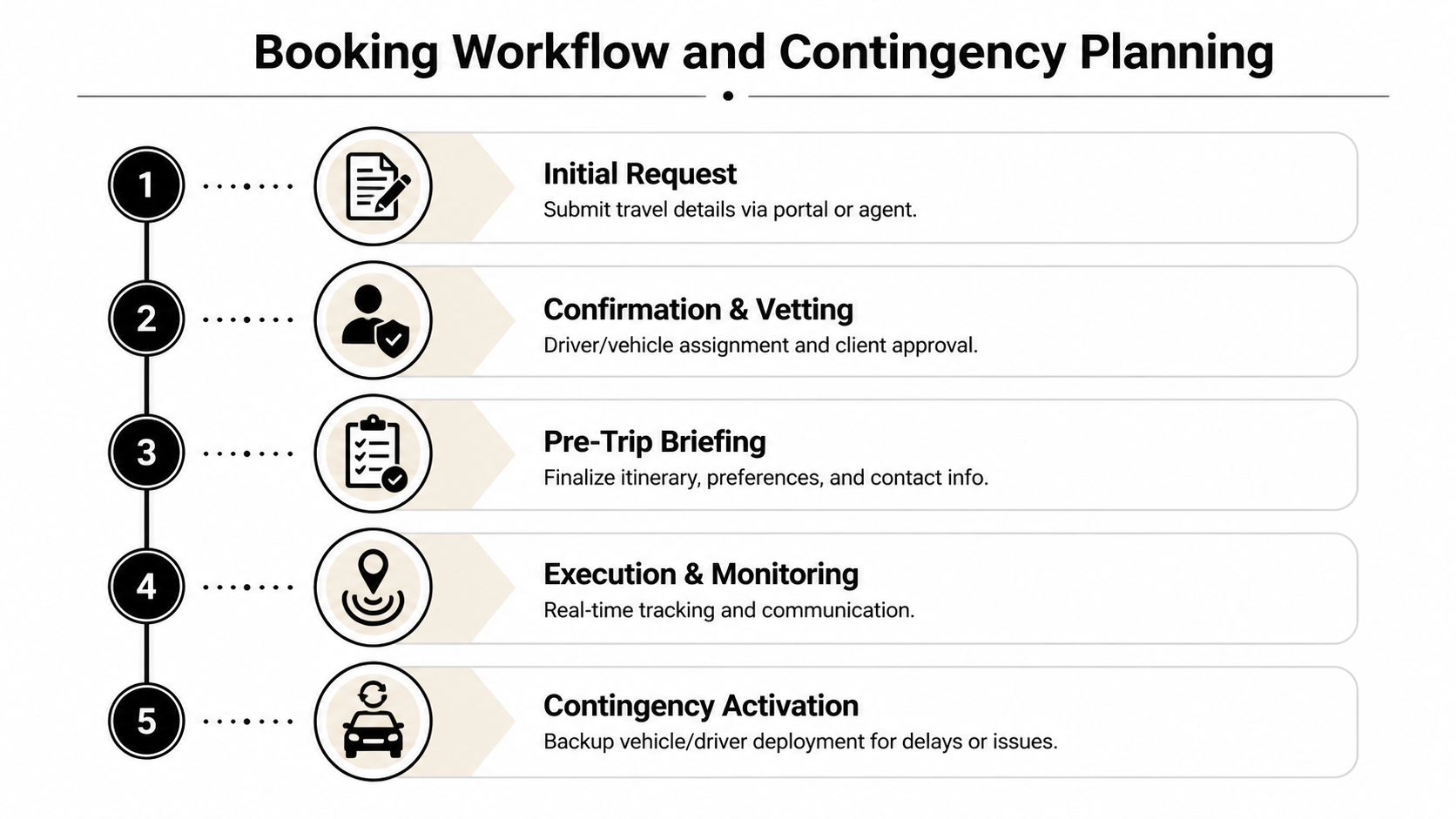
Design the backup plan
For every important journey, identify the response to a delayed flight, missed connection, vehicle breakdown, unavailable chauffeur, venue restriction, and last-minute itinerary change. Assign decision rights in advance. The traveler shouldn't have to decide whether to authorize a replacement vehicle while standing at baggage claim.
Global travel requires earlier coordination and stronger cross-border control. Coverage of corporate ground transportation reports that U.S. bookings for APAC journeys rose 53% year over year to June, EMEA bookings rose 45%, APAC-to-EMEA travel rose 66%, and APAC booking lead times increased 28%, as described in global corporate transportation coverage. Those figures point to a practical requirement: secure local capacity early, confirm affiliate accountability, and keep a 24/7 operations path open across time zones.
Use this video as a visual reference for how a professional booking and monitoring process can be presented:
Your contingency plan should name the trigger, the responsible operator, the replacement resource, the communication channel, and the approval threshold. If those fields are blank, the plan is only an intention.
Real-World Use Cases for Three Key Buyer Personas
A corporate travel manager should build a preferred-provider program around executive itineraries, airport movements, and multi-city roadshows. Start with a controlled pilot, require consolidated billing and duty-of-care reporting, then review vehicle condition, chauffeur consistency, change handling, and invoice accuracy before expanding the relationship.
An event planner needs a movement plan rather than a collection of reservations. Assign staging locations, passenger groups, loading sequence, venue contacts, dispatch ownership, and late-arrival procedures. For a conference or leadership gathering, the provider should supply a manifest process and a live escalation channel, while the planner retains one master itinerary that reflects every venue change.
A private aviation coordinator should treat the FBO as a specialized operating environment. Confirm access instructions, aircraft changes, customs timing, passenger confidentiality, luggage handling, and the handoff from aircraft or terminal to boardroom. Crew transport requires separate controls for roster changes, hotel timing, after-hours coverage, and rapid replacement.
Across all three personas, the buying test is the same: can the provider preserve time, privacy, safety, and spend visibility when the original plan changes? MLR Worldwide Service offers executive chauffeur service, airport and FBO support, corporate roadshows, event logistics, VIP secure transport, and crew movements, supported by a 24/7 concierge operations team and a vetted global affiliate network. Visit MLR Worldwide Service to discuss a ground transportation program built around your organization's actual routes, risk requirements, and reporting needs.