
The CEO's aircraft is on the ground, the board meeting is fixed, and the travel manager has a narrow window to move her from the FBO to the office. A chauffeur needs the correct manifest, the security lead needs confirmation that the handoff is controlled, the FBO needs to release the passenger without exposing the itinerary, and the vehicle must have a viable alternative if the planned route closes. If those people and decisions aren't aligned before touchdown, an expensive vehicle won't repair the process.
Executive protection transport is therefore an operational coordination function, not a luxury car service with a security label. It connects advance planning, vetted chauffeurs, vehicle selection, FBO and hotel logistics, communications, and contingency decisions into one movement plan. The standard is simple: the principal should experience a quiet, punctual journey while the team manages risk without creating unnecessary visibility.
What Executive Protection Transport Really Covers
A CEO steps off a transatlantic flight at a fixed-base operator. The chauffeur has the approved manifest, the protection lead has confirmed the handoff, and the FBO knows which contact may release the passenger. A route change reaches the driver before departure, not after the vehicle is already moving. The board meeting starts on time because the people, information, and decisions were aligned before arrival.
That is the working definition of executive protection transport. It is an operational coordination function that joins ground movement with threat-aware routing, controlled pickups, discreet communications, and the principal's protection team. For a broader explanation, see a practical guide to executive protection transport. Executive protection transportation guidance describes the service as specialized transportation that applies security protocols to chauffeur operations.
The provider must manage exposure created by predictable routes, airport and hotel surveillance, curbside waiting, public arrival information, and late itinerary changes. A polished vehicle does not solve any of those problems without clear ownership and timely communication.
The movement is the control point
Risk concentrates at transitions. A principal leaves an aircraft, crosses an FBO, enters a vehicle, reaches a hotel, changes cars, or steps out at a public venue. Every transition can create observation, delay, information leakage, or an uncontrolled interaction.
The program can serve:
- Corporate executives and board members: Especially during sensitive transactions, contentious announcements, litigation, or concentrated board travel.
- High-net-worth individuals and family offices: When privacy, predictable routines, and discreet logistics matter as much as physical protection.
- Visiting dignitaries and foreign delegations: When airport access, diplomatic coordination, and controlled handoffs exceed a standard transfer.
- Witnesses and legal participants: When court schedules, media attention, or contested proceedings increase exposure.
Executive protection transport supports close protection, residential security, event security, and intelligence functions. It does not replace them. The driver may belong to the protective detail, yet the transport plan still needs one owner across the chauffeur, advance team, FBO, venue, and executive.
Operational rule: Ask who owns the movement from aircraft door to final destination. If responsibility changes at every handoff, the plan has a gap.
Before selecting a provider, ask five questions: Who conducts the advance work? Who approves route changes? How are chauffeurs vetted and briefed? What happens when the primary vehicle fails? How does the provider protect itinerary and manifest data? The answers reveal operational maturity more clearly than a fleet presentation.
The Core Components of a Secure Transport Program
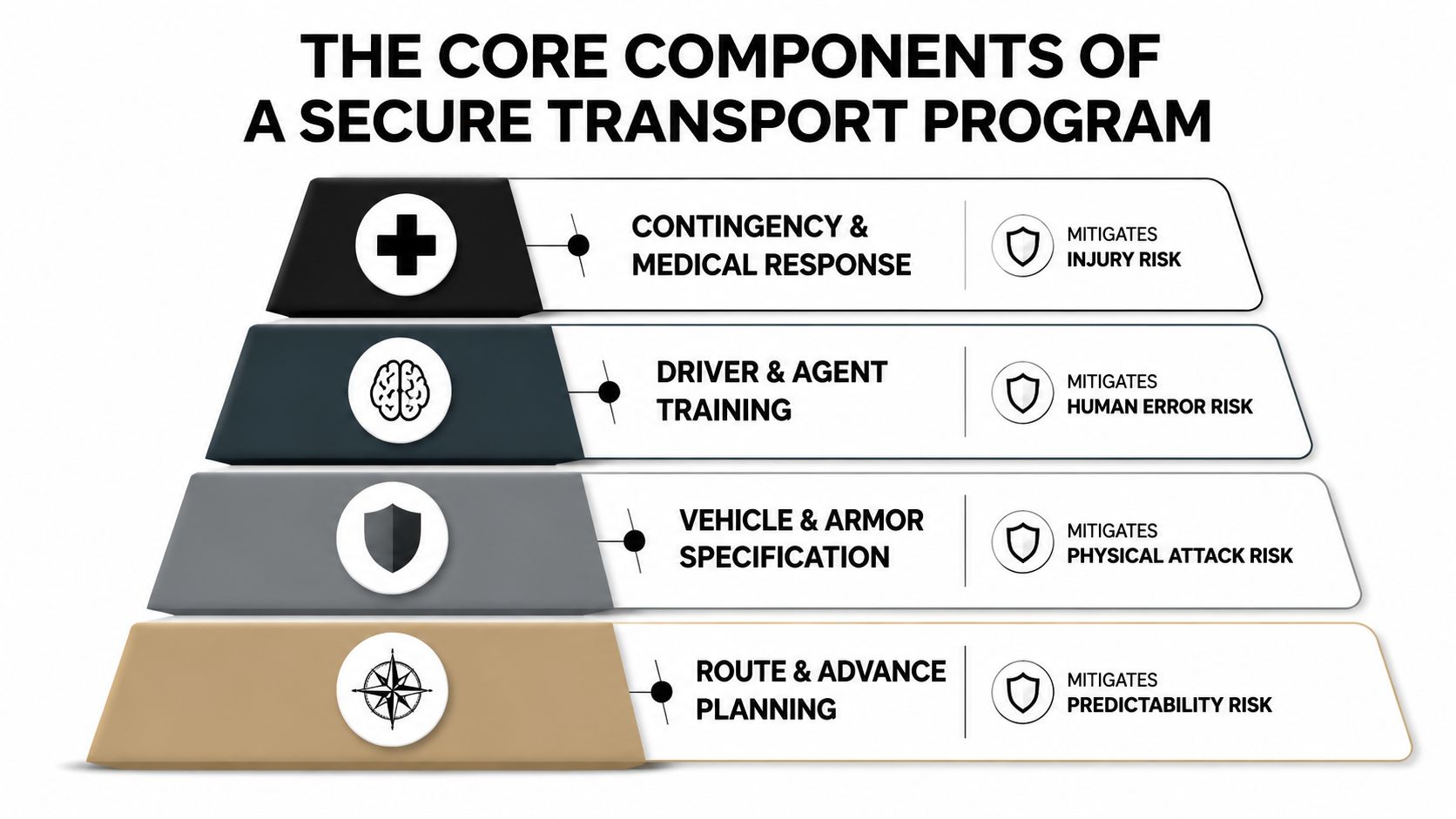
A secure transport program works as a stack. Each layer should mitigate a defined failure mode, and the provider should explain how the layers interact rather than presenting isolated features.
Start with advance and route control
Advance work establishes the movement's conditions before the principal travels. It includes itinerary mapping, primary and secondary routes, timing flexibility, pickup and drop-off checks, emergency facility information, and contacts for relevant airport or venue personnel. A credible provider can explain how it handles a route closure, a protest near a hotel, a delayed aircraft, or a principal who leaves a meeting earlier than expected.
Route planning also reduces predictability. A single route, fixed departure pattern, or publicly visible pickup point gives observers useful information. The plan should preserve alternatives without turning every movement into a conspicuous convoy.
Assign responsibility to the chauffeur layer
A security-trained chauffeur isn't merely a driver who wears a suit. The person needs clear instructions, professional discretion, route knowledge, emergency communication procedures, and an understanding of how to work with an advance agent or close protection officer. If the chauffeur is a separate contractor who receives only an address and pickup time, the transport layer is disconnected from the security function.
Match the vehicle system to the threat
The vehicle layer can include a standard executive sedan, a security-enhanced SUV, an armored vehicle, a follow car, or communications equipment. The correct selection depends on the threat model, passenger requirements, road environment, and need for mobility after damage. A vehicle specification shouldn't be driven by appearance or a generic “secure” label.
Keep coordination live
The lead, advance agent, chauffeur, travel coordinator, and operations desk need a shared operating picture. That may involve encrypted communications, controlled contact lists, secure itinerary distribution, and escalation procedures for route changes or medical events. The point isn't to add technology for its own sake. It's to ensure that the person making the decision has current information and authority to act.
Concierge and travel-desk support completes the system. FBO access, hotel garages, equipment, luggage, passenger preferences, and changed meeting times all affect movement security. A provider that manages these details discreetly can prevent a routine logistics issue from exposing the principal or forcing an improvised curbside pickup.
Fleet Standards, Chauffeur Training, and Vehicle Hardening
A serious provider can document its claims. Treat phrases such as “military-grade,” “fully vetted,” or “armored to the highest level” as unverified until the vendor identifies who certified the vehicle, what training the chauffeur completed, and when the records were reviewed. Executive protection transport depends on coordinated people and assets, not a polished vehicle presentation.
Verify the fleet before approving it
Request the fleet policy, maintenance records, ownership or operating arrangements, and replacement plan. Vehicles should be maintained continuously, carry no branding that advertises the principal's presence, and have a backup process that works in the actual operating city. GPS and telematics may support dispatch oversight, but the provider must explain tamper alerts, access controls, data retention, and who can view location information.
The replacement vehicle must be close enough, available, and assigned to a briefed chauffeur. Ask where backup assets are positioned, how quickly they can be deployed, and which operations-desk role authorizes a swap. Confirm how the chauffeur, advance team, FBO, and executive travel contact receive the change so a vehicle failure does not create a curbside improvisation.
Vet the person, not just the license
A security-trained chauffeur combines professional driving with threat awareness and discretion. A driving record is only one qualification. Ask for evidence of background screening, drug screening where lawful and appropriate, identity verification, first-aid training, defensive or evasive-driving instruction, and executive or close-protection training.
Verify communication standards, dress expectations, nondisclosure procedures, and route-specific briefings. The provider does not need to disclose sensitive personal information, but it should demonstrate that assigned personnel meet the contract's standards. “All drivers are security trained” is a description, not verification.
Specify armor as an integrated system
Begin armor procurement with the threat model. FMVSS governs vehicle safety compliance in the U.S. Protective requirements may also be mapped to NIJ, CEN EN 1063, or VPAM and Alpine levels. The earlier U.S. vehicle safety regulations reference distinguishes regulatory safety compliance from ballistic protection.
Ask for armor certification, glazing specifications, body-panel scope, undercarriage treatment, run-flat capability, fuel-system reinforcement, emergency communications, and restart capability. Ballistic resistance alone does not establish survivability if the vehicle is immobilized, catches fire, or cannot be exited.
For an armored car service, request the paperwork before approving the assignment. The file should include maintenance logs, armor validation, training certificates, and an assignment record. Missing, outdated, or unexplained documents indicate a capability warning.
How Secure Movements Are Planned and Executed
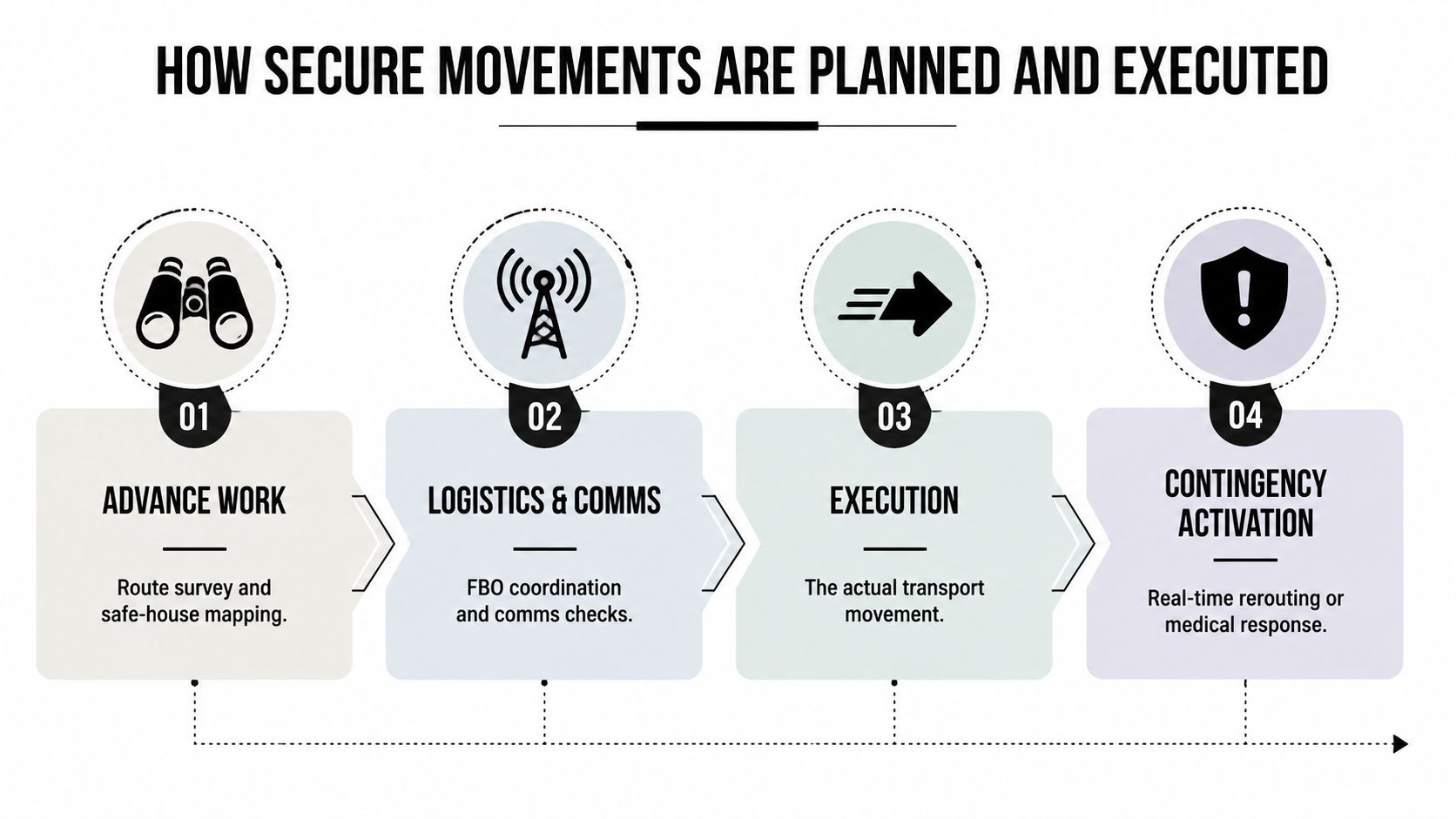
The movement starts before the driver turns the key. The operations team reviews the itinerary, threat information, passenger requirements, vehicle assignment, communications, access points, and fallback locations. The advance function then tests the plan against the physical environment, including routes, garages, FBO procedures, hotel entrances, medical facilities, and possible choke points.
Airside to roadside handoffs
An FBO handoff should have named roles and a clear confirmation sequence. The advance or ground coordinator confirms the aircraft status and access conditions. The chauffeur confirms vehicle position and readiness. The protection lead confirms that the principal is moving, and the receiving destination confirms that arrival access remains available.
Those signals should use approved channels, not a chain of casual messages that includes unnecessary itinerary detail. If the aircraft is delayed, the vehicle waits in a controlled position rather than exposing the chauffeur at a public curb. If access changes, the operations desk issues the reroute and records who authorized it.
A useful movement brief identifies:
- Primary movement: Vehicle, driver, passenger count, departure trigger, and destination access point.
- Alternate movement: Secondary route, backup entrance, replacement vehicle, and decision authority.
- Support assets: Follow car, advance agent, close protection personnel, or local liaison.
- Emergency response: Medical facility, safe location, communication fallback, and escalation path.
Multi-stop roadshows
Roadshows create fatigue and repetition. The team should plan each leg independently while preserving a single operating picture across the day. A primary vehicle may carry the principal, while a follow car or advance asset checks the next location, confirms access, and reports changes before departure.
Timing windows should account for loading, security checks, elevator delays, meeting overruns, and vehicle repositioning. The plan shouldn't depend on the principal leaving every meeting at the exact scheduled minute. If a meeting runs long, the next driver receives the revised trigger, the destination is notified discreetly, and the alternate route remains available.
The secure movement guidance from Daw Special Projects emphasizes advance reconnaissance, alternate routing, role separation, communication, and redundancy. Those principles matter more than the number of vehicles in the convoy.
A hotel-to-board-meeting-to-airport movement shows the workflow. The hotel departure uses a controlled garage or service entrance. The advance agent confirms the board venue's arrival point. The principal vehicle moves with an alternate route held by operations. If the meeting overruns, the airport or FBO receives a revised arrival window without exposing the original itinerary. If a route closes, the lead authorizes the alternate, the chauffeur executes it, and the receiving team confirms the new handoff.
The following video provides additional visual context for secure movement operations.
How to Choose an Executive Protection Transport Provider
Choose the provider that can demonstrate operational ownership, not the one with the most impressive vehicle photographs. A livery company may add a security page without changing its dispatch model, vetting standards, or incident procedures. A security-driven transport firm should be able to integrate with your existing detail, travel desk, FBO contacts, and escalation structure.
Start with a short list, then run a controlled pilot involving a real movement type, such as an airport transfer, board meeting, or multi-stop roadshow. Evaluate the provider's briefing quality, response to changes, driver conduct, documentation, privacy handling, and post-movement reporting. Don't commit to a broad regional program until the provider has shown that its local affiliates follow the same standard.
| Evaluation Criterion | What to Ask the Provider | What a Strong Answer Looks Like |
|---|---|---|
| Program scope | Do you provide transport only, or can you coordinate advance work, protection teams, FBOs, hotels, and operations support? | The provider defines its role, names its partners, and explains responsibility at every handoff. |
| Chauffeur vetting | What screening and training records can you provide for assigned chauffeurs? | The answer covers identity, background, driving, medical-response, security, confidentiality, and recurring review processes. |
| Principal matching | How do you match a principal with a chauffeur or team? | The provider considers preferences, language, route familiarity, assignment sensitivity, and continuity. |
| Route changes | Who can approve a reroute during movement, and how is the decision communicated? | A named operations role has authority, with an approved communications path and documented escalation. |
| Vehicle failure | What happens if the vehicle drops mid-leg? | The provider explains replacement location, passenger protection, luggage handling, dispatch authority, and client notification. |
| Fleet readiness | How do you verify maintenance, backup availability, and vehicle access in each city? | The provider supplies records and explains how affiliates are audited before assignment. |
| Security integration | Can you work with our close protection team or corporate security operations center? | The provider conducts a pre-movement briefing, follows the client's protocols, and accepts defined reporting requirements. |
| Privacy controls | Who can access manifests, location data, and itinerary changes? | Access is limited by role, retention is defined, and confidentiality obligations apply to staff and subcontractors. |
Answers that focus only on tinted glass, luxury interiors, or driver appearance should concern you. Ask for a sample movement brief, an anonymized incident report, the affiliate governance process, and the service-level terms before signing.
The Compliance Gap Most Programs Underestimate
A vehicle can arrive on time, look secure, and still expose the client to preventable compliance failures. The weak points are usually operational: unverified driver eligibility, unclear licensing authority, improper data access, jurisdictional limits, or equipment that cannot legally cross a border.
Cross-border roadshows expose these gaps quickly. Driver permissions, vehicle documents, privacy rules, firearms and protective-equipment restrictions, customs requirements, and local licensing may change between jurisdictions. Treating one city's procedure as a universal rule leaves the client, employees, chauffeur, and coordinating teams exposed.
Compliance belongs in the movement brief
The brief should assign ownership before the chauffeur, advance team, FBO, and executive begin coordinating the movement. Record:
- Who is authorized to drive: Verify licensing, employment status, background requirements, and subcontractor oversight.
- What equipment is lawful: Confirm restrictions on protective gear, communications equipment, weapons, and medical supplies.
- Where data travels: Limit access to manifests, location information, passenger details, and itinerary changes.
- Who can make decisions: Name the authority for rerouting, delaying departure, changing vehicles, or contacting law enforcement.
- What duty of care applies: Align provider procedures with the organization's travel-risk policy and counsel's requirements.
The provider should also explain how these controls work in real time. For example, if an executive changes a pickup point, the chauffeur should not act on an unverified message. The operations lead confirms the request, updates the movement brief, informs the advance team and FBO, and records the approval path.
Executive behavior remains part of the control system. A principal who ignores a departure window, shares live location data, or adds an unbriefed passenger can compromise a prepared movement. The 2025 ASIS executive protection report identifies budget constraints at 58%, executive noncompliance at 47%, and staffing and training limitations at 41% among cited challenges.
Give the principal a short protocol, explain its purpose, and assign one trusted contact for changes. A process people follow under schedule pressure protects the movement better than a detailed procedure nobody uses.
Liability, Insurance, and Contractual Considerations
A transport agreement should describe the risk allocation in plain language before the first booking. Start with the Certificate of Insurance, then have counsel verify that the underlying policies match the services being purchased. Depending on the arrangement, that review may include auto liability, excess or umbrella coverage, workers' compensation, and cyber coverage when the provider receives telemetry or sensitive itinerary information.
Ask whether coverage applies to named drivers, the full fleet, subcontractors, armored vehicles, and the territories where movements will occur. A certificate alone doesn't answer every operational question. Confirm exclusions, deductibles, cancellation terms, notice requirements, and whether the client can be added as an additional insured.
Put responsibility at every handoff
The contract should distinguish the duties of the security driver, external protection detail, corporate travel team, local affiliate, and principal's counsel. It should address route deviations, unauthorized passenger changes, vehicle substitution, delayed movements, client-directed instructions, and emergency actions.
Indemnity language deserves particular scrutiny. Broad clauses that make the client responsible for every event should be narrowed to the party's control and negligence. Confirm how waivers of subrogation apply when a principal's own vehicle, driver, or security team is involved.
The insurance coverage details for executive transportation should be reviewed alongside the master services agreement, not after an incident.
Before signature, confirm in writing:
- Named insured status: Who is covered, and who must receive notice?
- Territory and exclusions: Where can the provider operate, and what activities aren't covered?
- Confidentiality: Does the agreement protect manifests, location data, passenger identities, and itinerary changes?
- Subcontractors: Must affiliates meet the same insurance, vetting, and reporting standards?
- Dispute resolution: Which venue and law govern the relationship?
- Termination: What happens to active movements, data, and deposits after cancellation?
Frequently Asked Questions About Executive Protection Transport
How does it differ from a standard black-car service?
A standard black-car booking focuses on vehicle availability, routing, punctuality, and passenger comfort. Executive protection transport adds threat-aware planning, vetted security-trained personnel, controlled handoffs, confidentiality procedures, contingency routes, and integration with a protection or corporate security team.
Does every principal need an armored vehicle?
No. Armor should follow a documented threat model, not status or appearance. The procurement guidance in the federal vehicle safety framework supports separating general vehicle compliance from protective specifications. A lower-threat movement may need a discreet, well-maintained vehicle and trained chauffeur, while a credible threat may require a hardened vehicle and additional protective assets.
How should FBO handoffs work?
Share only the information necessary for the FBO, chauffeur, advance agent, and receiving team to perform their roles. Confirm aircraft status, access point, vehicle position, passenger identity, and departure trigger through an approved channel. Avoid broad email distribution of full manifests and live itinerary changes.
How are multi-stop roadshows staffed?
Staffing depends on the threat, geography, schedule, passenger count, and required redundancy. Ask the provider to price the primary vehicle, follow or advance support, waiting time, replacement capability, and operations oversight separately. The quote should also state cancellation rules, overtime treatment, luggage or equipment handling, child-seat requests, and gratuity policy.
What lead time is realistic?
Routine movements can be planned with reasonable notice when the city, vehicle, and chauffeur are already available. Armored vehicles, cross-border travel, multiple stops, FBO access, and close-protection integration require earlier coordination. Same-day requests can be handled by capable providers, but the available vehicle, driver continuity, and advance depth may be narrower.
Can recurring principals keep the same team?
They should, where operationally practical. Consistency improves communication and helps chauffeurs understand preferences without repeated disclosure of sensitive information. The provider should still maintain backup personnel who know the protocol, because a program that depends on one unavailable driver isn't resilient.
What should the travel manager do first?
Write the movement requirement before asking for a price. Include passenger profile, itinerary, threat information, vehicle expectations, protection-team contacts, privacy restrictions, accessibility or child-seat needs, cancellation rules, and the decision-maker for changes. Then ask each provider to explain its workflow and produce the documentation that supports its claims.
MLR Worldwide Service provides executive chauffeur services, VIP secure transport, FBO support, corporate roadshows, and 24/7 coordination for itinerary changes through vetted global affiliates. Visit MLR Worldwide Service to discuss a movement plan built around discreet chauffeurs, route coordination, and controlled air-to-ground handoffs.