
A CFO lands at a regional airport at 11:40 p.m. The driver waiting at the curb is unfamiliar, the vehicle wasn't pre-cleared, and nobody on the travel team can confirm who has access to the itinerary or where the car is being tracked. The ride may be comfortable, but comfort isn't the same as control.
Secure ground transportation is an operational discipline. It combines vetted personnel, suitable vehicles, journey planning, live monitoring, secure communications, and contingency procedures. A black SUV can be part of that program, but it doesn't create one by itself. The distinction matters for executives, family offices, aviation travelers, corporate travel managers, and anyone responsible for moving people through unfamiliar or high-threat environments.
The global armored vehicles market illustrates the scale of investment behind protected mobility. One industry estimate valued the market at US$32.41 billion in 2024 and projects US$44.56 billion by 2030, a 5.4% CAGR from 2025 to 2030. Other trackers forecast approximately US$40.5 billion in 2025 and US$59.3 billion by 2035, reinforcing that protected road mobility is a substantial global category, not a niche purchase (Grand View Research market estimate). This guide treats security as a system, then shows what to verify before booking.
What Secure Ground Transportation Really Means
A standard chauffeur service usually optimizes for punctuality, comfort, and presentation. A secure transport program adds accountability at every handoff. Before departure, the client should know the driver's identity, vehicle details, dispatch contact, pickup protocol, and escalation process. The provider should know more than the address. It should understand the principal's profile, the itinerary's sensitivity, and what happens if the planned route becomes unsuitable.
A useful starting point is distinguishing service quality from security control. A polished vehicle and courteous driver can improve the passenger experience, but neither proves that the driver has been screened, that the vehicle has been inspected, or that trip data is protected. For an overview of the broader category, see this explanation of what ground transportation includes, then apply a stricter standard when the passenger, itinerary, or information carries high value.
Security sits on a spectrum
Executive protection isn't binary. At one end, a low-threat airport transfer may require a vetted chauffeur, discreet communication, and monitored routing. At the other, an armored vehicle, trained protective driver, close-protection personnel, advance work, and multiple vehicles may be justified. Most corporate itineraries sit between those extremes.
The right question isn't, “Do we need an armored car?” It's, “What controls match this movement?” Consider the principal's visibility, destination conditions, travel timing, dependents, public appearances, sensitive materials, and the predictability of the route. Overprotecting a low-profile movement can create unnecessary visibility, while under-planning a public-facing executive arrival can leave obvious gaps.
What should be documented
Ask the provider to show, not merely describe:
- Driver controls: Background screening, driving history review, training records, identity confirmation, and confidentiality expectations.
- Vehicle controls: Maintenance records, inspection cadence, equipment checks, and any relevant armor or blast-resistance qualification.
- Operational controls: Primary and contingency routes, safe-haven planning, emergency contacts, and live monitoring responsibilities.
- Digital controls: Booking access permissions, authentication, encryption, retention rules, and procedures for last-minute itinerary changes.
Practical rule: If the provider can't explain who owns the decision when the plan changes, it doesn't have a complete security program.
The Three Layers of a Secure Transport Program
A reliable program has three connected layers. The first protects the passenger from physical threats. The second ensures that people follow the plan competently. The third protects the information and decisions that make the movement work.
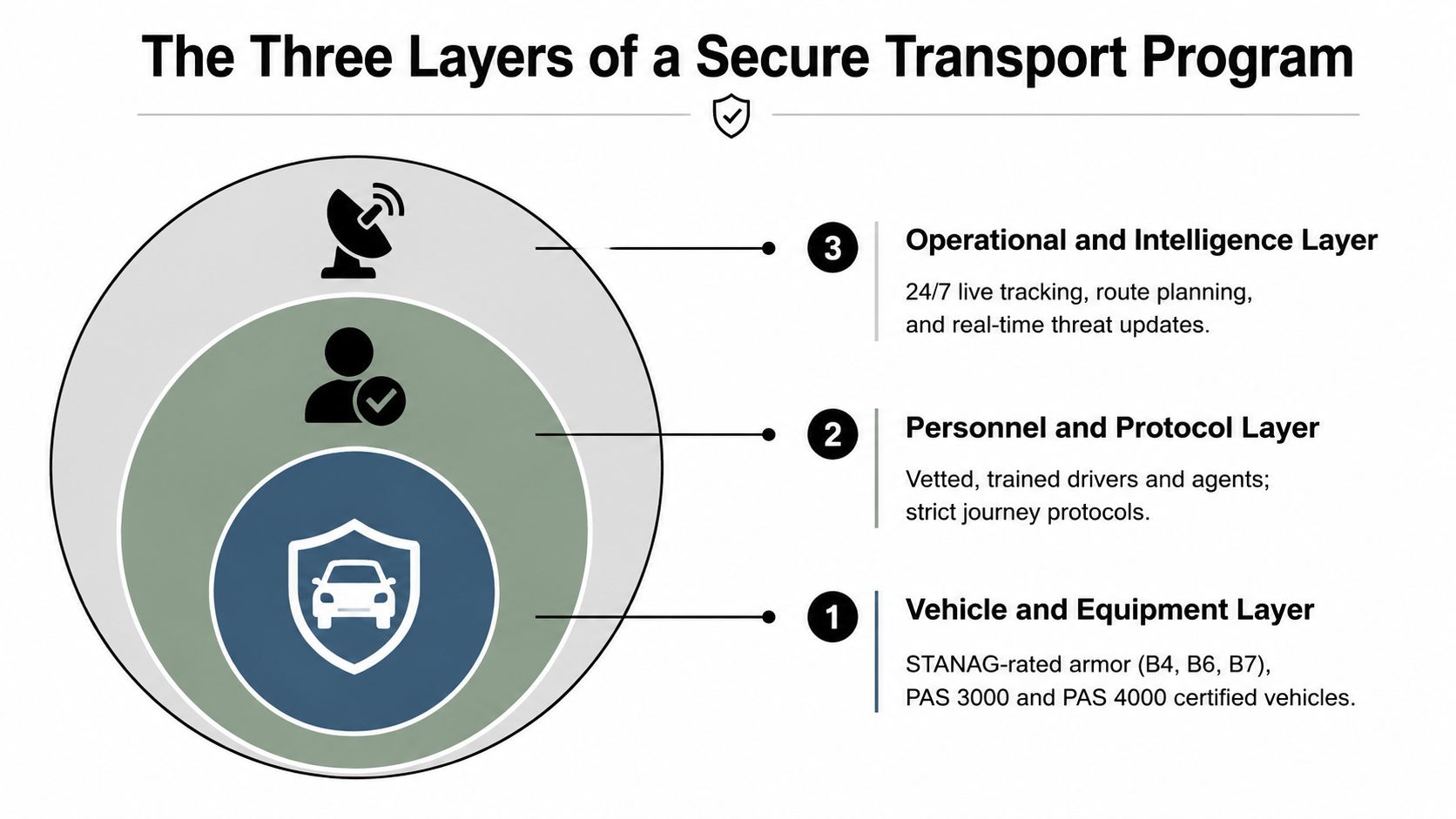
Layer one, vehicle and equipment
Vehicle selection should follow the assessed threat, not a sales brochure. NATO STANAG 4569 and AEP-55 define qualification and acceptance procedures for armored vehicles facing kinetic-energy projectiles, artillery fragments, mines, and improvised explosive devices (European Defence Agency standards reference). Civilian schemes such as PAS 300 test ballistic and blast resistance across handgun, shotgun, rifle, and under-vehicle, side, and roof blast scenarios.
Buyers may encounter labels such as B4, B6, and B7, PAS 3000, or PAS 4000. Treat each label as a starting point for verification. Request the actual standard, test scope, certificate holder, vehicle identity, and date of validation. Also check less visible controls, including run-flat tires, protected fuel systems, door and window integrity, secure OBD access, and restrictions on personal devices inside the vehicle.
Layer two, people and protocol
A capable vehicle becomes a weak control if the driver doesn't know how to use it under pressure. Drivers should be screened before assignment, trained for defensive driving and emergency response, briefed on the route, and required to complete a standardized pre-departure inspection.
For higher-risk movements, the operating model may include an executive-protection-trained driver, a second team member, an advance vehicle, or a lead-and-follow formation. Those choices have trade-offs. More personnel can improve redundancy, but they can also increase visibility, cost, and coordination demands. The provider should explain why its proposed posture fits the journey.
Layer three, digital and dispatch
Dispatch systems control sensitive information, including names, flight details, hotel locations, meeting addresses, and last-minute changes. Require encrypted booking and dispatch platforms, multi-factor authentication for dispatcher consoles, role-based access, GPS telemetry, geofencing, and a defined escalation chain.
A dispatch tablet connected through unsecured Wi-Fi can undermine a well-maintained vehicle and a well-trained driver. The failure occurs before the passenger enters the car, when an unauthorized person obtains the itinerary or manipulates the instructions. Security therefore depends on integration across all three layers, not on buying the most expensive vehicle.
How Journey Risk Assessment Works in Practice
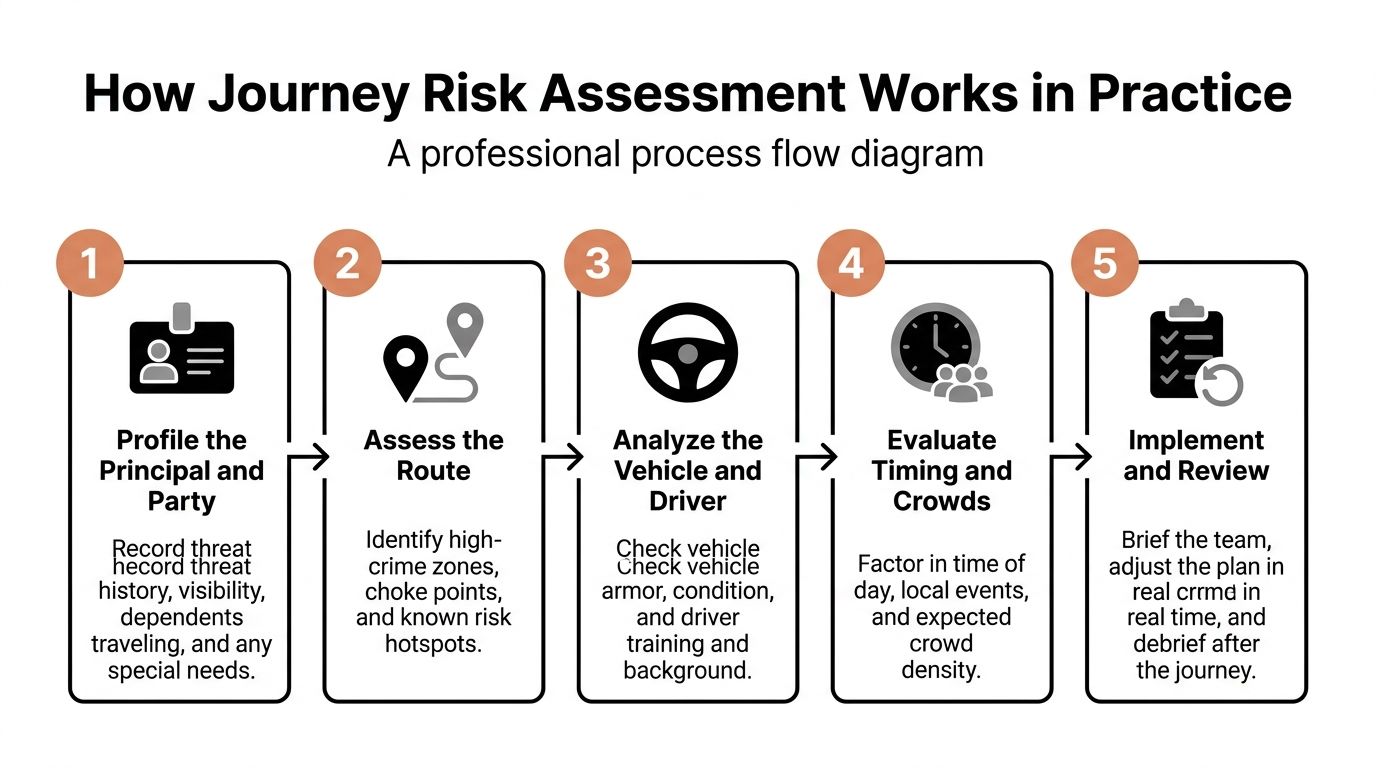
A journey risk assessment should produce decisions that a dispatcher and driver can execute. It shouldn't be a generic destination profile saved in a folder and ignored after approval.
Start with the passenger and movement
Profile the principal and everyone traveling. Record relevant threat history, public visibility, dependents, medical or accessibility needs, sensitive equipment, and the value of items in transit. Then define the movement itself, including pickup points, meeting locations, expected dwell time, public exposure, and whether the passenger's schedule is confidential.
The environment comes next. Use government advisories, local intelligence, transport-security information, and trusted vendor reporting. Map incidents and disruption points along candidate routes, then examine choke points, protest areas, isolated roads, exposed hotel entrances, and locations where the vehicle may have to stop.
Build options, not one route
Create a primary route and at least two alternatives. Each should identify practical safe havens, such as hospitals, police stations, embassy compounds, and vetted hotels. The precise choice depends on local conditions and the principal's needs, but a route without identified assistance points is incomplete.
The journey-management guidance in the professional security journal's transport risk guidance emphasizes multiple transport and route options, evacuation plans, safe havens, and real-time monitoring. That approach addresses the predictable exposure created by the final leg to a hotel, office, or airport.
Assign the operating posture
Choose the vehicle posture after the route and threat profile are clear:
- Single vehicle: Suitable for lower-threat movements with reliable communications and monitoring.
- Lead-and-follow: Adds redundancy and observation for movements where exposure or route complexity warrants it.
- Advance vehicle: Useful when the team needs to examine arrival conditions, staging, access points, or crowding before the principal arrives.
Finally, define who watches the vehicle, what triggers an alert, who contacts the driver, and how escalation reaches a 24/7 operations center. Update the assessment for every leg. Traffic, crowds, flight changes, local incidents, and pickup conditions can alter the risk after the original plan was approved.
Key Service Types for Executives and Aviation Travelers
Secure ground transportation isn't one commodity. The operating demands change depending on whether the passenger is crossing an airport ramp, rotating between meetings, moving with a flight crew, or arriving at a public event.
| Service Type | Coordination Point | Key Driver Requirement | Primary Risk |
|---|---|---|---|
| FBO handoff | Flight department, FBO, ramp or landside access | Airside procedures, identity confirmation, discreet staging | Missed handoff or unauthorized access |
| Airport transfer | Terminal, curb, baggage area, and hotel | Meet-and-greet discipline, luggage control, timing awareness | Exposure during the terminal-to-curb transition |
| Crew movement | Flight schedule, crew hotel, and multiple airports | Schedule reliability, fatigue awareness, rapid repositioning | Rotation disruption and missed reporting windows |
| Roadshow logistics | Executive office, venues, and meeting sequence | Route knowledge, standby capability, synchronized arrivals | Predictable patterns and cascading delays |
| Event transportation | Venue security, credentials, staging zones | Credentialed access, arrival coordination, surge planning | Crowds, congestion, and uncontrolled access |
Aviation movements need controlled handoffs
An FBO transfer requires more than a driver waiting at an airport address. The dispatcher must confirm whether the vehicle stages airside or landside, what access permissions apply, who meets the aircraft, and how luggage and passenger identity are handled. Airport transfers place more emphasis on terminal positioning, curb timing, and a discreet meet-and-greet process.
Crew movements are operationally different. A missed pickup can affect reporting, duty schedules, and an entire flight operation. The provider needs a dedicated process for schedule changes, multiple airports, and vehicle repositioning rather than treating each trip as an isolated reservation.
Corporate itineraries need dispatch depth
Roadshows require synchronized arrival windows, standby vehicles, and route alternatives between consecutive meetings. Event transportation adds credential checks, vehicle staging, VIP arrival coordination, and capacity planning for sudden changes.
A provider that claims to support every category without separate dispatch workflows deserves scrutiny. Ask who monitors the movement, how changes reach the driver, and whether the same operational desk handles a late-night FBO arrival and a large event convoy.
For executive movements involving personal protection teams, compare the transport plan with the guidance in executive protection transport services. The transport provider and protection team should agree on roles before the vehicle moves.
How to Vet and Audit a Secure Ground Provider
Start with evidence. A polished website cannot prove that a provider controls its drivers, data, affiliates, or incident response. Corporate buyers should request records, identify accountable owners, and test controls before awarding a contract.
Six checkpoints for procurement
Corporate credentials: Verify the legal entity, transportation registration, commercial insurance, and relevant security certifications. Confirm which company holds the contract when an affiliate or subcontractor operates the journey. The contracting entity must remain accountable for service failures.
Driver audit evidence: Do not accept a policy summary as proof. Request a sample redacted driver background check report, training certificates, and the process used to match the assigned driver to the booking. Test identity confirmation at pickup, including what the passenger receives and what the driver must verify. A control that works only on paper is not an operational control.
Vehicle safety: Request maintenance records, inspection schedules, the vehicle age policy, equipment lists, and documentation supporting any armor claims. For protected vehicles, match the stated resistance standard to the assessed threat. “Armored” alone does not describe the vehicle's actual protection.
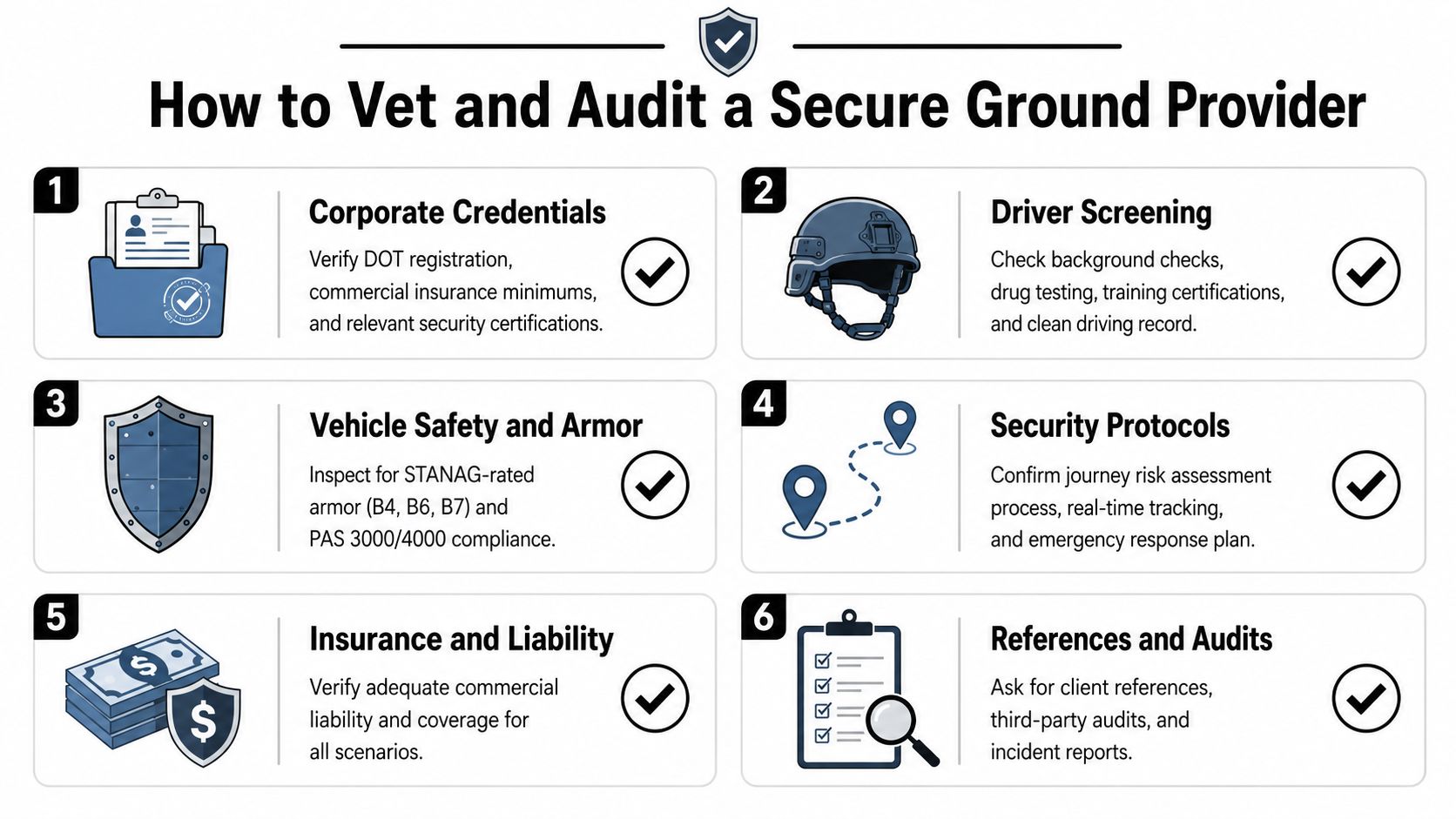
Dispatch security: Test the booking workflow with a controlled change. Ask how itinerary data and client profiles are encrypted, whether multi-factor authentication protects internal access, how permissions are assigned, how long records remain stored, and how dispatch verifies a last-minute instruction. Cybersecurity belongs in the transport audit because compromised itinerary data can expose a traveler before pickup.
Affiliate control: Obtain the local operating company's name before booking. Check that its insurance, vehicle inspections, privacy practices, driver controls, and incident reporting meet the contracting provider's requirements. Cross-border operations require a jurisdiction-by-jurisdiction review. In the UK, private-hire journeys require pre-booking and a licensing “triple lock” under the Transport Act framework. A global brand does not establish local compliance.
References and incidents: Request references from comparable corporate, aviation, family-office, or event clients. Ask for anonymized incident summaries, response procedures, and evidence of post-incident review. A provider unable to show how it records and learns from failures has an audit gap.
Audit question: “Show us the control, identify the owner, and explain what happens when it fails.”
Red flags include vague insurance answers, withheld certification records, undocumented cybersecurity practices, and unidentified affiliates. Re-audit whenever routes, subcontractors, technology, or operating jurisdictions change.
Misconceptions That Put Travelers at Risk
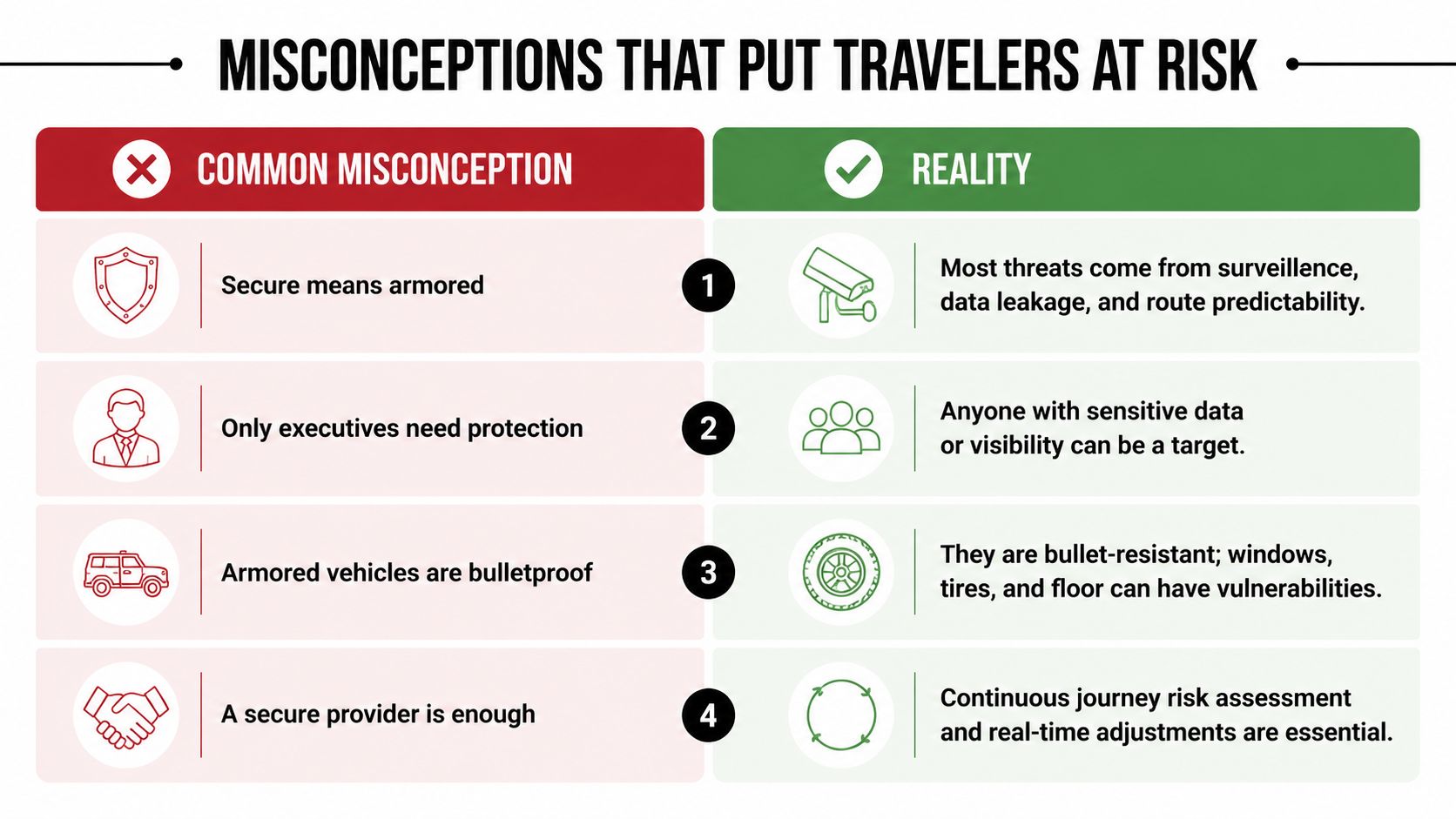
Security mistakes often begin with the wrong definition of “secure.” A vehicle can look imposing while the itinerary remains exposed, and a low-profile sedan can be the safer choice when it supports better discretion and stronger controls.
Armored doesn't mean invulnerable
Armored vehicles are designed and tested against defined threats. They aren't universally resistant to every weapon, blast, collision, or attack condition. Protection also depends on windows, tires, doors, roof, floor, fuel system, and how the vehicle is operated.
Most corporate movements don't automatically require armor. Surveillance, data leakage, predictable routes, and weak handoffs may create more practical exposure than a ballistic incident. Choose armor when the assessment supports it, then verify the actual protection standard and vehicle-specific documentation.
Armed isn't automatically safer
Visible firearms can attract attention, escalate encounters, or conflict with a low-profile movement plan. An armed detail may be appropriate under a specific threat assessment and local legal framework, but it shouldn't be treated as a default upgrade.
The better question is whether the team can detect problems early, avoid unnecessary exposure, communicate discreetly, and respond within a documented chain of command. Local licensing and rules matter as much as tactical preference.
Luxury branding proves nothing
A premium vehicle can still have an unvetted driver, unprotected booking data, weak maintenance controls, and no live dispatch oversight. A luxury van isn't secure because it has tinted glass or a recognizable badge.
Likewise, booking through a familiar international name doesn't guarantee consistent standards in a secondary city. Affiliate networks vary. Require the local operator's identity, insurance, driver controls, inspection records, and escalation contact before the trip.
Security must follow the traveler
Protection shouldn't stop at the vehicle door. Secure ground transportation includes the reservation, identity verification, route data, driver handoff, vehicle movement, destination arrival, and post-trip records. A provider is only as strong as the weakest operational link it permits into that chain.
How MLR Worldwide Service Delivers Secure Ground Transportation
MLR Worldwide Service's operating model connects executive chauffeur services, airport transfers, FBO support, corporate roadshows, event logistics, airline crew movements, and VIP secure transport. Its stated offering includes a curated fleet of executive sedans, premium SUVs, luxury vans, and specialty vehicles, with vehicles maintained for safety, cleanliness, and executive use.
The practical test is how those services are coordinated. A 24/7 concierge operations desk can manage an FBO handoff, a multi-stop itinerary, a late booking, or a last-minute reroute through one point of contact. That matters when a flight changes after the original vehicle assignment or when a corporate security team needs the driver and dispatcher working from the same updated instruction.
A journey from request to debrief
A disciplined movement begins with the pre-arrival review. The operations team confirms passenger details, flight information, pickup access, destination conditions, route choices, and any coordination requirements with a flight department or personal protection team.
The dispatch plan then assigns the vehicle and chauffeur, confirms the handoff procedure, and provides primary and contingency options. During the journey, GPS monitoring and live coordination support changes caused by traffic, access restrictions, or updated intelligence. After arrival, a debrief can capture delays, unusual observations, communication failures, or affiliate performance issues for future movements.
MLR also describes a vetted affiliate network spanning more than 500 cities. That geographic reach should still be audited at the local level. For cross-border work, ask which affiliate will operate the trip, how its screening and insurance align with the booking entity, and who owns incident escalation in that jurisdiction.
The strongest provider relationship is transparent. Corporate security teams, executive assistants, and flight departments should receive clear confirmations, named contacts, documented vehicle and driver details, and an explanation of how changes are authorized. That is the difference between ordering a car and managing a secure movement.
MLR Worldwide Service coordinates executive chauffeur services, airport and FBO transfers, roadshows, event logistics, crew movements, and VIP secure transport through a 24/7 concierge operation. For a journey that requires vetted chauffeurs, discreet coordination, route planning, and cross-border affiliate oversight, visit MLR Worldwide Service and discuss the itinerary with its operations team before booking.