
At 06:15, the dispatch desk is already handling more personal data than most generic GDPR checklists acknowledge. A corporate booker has entered a principal's pickup address and mobile number, an FBO has forwarded a passport scan, the chauffeur needs the correct meeting point, and a spouse has been added to the hotel transfer. By the time the vehicle leaves the garage, those details may exist in the reservation platform, dispatch console, chauffeur handset, affiliate inbox, GPS system, and airport access records.
A privacy notice and consent banner won't answer the questions an auditor asks. Who viewed the passport image? Was it cached on a personal device? Did the affiliate operator have instructions to delete the manifest? Why did live location remain available after drop-off? Effective GDPR compliance measures make those answers visible through booking, dispatch, device, vendor, and incident-response controls.
What GDPR Compliance Measures Look Like in a Chauffeured Operation
A chauffeured operation should treat every booking as a connected data flow, not as a collection of isolated software records. The passenger record begins with the corporate booker, moves into dispatch, reaches the chauffeur's mobile job ticket, may connect to telemetry or a dashcam system, and can cross into an affiliate's platform when another operator handles the next leg.
Follow the passenger record end to end
Consider the manifest for a corporate principal flying into Farnborough. The reservation platform may hold the passenger's name, booking contact, itinerary, payment token, travel companions, and special requests. Dispatch needs enough information to assign the vehicle and coordinate the pickup, but the chauffeur may only need the meeting point, passenger name, contact method, and operational notes. The FBO may hold an identity document, while the affiliate handling the return journey may receive a reduced manifest rather than the complete booking file.
That distinction is the practical meaning of data minimization. A chauffeur who needs a passenger's meeting point doesn't automatically need a passport image. A dispatcher coordinating a vehicle doesn't necessarily need unrestricted access to payment details. A partner operator needs written, trip-specific instructions, not an unrestricted copy of a client profile.
Practical rule: If a person can complete the task without seeing a field, the field shouldn't appear on that person's screen.
Create a one-page diagram that traces each handoff and records the location of every copy. The diagram should identify:
- Booking platform: Passenger identity, itinerary, contact details, payment references, preferences, and booking notes.
- Dispatch console: Assignment details, driver information, operational status, and escalation history.
- Chauffeur handheld: A restricted job ticket, pickup instructions, contact route, and essential passenger details.
- Vehicle systems: GPS position, trip status, camera feeds, and vehicle identifiers.
- FBO or airport partner: Identity documentation and access information supplied for a defined operational purpose.
- Affiliate operator: Only the information required for the assigned leg, with its role and instructions documented.
Make access visible
A controller audit rarely stops at written policy. The reviewer wants evidence that access follows job responsibilities. That means role-based permissions in the dispatch application, audit logs showing who opened sensitive records, and a documented process for removing access when a dispatcher or chauffeur leaves.
The same applies to live location data. GPS can be necessary during an active journey for dispatch coordination and safety, but that doesn't automatically justify indefinite retention. Set a defined retention rule, restrict access to operational roles, and make the deletion or anonymization event verifiable. If a client asks for a historical route, staff should know whether the request is supported by the original purpose, a legal claim, or another documented basis.
The strongest GDPR compliance measures also distinguish between pseudonymisation and anonymisation. Pseudonymised passenger identifiers remain personal data when a separate key or lookup table can reconnect them to a person. The Article 32 security guidance on encryption and pseudonymisation emphasizes separate storage, access restriction, and protection of the additional information.
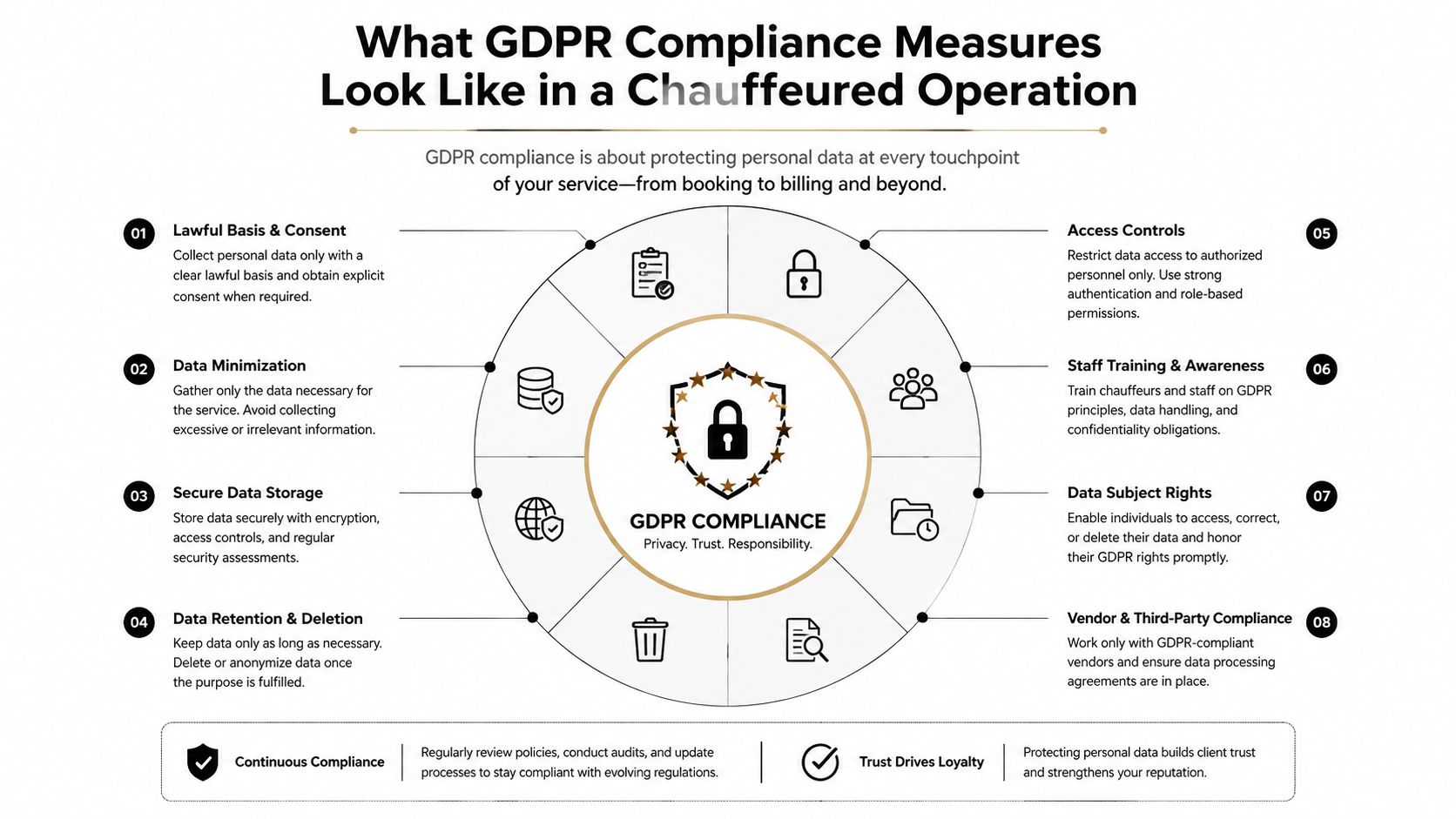
A register entry should exist for each system, but it shouldn't stop there. The entry must connect the system to the next handoff, name the data categories involved, identify the responsible role, and show how access, retention, deletion, and transfer controls operate in practice. That end-to-end view is what turns a compliance binder into an operational control system.
Choosing Lawful Bases and Retention Windows
Lawful basis and retention shouldn't sit in a general privacy policy. Dispatch teams need a decision matrix that connects each processing purpose to a documented basis, a retention trigger, and a deletion method.
For the booking itself, processing is generally linked to performing the transport agreement. The record should contain the information needed to provide the journey, communicate changes, manage payment, and resolve service issues. Retention then follows the organization's documented legal, accounting, and dispute requirements rather than an informal “keep everything” preference.
VIP preferences need more discipline. A seating preference or accessibility note may help deliver a requested service, but a broad behavioral profile used to anticipate future travel requires a separate purpose analysis. If the organization relies on legitimate interests, it should document the balancing assessment, explain the use clearly, provide an effective objection route, and review whether the profile is still needed.
Marketing is different again. Promotional communications require consent under the applicable ePrivacy rules, with the channel and purpose recorded separately. Security footage also needs its own purpose, notice, access restriction, and short, defensible retention period. An incident log should preserve evidence needed for legal claims or security review, not become a permanent archive of every operational event.
| Processing Purpose | Lawful Basis | Retention Window | Deletion Trigger |
|---|---|---|---|
| Booking and journey delivery | Contract performance or another documented basis appropriate to the transaction | The documented business and legal period needed for service, accounting, and disputes | End of the approved retention period or resolution of the relevant claim |
| Service preferences | Legitimate interests with a recorded balancing assessment, where appropriate | Review at a defined interval and remove information that no longer improves service | Withdrawal, objection, inactivity, or failed review |
| Marketing communications | Consent under applicable ePrivacy requirements | Until consent is withdrawn or the approved marketing record is no longer needed | Unsubscribe, consent withdrawal, or expiry of the stated purpose |
| In-cabin security footage | A separately assessed security basis | Short, purpose-limited period | Expiry of the security retention window unless preserved for an active investigation |
| Incident and near-miss records | Legal claims, security obligations, or another documented purpose | Only for the investigation, claim, or governance need | Closure of the matter and expiration of the approved evidence period |
For smaller organizations, avoid blindly documenting every low-risk activity forever. The European Commission's data protection guidance reflects a more selective approach to Article 30 record-keeping for smaller companies, while high-risk processing still demands clear documentation. The defensible answer is not less governance. It's sharper scoping.
Running a DPIA That Reflects Real Risks
A chauffeur operation's DPIA should begin with the journey, not a copied SaaS questionnaire. The relevant risk may arise from continuous GPS telemetry, a chauffeur handheld that stores a manifest, a profile built around high-net-worth travelers, or an affiliate receiving data in another jurisdiction.
Start with a screening record for each new or changed activity. Escalate to a full Data Protection Impact Assessment where the processing involves systematic profiling, extensive location monitoring, cross-border affiliate access, or new onboard surveillance technology. The assessment should describe the people affected, the data categories, the operational purpose, the recipients, and every system that stores or exposes the information.
Test necessity against the real alternative
A useful DPIA asks uncomfortable operational questions:
- Does dispatch need continuous precise location, or only journey status during an active assignment?
- Does the affiliate need the entire passenger profile, or just the information required for one leg?
- Does repeat-client service require a persistent profile, or can the chauffeur receive a one-time preference note?
- Does an onboard camera need continuous recording, or is a narrower security configuration sufficient?
For each answer, record the less intrusive alternative that was considered and why it was accepted or rejected. Mitigations may include blurred geofences around private residences, default deletion rules for trip telemetry, restricted views on shared dispatch screens, and an opt-out process for repeat-client profiling.
The DPIA must also assign owners. The operations lead confirms that a control works during a live booking. Security validates device and network safeguards. The DPO or privacy lead tests the legal reasoning. The affiliate manager confirms what a partner can access and how the partner will respond to a rights request or incident.
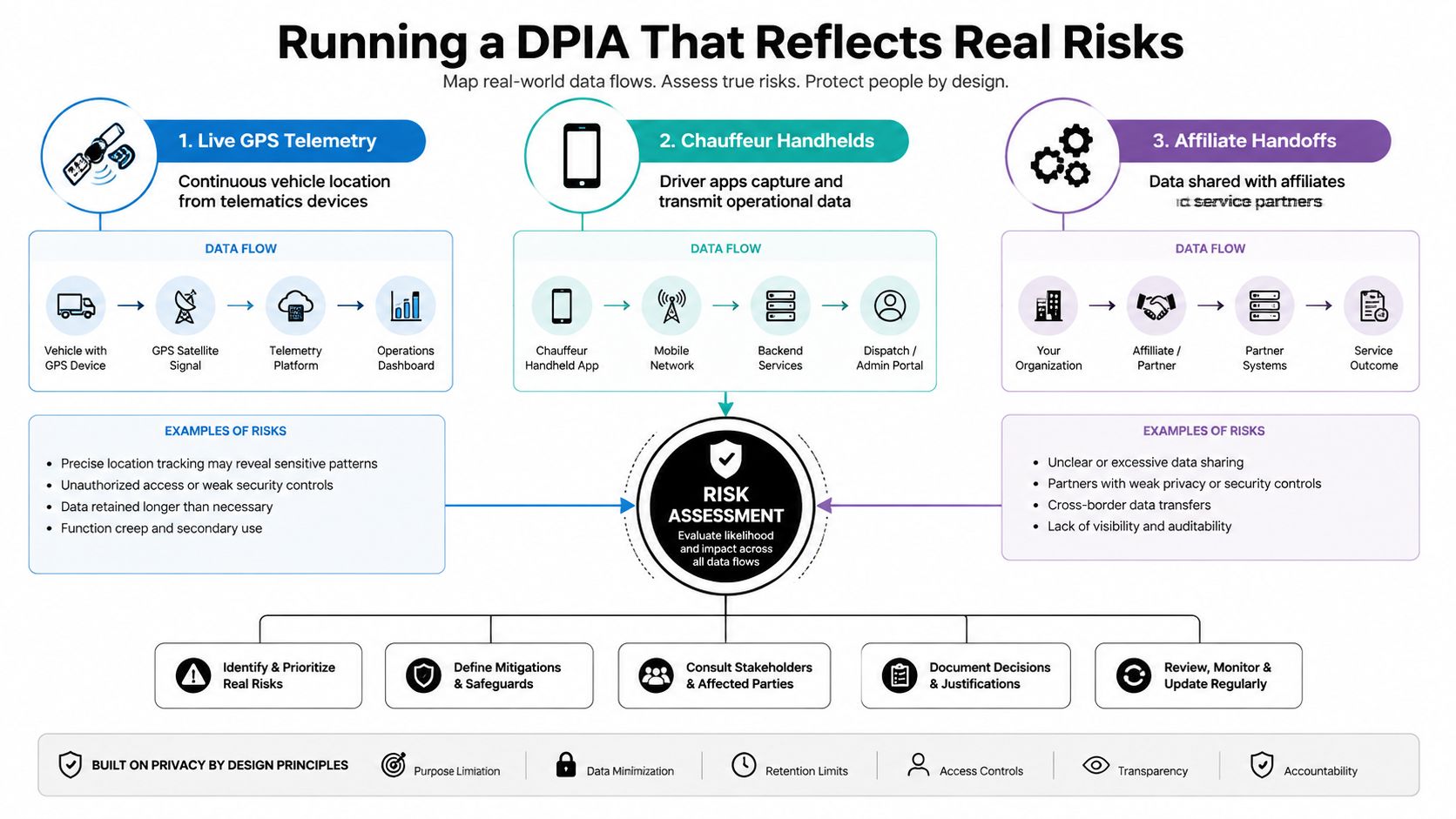
Approval isn't the finish line. Link the DPIA to change management so a new airport contract, affiliate, dispatch application, GPS supplier, or camera configuration triggers review. If residual risk remains high after mitigation, the controller should document the decision and consult the supervisory authority where GDPR requires prior consultation. An inspector should be able to follow the assessment from identified risk to implemented control to test result, rather than receive a polished PDF that nobody has opened since approval.
Security Controls Built Around Dispatch and Devices
Article 32 is often reduced to “turn on encryption.” That instruction is too vague to survive an audit. The control must identify the asset, the threat, the responsible owner, and the evidence showing that protection is active.
For dispatch software, permissions should follow shift duties. A chauffeur can receive a job ticket without browsing unrelated passenger records. A dispatcher can coordinate a journey without accessing every identity document. Administrator accounts need multi-factor authentication, and access reviews should be tied to roster changes, contractor departures, and role changes.
Chauffeur handhelds deserve their own control set. Enroll company devices in mobile-device management, enforce full-device encryption, block personal application installation where appropriate, and maintain remote-wipe capability. A lost device should produce a recorded response, not a debate about who has authority to disable it.
A device that leaves the depot is part of the privacy perimeter, even when the vehicle belongs to a partner.
Live telemetry needs separate treatment. Use pseudonymised identifiers on shared screens, protect dispatch APIs with transport encryption, restrict the key that reconnects a pseudonym to a passenger, and isolate vehicle cameras from ordinary passenger and office networks. Physical key cabinets also belong in the risk model. Access logs, controlled issuance, and prompt removal of former staff access connect physical security to personal-data protection.
| Asset | Threat | Required Control | Audit Evidence |
|---|---|---|---|
| Dispatch application | Excessive internal access | Role-based permissions and MFA for privileged accounts | Permission matrix, access logs, review approvals |
| Chauffeur handheld | Loss, theft, or local caching | MDM enrollment, encryption, screen lock, remote wipe | Device inventory, configuration report, wipe record |
| GPS telemetry | Unnecessary exposure or prolonged retention | Restricted roles, pseudonymisation, retention automation | Access history, key-separation design, deletion report |
| In-vehicle camera network | Lateral access from office or passenger systems | Network segregation and controlled administrator access | Network diagram, firewall review, test evidence |
| Physical key cabinet | Unauthorized vehicle access linked to staff identity | Issuance controls and access logging | Cabinet log, roster reconciliation, exception record |
The real-time transportation visibility guidance is relevant only when visibility is paired with privacy boundaries. More operational data isn't automatically better governance. The defensible setup is the one that gives the right employee the right information for the right journey, then removes or protects it when that purpose ends.
Vendor and Affiliate Contract Clauses That Hold Up
Affiliate networks create a recurring accountability problem. The booking operator may call a partner a processor, while the partner decides its own driver allocation, local records, and retention. A corporate client may also determine why the manifest is collected and ask the transport company to perform a defined service. Those facts must be analyzed before the contract label is chosen.
For a genuine processor relationship, the agreement should do more than repeat Article 28. It should define the precise trip-related purpose, documented instructions, permitted data fields, security requirements, rights-request assistance, subprocessor approval, deletion or return, and audit access. If the affiliate subcontracts at an FBO, the subcontracting path must be visible before the manifest moves again.
Clauses operations can actually enforce
A workable agreement should address:
- Defined scope: The affiliate may use passenger information only to perform the assigned journey and related safety or coordination tasks.
- Written instructions: The operator specifies the fields supplied, permitted recipients, retention rule, and approved communication channel.
- Incident escalation: The affiliate must alert the operator immediately under the agreed procedure, allowing the controller to assess the Article 33 deadline.
- Subprocessor control: The affiliate maintains an approved list and obtains authorization before adding another fleet or platform.
- Rights assistance: The partner preserves relevant records and responds quickly when the controller receives an access, erasure, or rectification request.
- Audit survival: Verification rights continue long enough to investigate an incident or confirm deletion after termination.
- International transfer safeguards: Standard Contractual Clauses and a transfer impact assessment are used where the destination and processing require them.
A corporate booker needs a different analysis if it determines the purpose of collecting traveler information. Controller-to-controller terms should clarify who gives the privacy information, who handles requests, how long the client retains the manifest, and whether the client can reuse preferences for unrelated travel or security purposes.
Contracts won't fix an unmanaged affiliate network. Keep a live register of partner roles, destinations, systems, subprocessors, transfer safeguards, training status, and the last evidence review. A confidentiality agreement can support the operational standard, but it shouldn't replace a full processing allocation. The client confidentiality agreement resource can be useful as part of that broader control framework.
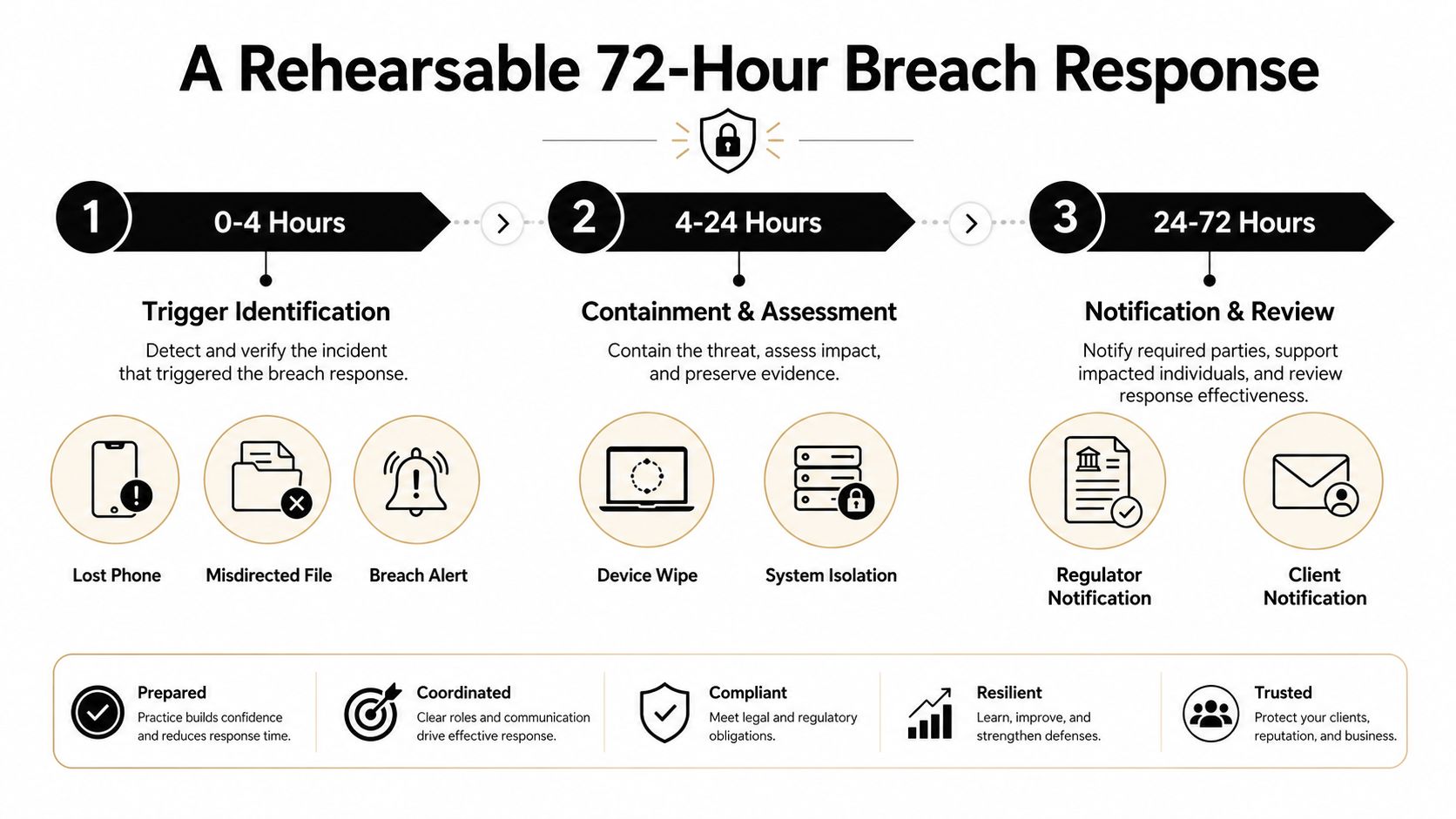
A Rehearsable 72-Hour Breach Response
A breach playbook must work while vehicles are moving and passengers are waiting at an FBO. Common triggers include a lost chauffeur handset, a manifest sent to the wrong corporate client, or an affiliate reporting unauthorized access to its dispatch system.
Assign ownership before the incident
At T+0, the Duty Manager opens the incident record, confirms the trigger, preserves the original message or call transcript, and stops further sharing. The dispatcher must not delete the sent email, overwrite a job ticket, or reset a device before evidence is preserved.
By T+4, the Duty Manager coordinates containment. The security lead remotely wipes or locks a lost device, disables exposed accounts, isolates a compromised affiliate connection, and restricts the affected booking record. The Affiliate Liaison obtains the partner's timeline, affected systems, recipients, and containment actions. Preserve GPS logs, FBO access records, dispatch audit trails, and relevant call recordings under controlled access.
At T+24, the DPO leads the risk assessment. Identify the data subjects, data categories, likely consequences, number and location of affected records where known, and the safeguards already in place. The question isn't whether the event feels embarrassing. It's whether the incident is likely to risk individuals' rights and freedoms and therefore requires notification to the supervisory authority.
At T+72, the DPO and Legal Counsel approve the notification position. The submission should explain what happened, what information was involved, what has been contained, what risks remain, and how affected people can obtain information. If high risk to individuals remains, the organization must also assess direct communication with those people. Client messaging should avoid exposing a VIP's identity or itinerary to additional recipients.
A rehearsed response is measured by the first action a dispatcher can take without waiting for a meeting.
Run exercises using actual operational evidence types, not abstract cyber scenarios. Test whether the team can identify the correct booking, preserve the live-call transcript, retrieve GPS history without broadening access, confirm the FBO handoff, and document every decision. The data breach notification workflow should sit beside the dispatch escalation process, not in a separate legal folder.
The European Data Protection Board's coordinated work on the right of access also reinforces the broader lesson. Regulators continue to identify failures in internal procedures and the information supplied to individuals. Breach response and rights response both depend on practiced workflows.
A short operational briefing can reinforce the sequence for dispatchers and supervisors:
Keeping the Program Audit-Ready
Compliance decays when nobody owns the routine. The record of processing should be reviewed against the live booking and dispatch environment, not against last year's spreadsheet. New affiliates, airport arrangements, camera systems, mobile applications, and telemetry suppliers should enter the change process before operations begin.
A practical cadence separates different kinds of assurance:
- Quarterly: Reconcile systems, purposes, data fields, recipients, retention rules, and affiliate roles against current bookings.
- Monthly: Review chauffeur device inventories, MDM status, remote-wipe capability, privileged access, and exceptions.
- After operational change: Refresh the DPIA when a new affiliate, airport contract, monitoring tool, or data flow changes the risk.
- On a recurring exercise cycle: Rehearse lost-device, misdirected-manifest, affiliate-intrusion, access-request, and deletion scenarios.
- After staff movement: Remove accounts, recover devices, revoke keys, and confirm confidentiality obligations for departing personnel.
The warning signs are concrete. An outdated processor list means the business no longer knows who receives manifests. An unsigned chauffeur confidentiality commitment weakens accountability at the point where passenger information is most exposed. A retention exception justified only by “client preference” signals that storage limitation has been replaced by informal habit. A DPIA that repeats the previous template without addressing the new affiliate or device is evidence of approval theater.
Keep evidence ready for inspection
A supervisory authority may ask for the processing register, lawful-basis decisions, retention schedule, deletion logs, access reviews, device configuration evidence, training records, rights-request files, incident timelines, vendor contracts, subprocessor lists, and international transfer assessments. The organization should be able to produce those artifacts as routine outputs.
Enforcement data shows why this operating rhythm matters. DLA Piper reported cumulative GDPR fines of €7.1 billion by 10 January 2026, with about €1.2 billion issued in 2025 alone, across the jurisdictions covered by its survey. The DLA Piper January 2026 survey makes the point clearly through the scale and continued pace of enforcement.
The CMS tracker, using a 1 March 2026 cutoff, recorded 2,685 fines totaling about €6.11 billion, or 3,062 fines when cases with limited information were included, and calculated an average fine of €2,277,122 across 2018 to 2026. CMS enforcement coverage shows why a program cannot focus only on famous cases. The exposure sits in ordinary records, devices, affiliates, requests, and decisions that nobody documented.
For transport operators, the audit-ready standard is simple to state and demanding to maintain. Every passenger-data flow needs an owner, every high-risk activity needs a living assessment, every external handoff needs a defensible role and contract, and every critical control needs evidence that it worked.
MLR Worldwide Service provides executive chauffeur transport, airport and FBO support, corporate roadshow logistics, VIP secure travel, and coordinated affiliate operations across international markets. Visit MLR Worldwide Service to discuss discreet ground transportation backed by structured planning, real-time coordination, and privacy-conscious service delivery.